“There is only one boss. The customer. And he can fire everybody in the company from the chairman on down, simply by spending his money somewhere else.”
— Sam Walton, Founder of Walmart
As rightly pointed out by Sam Walton, your customers are your greatest assets, and if you are not listening to them, you’re going to face a lot of trouble. If you want to create superior experiences, develop better products, and achieve brand loyalty, understanding the customer’s voice is extremely important.
Businesses cannot simply depend on the listed feedback mechanisms that existed before. They, rather, have to resort to advanced VoC tools that provide insights in real-time, enable omnichannel integrations, have the power to analyze data with AI and provide actionable dashboards.
Whether you are a marketing leader, a product manager, or a CX leader, picking the right VoC platform becomes the prime consideration. This guide will present the 8 best Voice of Customer tools in 2026, each carefully handpicked for their innovation and ease of use.
Benefits of Using VoC Tools
So, are you wondering whether it’s worthwhile to invest money in a VoC system? Let’s unpack that.
- Firstly, VoC tools give you a truly in-depth understanding of your customer journey across all touchpoints. You stop assuming, and you start knowing: what frustrates users, what they love, and where things fall brilliantly.
- If a product complaint and a feature request keep popping up in various situations, a good VoC system will almost always alert you to these issues before they escalate. The system grants you the power to be proactive rather than reactive.
- A VoC system will help you adjust the offerings and service strategy according to the preferences of the customers, because you hear them for once with utmost clarity in real-time.
Having said that, let’s now explore the best VoC tools and software that you should check out in 2026.
Top 8 Voice of Customer Tools for 2026
Before we explain the best VoC tools, hear this out: One size doesn’t fit for a VoC tool. Just because a Voice of Customer (VoC) tool looks cool does not mean it is right for you. So, choose wisely, but not blindly.
1. Crescendo.ai
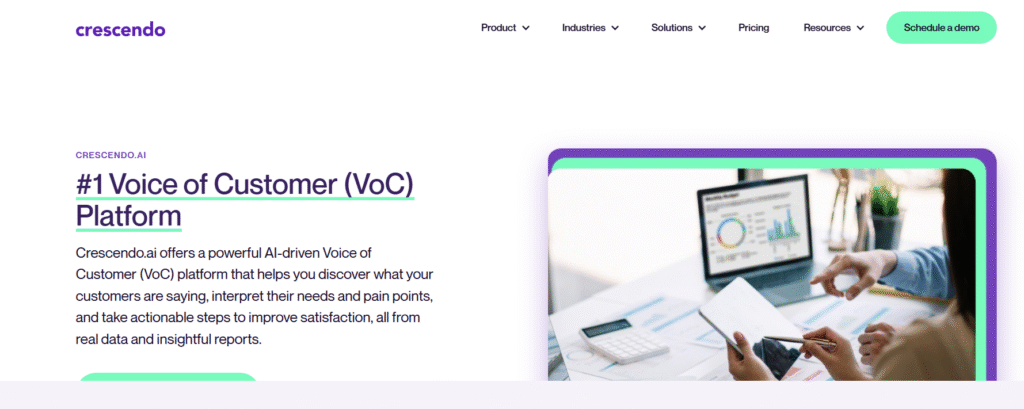
Crescendo.ai offers one of the most advanced built-in Voice of Customer (VoC) tools for analyzing customer service interactions (chat, email, voice, SMS) using AI. What sets it apart is its automated CSAT calculation, no need to rely on low survey response rates or incomplete feedback to gauge agent performance.
The intuitive VoC dashboard gives you everything at a glance:
- real-time sentiment analysis,
- smart issue categorization,
- conversation transcripts with summaries,
- CSAT scores with reasons,
- performance reports,
- technical issues reports,
- Fraud detection,
- handoff triggers, and actionable recommendations—
All auto-generated to help you make informed decisions fast.
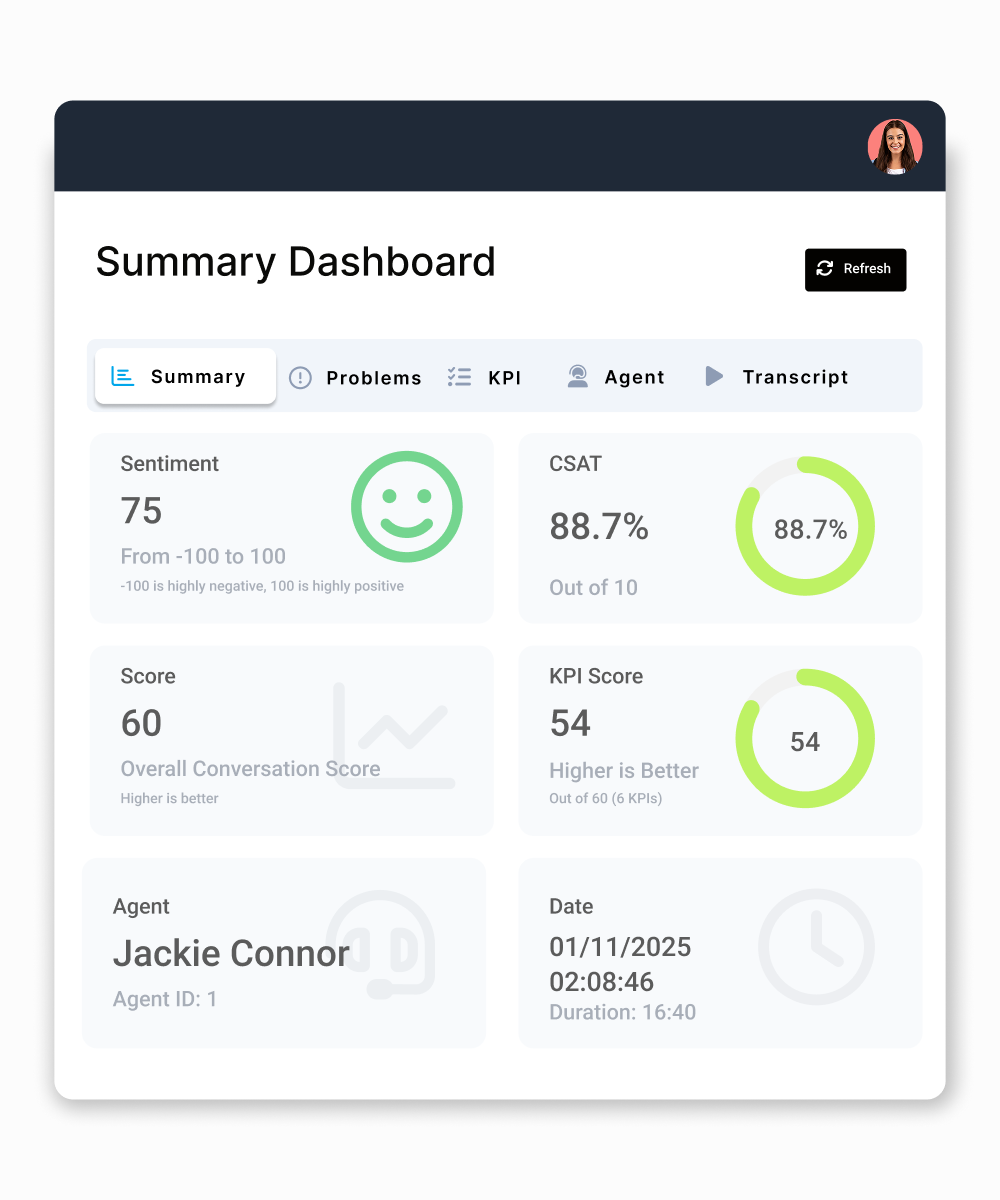
You will know which teams require coaching, which issues are the most frustrating for customers, and where you want to optimize support. Also, its AI is so good at its job that it can resolve 75% of interactions right away and flag technical issues like payment fraud or account duplication.
Pros:
• Analyzes 100% of conversations, no manual survey needed
• Smart auto-categorization helps prioritize real issues
• Gives handoff reasons and shows skill gaps between agents
• Supports 50+ languages
Cons:
• VoC is a complimentary feature, available only with the full service suite.
• Does not have features for social media listening.
Pricing:
Custom pay-per-resolution model. No hidden fees. Get in touch for the exact pricing.
2. Qualtrics
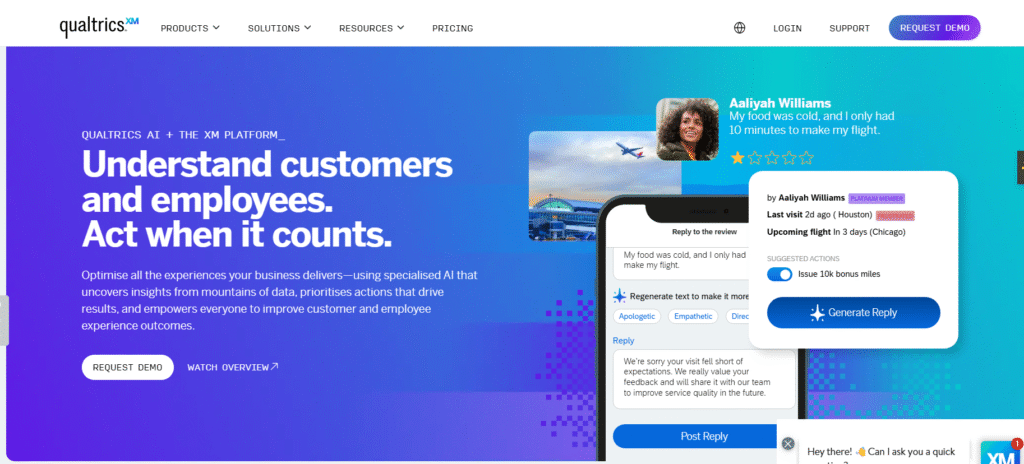
Annoyed by intermittent feedback and archaic survey instruments? Qualtrics takes up the challenge with a holistic platform that enables obtaining in-depth insights from customers and employees.
Whether your struggle is with low engagement, disconnected data silos, or convoluted feedback paths, Qualtrics offers an elegant solution to pulse surveys, lifecycle feedback, and generative AI-based summaries. You’ll know the nitty-gritty about what employees or customers care about just when it matters.
Pros:
• Generative AI summarization clarifies open-ended responses
• Pre-built benchmarks and 300+ metrics for full tracking of experience
• Flexible survey builder with advanced logic, rich media, and integrations
• Full journey coverage: customer, employee, candidate—all in one platform
Cons:
• May be overwhelming if only basic surveys are needed
• Implementation and data customization mandate vendor support
Pricing
Get in touch with the company for a quote
3. SurveySparrow
Does it seem that the surveys you send out usually fall flat? SurveySparrow offers a reinvention of the feedback collection ecosystem with chat-like forms that engage respondents on a more personal level, thereby eliciting honest responses that would be hard to extract through classical surveying formats.
You can truly wow your respondents with over 30 types of questions, including voice transcription, images, videos, dynamic logic, and CSS-driven white-labeling. In addition, it supports more than 70 languages for global reach and case management features so your team can immediately respond to red-flagged answers.
Pros:
• Enhances completion and engagement by mimicking a conversational chat-style format
• Voice transcription converts spoken answers into text; no more typing exhaustion!
• 600+ templates combined with sophisticated flow logic make form creation refinement a breeze
• Deep integrations with tools like Zendesk, HubSpot, Slack, Salesforce, etc.
Cons:
• The drag-and-drop editor is a nightmare for several designers as it misaligns elements
• Multiple price tiers and add-ons will make price clarity a little complex to understand
Pricing:
Individual plans start at ₹599/hour (billed yearly). Business plans with advanced workflows start at ₹4,499 per month. A free plan and a 14-day trial are offered.
4. AskNicely
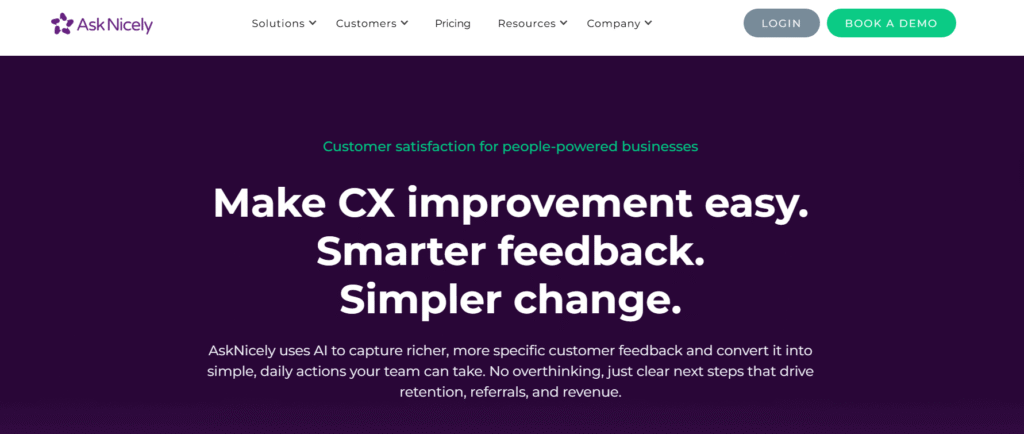
If you truly want to establish a customer-obsessed culture, then AskNicely is built to scale your mindset in that way. Instead of relying on ad-hoc feedback or on survey tools that don’t really work, AskNicely asks for always-on NPS and CSAT surveys to be filled in at opportune moments via SMS, email, kiosks, or even in-app, making sure you never miss a second.
AskNicely standardizes performance metrics, tracks sentiment trends, and coaches teams in service excellence, and in return, you get more retention, faster response times, and that cut-and-dried link between CX and revenue.
Pros:
• Real-time sharing of NPS and CSAT data through easy-to-understand dashboards
• Built-in automation for feedback and integrations with Slack, Teams, CRMs, etc.
• Location-wise view of performance; Team Leaderboards
• AI-powered insights coupled with presentation-ready reports for quick strategy alignment
Cons:
• Pricing scales aggressively as the volume of responses goes up
• Requires onboarding to gain full benefit across multi-location capabilities
Pricing:
Starts at $449 per month (annual billing) with unlimited users and AI-powered NPS surveys, while advanced CX insights, coaching tools, and branding features come along with higher tiers named Grow and Transform.
5. Chattermill
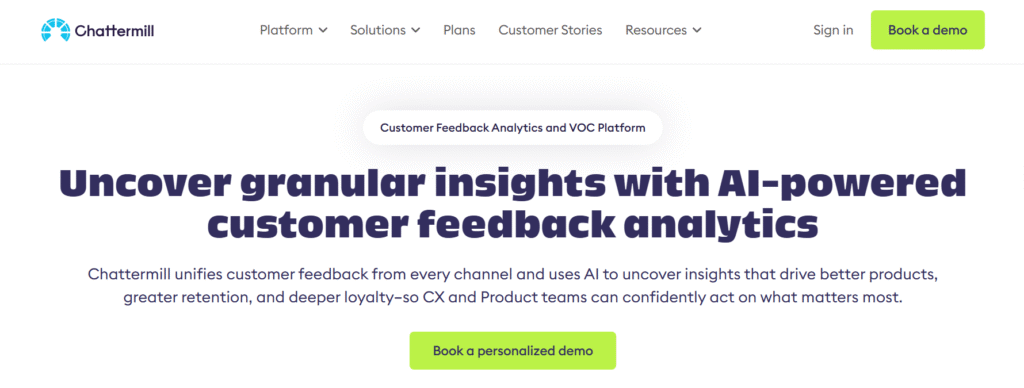
Chattermill is for businesses willing to take their analysis beyond mere survey outputs. It is an AI-powered analytics platform that essentially merges feedback data from surveys, support tickets, product reviews, social media, calls, etc., irrespective of language, and converts them into actionable insights.
The proprietary Lyra AI engine cleverly does more than just sift through keywords. It processes nuances, sentiment, and category context at scale. The combination of custom dashboards, anomaly detection, and Gen-AI summaries makes it an advanced yet very easy-to-use solution for enterprises looking for a comprehensive view of customer sentiment across various touchpoints.
Pros:
• Unifies structured and unstructured feedback analysis from all major channels
• Lyra AI offers deep sentiment analysis and theme detection with unprecedented precision
• Custom dashboards by team or region with real-time alerts and impact reporting
• Gen-AI summaries and insights by role for Product, Support, and CX teams
Cons:
• Does not allow for survey creation or distribution—really just pure analytics
• The credit-based price structure can become somewhat convoluted with large-scale usage
Pricing:
Custom pricing. There is a Pro plan (2 data sources, 10K data credits/month) to begin with, and Team and Enterprise tiers if you want to expand.
6. SentiSum

SentiSum is one of the best VoC tools that doesn’t address the surface problem; it digs deep to explain it. This AI-native VoC platform unifies feedback from support tickets, surveys, chats, reviews, and social media into one real-time stream and employs machine learning to explain why customers churn, get frustrated, or are delighted.
With integrations such as Zendesk, Jira, Slack, and Intercom, SentiSum acts as your AI-powered CX analyst and notices root causes and anomalies within minutes so that teams can intervene before the problems escalate.
Pros:
• AI-first root‑cause detection
• Real-time analysis from every single channel of feedback—with no silos
• Integrated into support and engagement tools with ease
• SOC 2 and GDPR certified and trusted by global enterprise brands
Cons:
• Suited mainly for support-ticket and feedback analysis—less for other text sources
• Accuracy sometimes falters, so manual inspection remains necessary
Pricing:
Custom pricing. Get in touch with the company for a quote
7. Brandwatch
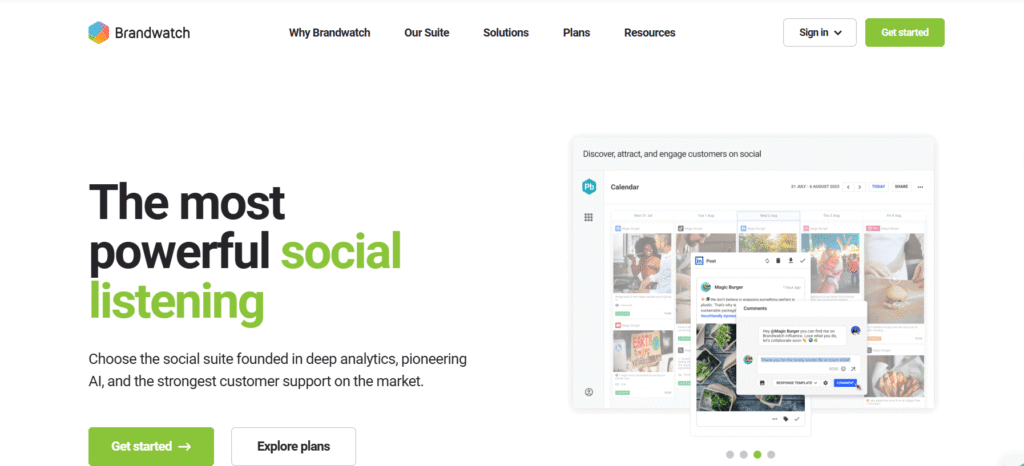
Brandwatch sells itself as an AI-powered, deeply analytic, and future-facing social suite offering tools in consumer intelligence, social-media management, influencer marketing, and brand monitoring.
Accordingly, it takes teams from searching billions of national and international online conversations to managing multichannel engagement and campaign workflows across platforms with the idea of spotting emerging trends, brand reputation protection, and optimized content, all through proprietary AI and an army of infinite consumer opinion.
Pros:
• Enterprise-grade AI monitoring of 100M+ sources with advanced trend detection
• Unified social inbox with a collaborative calendar for seamless team workflows
• Benchmark influencer search and campaign tracking
• Real-time alerting and brand-shielding against emerging threats
Cons:
• Many users report that onboarding can be difficult due to a feature-rich interface
• System latency and occasional bugs have been noted
Pricing:
Custom enterprise pricing is tailored to suit choice, and channel volume; available upon request.
8. Sprout Social
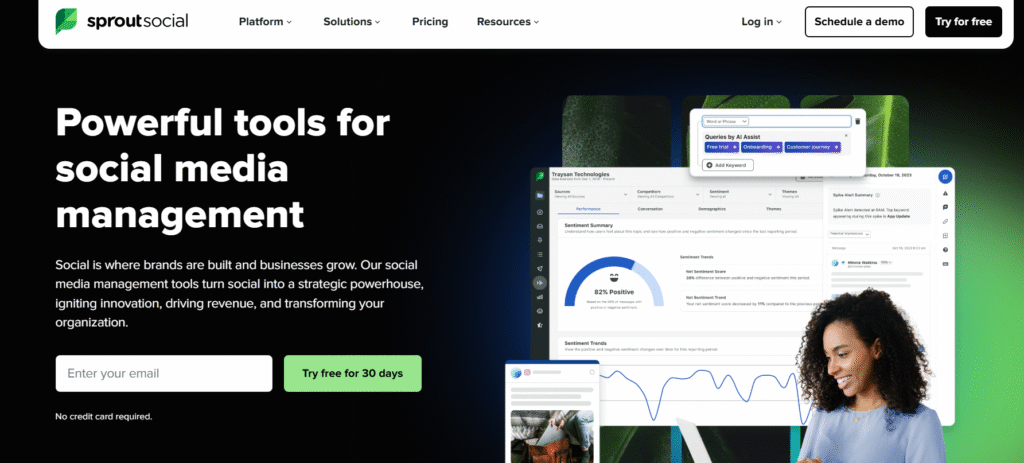
Sprout Social unifies publishing, engagement, analytics, and social listening together in one powerful dashboard. It is designed to help transform social media into a strategic growth driver for any kind or level of business. With features such as AI-powered smart inbox routing, sentiment detection, campaign planning, and cross-channel analytics, teams will be able to respond faster, collaborate better, and measure what truly matters. In addition to that, integration with the likes of Salesforce, TikTok, Pinterest, and Grammarly seems to set social data into a broader workflow.
Pros:
• Offers true enterprise-grade scalability for agencies and large teams
• Smart Inbox with AI-driven prioritization
• Flexible customizations include Premium Analytics and Employee Advocacy.
• Influencer marketing is also available as a standalone offering, again, without needing to fully invest in the whole platform
Cons:
• Manual input is mandated to automate competitor benchmarking
• Sentiment analysis sometimes mislabels sarcasm or messages with complex contexts
Pricing:
Starts at $249 per user/month (Standard) for up to 5 social profiles; Professional ($299/user/month) and Advanced plan is $399/user/month. Comes with a 30-day free trial.
Final Words
With numerous Voice of Customer tools available, the best approach would be to combine a native platform that is more robust, like Crescendo.ai, Zendesk, or Intercom, with a third-party product, like Sprout Social and SentiSum, that focuses on social listening and external market feedback. That way, you get an internal perspective mixed with an external view.