Getting a digital product right starts long before a single line of code is written. If the initial groundwork is shaky, the whole project suffers, deadlines slip, budgets balloon, and the final product misses the mark.
That groundwork is requirements gathering and workflow optimization. Many businesses outsource this critical phase.
They need an outside perspective, one that cuts through internal assumptions. The best providers aren’t just note-takers.
They’re business analysts who map processes, challenge logic, and align technology with actual business goals. The difference between them and a formal consultant is tangible results.
What Requirements Gathering and Workflow Optimization Actually Involve
This work is fundamentally about understanding how a business operates and where it wants to go. It’s not simply making a list of what a new app should do.
It’s a deep examination of processes, roles, decisions, and priorities. The job is to translate messy, often conflicting, business needs into a clear plan for technologists. This involves several key actions:
- Interviewing stakeholders and clarifying requirements;
- Mapping and documenting business processes;
- Identifying bottlenecks and inefficiencies;
- Aligning business goals with technical execution.
Skip this, and you’re building on sand. The project timeline, budget, and final quality will almost certainly be compromised. It’s that straightforward.
How We Selected the Top Companies
Our selection wasn’t based on market share or flashy marketing. We looked for firms with a reputation for practical, hands-on business analysis. We wanted evidence of real experience, not just textbook methodology.
The focus was on companies that move beyond templates to ask the tough questions. According to our data, the most effective partners share common traits. Our main criteria included:
- Proven experience in requirements gathering;
- Clear focus on workflow and process optimization;
- Ability to work with complex, multi-stakeholder projects;
- Strong documentation and communication practices.
This list isn’t about popularity. It’s about identifying partners who provide genuine utility, who can step into a complicated situation and create clarity.
Top Companies for Requirements Gathering and Workflow Optimization
The following companies are noted for their specific approach to this foundational work. This isn’t a ranked list by size or revenue.
It’s a look at firms recognized for their methodological expertise and their ability to improve how businesses prepare for digital projects. Each brings a slightly different angle to the same core discipline.
Geniusee
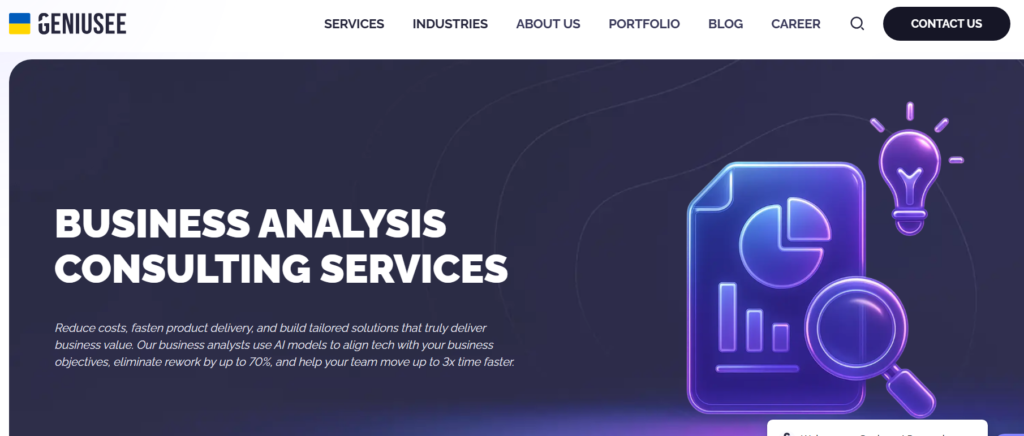
Geniusee positions business analysis as a standalone, critical service. Their approach treats the discovery phase as a product in itself. They dig into the operational nitty-gritty before any development talk begins, which we think prevents a ton of rework later.
Their team is built to deconstruct complex business environments and rebuild them as efficient, logical workflows. The focus is on creating a single source of truth that everyone, from executives to engineers, can follow. Key aspects of their service include:
- End-to-end business analysis services;
- Strong focus on requirements documentation and validation;
- Experience across multiple industries and product types;
- Close collaboration with product and engineering teams.
For projects where the business logic is complex or poorly defined, Geniusee business analysis service offers a structured path forward. They turn ambiguity into a clear action plan, which is why they’re featured here.
Carmatec
Carmatec employs a very structured, almost surgical, approach to dissecting business processes. They are big on visualization, mapping everything out so inefficiencies become obvious. Their analysts act as translators between the business side and the tech team, ensuring nothing gets lost.
The goal is always operational efficiency, stripping out unnecessary steps. Their methodology is documentation-driven, creating artifacts that serve the project long after the initial phase. They typically emphasize:
- Structured requirements gathering process;
- Business process modeling and analysis;
- Focus on operational efficiency;
- Documentation-driven approach.
You get a solid, well-documented foundation. It’s systematic and leaves little room for misinterpretation.
BeyondKey
BeyondKey thrives in dynamic environments where requirements might shift. Their style is highly collaborative, working with client teams to define needs rather than just extracting a list.
They’re good at adapting when project scopes change, which happens more often than not. This flexibility makes them a fit for businesses undergoing rapid growth or digital transition.
Their analysts are skilled at managing evolving expectations across different stakeholder groups. Their strengths often involve:
- Collaborative approach to requirements definition;
- Support for workflow improvements;
- Flexibility in changing project scopes;
- Experience with complex business systems.
They keep the process moving even when the destination isn’t fully fixed. It’s a practical, adaptive way of working.
Computools
Computools is focused on alignment. Their main thing is making sure business objectives and technical execution are perfectly synced. They analyze requirements across the entire project lifecycle, not just at the start.
This means they’re constantly checking that the work being done serves the original business goal. They provide a lot of decision support, using analysis to guide priorities when trade-offs are necessary.
Clarity and structure are non-negotiable for them. They bring:
- Requirements analysis across project lifecycle;
- Workflow alignment between stakeholders and teams;
- Strong focus on clarity and structure;
- Business-driven decision support.
The outcome is a project that stays on track strategically, not just tactically.
SysGears
SysGears applies business analysis principles directly within software development workflows. They optimize the internal processes of building software as much as they clarify the client’s business needs.
This dual focus can streamline the entire production pipeline. They’re experienced with scalable systems, understanding how requirements evolve as a product grows.
Their documentation bridges technical and business audiences effectively. Their service usually covers:
- Business analysis for software projects;
- Process optimization within development workflows;
- Clear technical and business documentation;
- Experience with scalable systems.
It’s a technical analyst’s approach, good for clients who value that deep dive into the development mechanics.
How to Choose the Right Partner for Your Business
Choosing the right firm isn’t about picking the biggest name. Look past the marketing slicks. You need a partner who will genuinely engage with your business problem, not just sell you a standard package. Ask how they run discovery.
Do they just host meetings, or do they challenge unclear assumptions? Honestly, the quality of their preliminary documentation from a first meeting can tell you a lot. Scrutinize their communication habits from the very first call. Consider these points:
- Depth of requirements discovery process;
- Ability to challenge unclear assumptions;
- Quality of documentation and communication;
- Experience with similar business models.
The right fit understands your context, not just the theory. Maybe that’s a firm with specific industry experience, or one whose communication style matches your team’s velocity.
Conclusion
Investing in proper requirements gathering and workflow optimization isn’t an administrative step. It’s a strategic one. It directly determines whether your project delivers value or turns into a costly lesson.
The initial time and resource commitment pays back through reduced rework, clearer timelines, and a product that actually works for the business. Teams move faster when assumptions are clarified early, and decision-making becomes simpler once priorities are clearly defined.
The choice of partner here is critical. You are trusting them to define the problem correctly before anyone starts building a solution. A weak discovery phase locks teams into flawed logic that is expensive to undo later.
Get this foundation wrong, and everything that follows becomes an uphill battle, no matter how strong the engineering or design effort is.