Search feels different in 2026. Artificial intelligence has moved us past the era of simple blue links. Most people now want immediate clarity without digging through multiple pages.
This shift has made Answer Engine Optimization a fierce rival to traditional SEO. One strategy brings visitors to your door. The other serves them right on the sidewalk. Both have merit, but the objective is always a conversion.
The numbers prove this evolution is real. Data reveals that over 58% of searches now end without a single click. Users find answers directly within AI summaries. This forces a vital question. Which approach actually turns a silent viewer into a loyal customer?
Defining Both Approaches
Traditional SEO
At its core, traditional SEO refines a website’s visibility in organic search results. The objective is simple. You want to guide a person from a search bar directly to your landing page.
This process relies on technical health and keyword relevance. It also depends on building authority through quality links. In this model, success means standing out in a crowded list of results. You win by capturing interest and earning a click.
Answer Engine Optimization (AEO)
Answer Engine Optimization works by tailoring content specifically for AI algorithms and large language models. The objective shifts from simply winning a click to becoming the cited authority in a generated response.
This strategy focuses on clear data and conversational phrasing that matches how people interact with digital assistants.
As these interfaces become more common, many organizations now invest in specialized Answer Engine Optimization services. These services help structure information so that machines can easily interpret and verify its accuracy.
The goal is to stay relevant even when a user never visits a traditional website. It is about becoming the trusted source that AI models prefer to reference.
How the User Journey Differs
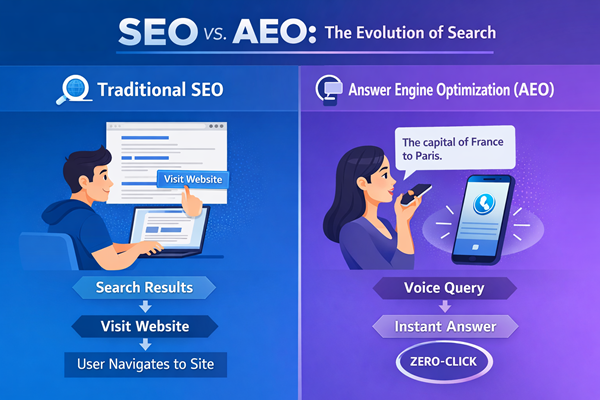
The Shift in Click-Through Behavior
Traditional SEO relies on a link. A user clicks to visit a website before they engage. AEO creates a zero-click experience.
It delivers answers directly in the search interface. Users find what they need without leaving the AI summary. It shifts the engagement point from the landing page to the results screen.
Evolving Visibility and Traffic Sources
Standard SEO still secures visibility in text-based searches. It builds a broad presence on Google and Bing. AEO wins in voice search and AI chat tools. This visibility happens even without a site visit. It places a brand at the center of a user’s conversation. Success now requires appearing in both links and AI responses.
Conversion Metrics in 2026
Comparing Conversion Performance
Conversion results tell two different stories. Traditional SEO traffic usually converts at an average rate of 2.4%. These visitors are often in the early stages of research. They need more time to trust a brand after clicking a link. AEO traffic offers a shortcut.
The AI assistant has already vetted the information for the user. When someone clicks through a citation, they are much more likely to buy. This pre-qualification pushes the conversion rate up to 4.1%.
Analyzing User Engagement
Engagement patterns also show a clear contrast. SEO pulls in a wide net of people who may bounce quickly. AEO visitors arrive with a focused purpose. They stay longer and engage more. Businesses using Answer Engine Optimization services notice that these users arrive ready to commit.
Every visit becomes more valuable when the intent is already clear. Deep engagement follows when a user’s question is answered before they reach the page.
Where Each Approach Excels and Falls Short
The Case for Traditional SEO
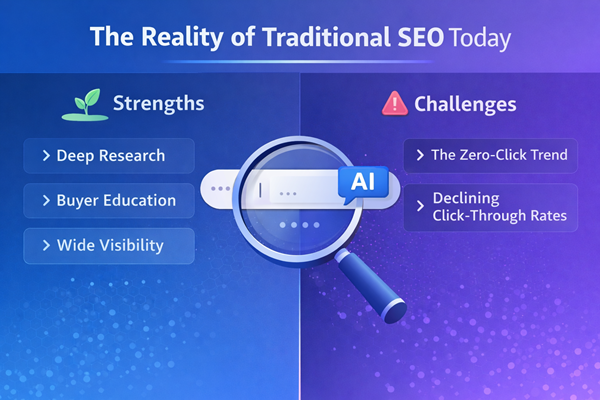
Traditional SEO still provides a solid foundation for digital growth. It works well for research phases where customers need deep information. However, its effectiveness is fading in the modern search landscape.
The rise of zero-click results means that high rankings often fail to drive actual traffic. Relying solely on links is a shrinking strategy as AI reshapes how people find facts.
Traditional SEO Highlights:
- Builds wide visibility across diverse queries.
- Supports long-term buyer education.
- Faces declining clicks due to zero-click trends.
The Case for AEO
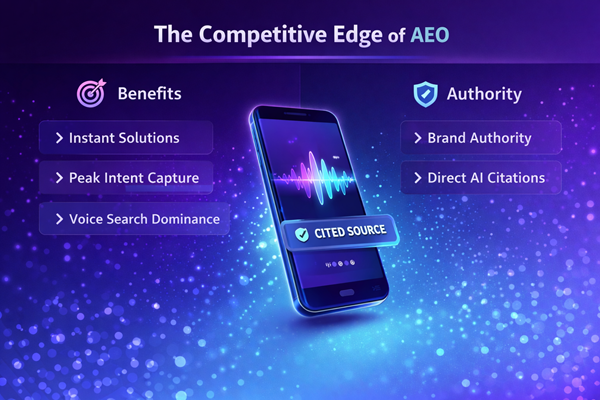
AEO offers a much sharper competitive advantage. It captures users at the peak of their intent by providing immediate answers. This strategy is essential for winning in voice and conversational search.
By appearing as the cited source in an AI summary, a brand gains authority that a simple link cannot match. While it requires technical precision, the reward is a highly qualified audience ready to act.
AEO Highlights:
- Targets high-intent users with instant solutions.
- Builds authority through direct AI citations.
- Dominates voice and chat search environments.
Conclusion
Digital growth now hinges on meeting users at the appropriate moment. Balancing a strong site with AI-ready content is the most reliable path forward. It is time to decide how your brand will answer the next query.