he SaaS landscape has evolved rapidly over the past decade. What once differentiated software was accessibility and subscription pricing. Today, that is no longer enough. Modern SaaS products are expected to deliver intelligence, automation, and measurable business outcomes.
As a result, saas software development services now focus on embedding AI-driven analytics and workflow orchestration into product architecture from the outset. For startups and enterprises alike, these capabilities have moved from being competitive advantages to becoming core product requirements.
In Australia’s increasingly digital economy, businesses are seeking SaaS platforms that do more than store data or digitise manual tasks. They expect systems that interpret information, recommend actions, and automate decisions in real time. This shift is reshaping how SaaS products are designed, developed, and scaled.
The Shift from Functional to Intelligent SaaS
Traditional SaaS platforms focused on solving a specific operational problem. They streamlined accounting, managed customer relationships, or tracked inventory. While these capabilities remain important, customers now expect more sophisticated functionality.
AI-driven analytics enables SaaS products to extract meaningful insights from data rather than simply displaying it. Instead of providing static reports, platforms can identify patterns, forecast trends, and highlight anomalies automatically.
For example, a SaaS product used in retail can predict demand fluctuations, while a logistics platform can optimise route planning based on real-time conditions.
Why Analytics Alone Is Not Enough
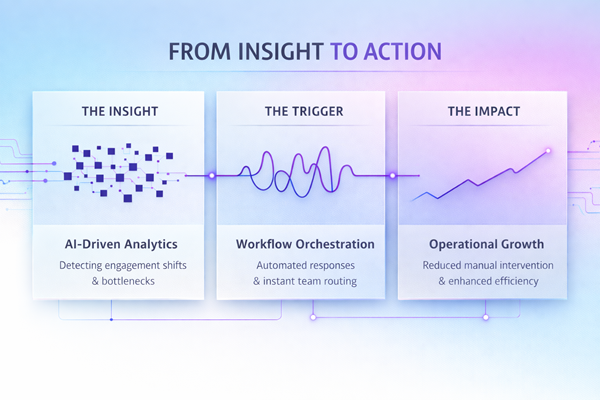
While analytics provides insight, action is what drives value. This is where workflow orchestration becomes critical.
Workflow orchestration connects data, systems, and processes across an organisation. It ensures that when an insight is generated, it triggers the appropriate response automatically.
For instance, if analytics detect a decline in user engagement, the system might initiate targeted communication campaigns. If operational bottlenecks are identified, alerts can be routed to the relevant teams instantly.
By integrating AI-driven analytics with workflow orchestration, SaaS products move beyond passive reporting. They become active participants in business operations.
For startups, this capability accelerates growth by reducing manual intervention. For established enterprises, it enhances efficiency and improves cross-department collaboration.
Enabling Scalable Growth Through Automation
Scalability is one of the primary reasons organisations adopt SaaS solutions. However, scaling successfully requires more than adding infrastructure capacity. It demands intelligent systems that can adapt to increasing complexity.
AI-driven analytics allows platforms to learn from usage behaviour, optimise resource allocation, and anticipate system demands. Workflow orchestration ensures processes remain streamlined even as customer numbers grow.
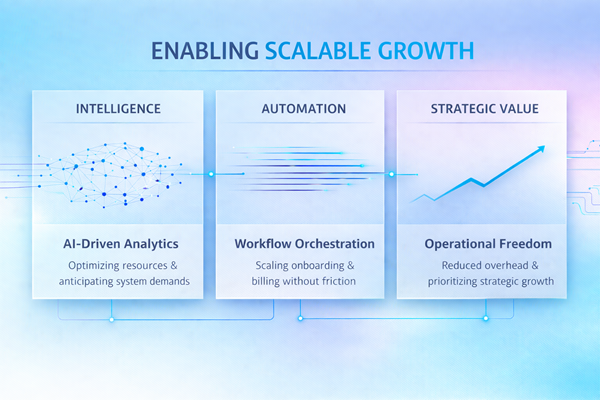
Consider a subscription-based SaaS platform serving Australian SMEs. As customer volumes increase, onboarding, billing, support, and compliance processes must scale seamlessly. Automated workflows can handle repetitive tasks, while analytics continuously refine the experience based on user behaviour.
This combination reduces operational overhead and allows businesses to focus on strategic growth rather than administrative tasks.
Strengthening Decision-Making with Real-Time Intelligence
In a competitive market, speed and accuracy of decision-making are essential. Static dashboards are no longer sufficient for leaders who need immediate insights.
AI-powered analytics engines process data in real time, identifying trends as they emerge. Workflow orchestration then ensures relevant stakeholders receive timely notifications or automated recommendations.
For example, in financial services, anomaly detection algorithms can flag unusual transactions instantly. In healthcare SaaS platforms, predictive models can identify patient risk factors before issues escalate. These capabilities enhance reliability and build trust among users.
Embedding such intelligence requires a cohesive approach to Digital Product Development Services, where data science, engineering, and user experience are aligned from the earliest stages of design.
Improving Customer Experience and Retention
Customer expectations have shifted significantly. Users now expect intuitive interfaces, personalised experiences, and proactive support.
AI-driven analytics helps SaaS platforms understand user behaviour at a granular level. By analysing feature usage patterns and engagement metrics, products can deliver tailored recommendations and adaptive interfaces.
Workflow orchestration enhances this experience by automating personalised interactions. For instance, onboarding flows can adjust based on user roles, while support tickets can be routed intelligently to reduce response times.
In the Australian market, where customer loyalty is closely linked to service quality, these enhancements play a crucial role in long-term retention and brand reputation.
Building Resilient and Future-Ready Architectures
Modern SaaS products must operate across distributed environments, integrate with third-party systems, and comply with evolving regulations. AI and orchestration capabilities must be built into secure, scalable architectures.
Cloud-native design, microservices, and API-driven integrations form the foundation of intelligent SaaS platforms. AI models require reliable data pipelines, while workflow engines depend on stable system integrations.
Organisations often collaborate with a digital transformation partner to align technology investments with long-term business objectives. Such partnerships ensure that AI capabilities are not isolated features but integrated components of a broader strategic roadmap.
Driving Competitive Advantage in the Australian Market
Australia’s startup ecosystem is highly competitive, and established enterprises are undergoing rapid digital transformation. In this environment, SaaS providers must offer differentiated value.
AI-driven analytics enables deeper insights into customer needs and market dynamics. Workflow orchestration ensures that those insights translate into measurable outcomes.
Startups launching new SaaS products can use intelligent automation to accelerate go-to-market strategies. Enterprises modernising legacy systems can leverage orchestration to unify fragmented processes.
In both cases, intelligence becomes the defining factor between a product that merely functions and one that leads the market.
From Insight to Action: The New Standard
The integration of AI-driven analytics and workflow orchestration represents a fundamental shift in SaaS product strategy. Businesses are no longer satisfied with tools that simply store or visualise data. They require platforms that interpret information, automate decisions, and drive tangible results.
As SaaS products continue to evolve, intelligence and automation will shape customer expectations and industry standards. Companies that prioritise these capabilities will not only enhance operational efficiency but also unlock new revenue streams and sustainable growth opportunities.
Conclusion
AI-driven analytics and workflow orchestration are no longer optional enhancements in SaaS products. They are foundational components that enable smarter decisions, streamlined operations, and scalable growth.
In an increasingly competitive and data-driven landscape, intelligent SaaS platforms will define the next generation of successful digital businesses in Australia.