Executive Summary
- AI tools alone rarely improve business performance.
- In 2026, the real advantage comes from using AI in the right workflows.
- Businesses need to decide where AI should automate work, support people, or reshape a process.
- Without ownership, context, and clear success measures, AI tools just add activity without real value.
An AI strategy defines where AI fits in the business, what it should improve, how it connects to workflows and data, and how to measure success. In 2026, most companies already have access to AI tools. So, the real challenge is to use them in the right workflows to improve execution, decision quality, and business outcomes.
Bad workflows don’t get better with a smarter co-pilot. Many businesses still struggle because they’re not aware of how pilots and prompts work. Teams may produce more output, but performance often changes very little because AI can’t fix broken processes.
What companies should focus on is crafting a strong AI strategy where AI supports work, human judgment remains essential, and impact is to be evaluated clearly.
Why does AI adoption fail to deliver business value?
AI adoption usually fails not because the models are weak, but because businesses try to layer AI onto weak workflows, fragmented systems, and unclear ownership.
For instance, a social media team may adopt multiple AI tools for keyword research, briefs, drafting, captions, scheduling, and reporting, yet still spend more time managing work. Because while each tool improves a specific task, without a clear AI transformation strategy, complexity increases, making scaling execution harder.
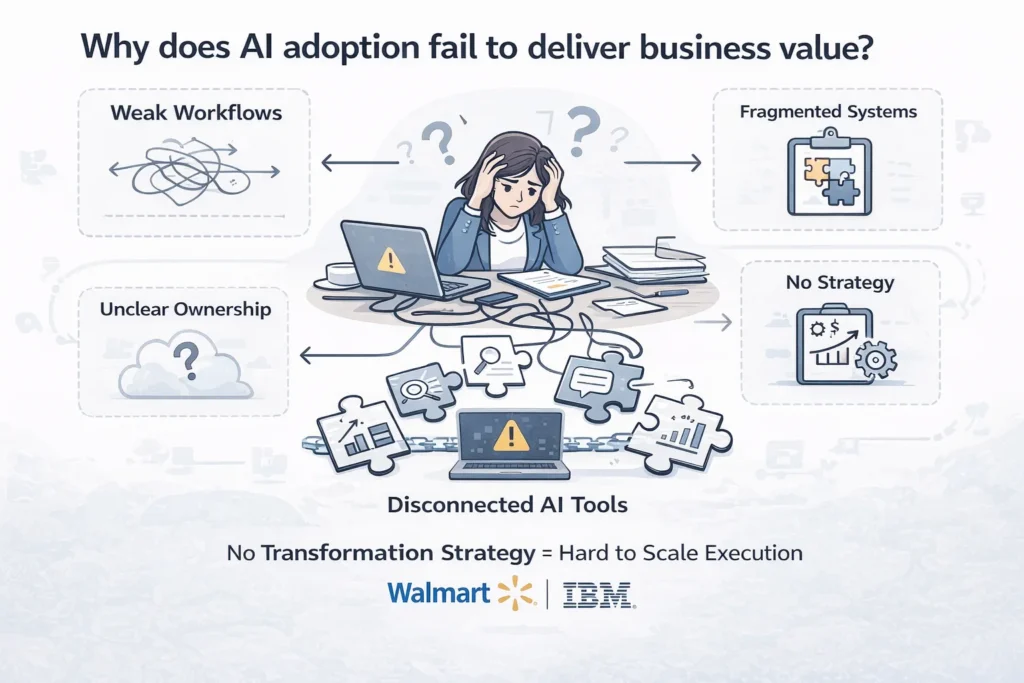
Here’s what happens:
1. Accountability becomes fragmented
Different teams use AI for their own goals, but leaders lack visibility into overall impact. The content team may prioritize publishing volume, while the social team focuses on engagement, making it difficult to assess contribution to shared business outcomes.
2. Teams deal with zero-context hallucinations
When AI tools are not connected to an approved internal context, they produce outputs that lack business relevance. For instance, social media content may appear polished but have outdated or misaligned topics, which lowers reliability and increases rework time.
3. Implementation debt increases
Businesses often introduce AI tools without redesigning how work moves across planning, creation, approval, and reporting. Over time, teams manage more systems and review more outputs, increasing process complexity without improving execution quality.
4. Trust breaks down
When AI outputs feel inconsistent, off-brand, or difficult to verify, teams lose confidence in the results. They spend more time checking the work or stop using the tools altogether. This reduces adoption and limits the return on investment.
5. Activity grows without real outcomes
Being busy and being productive are not the same thing. AI can help teams increase the volume of drafts, posts, or content variations without improving rankings, engagement quality, conversion, or campaign efficiency. But it does not guarantee better performance, especially when efforts are not aligned with measurable business goals.
How should businesses approach AI strategy in 2026?
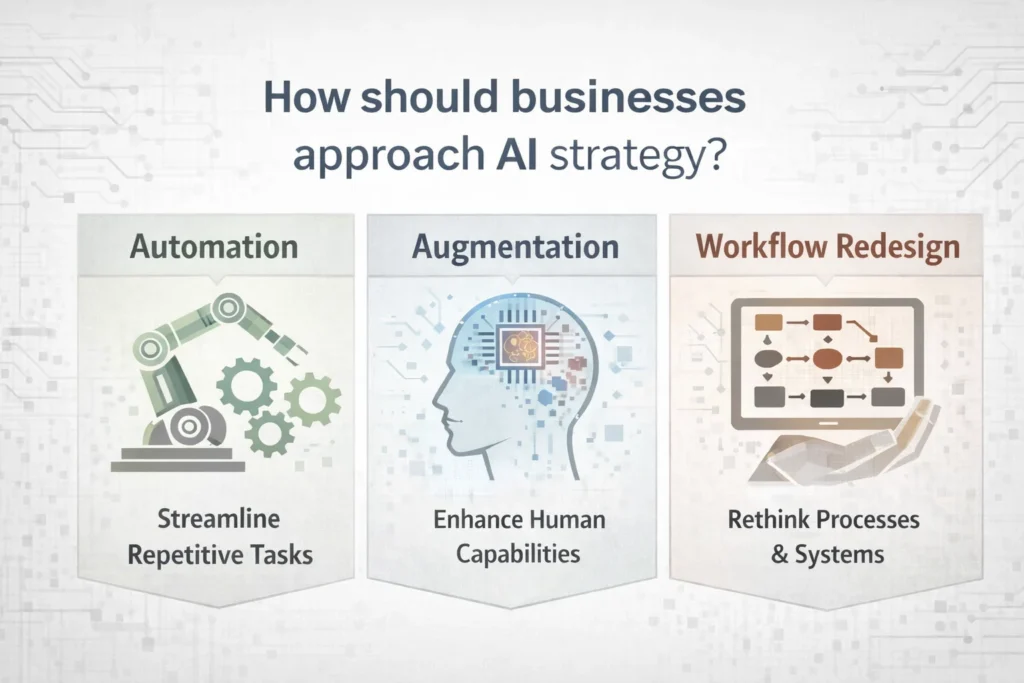
In 2026, enterprise AI strategies typically fall into three categories: automation, augmentation, and workflow redesign. The right choice depends on the type of work, the level of risk, and the business outcome you want to improve.
1. Automation
Automation reduces manual effort in routine, repeatable work where rules are stable and consistency matters most. In 2026, automation is often supported by automated evaluation (auto-evals) that continuously check output accuracy and reduce manual validation effort.
Common use cases:
- document routing
- invoice processing
- ticket classification
- data extraction
- status updates
What to watch:
Automation creates value only when exception handling, ownership, and accuracy controls are clearly defined. Automated evaluation helps teams maintain consistency without increasing review workload.
2. Augmentation
Augmentation helps people work faster and make better decisions while preserving human judgment. In 2026, augmentation commonly appears as embedded copilots connected to grounded internal knowledge (RAG), enabling teams to work with business-aware information rather than generic outputs.
Common use cases:
- analysis
- planning
- internal research
- reporting support
- sales enablement
- campaign evaluation
What to watch:
Augmentation performs best when outputs reflect the current internal context and verification effort remains manageable. Grounded internal knowledge reduces contextual gaps and improves decision confidence.
3. Workflow redesign
Workflow redesign improves how work moves across systems, teams, and decisions. In 2026, this often includes agentic workflow design, where AI supports multi-step execution under defined rules, with approval logic, action limits, and fallback controls to keep execution safe and auditable.
This is already becoming more visible in areas such as service operations, internal approvals, and AI agents in software delivery, where work needs to move across tools, stages, and human checkpoints.
Common use cases:
- AI connected to internal knowledge sources (RAG-enabled assistants)
- CRM and analytics workflows
- service systems
- approval flows
- multi-step execution processes
What to watch:
Workflow-level value depends on strong integration, approval controls, auditability, and production-grade reliability. Teams also need monitoring, fallback paths, and clear escalation procedures when AI cannot safely complete a step.
What are the steps to building an effective AI strategy?
A useful AI strategy does not start with a broad AI ambition. It starts with a business problem, tests whether the business is ready to support the solution, and then builds from there. In 2026, the goal is not to add more AI activity. It is to apply AI where it can improve execution, integrate with real workflows, and scale without creating more complexity.
Step 1. Define the business problem and check readiness
The best AI strategy happens before you adopt any AI tool. Start with a visible business issue, then assess whether the data, connected systems, ownership, and workflow discipline are strong enough to support AI. A promising use case can still fail if the business context is weak from the start.
Step 2. Map the workflow, not just the task
Look at how work actually moves across teams, systems, approvals, and handoffs. The aim is not just to speed up one task, but to identify where delays, duplication, and manual effort are slowing the entire process.
Step 3. Decide the role of AI
Once the friction is clear, decide whether AI should automate a routine task, support human judgment, or help redesign a larger workflow. This keeps the strategy aligned with the type of work rather than forcing AI into situations where a simpler process fix would be better.
Step 4. Connect AI to the right business context
AI becomes useful only when it can access the right documents, rules, data, and system context at the right point in the workflow. For some use cases, that means grounded access to internal knowledge. For others, it means integration with CRM, analytics, service, or operational systems.
Step 5. Set clear metrics
Before scaling, establish guardrails. Define where human review is needed, identify actions that require approval, set fallback triggers for failures, and continuously monitor performance. In 2026, companies should measure success through workflow outcomes such as cycle-time reduction, decision speed, or lower review effort, not system activity.
Step 6. Scale with evidence, not enthusiasm
Start with a focused implementation, but build on shared standards for governance, data access, and integration. The purpose of a pilot is not just to prove that AI works. It is to prove that the workflow improves in a way that supports the business, builds trust, and scales.
What should businesses do and avoid in an AI strategy?
| What to Do | What to Avoid |
| Start with a business problem and check readiness | Start with a tool and look for a use case later |
| Map the full workflow | Optimize one task while the rest of the process stays broken |
| Connect AI to the right data, systems, and rules | Rely on generic outputs without grounded context |
| Define governance, review rules, and success metrics | Scale based on activity, speed, or excitement alone |
| Expand only after the workflow proves value | Roll out broadly before trust, quality, and ownership are clear |
When should businesses bring in AI consultants for implementation?
Not every business needs to build a large in-house AI team from the start. But at some point, the pilot becomes the problem. The tool becomes harder to manage than expected. What begins as a promising pilot can quickly turn into a larger challenge involving workflow redesign, data access, integration, governance, evaluation, and production support.
That is usually where the real capability gap shows up. Some businesses know exactly what problem they want to solve, but don’t have the technical bandwidth to implement it well. Others are still earlier in the process and need help deciding which use cases are worth pursuing, which data and systems should be involved, and what should be governed before anything scales.
Some businesses know what they want to improve, but still need more structure around roadmap decisions, workflow alignment, and execution. At that stage, specialized support for AI strategy and implementation can help clarify what should move forward and how.
Outside help isn’t a weakness, but waiting too long might be. AI work can become operationally demanding very quickly, and the right support can help close gaps before they turn into delays, rework, or weak business outcomes.
Key Business Takeaway
AI delivers meaningful efficiency only when it is applied to clearly defined business problems. When used thoughtfully, it can reduce manual effort, shorten cycle times, and free up resources for higher-value work.
More tools won’t fix where you need a smarter strategy. The problem with AI is that it can introduce repetition or hallucinated outputs. So, businesses need a more deliberate and creative approach. In 2026, the edge isn’t using more AI tools; it’s knowing exactly where to use them.
FAQs
What is an AI strategy?
An AI strategy is a business plan for deciding where AI fits, what it should improve, how it connects to workflows and data, and how success will be measured.
What is the difference between automation and augmentation?
Automation handles repetitive work with minimal judgment. Augmentation helps people work faster or make better decisions while maintaining human oversight.
What is the role of RAG in AI strategy?
RAG helps connect AI to approved internal knowledge, so outputs are grounded in a relevant business context rather than relying solely on generic model responses.
How long does it take to build an AI strategy?
A focused AI strategy for one business problem can often take shape in a few weeks. A broader enterprise AI strategy usually takes longer because it involves more workflows, systems, stakeholders, and governance decisions.
How should businesses evaluate the cost of AI implementation?
The cost of implementing AI varies based on the use case, the level of integration required, governance needs, and whether the business is automating a task or redesigning a workflow.
When should a company use AI consulting services?
Businesses usually reach out to AI consulting partners for custom services when they need help selecting use cases, shaping the roadmap, aligning AI with workflows, or moving from pilots to a more structured approach.
When should a business consider AI staff augmentation?
AI staff augmentation is most useful when a business already knows what it wants to build but needs additional technical or delivery support to execute and scale efficiently.