A few months ago, I spoke with a COO whose startup was scaling fast. New signups were doubling each month, but their two-person support team couldn’t keep up. They brought in an outsourcing firm recommended by another founder, hoping for fast relief.
But instead of just clearing tickets, the new team started tagging bugs, documenting unclear flows, and creating internal summaries for the product. When a payment outage hit, they had already flagged the warning signs two days earlier, based on patterns in support logs.
That’s what good outsourced support looks like. Not just coverage, but contribution.
I’ve seen the other kind too: firms that promise 24/7 response, but deliver cut-and-paste answers from agents who barely know what your product does. In that scenario, support becomes a liability, not a strength.
Outsourcing support is about who you trust to speak for your company when your customers are frustrated and expecting answers.
If You’re in a Hurry: The 3 Best Customer Support Outsourcing Firms
- Somewhere: Best for Cost-Efficient, Remote Customer Support
- Global talent across 4+ regions
- 6-month replacement guarantee
- No upfront fees, pay on hire
- Helpware: Best for Omnichannel Enterprise Support
- Tailored BPO for large-scale ops
- Global offices with 24/7 coverage
- High client satisfaction ratings
- SupportNinja: Best for Fast-Growth Tech Startups
- Scales with early-stage SaaS
- Nearshore and offshore teams
- CX training and culture alignment
Looking for deeper insight or better alignment? Keep reading for full agency reviews and strategic advice on outsourcing customer support the right way.
How to Choose the Right Customer Support Outsourcing Partner
1. Prioritize Process Integration, Not Just Coverage
A lot of companies get dazzled by 24/7 promises. But round-the-clock support means nothing if your outsourced agents can’t escalate bugs, sync with your product team, or pull the right data from your CRM. The best agencies embed into your workflows.
They work inside your help desk, not alongside it, and they document feedback loops that actually reach product, engineering, or operations. If you’re getting a team that “answers tickets” but can’t flag upstream issues, you’re just delaying resolution.
2. Screen for Language Nuance and Empathy
Customer support is emotional work. Tone, timing, and clarity make the difference between a churned customer and a product evangelist. Strong providers test for more than grammar. They vet for empathy, tone-matching, and the ability to de-escalate with dignity.
Bonus if they can support multiple languages with native fluency. If your support feels robotic or tone-deaf, it doesn’t matter how fast it is. Your brand takes the hit.
3. Evaluate for Technical and Tooling Fluency
I once watched a provider train agents using outdated screenshots from an internal tool. The result? Errors that created data integrity issues. The best outsourced teams learn your stack: help desk software, internal dashboards, even custom admin panels.
Ask how they train on tools, how often they update internal wikis, and whether they can handle product-specific edge cases without constant handholding.
4. Understand Their Hiring and Training Pipeline
Support is often the first role outsourced, but it’s also one of the easiest to under-resource. You want to know how your partner sources, screens, and trains reps. Do they use competency-based interviews? Simulations?
Can they walk you through their onboarding timeline? If the answer is “we just hire people with call center experience,” that’s a red flag. The best partners treat support like a craft, not a fallback career.
5. Ask About Retention, Not Just Ramp Time
High agent churn kills consistency. If the team answering your tickets turns over every 60 days, knowledge fades, context slips, and your customers notice. Great agencies share internal retention metrics and explain how they keep agents engaged.
Look for providers that invest in team culture, offer role progression, and build long-term relationships with both clients and support staff. Continuity builds quality.
7 Best Outsourced Customer Service Firms for 2026
1. Somewhere: Best for Cost-Efficient, Remote Customer Suppo
- Founded: 2009
- Headquarters: Dallas, TX
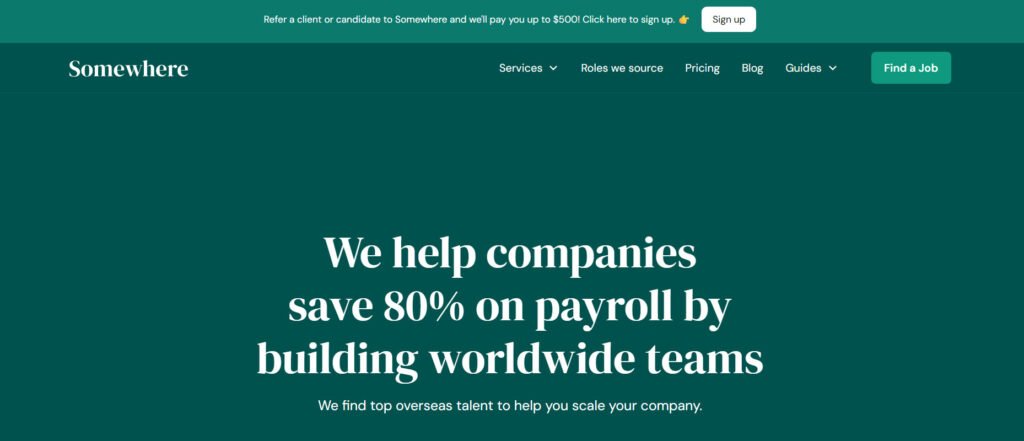
Why Somewhere is the best outsourced customer support services company: Somewhere helps companies build dedicated, remote customer support teams by tapping into high-quality talent pools in Latin America, the Philippines, South Africa, and Eastern Europe. Unlike full-service BPOs, Somewhere is helping you hire support staff directly, which gives you more control over process, culture, and systems.
What makes them especially effective is their focus on asynchronous fluency. Their candidates are hired for their ability to self-manage, communicate clearly across time zones, and integrate directly into tools like Zendesk, Intercom, or HubSpot. Every placement comes with a six-month replacement guarantee, and their pay-on-hire model removes risk for teams scaling cautiously.
If you’re growing fast, already using Slack or Notion to run ops, and need support reps who feel like part of your company (not a vendor), Somewhere delivers reliable talent without the overhead of traditional BPO setups.
2. Helpware: Best for Omnichannel Enterprise Support
- Founded: 2015
- Headquarters: Lexington, KY
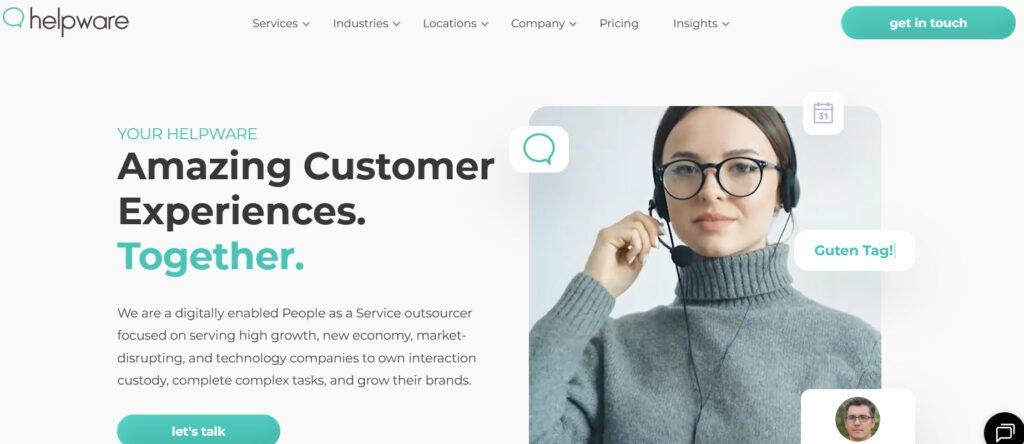
Helpware operates more like a true business process outsourcing (BPO) partner, supporting enterprise clients with fully managed customer experience teams across live chat, email, phone, and social media. Their strength lies in how they configure global support hubs (across the U.S., Ukraine, Mexico, the Philippines, and Germany) so clients can build localized support operations with global uptime.
What sets Helpware apart is how much ownership they take of the support operation. They don’t just staff a team. They build it, train it, and monitor it, often embedding QA functions and team leads directly into the contract. For companies operating across multiple markets or languages (or ones that need strong documentation and process control), this model works well.
Their clients tend to be mid-market and enterprise businesses with multichannel support demands. If you’re looking for a hands-off provider who can fully own customer support as a function while maintaining SLAs and brand consistency, Helpware brings both infrastructure and scale.
3. SupportNinja: Best for Fast-Growth Tech Startups
- Founded: 2015
- Headquarters: Austin, TX
SupportNinja was built for startups and tech companies that need to scale customer service quickly without adding internal headcount. Their delivery model spans North America, Latin America, and Southeast Asia, making them a strong fit for companies that need 24/7 coverage or nearshore support aligned with U.S. time zones.
What makes them valuable for early-stage or Series A/B startups is their operational flexibility. They offer both shared and dedicated agent models, and their onboarding process is designed to plug into fast-moving teams using tools like Zendesk, Intercom, Gorgias, and Salesforce. They also offer training services and can mirror your brand voice and workflows across multiple channels.
SupportNinja understands startup cadence. Their reps are coached to handle edge cases, product feedback, and the kind of emotionally charged interactions that happen when a feature breaks or an update misses the mark. If you’re scaling CX during high-growth sprints, they’re built to keep pace.
4. Helplama: Best for Small Business and Flex-Scale Support
- Founded: 2016
- Headquarters: Walnut, CA
Helplama positions itself as a customer support partner specifically for small and midsize businesses that need flexibility, not fixed headcount. What makes them stand out is their hybrid offering: you can start with shared agents and transition to dedicated staff as your volume grows. That’s especially useful for early-stage companies or seasonal businesses that experience fluctuating demand.
Their services cover live chat, email, phone, and social media support. Agents are trained on your specific brand voice and product before going live, and they offer a “zero-risk” trial period to start. For companies that want to test outsourcing without a long-term commitment, Helplama lowers the barrier to entry without sacrificing quality.
They’re best suited to businesses with e-commerce storefronts, DTC operations, or early-stage SaaS tools where responsiveness matters, but budget still drives decision-making.
5. Foundever: Best for Large-Scale, Global Support Operations
- Founded: 1985 (rebrand from Sitel/Sykes)
- Headquarters: Miami, FL
Foundever is the result of a global merger between Sitel Group and SYKES, now operating under a unified brand with over 170,000 employees in 45+ countries. This is enterprise-grade outsourcing built for multinational companies with high complexity, high volume, and high compliance demands.
Their model includes omnichannel support (voice, chat, email, social media, and even in-app) delivered through a network of global service centers and remote agents. What differentiates them is their maturity: they offer deep expertise in industries like financial services, healthcare, telecom, and travel, where data privacy and uptime are non-negotiable.
Foundever is best for Fortune 500-level organizations looking to outsource entire CX departments, with built-in reporting, process optimization, and quality assurance baked into long-term contracts.
6. Teleperformance: Best for Compliance-Driven, Multilingual Coverage
- Founded: 1978
- Headquarters: Paris, France
Teleperformance is one of the oldest and most recognized names in the customer support outsourcing industry. With over 400,000 employees operating in 170+ markets, they’re built for companies that require airtight compliance, deep industry experience, and multilingual support across dozens of languages.
Their services go beyond ticket resolution. Teleperformance supports identity verification, KYC workflows, technical troubleshooting, and regulated customer engagement, making them a top choice for banks, telcos, government contractors, and healthcare providers.
What they offer in scale, they also back up with infrastructure: ISO-certified facilities, AI-powered QA systems, and dedicated client pods for each account. If you’re hiring with a compliance or regulatory lens, Teleperformance brings the operational muscle and process rigor most smaller firms can’t match.
7. Atento: Best for Latin American and Multiregional Market Support

- Founded: 1999
- Headquarters: Madrid, Spain
Atento is a leading CRM and BPO provider in Latin America, with an operational presence in 13 countries and more than 150,000 employees globally. Their sweet spot is supporting companies that need customer engagement in Spanish and Portuguese, along with U.S. English coverage for North American expansion.
They specialize in voice-heavy and mobile-first customer bases. Ideal for telecom, fintech, insurance, and public services sectors. Atento also builds out localized sales and retention teams that operate under your brand but are fully managed by their internal infrastructure.
For companies entering or scaling in LATAM, or U.S. firms needing culturally attuned nearshore support, Atento brings regional fluency and experience that’s hard to replicate with global-only providers.
What the Right Support Partner Really Delivers
Customer support is the operational front line of your brand. It’s where churn gets reversed, bugs get surfaced, and trust gets built, or broken. That’s why picking the right outsourced partner is about aligning support with the way your business actually runs.
Some companies need full-stack BPOs who can scale across regions and channels. Others need embedded remote teams who act like full-time staff. Some need both. The real question is: how much control do you want to retain, and how much context does your support team need to be effective?
Each of the seven firms listed above offers a different answer to that question. Somewhere gives you embedded reps without the overhead. Helpware and SupportNinja offer managed scale with startup fluency. Teleperformance and Foundever bring enterprise-grade infrastructure. The best fit comes down to what your customers expect and how much ownership you want your support team to take.
Start with that clarity, and the right partner becomes obvious.