
Embarking on an artificial intelligence project can feel like planning a voyage into the unknown. The potential rewards are immense, promising to revolutionize how you do business, but the costs can seem shrouded in mystery.
Business leaders often ask a simple question: “What will it actually cost?” The answer is rarely a single number. Instead, it’s a mosaic of interconnected expenses, each one critical to the success of the final product.
Understanding the anatomy of an AI budget is the first step toward making a smart investment. It’s about looking past the allure of the technology and getting a firm grasp on the practical, tangible resources required to bring an AI solution to life.
By breaking it down, you can transform a daunting figure into a manageable financial plan.
The human element: Assembling your team
The most significant portion of any AI budget is almost always the people. AI is not a plug-and-play technology. It is built, trained, and maintained by highly specialized experts, and their talent comes at a premium. Your team is the engine of your project, and it needs several key roles.
- Data scientists: These are the thinkers and experimenters. They explore the data, design the models, and test the hypotheses that form the core of your AI’s intelligence.
- Machine learning engineers: These are the builders. They take the models created by data scientists and turn them into robust, production-ready software that can handle real-world demands.
- Data engineers: Before any science can happen, you need clean, accessible data. Data engineers build the pipelines that collect, process, and organize the vast amounts of information your AI will learn from.
- Project manager: This role is crucial for keeping the project on track and on budget. They bridge the gap between the technical team and business stakeholders, ensuring everyone is aligned.
The size and composition of your team will directly influence your costs. A small project might only require a couple of versatile experts, while a large-scale enterprise solution could demand a full, dedicated team.
The fuel for the fire: Data and infrastructure
AI is incredibly hungry for two things: data and computing power. Without them, even the most brilliant team is powerless. The costs associated with these resources are often underestimated.
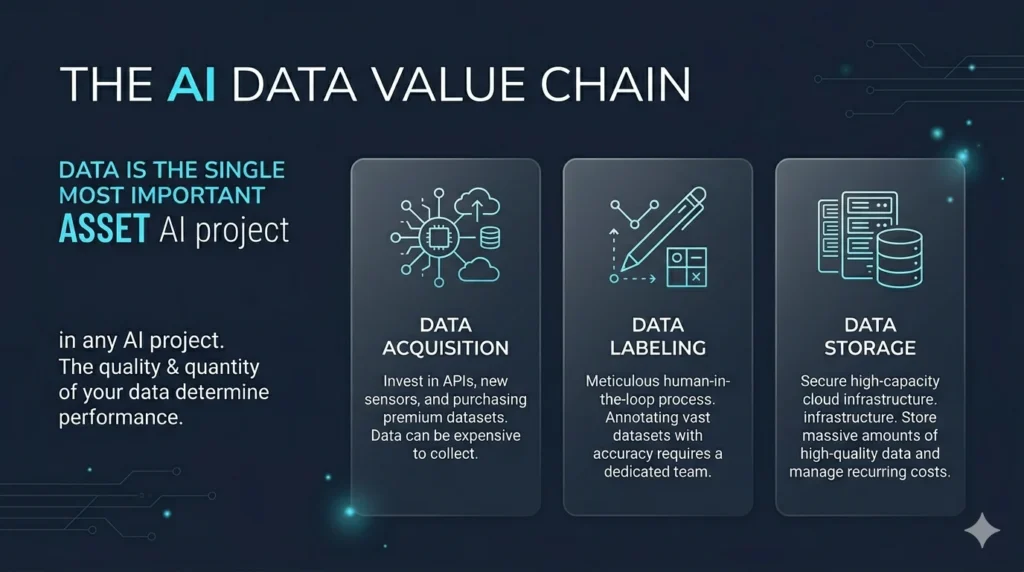
Your data is the single most important asset in any AI project. The quality and quantity of your data will determine the performance of your model. The associated costs can include:
- Data acquisition: You might need to purchase datasets, pay for access to APIs, or invest in new sensors to collect the information you need.
- Data labeling: Many AI models require manually labeled data, which can be a time-consuming and expensive process, often requiring a team of annotators to meticulously classify images or text.
- Data storage: High-quality data, especially images or video, requires significant storage space, which translates into recurring cloud storage fees.
Once you have the data, you need the horsepower to process it. Training a modern AI model can take days or even weeks of continuous computation on specialized hardware.
The cost of AI development is therefore heavily influenced by your choice of infrastructure, which typically involves renting powerful GPU-enabled servers from cloud providers like AWS, Google Cloud, or Azure.
These costs are not a one-time expense, as you will need ongoing computing power to retrain and run your model in production.
The final equation
Ultimately, the price of an AI project is a reflection of its complexity and scope. A simple chatbot built on an existing platform will cost a fraction of a custom computer vision system designed to detect manufacturing defects in real time.
For businesses looking to navigate this complex landscape, partnering with a firm that provides expert AI development services can offer clarity and a predictable path forward.
By understanding that the final cost is a blend of talent, data, and tools, you can approach your AI initiative not as a mysterious expense, but as a strategic investment with a clear and well-defined budget.