
Do rich snippets help SEO?
The short answer is yes, but indirectly. Rich snippets are not a confirmed ranking factor, yet they can increase click-through rate (CTR), improve search visibility, build trust, and drive more organic traffic. These improvements can positively influence overall SEO performance over time.
This topic has become more important because modern search results are no longer just a list of blue links. Today’s SERPs include AI Overviews, featured snippets, People Also Ask boxes, videos, product cards, and other enhanced search features. As a result, websites must compete not only for rankings but also for attention and clicks.
Rich snippets help pages stand out by adding extra information such as ratings, FAQs, prices, breadcrumbs, and images. This additional context can make users more confident about clicking a result, even if it is not in the first position.
At the same time, the rise of zero-click searches means many users get answers directly on the search page without visiting a website. In this environment, improving SERP visibility and user engagement signals has become just as important as traditional ranking improvements.
That is why understanding how rich snippets work, and how they can support your broader SEO strategy, is essential for anyone looking to increase organic traffic in today’s competitive search landscape.
What Are Rich Snippets?
Rich Snippets Definition
Rich snippets are enhanced search results that display additional information beyond the standard title, URL, and meta description. This extra information helps users understand what a page is about before they click on it.
These enhancements are created using structured data (schema markup) that helps search engines better interpret the content on a webpage. When implemented correctly, Google may show this additional information directly in the search results.
Common elements that can appear in rich snippets include:
- ⭐ Ratings and reviews – Star ratings and review counts for products, services, or courses
- ❓ FAQs – Expandable question-answer sections shown under the search result
- 💰 Price information – Product pricing, availability, and offers
- 🖼️ Images or thumbnails – Visual previews, often used for recipes, videos, or products
- 🧭 Breadcrumbs – Structured navigation paths showing page hierarchy
By providing this extra context, rich snippets make search results more informative, visually appealing, and trustworthy, which can influence user behaviour and improve the likelihood of clicks.
Rich Snippets vs Rich Results vs Featured Snippets
These three SERP features are often confused, but they serve different purposes in SEO and search visibility.
| Feature | Rich Snippets | Rich Results | Featured Snippet |
|---|---|---|---|
| Uses Schema Markup | Yes | Yes | No |
| Position in SERP | Within normal organic results | Within normal organic results (enhanced format) | Appears at Position 0 (above organic results) |
| Main Purpose | Add extra details to an existing result | Show visually enhanced search features | Provide a direct answer to a query |
| Example | ⭐ Star ratings under a blog or product page | 🍲 Recipe card with image, cooking time, calories | 📄 Paragraph answer box explaining a topic |
- Rich snippets are the simplest enhancement, they add elements like ratings, breadcrumbs, or FAQ dropdowns to standard listings.
- Rich results are a broader category that includes more visually rich formats such as recipes, products, events, and videos. All rich snippets are rich results, but not all rich results are simple snippets.
- Featured snippets, on the other hand, are completely different. They are selected by Google to give a quick, direct answer to a search query and usually appear at the very top of the results page, often called Position 0.
Understanding this difference is important because each feature requires a different optimization strategy and content structure to capture maximum SERP visibility.
How Rich Snippets Improve SEO Performance
Rich snippets may not directly boost rankings, but they can significantly improve overall SEO performance by influencing how users interact with search results and how search engines interpret content.
1. Higher Click-Through Rate (CTR)
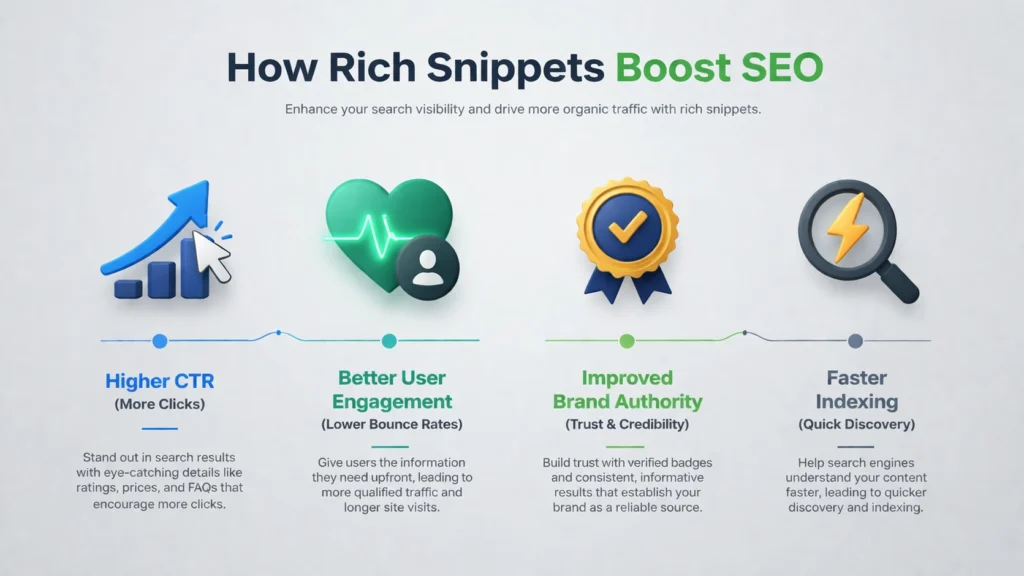
One of the biggest SEO benefits of rich snippets is an increase in click-through rate.
When a search result includes visual enhancements like star ratings, FAQs, pricing details, or images, it naturally draws more attention compared to plain blue links. These elements make the result more informative and appealing, encouraging users to click.
Key reasons why CTR improves:
- Visual elements make listings stand out in crowded SERPs
- Extra information reduces user uncertainty
- Rich snippets take up more SERP space, increasing visibility
- Users can quickly identify the most relevant result
Stat Insight:
Several industry studies suggest that pages using structured data can experience 20–30% higher CTR, depending on query intent, competition, and snippet type.
2. Better User Engagement Signals
Rich snippets help attract more qualified clicks, meaning users who click are more likely to find what they are looking for.
This can lead to improved engagement signals such as:
- Lower bounce rates
- Longer dwell time
- More page interactions
- Increased session duration
When users see FAQs, ratings, or product details in advance, they already have clearer expectations, which improves satisfaction after landing on the page.
3. Improved Brand Authority
Rich snippets that display reviews, ratings, or structured information can strengthen trust even before a user visits the website.
Benefits include:
- Builds credibility and social proof
- Positions the brand as reliable and informative
- Helps smaller websites compete with larger domains
- Encourages repeat clicks from returning users
Over time, consistent visibility with rich snippets can contribute to stronger brand recognition in search results.
4. Faster Content Understanding by Search Engines
Structured data used to generate rich snippets helps search engines better understand the meaning and context of your content.
This improves:
- Content categorization
- Relevance matching for search queries
- Eligibility for enhanced SERP features
- Appearance in voice search and semantic search results
By clearly communicating what a page contains, whether it is a product, article, FAQ, or tutorial, schema markup helps search engines process information more efficiently, which supports long-term SEO performance.
Types of Rich Snippets That Help SEO the Most
Not all rich snippets deliver the same SEO value. Some types are especially powerful because they increase visibility, improve CTR, and help capture additional SERP features. Choosing the right snippet type depends on your content format and search intent.
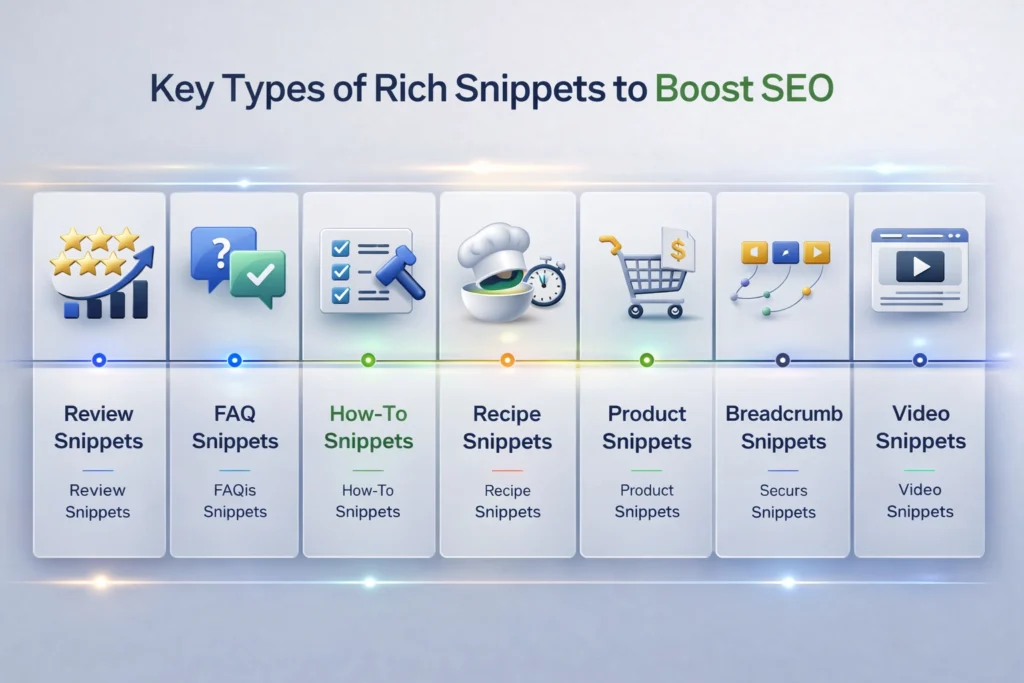
Review Snippets
Review snippets display star ratings, review counts, and sometimes reviewer information directly in search results. These are commonly used for products, courses, tools, services, and local businesses.
SEO benefits of review snippets:
- ⭐ Star ratings instantly attract user attention
- Provide social proof and trust signals
- Improve CTR, especially for commercial and comparison queries
- Help users quickly evaluate quality before clicking
They are particularly effective on product pages, SaaS landing pages, and service listings.
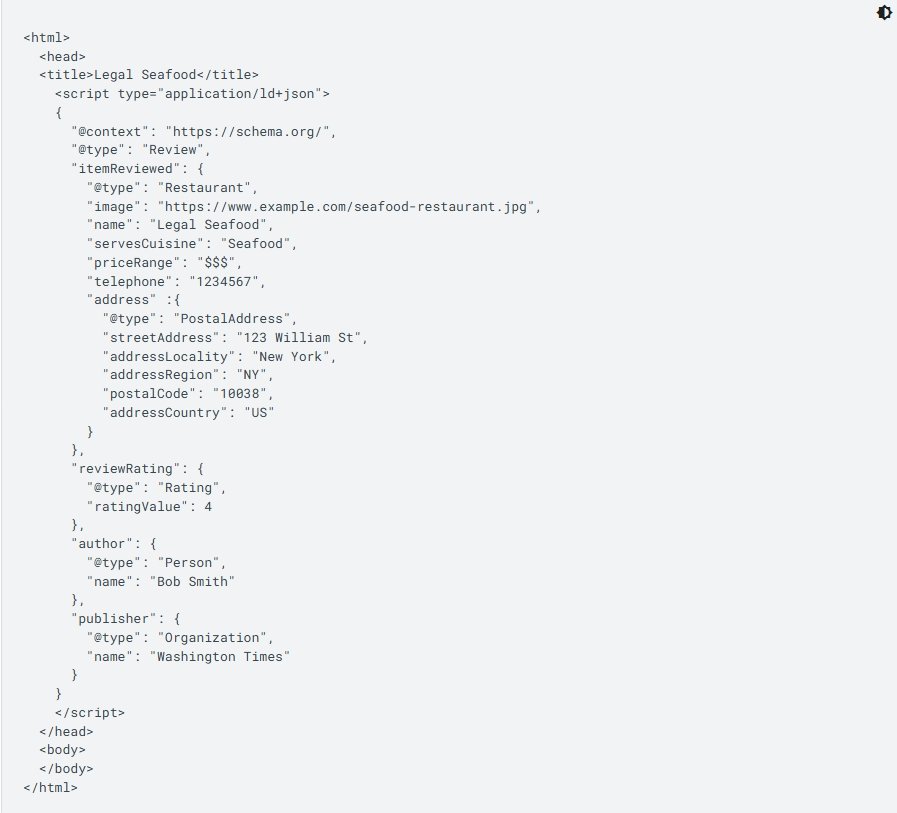
Example:
Copy Code & Try it out in Rich Results Test
FAQ Snippets
FAQ snippets show expandable question-and-answer sections below a search result. These help websites capture more SERP space and address multiple user queries at once.
Why FAQ snippets help SEO:
- Increase search result visibility
- Help target long-tail and conversational keywords
- Can capture traffic from “People Also Ask”-type queries
- Improve click relevance by answering common doubts in advance
They work best for informational blog posts, guides, and service pages.
How-To Snippets
How-to rich snippets highlight step-by-step instructions in search results. They are ideal for tutorial-based content where users want a clear process.
SEO advantages include:
- Showcase structured steps directly in SERPs
- Improve relevance for task-based search intent
- Increase engagement from users looking for practical solutions
- Can enhance visibility on both mobile and voice search
These snippets are useful for DIY guides, technical tutorials, and educational content.
Recipe Snippets
Recipe rich snippets are among the most visually enhanced search features. They can display images, cooking time, ratings, calories, and ingredient details.
SEO impact of recipe snippets:
- Strong visual appeal increases CTR
- Helps dominate SERP space for food-related queries
- Improves chances of appearing in image and voice search results
- Encourages highly targeted traffic
Product Snippets
Product snippets show key commercial details such as price, availability, reviews, and product specifications.
SEO benefits include:
- Helps users compare options quickly
- Drives high-intent traffic for purchase queries
- Increases trust and reduces friction before clicking
- Supports visibility in shopping-related search features
These snippets are critical for eCommerce websites and SaaS pricing pages.
Breadcrumb Snippets
Breadcrumb snippets replace the full URL with a structured navigation path, showing users where the page sits within the website hierarchy.
Why they matter for SEO:
- Improve result readability
- Help users understand site structure and context
- Enhance internal linking signals
- Support better crawling and indexing
They are useful across large blogs, marketplaces, and enterprise websites.
Video Snippets
Video rich snippets display video thumbnails, duration, and sometimes key moments in search results.
SEO advantages:
- Highly engaging visual format increases CTR
- Helps capture video search traffic
- Improves dwell time when users watch embedded content
- Can appear in multiple SERP features including video carousels
These are ideal for tutorial videos, product demos, and educational content.
Rich Snippets vs Traditional SEO, Which Is More Important?
Both traditional SEO and rich snippets optimization play important roles in improving organic performance. However, they serve different purposes. Traditional SEO focuses on helping a page rank higher, while rich snippets focus on helping a page stand out and attract more clicks.
Understanding how they complement each other is essential for building a strong search strategy.
| Factor | Traditional SEO | Rich Snippets |
|---|---|---|
| Ranking Impact | Direct influence through content quality, backlinks, keywords, and technical optimization | Indirect influence by improving CTR, engagement, and search visibility |
| Visibility in SERP | Standard blue link result | Enhanced result with additional information like ratings, FAQs, price, or images |
| Click-Through Rate (CTR) | Usually moderate and depends heavily on position | Often higher due to visual enhancements and extra context |
| Technical Effort | Medium — involves on-page optimization, link building, site speed, UX improvements | Medium to high — requires structured data implementation, testing, and ongoing validation |
Which One Should You Focus On?
The best approach is not choosing one over the other, but combining both.
- Traditional SEO helps you reach the top positions.
- Rich snippets help you maximize clicks and user engagement once you are visible.
A page ranking in position 3 with rich snippets can sometimes receive more traffic than a plain result in position 2, simply because it appears more trustworthy and informative.
In modern SEO, success comes from ranking well and winning attention in the SERP, and rich snippets are a key tool for achieving that balance.
How to Add Rich Snippets (Step-by-Step Guide)
Adding rich snippets to your website involves implementing structured data (schema markup) so that search engines can understand your content better and make your pages eligible for enhanced search results.
Follow this practical step-by-step process to implement rich snippets correctly.
Step 1: Identify Suitable Schema Type
The first step is to determine which type of structured data matches your content and search intent. Using the wrong schema type can prevent rich snippets from appearing.
Common schema types include:
- Product Schema – Best for eCommerce pages showing price, availability, and reviews
- Article Schema – Suitable for blog posts, news articles, and guides
- FAQ Schema – Ideal for pages that answer common user questions
- Local Business Schema – Useful for businesses targeting local search visibility
Before implementation, analyze the SERP for your target keyword and see which rich results competitors are getting.
Step 2: Generate Schema Markup
Once you select the schema type, the next step is to create structured data code.
The most recommended format is JSON-LD, because:
- It is easy to implement and maintain
- Supported directly by search engines
- Does not interfere with visible page content
- Reduces chances of markup errors
You can generate schema using online generators, SEO plugins, or manually write the JSON-LD code based on schema documentation.
Step 3: Add Schema to Your Website
After generating the markup, you need to place it correctly on your webpage.
Common implementation methods:
- Manual implementation – Add JSON-LD code inside the
<head>section or via CMS custom code areas - SEO plugins – Tools like WordPress schema plugins simplify the process
- Tag Manager – Add structured data using tag management systems without editing site code
Ensure the structured data matches the visible content on the page, otherwise Google may ignore it.
Step 4: Test Using Google Rich Results Test
Before publishing or after adding markup, always validate your structured data.
Use testing tools to:
- Detect missing required fields
- Identify syntax errors
- Confirm eligibility for rich results
- Preview how enhanced results may appear
Fix all warnings and errors to increase the chances of rich snippets being shown.
Step 5: Monitor Performance in Search Console
Implementation is not the final step. You must track performance and indexing status.
Monitor:
- Rich result impressions and clicks
- CTR improvements
- Structured data enhancement reports
- Index coverage issues
Over time, refine schema implementation based on performance data and optimize content quality to maximize the SEO benefits of rich snippets.
Common Mistakes That Prevent Rich Snippets From Showing
Even after implementing structured data, rich snippets may not appear in search results. This usually happens due to technical errors, quality issues, or trust signals that search engines evaluate before displaying enhanced results.
Understanding these common mistakes can help you fix problems early and improve your chances of earning rich snippets.
Spammy Structured Data
Using structured data in a manipulative or misleading way is one of the biggest reasons rich snippets fail to appear.
Examples include:
- Adding schema that does not match the actual page content
- Overusing markup on irrelevant pages
- Marking up hidden or non-visible content
- Using structured data purely to gain search visibility
Search engines may ignore or even penalize pages that use spammy markup practices.
Fake Reviews or Ratings
Review snippets are powerful, but they must be authentic and verifiable.
Common issues that prevent review snippets:
- Displaying self-created or misleading ratings
- Showing reviews that are not visible to users
- Marking up reviews for categories that are not eligible
- Using aggregate ratings without real user feedback
Search engines have strict guidelines around review schema, and violating them can result in manual actions or removal of rich results eligibility.
Missing Required Schema Fields
Each schema type has mandatory properties that must be included for eligibility.
For example:
- Product schema may require price, availability, and review data
- FAQ schema requires properly structured question and answer pairs
- Article schema needs headline, author, and publication date
If required fields are missing or incorrectly formatted, search engines may simply ignore the markup.
Thin or Low-Quality Content
Structured data alone cannot compensate for weak content.
Pages with:
- Very little useful information
- Duplicate or copied content
- Poor readability or user experience
- Lack of depth compared to competitors
may not qualify for rich snippets even if schema markup is technically correct. Search engines prioritize content quality and usefulness before awarding enhanced SERP features.
Low Domain Trust or Authority
Search engines are more likely to show rich snippets for websites that demonstrate credibility and consistent quality signals.
Factors that can affect trust include:
- Limited backlinks or brand mentions
- New or rarely updated websites
- Poor technical SEO performance
- History of guideline violations
Building authority through content consistency, user satisfaction, and ethical SEO practices can gradually improve your eligibility for rich snippets.
H2: Why Your Rich Snippets Are Not Appearing Indexing issues Schema errors Low authority site Competitive SERP Google algorithm choice
Why Your Rich Snippets Are Not Appearing
Implementing structured data does not guarantee that rich snippets will be shown in search results. Search engines evaluate multiple technical and quality factors before deciding whether a page is eligible for enhanced display.
Here are the most common reasons why your rich snippets may not be appearing.
Indexing Issues
If a page is not properly indexed, rich snippets cannot appear.
Possible indexing problems include:
- Page blocked by robots.txt or meta noindex tag
- Crawl errors or server response issues
- Recently published content that Google has not processed yet
- Canonical tags pointing to another URL
Always confirm that the page is indexed by checking the URL inspection tool in Search Console.
Schema Errors
Even small markup mistakes can prevent eligibility for rich results.
Common schema issues:
- Missing required properties
- Incorrect JSON-LD formatting
- Using outdated or unsupported schema types
- Structured data not matching visible content
Validation tools can help identify warnings and errors that must be fixed before search engines consider showing rich snippets.
Low Authority Website
Websites with limited trust signals may struggle to get enhanced search features.
Reasons may include:
- Few quality backlinks
- Weak brand recognition
- Limited content depth
- Inconsistent publishing history
Improving overall SEO strength and credibility increases the chances of rich snippets appearing over time.
Highly Competitive SERP
In many industries, several websites implement structured data for the same keyword. Search engines may only show rich snippets for a small number of results to avoid clutter.
This means:
- Even correct schema may not always be displayed
- Stronger competitors may dominate enhanced listings
- Continuous optimization and content improvement are required
Analyzing competitor snippets can help you identify content gaps and opportunities.
Search Engine Algorithm Choice
Ultimately, displaying rich snippets is a search engine decision.
Even when all technical requirements are met, algorithms may choose not to show enhanced results based on factors such as:
- Query intent
- Device type
- User behavior patterns
- Experimentation with SERP layouts
Because of this, rich snippets should be treated as an opportunity rather than a guaranteed outcome. Consistent optimization and high-quality content increase the probability of earning them.
Do Rich Snippets Guarantee Higher Rankings?
Clear answer: No.
Rich snippets do not guarantee higher rankings in search results. They are not considered a direct ranking factor in search engine algorithms.
However, they can still play an important role in improving overall SEO performance by influencing how users interact with your search listings.
Ranking Factors vs Visibility Factors
To understand the real impact of rich snippets, it is important to distinguish between ranking factors and visibility factors.
Ranking factors are elements that directly affect where a page appears in search results. These typically include:
- Content relevance and quality
- Backlinks and domain authority
- Page experience signals such as speed and mobile usability
- Proper keyword targeting and search intent alignment
Improving these factors can help a page move higher in the rankings.
Visibility factors, on the other hand, influence how noticeable and attractive a search result appears once it is already ranking. Rich snippets fall into this category.
They help by:
- Making listings more visually prominent
- Providing additional information like ratings, FAQs, or prices
- Increasing click-through rate and user confidence
- Encouraging more qualified traffic
For example, a page ranking in position 4 with rich snippets may receive more clicks than a plain result in position 2, simply because it looks more trustworthy and informative.
In practical SEO strategy, ranking factors help you reach the top of the SERP, while visibility factors like rich snippets help you win more clicks and engagement after you get there.
Future of Rich Snippets in SEO
Rich snippets are expected to play an even more important role as search continues to evolve. Modern search engines are moving toward understanding meaning, context, and user intent, rather than just matching keywords. In this changing environment, structured data and enhanced search features are becoming key components of long-term SEO strategy.
AI Search Evolution
Search results are rapidly changing with the growth of AI-powered search experiences, generative answers, and conversational queries.
This shift means:
- Users often receive summarized answers directly in search
- Traditional organic listings must compete with AI-generated responses
- Search engines rely more on clearly structured and trusted content sources
Rich snippets can help websites remain visible by making content easier for search engines to interpret and feature in enhanced result formats.
Increasing Importance of Structured Data
Structured data is becoming more critical because it helps search engines understand relationships between different types of information.
As search systems become more advanced, structured data may:
- Improve eligibility for new SERP features
- Support voice search and assistant-based queries
- Help content appear in visual and interactive search formats
- Enable better categorization of pages and entities
Websites that implement structured data early and consistently are likely to have a competitive advantage in future search environments.
Growth of Entity SEO and Semantic Search
Search engines are focusing more on entities (people, brands, products, places, concepts) and how they connect with each other. This approach is known as semantic search.
Rich snippets contribute to this trend by:
- Clarifying what a page is about beyond simple keywords
- Helping search engines build knowledge graphs and contextual understanding
- Supporting topical authority and content clustering strategies
- Improving relevance matching for complex or conversational queries
As entity-based optimization becomes more common, structured data and rich snippets will play a vital role in helping websites gain visibility, credibility, and sustained organic traffic.
Best Practices to Maximize SEO Benefits From Rich Snippets
Rich snippets work best when they are part of a complete SEO strategy. Simply adding structured data is not enough — you also need strong content, good user experience, and authority signals to fully benefit from enhanced search visibility.
Here are the most effective best practices to maximize the SEO impact of rich snippets.
Combine Schema With Strong Content
Structured data should support high-quality, intent-focused content.
To improve results:
- Create detailed and useful pages that fully answer user queries
- Match schema type with the actual content format
- Keep information updated and accurate
- Use clear headings, lists, and step-based explanations
Search engines are more likely to show rich snippets for pages that demonstrate depth, relevance, and usefulness.
Improve Page User Experience (UX)
User experience plays an important role in how visitors interact with your site after clicking a rich result.
Focus on:
- Fast page loading speed
- Mobile-friendly design
- Clean layout and easy navigation
- Readable typography and structured formatting
When users have a positive experience, engagement signals improve, which can support long-term SEO performance.
Optimize Title Tags and Meta Descriptions
Even with rich snippets, the title and meta description remain critical for CTR.
Best practices include:
- Use primary keywords naturally in titles
- Write compelling descriptions that highlight value
- Avoid truncation by maintaining optimal length
- Align messaging with search intent
Well-optimized metadata combined with rich snippets can significantly increase search visibility and clicks.
Build Quality Backlinks
Authority signals still matter. Websites with stronger backlink profiles often have higher chances of earning rich snippets and maintaining visibility.
To improve authority:
- Earn links from relevant and trustworthy websites
- Publish link-worthy resources such as guides, tools, or case studies
- Maintain consistent content publishing
- Strengthen internal linking structures
Backlinks help search engines trust your content, which supports eligibility for enhanced SERP features.
Target Long-Tail and Intent-Based Keywords
Rich snippets perform particularly well for specific, question-based, or action-focused queries.
Effective targeting strategies include:
- Optimizing FAQ sections for conversational searches
- Creating how-to content for process-driven queries
- Targeting niche product or comparison keywords
- Answering multiple related questions within one page
Long-tail keyword optimization increases the chances of triggering FAQ, how-to, and featured-style rich results, helping you capture more organic traffic from diverse search intents.
FAQs (People Also Ask Optimization Section)
1. Do Rich Snippets Increase Traffic?
Yes, rich snippets can increase organic traffic indirectly. They make search results more visible and attractive by showing extra information such as ratings, FAQs, or prices. This often leads to a higher click-through rate (CTR), which can bring more visitors to your website even if your ranking position remains the same.
2. Are Rich Snippets a Ranking Factor?
No, rich snippets are not a direct ranking factor. Search engines have confirmed that structured data itself does not automatically improve rankings. However, rich snippets can improve visibility, user trust, and engagement, which may contribute to better SEO performance over time.
3. How Long Does It Take for Rich Snippets to Appear?
There is no fixed timeline. Rich snippets may appear within a few days or take several weeks depending on factors such as:
- Crawl and indexing frequency
- Website authority
- Correct schema implementation
- Competition for the target keyword
Even after proper implementation, search engines decide when and whether to display enhanced results.
4. Can All Websites Get Rich Snippets?
In theory, any website can become eligible for rich snippets by implementing structured data correctly. However, actual display depends on:
- Content quality and relevance
- Trust signals and backlinks
- Technical SEO health
- Search engine guidelines
Websites with stronger authority and well-structured content generally have higher chances of earning rich snippets.
5. What Is Structured Data in SEO?
Structured data is a standardized format used to describe webpage content so search engines can understand it more clearly. It is usually added in formats like JSON-LD and can define elements such as products, articles, reviews, FAQs, events, or local businesses. Proper structured data helps pages become eligible for enhanced search features like rich snippets.
6. Do FAQ Snippets Still Work?
Yes, FAQ snippets still work, but their visibility has become more selective. Search engines now show FAQ rich results only when they add clear value to users.
To improve chances of getting FAQ snippets:
- Provide concise and relevant answers
- Avoid excessive or repetitive questions
- Ensure FAQ content matches user intent
- Maintain high overall content quality
When implemented strategically, FAQ schema can still help increase SERP visibility and capture long-tail search traffic.
Conclusion
Rich snippets should be seen as visibility multipliers rather than direct ranking boosters. They do not automatically push your pages higher in search results, but they can make your listings more noticeable, trustworthy, and informative. This improved visibility often leads to higher click-through rates, better user engagement, and increased organic traffic over time.
To get the best results, rich snippets should be implemented as part of a holistic SEO strategy. This means combining structured data with high-quality content, strong on-page optimization, good user experience, and consistent authority building through backlinks and brand signals.
In competitive search environments where multiple websites are targeting the same keywords, rich snippets can provide a clear competitive advantage. They help your pages stand out, capture more attention, and maximize the value of the rankings you already earn. Over the long term, websites that effectively use structured data alongside traditional SEO practices are better positioned to sustain and grow their organic visibility.