In digital commerce sector, businesses face immense pressure to quickly launch features, personalize experiences, and integrate countless technologies. Adobe Commerce platforms can help in fulfilling those goals by harnessing the power of flexibility and scalability. In the long term, however, this very flexibility can morph into textural debt and slow innovation worldwide.
Working with clients in mid-sized and large retail spaces leveraging Adobe Commerce with high hopes and aspirations, only to be faced with obstacles a few years later from performance bottlenecks, complex integrations, and upgrade headaches…typically not limited by the platform itself but by hasty implementations and less structured governance around Adobe Commerce Development Services.
The paper will elucidate how technical debt accumulates in an Adobe Commerce environment and what businesses operating in Australia should do in turning these notions of technical debt on their head!
What can be termed technical debt in Adobe Commerce?
Technical debt is seen as the cost associated in the long run of going for quick or easy solutions.
In Adobe Commerce, this can mainly be seen as:
- custom code overrides core functionalities
- badly targeted integrations in documentation
- poor use of computer languages with little or no information in extension or some third-party software
- poor or poorly constructed queries in databases
- poor or nonexistent workflows
Though speed may sound sweet in the progress of delivery, the disadvantageous risks are gradually expanding.
Why Adobe Commerce Is Prone to Technical Debt
Adobe Commerce has unlimited customisability. That’s both its strength and its greatest weakness.
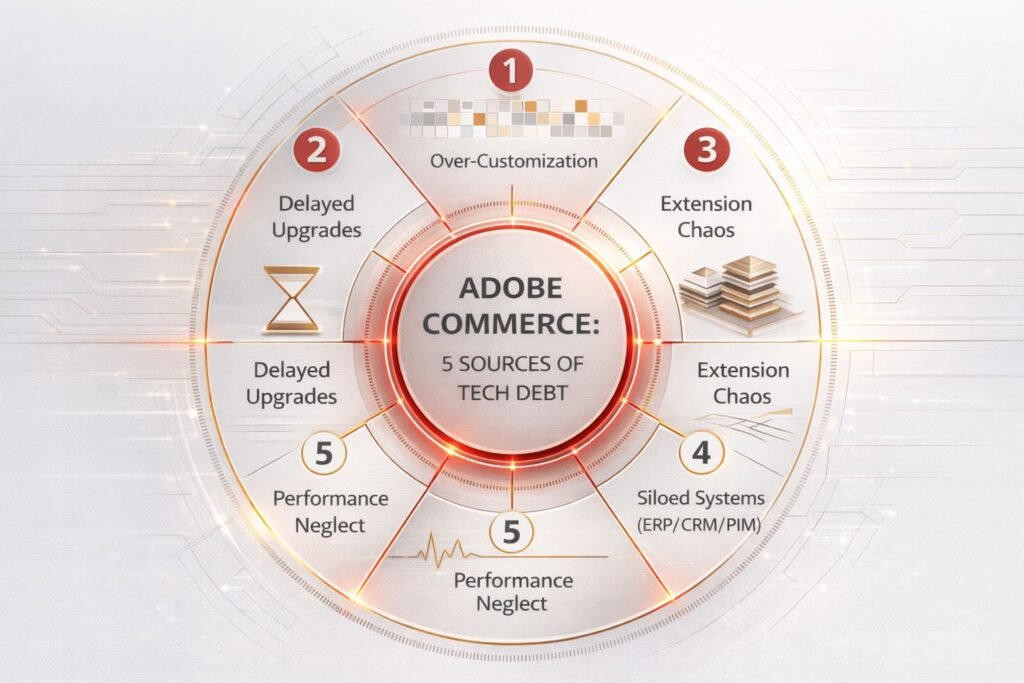
1. Over-Customisation of Core Features
Many businesses would resort to customising core modules instead of working with well-regarded extensions. This can result in various possibilities like:
- Incompatibility with future patches or upgrades
- Increased links to vulnerabilities
- Rising maintenance costs
- Extended deployment cycles
Whenever core files are modified, intending to make future updates get problematic and risky. Each upgrade entails extensive testing, thereby increasing downtimes and costs.
2. Jumble of Third-Party Extensions
The Adobe Commerce ecosystem comes with thousands of extensions, and not all extensions embody the same level of qualified work.
- Common complaints:
- Incompatibility with existing modules
- Extensions support is not sustainable
- Functional overlap
- Performance decreases
Extension sprawl lands up stacking code without getting caught in technical assets unchecked.
3. Road-Mapped Harmony Integrations of ERP, CRM, and PIM Systems
Planning an e-commerce business phase consists of seamless integration amongst these planned systems.
ERP single point, CRM, marketing automation, payment gateways—all touching each other.
Yet, quick integrations that:
- Side-step API best practices
- Do not carry error-handling logic
- Leave behind data inconsistencies
- Load up the system
Yet, beyond the stated points, failure will eventually lead to manual bending back and coordination interface.
4. Ignoring Performance Optimisation
It has been powered up by Adobe commerce but the amount of valuable configuration and hosting architecture means a lot to that performance.
Without optimization,
- Page load times will suffer
- Checkout friction will increase
- Conversion rates will go down
- SEO will defeat
Most companies wait until the problem is visible to start performance tuning. By this time, significant technical debt has been created in the system.
5. Delayed Platform Upgrades
Adobe Commerce platform upgrades being late cause increased:
- risks for security
- exposure to legal lawsuits
- technical compatibility issues
- higher infrastructure costs
This upgrade avoidance may be one of the most costly ways of incurring technical debt. Yet the maintenance gets more difficult with each version left untouched.
Business Impacts of Technical Debt
Technical debt is not just a developer problem; it is a strategic risk.
The costs on the business side of it include:
- Fewer streets for the go-to market with new campaigns
- Higher development budgets
- There has been a substantially reduced possibility of stability during peak sales seasons.
- Trimmed profits from Web investments
Shrinking capability of deploying AI – Driven digital commerce solutions
With the evolution and alterations, these never-ending customer expectations and fast trends are a gone-for-good scenario. Technical inefficiencies are directly proportionate to capital loss.
The Pros of Getting in Front of Technical Debt
It is not a straightforward operation of mending soiled code but, instead, is the real challenge to unshackle growth.
Here-in-below are Points businesses actually realize from stiff-repair.
1. Better Performance and Conversion Rates
Optimising code and infrastructure can significantly reduce load times. Faster sites lead to:
- Better customer satisfaction
- Improved SEO visibility
- Higher checkout completion
2. Easier Adoption of AI-Based Digital Commerce
AI-based digital commerce is the backbone of modern retail, mainly for:
- Personalized product recommendations
- Predictive inventory management
- Intelligent search
- Automated merchandising
Well-structured and stable integrations are essential for AI tools to function, as much as the very fundamental data structures are.
AI implementation will work smoothly with basic technical debt reduction and be more economically viable.
3. Lower Long-Term Development Costs
When systems are modular, well-documented, and scalable:
- Quick and pain-free implementation of new features
- Reduced testing cycles to commence testing very quickly after deployment of new features
- Ensuring fewer production-side issues
- Enhanced productivity of the team
This will enable an organization to grow in a sustainable manner rather than having to be reactive to problems.
What Should the Decision-Makers Do?
Technical debt must be considered a governance issue rather than a technical one, and all leaders, including the technology executives, must make a unanimous effort to solve it.
Here is the recommended-textbook-stage approach:
1. Instruct a Comprehensive Technical Audit
Order an audit that reviews the following:
- Code quality
- Usage of extensions
- Status of the database
- State of infrastructure installation
- Security compliance
- Integration patterns
It is much more feasible for an experienced commerce development Magento agency to incorporate Adobe Commerce Development Services. They should be there to give feedback in an objective and un-biased manner, while prioritizing concerns.
2. Develop Standards of Development
- Create clear guidelines for:
- Module development
- Code documentation
- Version control
- Deployment workflows
- Testing protocols
Standardization prevents inconsistent development practices across teams.
3. Embrace a Composable and Modular Architecture
This is now mostly the ethos in modern digital commerce–Composable architecture.
This means:
- Effective use of APIs
- Decoupling front-end from back-end systems
- Using microservices
- Lesser needs for core overrides
Composable strategies reduce long-term rigidness and support AI-driven digital commerce capabilities.
4. Regular Refactoring Cycles Planned
Refactoring should be part of quarterly or bi-annual roadmaps.
Instead of waiting for breakdowns:
- Clean redundant code
- Remove unused extensions
- Optimize queries
- Improve caching strategies
Proactive maintenance prevents exponential growth of technical debt.
5. Align Business and Technology Strategy
Technical decisions should align with business goals such as:
- Expansion into new markets
- Promotion of omnichannel commerce platform
- Omnichannel Integration
- Headless Commerce Adoption
- Advanced Analytics and AI
The understanding of senior management about the long-term costs involved in taking shortcuts goes a long way into making investment decisions more strategic.
Role of Hosting and Infrastructure
When host sites crack under heavy burdens, or are used under peak sale periods such as EOFY and Black Friday, swift infrastructure experiences become crucial to Australians.
Cloud-native architecture, sturdy CDN setups, elastic architecture, and proper capacity planning minimize operational risks.
For infrastructure providers or environments under-provisioned or under-configured, scenarios amplify technical debt, particularly in cases of traffic surges.
A well-designed hosting strategy complements clean code practices.
Governance and Ongoing Monitoring
Techniques to reduce debt can never be used once but must progress continuously.
Deploy:
- Performance monitoring tools
- Security scanning
- Automated testing
- CI/CD pipelines
- Regular stakeholder reviews.
Transparent reporting allows higher management to carry out a perception of technical risk in business terms.
Creation of a Future-Ready Adobe Commerce Ecosystem
Adobe Commerce has become one of the most powerful platforms for enterprise eCommerce. It may look either as a global or as an elegant scalability for a complex product catalogue. Today, Adobe Commerce has served the market with significant Business-to-Business functionality, while it also provides advanced personalisation.
However, continued success comes from:
- Strategic development advancement
- Continuous investment
- Simultaneous consummate stage design by crews of developers
- Meticulous compliance to architectural practices
The elephant in the room sits quietly, and all seems well until technical debt comes back at its most inconvenient moment.
Forward-thinking organisations are looking at their digital commerce infrastructure as an investment asset-from a long-term perspective, rather than an IT project for this fiscal year for the closure curtain.
Conclusion
Technical debt on an Adobe Commerce system is not something that happens overnight. It progresses slowly.
It calls attention to short-term band-aids like quick customisations, unmanaged extensions, postponed upgrades, and schizoid integrations on Adobe Commerce.
There are many decision-makers in Australia who are not asking whether technical debt exists but how well managed it should be.
By investing in structured reviews, new architecture, and disciplined Adobe Commerce Development Services, businesses can work to minimize latent risks and impractical scaling and prepare themselves to be a platform for AI-driven digital commerce transformation tomorrow.
Sustainable growth in a digitally competitive economy is more than just the next new features; this growth involves creating a platform for innovation whereby there never arises any obstructive factor.
So, address the technical debt today to create an e-commerce system that performs reliably, now for the next future.