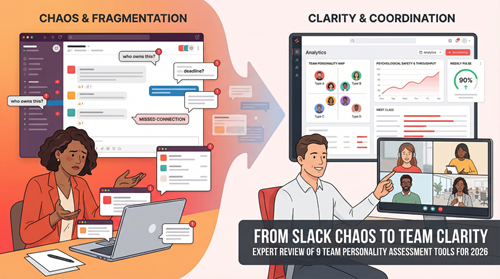
Slack pings pile up, three threads debate one decision, and projects stall. In 2025, leaders estimated that poor coordination cost each employee 7.4 work hours a week, about $5,200 a year, according to Market.biz communication statistics.
In 2026, top teams won’t work longer; they’ll spot friction fast and fix it. This guide shows you how: we vetted nine research-backed personality and pulse platforms that turn collaboration drag into momentum.
Why team personality assessments matter in 2026
When Google analyzed 180 of its own teams, those scoring high on psychological safety beat revenue goals by an average of 17 percent, according to a Google Re:Work study. Trust, in other words, fuels cash flow.
Yet many organizations still improvise. Only 46 percent of U.S. employees know what’s expected of them at work, according to Gallup’s 2025 engagement pulse. That ambiguity is costly: Gallup estimates that lost productivity drains about $2 trillion from the U.S. economy each year.
The upside is equally clear. A 2024 Forrester Total Economic Impact study found that companies using Culture Amp’s people-analytics platform achieved a 311 percent three-year ROI and $2.3 million in net present value.
Hybrid work raises the stakes. With half the team in chat and half in a conference room, misreads multiply. Modern personality assessment platforms surface hidden patterns, flag when decisions bottleneck around one style or when response times slump after lunch, and help leaders refine workflows just as they tweak sales funnels.
Put simply, personality assessments in 2026 are operational dashboards, not soft-skill electives. Use them and you convert friction into throughput. Ignore them and you risk missed deadlines, churn, and a culture stuck in guesswork.
Key trends shaping team assessments in 2026
The team-survey PDF is obsolete. Four forces now shape how you capture and correct collaboration data:
- Real-time AI coaching becomes mainstream. Sixty-one percent of executives say their companies already use generative AI, and 52 percent have deployed AI agents or chatbots inside Slack or Teams, with another 38 percent rolling them out this year, according to a Slack AI adoption survey. These bots watch conversation patterns and nudge the group before friction hardens, turning feedback from a post-mortem into play-by-play guidance.
- Pulse cadence shifts from quarterly to continuous. Gallup reports that managers who hold meaningful weekly check-ins see up to 18 percent higher engagement and 28 percent lower turnover compared with peers who wait longer. Modern pulse tools mirror that rhythm: three taps on a phone Monday morning, practical insight by lunch.
- Suites replace scattered point solutions. In 2025, 15Five folded its standalone Engage portal into the core product, giving users one dashboard for performance, engagement, and lifecycle feedback. Fewer sign-ins mean richer correlations. For example, you can connect low psychological safety to slow code reviews without exporting a CSV.
- Privacy and bias scrutiny grows. Research cited by Deloitte shows only 30 percent of employees are comfortable with employers scanning email, while clear communication about data use doubles acceptance to just over 50 percent. Buyers now expect GDPR-grade safeguards, anonymized analytics, and built-in bias audits.
Taken together, these trends set a clear brief for 2026: choose tools that coach in the moment, check team health often, integrate with your existing stack, and treat ethics as non-negotiable. Anything less feels dated the moment you sign the contract.
How we scored every platform
A clear, consistent method keeps the rankings honest. Before we opened a single demo, we built a 100-point rubric around four questions every 2026 team cares about: Is it scientific? Is it actionable? Is it fast? Does it fit our stack?
- Scientific validity (25 points). Tools grounded in peer-reviewed research or large data sets earn top marks because advice is only as strong as its evidence.
- Insights and actionability (20 points). Dashboards score only if a manager can skim one page and change a meeting this week.
- Ease of use (20 points). Surveys must finish in 30 minutes or less, deploy without consultants, and surface plain-language results; slower tools become shelfware.
- Integration and workflow fit (15 points). Slack, Teams, Jira, or your HRIS should welcome the data with zero extra logins.
- Pricing transparency (10 points). Public prices, free trials, and no “contact sales” walls score highest.
- Support and community (10 points). Active forums and responsive success teams help new habits stick.
Any vendor scoring 80 or more made the list. The result is a ranking you can trust, grounded in evidence rather than sponsorship.
1. TeamDynamics
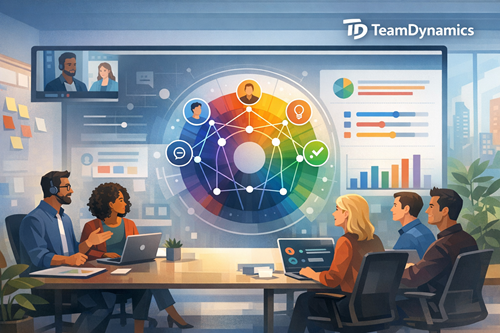
TeamDynamics is designed for teams that need fast, practical insight rather than static reports. A 15-minute survey maps the entire squad to one of 16 TeamDynamics Types and immediately delivers micro-coaching inside Slack or Microsoft Teams.
Instead of a PDF that gets forgotten, teams receive a live team profile showing collective preferences around communication, decision speed, and execution style. Each individual also gets CoDynamics cards that explain where their personal style supports or disrupts the team’s rhythm.
Action nudges update in real time, for example, limiting ideation time for highly decisive teams or rotating facilitators when one voice consistently dominates discussions. The Pro plan is priced as a one-time $39 per person with ongoing access, plus a free trial for piloting.
TeamDynamics is ideal for hybrid or agile teams iterating weekly who want to remove friction between sprints. It is not a clinical psychometric and will not identify dark-side derailers, so teams needing deeper sentiment tracking should pair it with a weekly pulse survey.
2. CliftonStrengths

CliftonStrengths (formerly StrengthsFinder) is built on the principle that people perform best when they consistently apply their natural talents.
A 30-minute online assessment ranks participants across 34 talent themes and provides either a Top 5 report or a full profile. When teams map these results together, role clarity improves quickly: Activators initiate work, Analytical thinkers test assumptions, and Relators stabilize morale under pressure.
Gallup’s large-scale research backs the impact, showing teams that use strengths daily achieve higher productivity and profitability than peers. The shared vocabulary simplifies feedback and hand-offs, while the one-time pricing keeps costs low.
CliftonStrengths works best for boosting morale after reorganizations or clarifying fuzzy roles, but because it focuses on talent rather than workflow, it pairs well with team-level diagnostics or pulse surveys.
3. Myers-Briggs Type Indicator
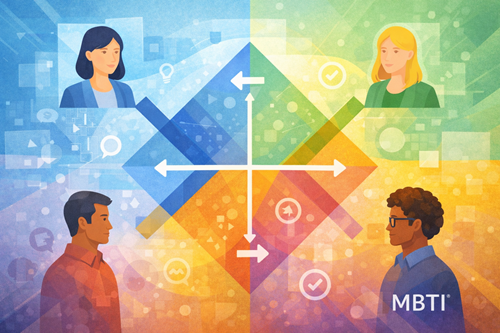
The Myers-Briggs Type Indicator (MBTI) categorizes individuals into 16 four-letter types based on how they process information and make decisions.
In team settings, these labels often spark quick moments of recognition and empathy, helping members understand why colleagues communicate or reflect differently.
This makes MBTI a popular icebreaker for new or fast-growing teams. However, psychologists consistently point out its limitations, including binary trait framing, inconsistent test–retest reliability, and weak links to job performance.
The official assessment takes about 20 minutes and costs $59.95 per person, with discounts for teams. MBTI is most effective when trust is low and the goal is dialogue rather than analytics. It opens conversations but should be followed by more rigorous tools if teams need to improve workflows or performance.
4. EverythingDiSC
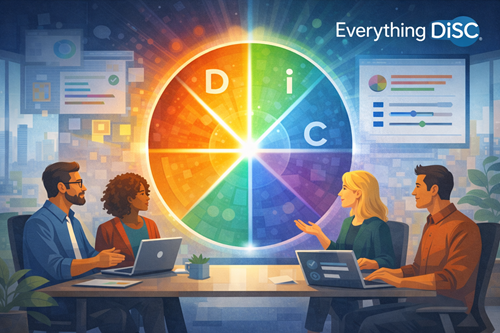
EverythingDiSC translates personality theory into four practical styles, Dominance, Influence, Steadiness, and Conscientiousness—and places every team member on a shared visual map. This common language helps teams navigate everyday interactions, especially in meetings or written communication.
For example, a team can intentionally pause to hear quieter Steadiness voices before making decisions dominated by high-Dominance styles. The framework’s longevity comes from its simplicity and scale, with millions of participants across thousands of organizations.
The assessment takes about 20 minutes and typically costs $75–$90 per person, with optional workshops to reinforce learning. EverythingDiSC excels in sales, marketing, and cross-functional teams where tone and pacing matter.
Without reinforcement, however, the shorthand can fade, and it does not address engagement trends or project-phase energy.
5. Enneagram
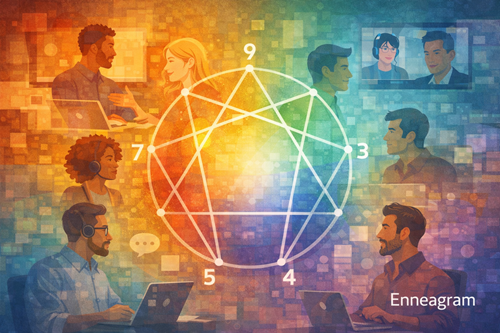
The Enneagram focuses on underlying motivations rather than observable behavior, grouping personalities into nine core types shaped by distinct emotional drivers. In established teams, Enneagram sessions often surface hidden tensions in a psychologically safe way, helping members understand stress reactions and communication patterns.
Teams frequently report faster conflict resolution once motivations are named and normalized. The RHETI assessment takes about 40 minutes and costs around $20 per person, with discounts for larger groups. Because insights can feel personal, facilitated debriefs should be optional and handled carefully.
Research on reliability and validity is mixed, so the Enneagram should be used as an empathy-building tool rather than a basis for hiring or performance decisions. It works best when challenges are emotional or relational rather than procedural.
6. CultureAmp
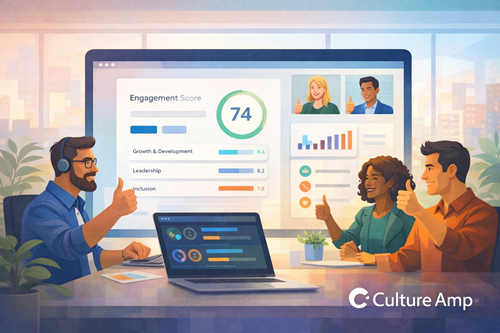
CultureAmp is an employee-experience platform rather than a personality assessment, designed to measure engagement, inclusion, and leadership effectiveness at scale. Using benchmarks from thousands of organizations, it helps leaders understand how culture connects to outcomes.
Its value lies not just in dashboards but in action, managers receive tailored prompts and learning resources shortly after survey results surface.
Independent economic analysis shows strong returns on investment through higher engagement and reduced attrition. Pricing scales with headcount and includes enterprise-grade security and compliance features. Culture Amp is best suited for mid-to-large organizations with the capacity to act on continuous feedback. Smaller teams may find it more robust than necessary.
7. Officevibe
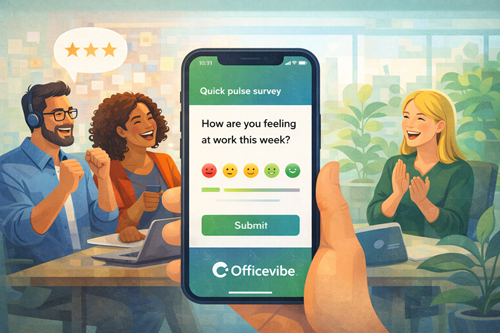
Officevibe delivers quick, anonymous pulse surveys directly through Slack, Teams, or email, typically one question per week. This low-effort format keeps participation high while allowing managers to track trends across key engagement drivers.
Live dashboards and anonymous comments help leaders address issues before they escalate, such as workload imbalance or lack of recognition. The platform is affordably priced at around $5 per user per month after a free trial and is easy to set up.
Officevibe does not analyze personality or workflow dynamics, but it works well alongside tools like TeamDynamics or DiSC by showing where sentiment is shifting and signaling when intervention is needed.
8. Working Genius
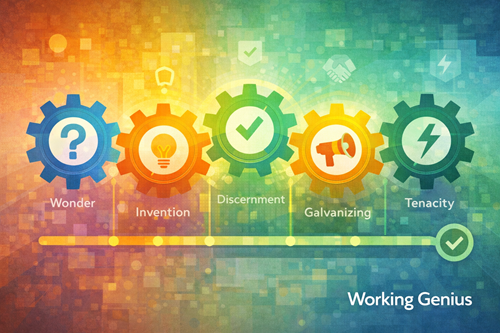
Working Genius focuses on how people experience energy across six stages of work: Wonder, Invention, Discernment, Galvanizing, Enablement, and Tenacity. A short assessment identifies each person’s strengths, competencies, and frustrations, allowing teams to see where energy gaps might stall projects.
Teams often discover that no one naturally owns certain phases, prompting role rotation or support strategies. The assessment is quick, affordable, and supported by a facilitator guide for team discussions.
While research is still emerging, Working Genius is particularly useful for teams that consistently stall at the same project phase. It complements communication tools but does not address relationships or culture on its own.
9. Predictive Index
The Predictive Index (PI) Behavioral Assessment is a fast, data-driven tool that measures four core drives and aggregates results into team-level insights.
Its Team Discovery tools help leaders see whether a team’s collective style aligns with the demands of the work, revealing gaps that can be addressed through coaching or hiring. PI is widely adopted and backed by customer outcome studies showing improvements in performance and retention when talent aligns with strategy.
Access is typically through an annual license, with optional training for internal practitioners. Predictive Index is best suited for growing organizations that want a single system to support hiring, development, and team design.
For simpler communication challenges, lighter tools may be faster and more cost-effective.
How to choose the right tool: five decisive steps
Buying a team-assessment platform without a plan is like buying software you never open. Follow these five steps and the best fit will surface quickly.
- Pinpoint the pain. Write one line that names the problem: “Decisions stall because no one owns them,” or “Morale dropped after the merger.” Workflow friction? Look at TeamDynamics or DiSC. Disengagement? Pulse tools such as Culture Amp or Officevibe win.
- Pick team focus or individual focus. Need a collective snapshot (TeamDynamics, Culture Amp) or individual insight that rolls up (CliftonStrengths, MBTI)? Decide before demo day.
- Match depth to capacity. A 10-minute Working Genius fits a lunch break. Predictive Index pays off only if you can certify a PI Practitioner and weave data into hiring. Choose what you will actually use.
- Confirm integration and privacy. Check Slack, Teams, or HRIS hooks, and request the data-processing agreement up front. Hybrid teams live in chat apps; if feedback lands in a separate portal, usage drops.
- Plan the follow-through. Book a debrief within seven days of results, then schedule a 30-day pulse. Gallup research shows teams that discuss findings within a month improve roughly two times faster on engagement metrics. No follow-through, no ROI.
Use these steps to narrow nine contenders to one or two in an afternoon, freeing your energy for action instead of endless slide-deck debates.
Conclusion
Dashboards matter only when you change a behavior the same week you see the data. Pick one platform, surface the pattern, and run a micro-experiment: tighten a decision rule, rotate a meeting role, or send the thank-you your pulse survey highlighted as missing.
Measure again. Did psychological safety rise? Did sprint lead time fall? Gallup research shows teams that revisit survey results within 30 days improve twice as quickly on engagement metrics. Keep the assess-act-reassess loop spinning and collaboration shifts from black box to competitive edge.
The nine tools above cover every budget, from a $5 pulse check to enterprise analytics. Choose one, start small, and turn insights into momentum. The next move is yours.
Frequently Asked Questions
1. Are these assessments valid for global teams?
Generally, yes—if you use localized versions and discuss cultural nuance. Tools built on broad trait models, such as the Big Five or PI’s four-factor framework, provide country-specific norms. Run a brief calibration session so teams can compare how the same score appears in different cultures.
2. How do I win over skeptics who think personality tests are fluff?
Lead with business data. Gallup’s 2022 meta-analysis links strengths-based development to 12 percent higher productivity and 8.9 percent higher profitability. Share quick wins—like a five percent drop in voluntary turnover after weekly pulse surveys—and focus the debrief on workflow tweaks, not armchair psychology.
3. Could using a test backfire legally or ethically?
For development, risk stays low when participation is voluntary and results remain confidential. For hiring, use assessments validated for selection, follow EEOC guidelines, and comply with GDPR and CCPA. Never base promotions solely on a four-letter type.
4. How often should we reassess?
Run a full strengths or personality assessment annually or after major team changes. Keep a weekly or bi-weekly pulse running to track sentiment in real time.
5. Can one tool do it all?
Not yet. High-performing teams layer approaches: a one-time team-type diagnostic for shared language, lightweight pulses for morale, and project-phase energy mapping when execution lags. Think of it as a toolbox, not a silver bullet.