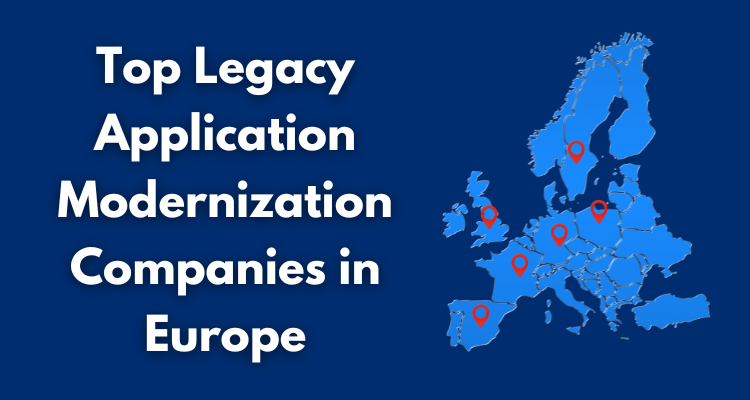
The legacy application modernization market in Europe is experiencing remarkable growth, expanding from USD 8.1 billion in 2022 to a projected USD 19 billion by 2026. This surge is driven by regulatory compliance requirements, cybersecurity concerns, and the pressing need to reduce operational costs.
The leading legacy application modernization companies in Europe to watch in 2026 include:
- Accenture
- Deloitte
- Intellias
- CHI Software
- N-iX
- Andersen
These companies stand out for their ability to combine strategy, engineering, cloud-native architecture, AI integration, and regulatory compliance expertise, making them trusted partners for large-scale modernization initiatives across Europe.
Organizations across the continent are prioritizing modernization to leverage cloud computing, artificial intelligence, and automation while maintaining business continuity.
Global Leaders with European Expertise
1. Accenture
Accenture stands at the forefront of legacy modernization, employing advanced automation, data-driven insights, and cloud-native frameworks to accelerate digital transformation cycles while minimizing business disruption.
Their comprehensive approach spans legacy system modernization, cloud enablement across AWS, Azure, and Google Cloud, application re-engineering, microservices development, DevOps automation, mainframe and ERP modernization, and AI integration.
With deep expertise across banking, healthcare, retail, manufacturing, energy, public sector, telecommunications, and consumer goods, Accenture combines end-to-end capabilities with strong ecosystem partnerships to ensure organizations remain competitive.
2. Deloitte
Deloitte differentiates itself through business-driven systems integration that aligns technology implementations with strategic organizational goals rather than pursuing purely technical solutions.
Their cloud-first approach leveraging AWS, Azure, and Google Cloud, combined with advanced analytics and AI-powered integration platforms, makes them particularly valuable for large-scale digital transformations, ERP implementations, and customer experience platform integrations.
Deloitte emphasizes the integration of AI and analytics into modernization strategies, helping organizations rethink processes, reengineer digital cores, and reimagine business capabilities, moving beyond incremental approaches to comprehensive transformation.
3. Intellias
Intellias focuses on modernizing applications and transforming digital products while integrating legacy systems with current technologies.
With expanded presence across Europe, including a strengthened Munich office serving the DACH region, Intellias combines engineering expertise with deep domain knowledge to tackle complex modernization tasks while maintaining operational continuity.
Their services encompass application modernization, software development for web, mobile, and enterprise platforms, AI and data solutions, cloud development, consulting, staff augmentation, QA, UI/UX design, and DevOps services.
4. CHI Software
CHI Software, headquartered in Limassol, Cyprus, has become a recognized European leader in legacy application modernization, combining strategic consultation with comprehensive technical delivery. The company’s approach emphasizes step-by-step modernization that balances organizational needs with technological innovation.
CHI Software’s legacy modernization services focus on multiple critical dimensions. The company guides organizations through upgrading outdated systems to modern tech stacks while introducing microservices architecture, containerization using Docker and Kubernetes, and infrastructure-as-code practices that improve scalability and maintainability.
Their automation and DevOps practices accelerate software delivery through CI/CD pipelines using Jenkins, GitLab CI, and Terraform, enabling faster rollbacks and enhanced team efficiency.
CHI Software’s case studies demonstrate concrete results across complex modernization scenarios. In the DSD Software Modernization project, the company transformed a legacy logistics platform into a scalable, efficient tool, achieving 97% retention and faster, smoother operations through step-by-step modernization.
They delivers production-ready modernization across healthcare, fintech, education, and enterprise software. Client testimonials highlight their transformative impact, with partners crediting CHI Software’s role in bringing flexibility, scalability, and technical expertise to achieve scalable, future-proof systems.
5. N-iX
N-iX takes a structured, process-driven approach to modernization with teams operating across the UK and Europe. Their expertise spans cloud, AI, IoT, and cybersecurity integration, making them particularly valuable for finance, retail, manufacturing, logistics, and agriculture sectors seeking large-scale digital transformation.
N-iX combines application modernization, cloud solutions, infrastructure support, AI consulting, data analytics, embedded systems development, and cybersecurity services.
6. Andersen
With offices in London, Munich, Krakow, and Warsaw, Andersen combines deep technical expertise with practical project management, understanding clients’ systems before carefully integrating new technologies.
Their work spans finance, healthcare, and logistics, offering comprehensive services from front-end and back-end development to AI and data solutions while maintaining realistic expectations about organizational readiness.
Market Trends Shaping 2026
AI-Powered Modernization
AI is becoming increasingly central to legacy transformation strategies. Organizations employ AI-powered analysis to accelerate modernization processes and reduce technical debt risks. Real-time streaming for observability allows teams to detect issues instantly and understand system behavior at scale.
Predictive analytics drive performance and resource management, while AI and machine learning automatically identify anomalous patterns, failures, and security threats.
Cloud-Native Architectures
Cloud-native architectures and microservices remain foundational to modernization approaches. Organizations adopt DevOps, CI/CD automation, platform engineering, and feature flags alongside blue-green and canary deployments.
SRE practices including SLOs and observability maintain performance and operational efficiency during transformation.
Regulatory Compliance and Security
Regulatory compliance and security continue driving modernization urgency, particularly in energy, telecom, and financial services. Germany’s Digitisation of the Energy Transition Law, the EU AI Act, and international compliance standards mandate modern infrastructure capabilities.
Cybersecurity concerns, heightened by increased attacks on antiquated infrastructure, make security-first modernization principles essential.
Cost Optimization
Cost optimization and operational efficiency remain primary drivers, with modernization increasing operational efficiency by 25% and lowering IT expenses by up to 30% in many cases. Infrastructure cost reduction of 20-30% is achievable through cloud optimization and resource consolidation.
Conclusion
Organizations should prioritize modernization partners with demonstrated expertise in their specific industries, proven deployment track records, combined strategy and implementation capabilities, and strong foundations in data pipelines, system architecture, and cloud integration.
The convergence of AI capabilities, regulatory compliance requirements, and movement toward specialized applications makes 2026 a pivotal year for organizations to partner with experienced vendors capable of navigating both innovation acceleration and governance demands.