The era of “spray and pray” marketing is over. If your strategy in 2026 still relies on blasting generic emails to a cold database, this approach drains your budget and actively erodes your hard-earned brand reputation.
For years, a Marketing CRM (or MAP – Marketing Automation Platform) was simply a glorified spreadsheet that could send newsletters. Today, it must be a Revenue Operating System. The defining challenge for business owners in 2026is “Channel Fatigue.” Open rates for emails are stabilizing, but “Attention Rates” are plummeting. Your customers might ignore their inbox, but they never ignore their WhatsApp or Instagram Direct Messages.
The best CRM for 2026 isn’t the one with the most complex, spaghetti-like workflows. It is the one that minimizes the friction between a “Lead” and a “Conversation.” It creates a direct line to revenue.
The “Silent Leak” in Your Funnel: Why Traditional MAPs Are Failing
There is a massive disconnect between legacy Marketing Automation Platforms and actual customer behavior.
Traditional tools, think of the old-school Salesforce setups or early 2010s email giants, treat customers as rows of data. They track “opens” and “clicks.” But in 2026, tracking pixels are blocked by browsers, and cookies are dead. This is the new reality of Zero-Party Data.
You can no longer spy on your customers to guess what they want. You need to ask them. This shift has given rise to “Conversational CRMs.” These platforms actively transform every outbound message into an invitation for dialogue. They turn a static marketing funnel into a dynamic two-way dialogue.
If your current tool doesn’t allow a lead to reply “I’m interested” and immediately trigger a sales sequence, you have a leak in your funnel.
Ranking Criteria: What Actually Matters in 2026?
We ignored the vanity metrics. We ranked these 10 tools based on three factors that directly impact your bottom line:
- Messaging Capability: Does it have native WhatsApp/Instagram integration? (Non-negotiable in 2026).
- Ease of Adoption: If it takes 6 months and a certified consultant to implement, it fails. Speed is currency.
- Revenue Attribution: Can I clearly see if this specific chat or email led to a dollar in the bank?
Here are the top marketing platforms that survived the cut.
1. Kommo
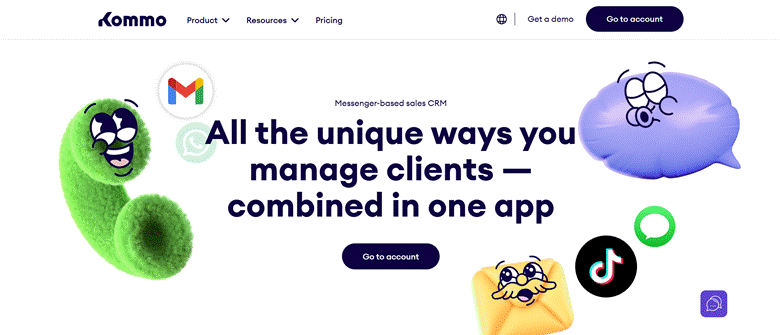
Kommo is one of the leaders of the “New Wave” of Marketing CRMs. While competitors scramble to add chat features as an afterthought, Kommo was built from the ground up as a Conversational CRM.
This distinction is crucial. Most tools treat a WhatsApp message as a “support ticket.” Kommo treats it as a “Lead.” It captures inquiries from Instagram, Facebook, and WhatsApp and drops them directly into a visual sales pipeline. It automates the dialogue, ensuring no lead is left “on read.” For entrepreneurs who realize that chatting is the new selling, this is the gold standard.
Why it wins for modern marketing:
- Visual Automation: You can build “Salesbot” workflows visually. If a customer clicks an Instagram ad, the bot qualifies them, tags them, and alerts a human only when they are ready to buy.
- WhatsApp Native: It offers one of the most robust official WhatsApp Business API integrations. You can send broadcast campaigns that actually land in the user’s pocket, not their spam folder.
- Retargeting Sync: It synchronizes your CRM segments with Facebook/Instagram Advertising audiences automatically.
- Mobile First: The mobile app is fully functional, allowing business owners to run marketing campaigns from their phone.
2. HubSpot Marketing Hub
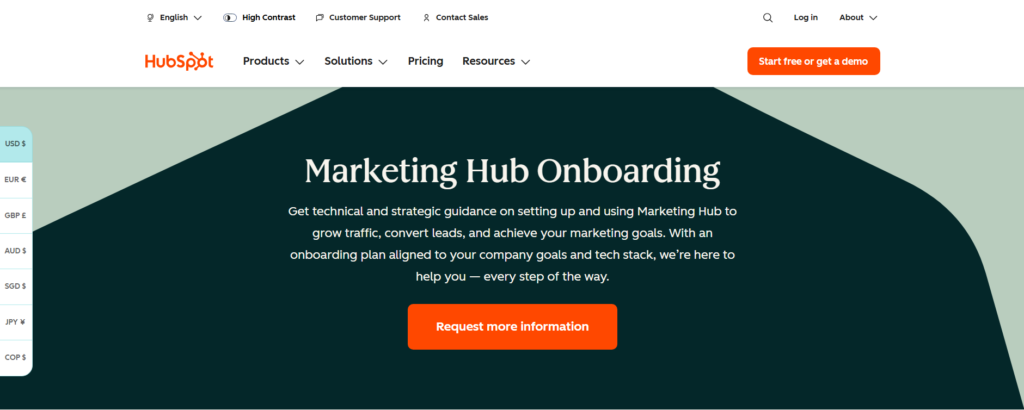
HubSpot is the ecosystem giant. It effectively coined the term “Inbound Marketing,” and its platform reflects that heritage.
It is the “safe bet” for scaling companies. If you have a dedicated marketing team that produces blogs, whitepapers, and social content, HubSpot connects it all. It tracks a user from their first Google search all the way to the signed contract. It is powerful, polished, and undeniably expensive.
Why it wins for scale:
- Content Management: It hosts your blog and landing pages, providing SEO recommendations while you type.
- Unified Data: Because it shares a database with HubSpot Sales, marketing knows exactly when a lead turns into a deal.
- Social Media: You can schedule posts for LinkedIn, Instagram, and X (Twitter) directly from the platform.
3. ActiveCampaign
ActiveCampaign is the “Automation Architect.” If your marketing strategy relies on complex logic—”If they click link A, wait 2 hours, then send SMS B”, this is your tool.
It is widely considered to have the best email deliverability and the most flexible automation builder in the market. It doesn’t try to be a CMS or a Helpdesk; it focuses purely on sending the right message at the exact right millisecond.
Why it wins for logic:
- Site Tracking: It can trigger emails based on specific pages a lead visits on your website.
- Predictive Sending: Uses AI to send emails at the specific time each user is most likely to open them.
- Split Testing: You can A/B test entire automation paths, not just email subject lines.
4. Salesforce Marketing Cloud
Salesforce Marketing Cloud is the enterprise beast. It is capable of almost anything, provided you have a team of developers to run it.
This is not for small businesses. It is for Fortune 500 retailers who need to send 10 million personalized emails in an hour while syncing with offline point-of-sale data. It handles massive complexity and data volume that would crash smaller tools.
Why it wins for enterprise:
- Journey Builder: A sophisticated tool for mapping out multi-channel customer lifecycles across email, mobile, and ads.
- Data Studio: Allows for secure data sharing and second-party data enrichment.
- Einstein AI: Predictive analytics that score engagement likelihood with high accuracy.
5. Klaviyo
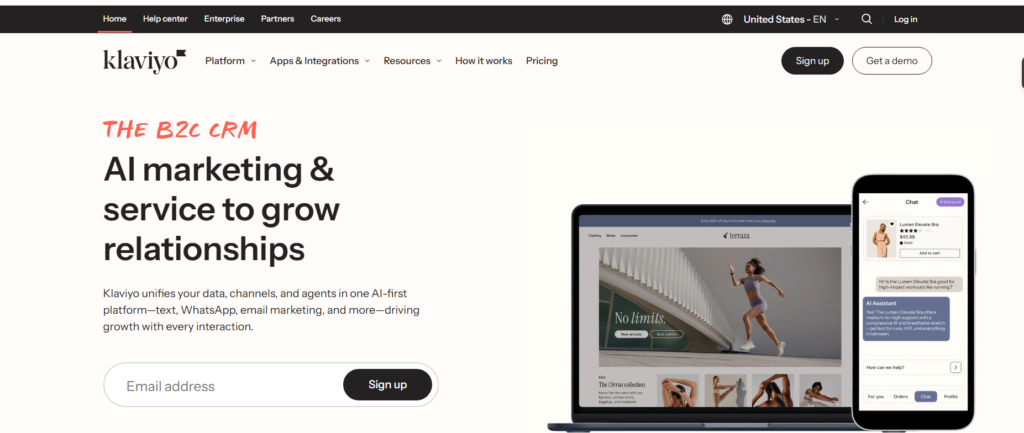
Klaviyo is the undisputed king of E-commerce marketing. If you use Shopify, this is likely the default choice.
Klaviyo understands purchase data better than anyone. It doesn’t just know “John opened an email.” It knows “John bought Red Sneakers size 10, so he needs a cross-sell email for Red Laces in 30 days.” It turns transaction history into immediate revenue.
Why it wins for E-commerce:
- Predictive Analytics: It calculates the expected date of the next order and the Lifetime Value of each customer.
- Pre-built Flows: Comes with “Abandoned Cart” and “Browse Abandonment” automations ready to go.
- Benchmarks: Compares your open rates and revenue per recipient against peers in your specific industry.
6. Brevo
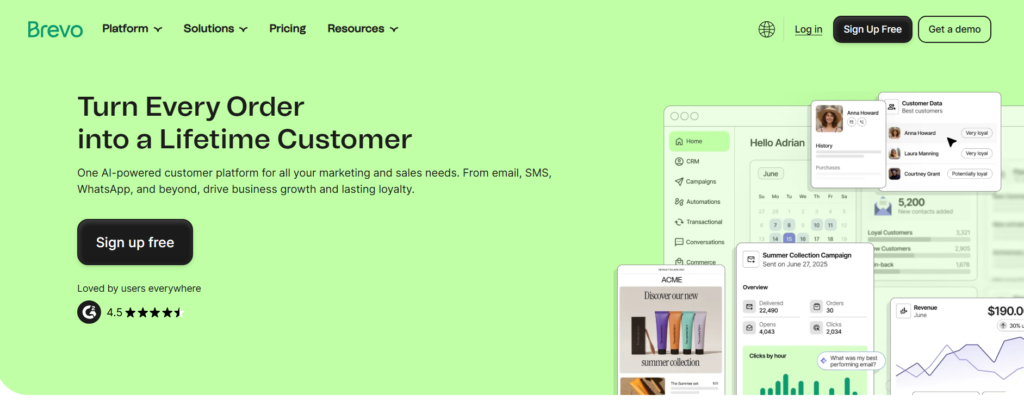
Brevo (formerly Sendinblue) is the budget-friendly all-rounder. It realized that small businesses need “good enough” features across the board without bankruptcy-inducing prices.
It offers email marketing, SMS, WhatsApp campaigns, and a basic CRM in one dashboard. While it lacks the depth of HubSpot or the chat power of Kommo, it is an incredible value proposition for startups.
Why it wins for budget:
- Transactional Email: One of the best engines for sending receipts and password resets reliably.
- Pay As You Go: Unlike others, Brevo often charges based on email volume, not the number of contacts stored. This is huge for businesses with large, low-engagement lists.
- SMS Marketing: Built-in directly, no third-party integration needed.
7. Pipedrive
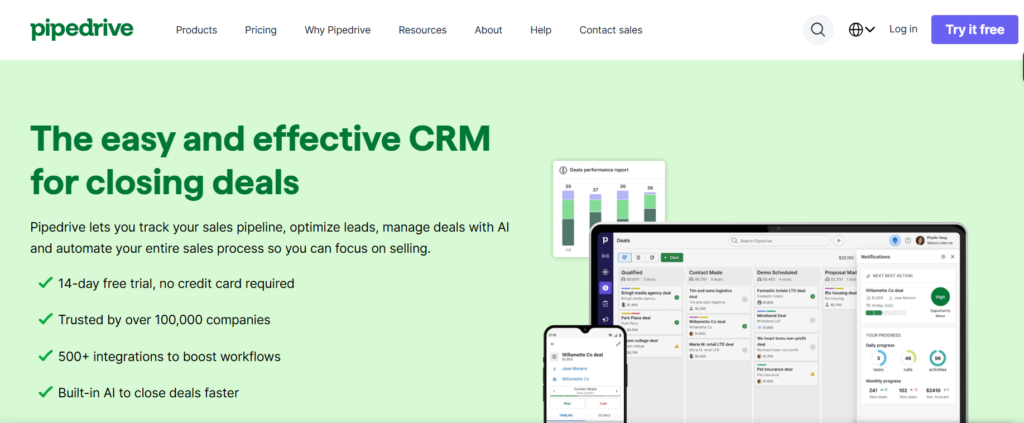
Pipedrive is a “Sales-First” CRM, but it makes this list for a specific reason: Marketing Alignment.
Many marketing teams generate leads that disappear into a black hole because the sales CRM is too complex. Pipedrive solves this. It is visually addictive. While it requires the “Campaigns” add-on to function as a MAP, it ensures that marketing leads are actually worked by sales.
Why it wins for alignment:
- Activity Focus: It forces the team to focus on actions (calls, emails) rather than just data entry.
- Email Sync: Automatically tracks email opens and clicks inside the deal card.
- Visual Pipeline: Marketers can see exactly which campaigns are generating “Won” deals, not just clicks.
8. Zoho CRM Plus
Zoho CRM Plus is the “Swiss Army Knife” of the industry. It is a suite of over 10 different apps bundled together.
For tech-savvy entrepreneurs who want to DIY their stack, Zoho offers incredible power per dollar. You get social media management, email marketing, helpdesk, and CRM all in one login. It can be clunky and the UI isn’t the prettiest, but the functionality is undeniable.
Why it wins for value:
- Zoho Social: A powerful social media scheduling tool included in the price.
- Canvas: A design studio that lets you completely redesign the look of your CRM without coding.
- Zia AI: An AI assistant that suggests the best time to contact a lead.
9. Keap
Keap (formerly Infusionsoft) is designed specifically for service-based small businesses. Think coaches, consultants, and home service providers.
It combines CRM, Marketing Automation, and Invoicing. If you need a tool that can send a marketing email, let the client book an appointment, and then automatically charge their credit card, Keap is the specialist.
Why it wins for services:
- Lifecycle Marketing: Built around the concept of “Collect, Convert, Close.”
- Appointments: Native booking tool that rivals Calendly.
- Invoicing: You can trigger automation when an invoice is paid (e.g., send a “Thank You” packet).
10. Monday.com CRM
Monday.com CRM is for the “anti-CRM” crowd. It is essentially a colorful, highly flexible project management tool adapted for sales and marketing.
If your marketing team thinks in terms of “Projects” and “Tasks” rather than “Leads” and “Opportunities,” this interface will feel natural. It is incredibly customizable, you can build any workflow you can imagine using their “columns” system.
Why it wins for flexibility:
- No Code: You can build marketing dashboards and content calendars without a single line of code.
- Collaboration: It feels like a social network; tagging team members and updating statuses is fun.
- Visuals: Color-coded status bars give an instant overview of campaign health.
Conclusion: Stop Buying “Shelfware”
The most expensive software in the world is the one your team doesn’t use. We call this “Shelfware”, tools that sit on a digital shelf, collecting dust while you pay the monthly invoice.
In 2026, don’t chase the tool with the most features. Chase the tool that reduces the distance between you and your customer. If your customers are on WhatsApp, buying an email-only platform is a strategic failure. If your team hates data entry, buying a complex enterprise tool is a waste of cash.
Audit your current “Conversation Gap.” How hard is it for a lead to talk to you? Choose the tool that bridges that gap the fastest.