Service brands sell outcomes that are difficult to see or verify before purchase. There is no product to touch, no demo that fully captures the experience, and no instant guarantee of results.
Because of this uncertainty, trust often becomes the deciding factor. Buyers move forward not when they are persuaded harder, but when they feel confident that the risk is understood and manageable. The fastest way to build that confidence is through clear, credible proof that people like them have already succeeded.
Effective proof does more than signal popularity. It reduces perceived risk by answering quiet questions buyers may not voice out loud: Will this work for someone in my role? Will it fit my situation? How long will results actually take? When testimonials, case studies, and reviews address these questions directly, they create reassurance without pressure.
Teams that treat proof as a performance asset, rather than a vanity metric, use it intentionally across the funnel. Instead of chasing volume or star ratings alone, they focus on relevance, timing, and specificity. The result is not just higher conversion rates, but stronger pipeline quality and shorter payback time.
Deals close with fewer objections, expectations are set more accurately, and customers arrive already aligned with what success looks like. Over time, this creates a healthier growth loop built on trust that compounds instead of eroding.
Why Proof Beats Persuasion
Prospects carry risk on their shoulders. They ask if your service will work for a company of their size, in their industry, with their constraints. Persuasion tries to answer with promises. Proof answers with evidence. Adopting structured social proof strategies turns customer voice into decision fuel that reduces friction and shortens the path to yes.
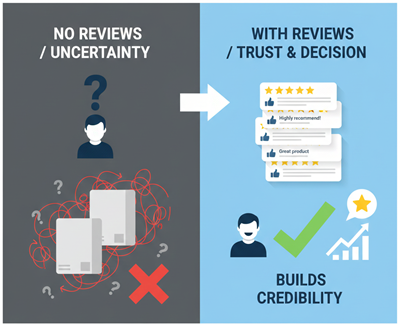
Proof works because it compresses uncertainty. A facilities manager trusts a facilities manager, a founder trusts a founder. Matched stories, clear numbers, and realistic time frames show buyers what success looks like without asking them to imagine it.
- Buyers feel the risk, not the seller: Prospects carry the weight of risk when making a decision. They worry about whether a service will work for a company like theirs, within their budget, team size, industry rules, or internal constraints. This risk makes them cautious and slows down decisions.
- Persuasion relies on promises: Traditional persuasion focuses on claims, features, and confident language. While it may sound compelling, promises require the buyer to believe without evidence, which increases doubt rather than removing it.
- Proof replaces claims with evidence: Proof answers buyer questions using real outcomes from real customers. Instead of saying “this works,” it shows how it worked, for whom, and under what conditions.
- Customer voice is more trusted than brand voice: Buyers trust people like themselves more than marketing messages. A facilities manager believes another facilities manager. A founder listens to another founder. Role-matched proof feels credible and relatable.
- Proof reduces uncertainty faster: Structured proof compresses uncertainty by showing what success actually looks like. Clear numbers, timelines, and realistic outcomes reduce the need for guesswork.
- Buyers don’t want to imagine outcomes: Proof removes the mental effort of imagining results. When prospects see matched stories with real data and timeframes, the path forward becomes clearer.
Structured proof shortens the path to yes
When proof is used intentionally across the journey, it reduces friction, builds confidence, and helps buyers move forward with less hesitation and fewer objections.
A Simple Framework For Service Brands
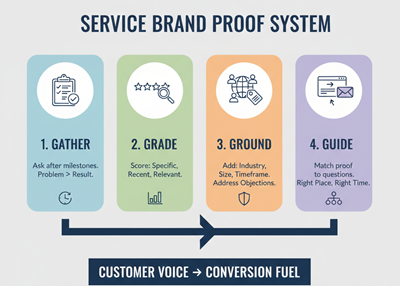
This four-step workflow helps service brands turn raw customer feedback into proof that actually improves conversion. Instead of collecting testimonials at random, it creates a repeatable system that makes proof more useful, relevant, and believable.
1. Gather
Capture proof at moments when customers have clearly experienced value. These moments make feedback more accurate and detailed because the impact is fresh in their mind.
- Ask right after milestones like a go-live, a first savings report, or a resolved support issue
- Prompt for specifics: what problem existed, what changed, and what result followed
- Avoid vague questions that lead to generic praise
Specific details are far more persuasive than emotional but unclear sentiment.
2. Grade
Not all proof is equal. Grading helps you focus on assets that will actually influence decisions.
- Score each piece on specificity, recency, and relevance
- Short, clear stories often outperform long testimonials
- Look for proof that names the problem, action taken, and outcome achieved
3. Ground
Context makes proof relatable. Without it, buyers struggle to see themselves in the story.
- Add industry, team size, timeframe, and use case
- Include the key objection that nearly stopped the deal
- Keep results measurable and realistic, not exaggerated
4. Guide
Proof works best when it answers a real question at the right moment.
- Map common objections to matching proof assets
- Route stories to the right pages, ads, emails, or sales follow-ups
- Use proof to remove friction, not just decorate content
From Collection To Conversion
From Collection to Conversion is about turning customer proof into something that From Collection to Conversion is about turning customer proof into an active decision-making tool, not something that sits passively on a website or in a folder. Proof only creates impact when it is placed with intention and shown at moments where buyers are naturally looking for reassurance.
Rather than using testimonials everywhere, teams should start with small, high-impact placements and then scale what clearly improves engagement and conversion.
On high-intent landing pages, role-matched testimonials should be positioned above the fold. When visitors instantly see someone with a similar role, company size, or challenge achieving results, it builds relevance and trust before they even begin scrolling. On pricing pages, outcome capsules help buyers connect cost to value. Each plan should be paired with one clear, realistic outcome and a defined timeframe so expectations are grounded and believable.
Near forms, bite-sized proof such as a short customer outcome beside the submit button can reduce last-mile anxiety. This is often the moment where hesitation is highest. For sales teams, building an objection library ensures proof is used consistently. Each common concern should be paired with:
- Two relevant proof assets
- One short bridging sentence reps can paste into follow-ups
Proof should also support the full customer lifecycle. In onboarding emails, showing day-30 outcomes from similar accounts sets confidence early. Before renewal, reinforce trust with a real checkpoint story. Throughout every stage, authenticity matters. Be honest about timelines and trade-offs. Buyers reward accuracy with long-term trust, not just quick conversions.
Metrics That Matter
Treat proof like a campaign with clear targets, not a visual add-on. Each metric below shows how proof reduces risk and improves decision quality at different stages of the journey.
- Landing conversion rate: When proof is added or moved on a page, changes in conversion rate show whether it reduces hesitation at the decision point. If visitors act more quickly after seeing proof, it’s doing its job.
- Qualified lead rate: This metric shows whether proof attracts buyers who are a real fit. Strong proof clarifies who the service is for, filtering out low-intent or mismatched leads rather than simply increasing clicks.
- Sales cycle length and win rate: For segments receiving role- or industry-matched stories, shorter cycles and higher win rate indicate objections are being answered earlier. Proof shifts conversations from “will this work?” to “how do we start?”
- Cost per acquisition (CPA): In paid campaigns, proof can improve relevance and trust, leading to lower CPA. Even small reductions signal that the proof is strengthening first impressions.
- Onboarding velocity: When day-one emails include real customer outcomes and timelines, new customers ramp faster. This metric shows whether proof sets realistic expectations and reduces early confusion.
- Retention and expansion: Case studies used to coach new internal champions help accounts grow. Improved retention and upsell signal that proof continues to deliver value post-sale.
Test changes in weeks, then scale in quarters. Adjust one proof variable at a time, keep samples clean, and draw simple, repeatable conclusions.
Bringing Proof To Life Across Channels
Service brands see the greatest gains when proof is woven consistently through the entire customer journey, rather than treated as a last-minute sales aid. When marketing introduces real outcomes early, it builds relevance and confidence before a prospect ever speaks to sales.
As conversations progress, sales teams can then use targeted stories and examples to address specific objections and remove final barriers to action. After the deal closes, success and support teams play a critical role by capturing feedback and results, creating the next wave of proof that fuels future growth.
To keep this proof flywheel turning, a light but reliable operational rhythm is essential. Start by running a monthly proof harvest with customer success and support teams to collect fresh wins, quotes, and outcomes while they are still timely and specific. Each quarter, prioritise two key customer segments and rewrite their core pages with proof that directly matches their needs, language, and decision drivers.
Train sales reps to tag the objection that a piece of proof resolved, then share the strongest examples during regular standups to reinforce learning. Finally, refresh your top five proof assets every quarter so recency stays high, credibility remains strong, and trust continues to compound across every channel.
When proof is continuous, you build credibility that compounds. Prospects see people like them succeeding, teams stay aligned on what outcomes matter and budgets flow to the channels that demonstrate value fastest.
Strong reviews become more than reputation, they become revenue. Start with one page, one placement and one audience, then expand the winners. With disciplined use of proof, service brands turn what customers say into what the next customer does.