The internet has always had a misinformation problem, but AI changes the physics of it. In the past, bad information had friction. Someone had to write it, format it, post it, and hope it spread. Now, a single prompt can mass-produce polished explanations, confident summaries, and helpful advice at a scale that makes fact-checking feel like drinking from a firehose.
The real danger is not that AI makes things up. The real danger is that it can make them up convincingly. A fluent paragraph triggers a human shortcut: sounds coherent, therefore it’s credible. That shortcut worked well enough in everyday life when language correlated with expertise. Online, that correlation is breaking.
By the second or third paragraph, many readers are already searching for a shortcut to finish a task, answer a question, or reduce stress. That’s where services framed as WritePaper student writing assistance can appear especially attractive: fast, clean, confident output on demand. The problem is that confident output and correct output are not the same thing, and the difference is easy to miss when you’re tired, busy, or under pressure.
The Confidence Trap: Fluency Masquerading as Truth
Humans are pattern detectors. We equate smooth language with competence because, most of the time, it’s a reliable signal. AI exploits that instinct accidentally and continuously. It generates text that reads like an expert, even when it is improvising, guessing, or stitching together half-remembered patterns.
This matters because fluency doesn’t just persuade, it disarms skepticism. Once a reader’s guard drops, the text stops being evaluated and begins to be absorbed. The result is a new kind of misinformation: not sensational, not obviously biased, and not even intentionally deceptive, but quietly wrong in ways that steer decisions, beliefs, and learning.
Scale Beats Scrutiny: Why This Risk Is Different
Traditional misinformation spreads by attention. AI-generated misinformation spreads by convenience. It shows up in emails, customer support, social posts, search results, and even internal company documentation. And it can be tailored to each audience, sounding just right in tone and complexity.
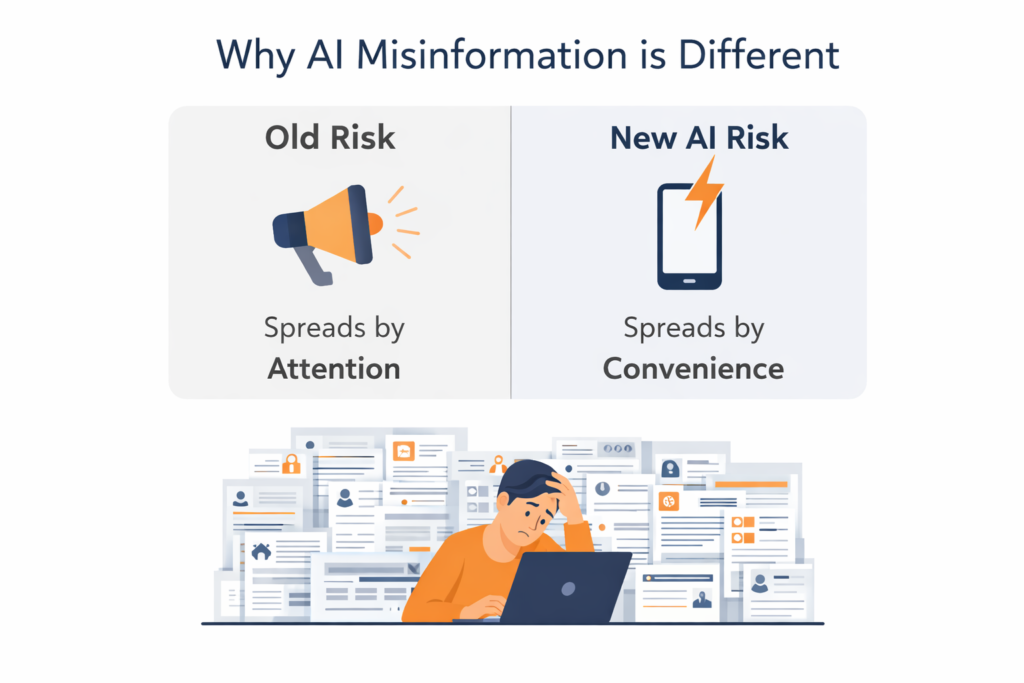
That scale overwhelms the usual defenses. Teachers can’t individually verify every citation. Managers can’t double-check every summarized report. Users can’t validate every claim before making choices about health, money, or politics. When the cost of producing persuasive text collapses, the burden shifts to the consumer, who is the least equipped to carry it.
The Classroom Case Study: Help vs. Harm
Education is one of the earliest places where this risk becomes visible because students have clear incentives: deadlines, grades, and limited time. AI can feel like a lifeline. Sometimes it is helpful, especially for brainstorming, outlining, or clarifying confusing concepts. The boundary gets crossed when AI replaces understanding with output.
That’s when the internet’s biggest risk shows up in miniature: a student turns in something that looks right but is conceptually off. The student receives a decent grade, internalizes the wrong lesson, and carries a weaker foundation forward. Multiply that by thousands of assignments, and you get a generation that has more text and less comprehension.
If you’re using a tool as a homework helper, the safer posture is to treat it like a tutor, not a ghostwriter. Ask for explanations, counterexamples, and step-by-step reasoning. Then verify those steps against your textbook, lecture notes, or reputable sources. The goal is not to finish, but to learn what finishing requires.
Where Hallucinations Hurt Most: High-Stakes Domains
Some errors are harmless. Others are expensive. In high-stakes areas, AI that sounds smart can cause damage long before anyone notices. The most dangerous failures share three traits: they are plausible, specific, and difficult for non-experts to detect.
Common high-impact areas include:
- Medical guidance (misstating dosages, contraindications, or symptoms)
- Legal explanations (confusing jurisdiction, deadlines, or standards)
- Financial advice (incorrect tax rules, risk assumptions, or product details)
- Technical instructions (unsafe configurations, security holes, bad dependencies)
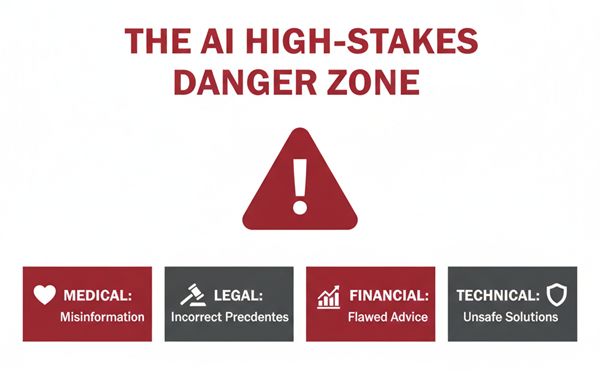
The risk isn’t just that AI might be wrong. It’s that it might be wrong in a way that encourages action. A vague answer prompts caution. A detailed answer prompts confidence, and confidence prompts decisions.
Search Is Changing: The Internet Becomes a Conversation
Search used to return a list of sources. You could compare, skim, and triangulate. Now search increasingly returns a single synthesized response, or users bypass search entirely and ask a chatbot. That shift removes the natural habit of looking at multiple perspectives.
Even when AI provides citations, the citations can be irrelevant, misquoted, or loosely related. People see a link-shaped object and assume credibility. Over time, the web becomes less a library and more a ventriloquist: you hear a voice, not the underlying documents. When that happens, persuasion becomes the default, and verification becomes optional.
For students and researchers, this is especially risky when exploring qualitative research topics, where nuance matters and evidence is often contextual rather than purely numerical. A small misinterpretation of a concept, framework, or methodology can derail an entire argument while still sounding academically polished.
Practical Defenses: How to Stay Smart Around Smart Text
You don’t need to reject AI to protect yourself from it. You need a workflow that assumes the output may be wrong, even when it reads well. Think of AI as a draft generator and hypothesis engine, not a truth machine.
Here are practical habits that work in real life:
- Interrogate the claims. Ask: What would prove this wrong? What assumptions does it rely on?
- Demand structure. Request definitions, steps, and constraints. Vague expert tone hides gaps.
- Verify two key facts. Pick the most important claims and confirm them via reliable sources.
- Watch for invented specifics. Names, dates, studies, and quotes are common failure points.
- Use adversarial prompts. Ask the tool to argue the opposite side or list weaknesses.
These moves create friction, and friction is what the internet is losing. Your goal is to reintroduce it deliberately.
The Deeper Risk: Trust Erosion and Reality Fragmentation
The biggest risk isn’t just misinformation. It’s a trust collapse. When people can’t tell what’s real, they stop believing anything. Or worse, they believe only what matches their preferences. AI that sounds authoritative accelerates both outcomes.
As the web fills with synthetic text, proof becomes easier to fabricate and harder to evaluate. That doesn’t just confuse individuals. It weakens shared reality, the baseline that societies need to debate, vote, collaborate, and solve problems together. Once that baseline erodes, every conversation becomes an argument about what counts as evidence.
The internet’s next era will reward people who can verify, triangulate, and think probabilistically. AI can help, but only if we treat it as a tool that requires supervision, like any powerful machine. The moment we confuse eloquence for accuracy, we outsource our judgment to something that doesn’t understand truth, only patterns. And that is how the internet becomes extremely informative, incredibly productive, and quietly unreliable all at once.