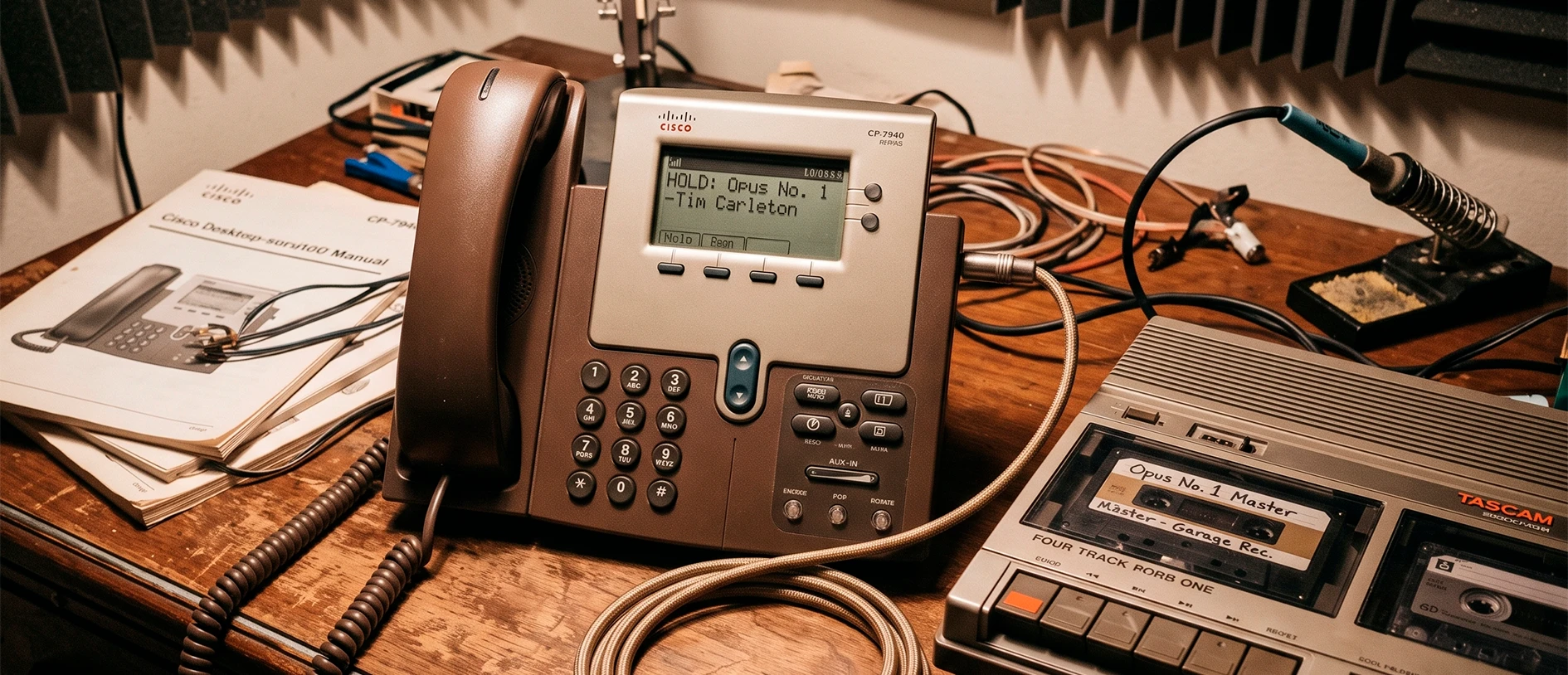
One of the most-heard pieces of music in the world was recorded in a garage. Tim Carleton was 16 in 1989 when he and a friend put Opus No. 1 down on a four-track machine at his parents’ house. It ended up as the default hold music on Cisco’s phone systems, and it has been playing to people on hold ever since. Most of them heard a thin, slightly crunchy version of it, partly down to the phone line itself.
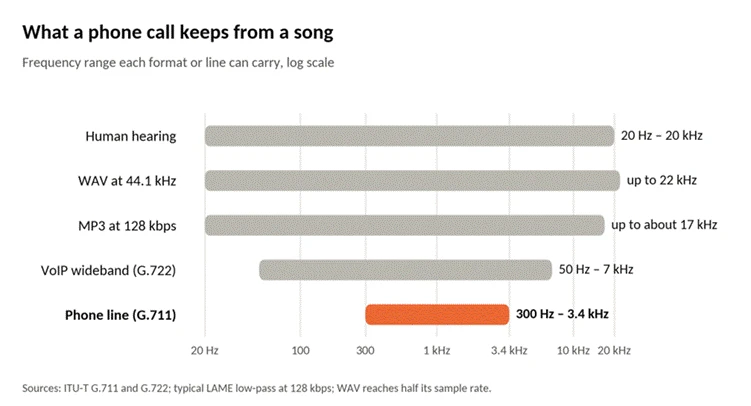
A normal phone call only carries sound between roughly 300 and 3,400 Hz. The bass line and the shimmer of the cymbals simply don’t make it. Small wonder hold music has such a bad name. On top of that, business phone systems are fussy about the file you give them.
Convertio converts mp3 to wav in the browser, and the settings next to the file let you drop it to 8,000 Hz mono before converting.
Contents: What 3CX and Teams ask for · Two flavours of phone audio · The licence part · Quick comparison
What 3CX and Teams ask for
• 3CX only takes hold music as a 16-bit WAV at 8 kHz in mono, and the file can’t be bigger than 10 MB.
• Microsoft Teams is more relaxed and takes an MP3 for auto attendant greetings, as long as the file stays under 5 MB.
3CX can carry HD calls, yet its uploads are still stuck at phone quality. Admins have grumbled about that on the 3CX forum since at least 2017, and it does feel a bit backwards to me. In Teams, 5 MB is about five minutes of an ordinary MP3, which is plenty for a greeting.
Two flavours of phone audio
Phone networks run on G.711, a standard from 1972. It measures the sound 8,000 times a second. It comes in two flavours: µ-law in North America and Japan, A-law almost everywhere else. Convertio’s WAV settings list both of them. If a system asks for G.711, I’d check which of the two it means before converting.
A minute of 8 kHz mono WAV takes about 0.96 MB, the same as a 128 kbps MP3. In µ-law it’s half that.
The licence part
Hold music itself supposedly started with a fault. In 1962 a loose wire at Alfred Levy’s factory touched a metal girder, and callers on hold heard the radio station next door. Levy patented a proper version four years later.
Playing a commercial song to callers usually needs a licence, even when it comes from a radio station that already pays for its own. In the UK that’s TheMusicLicence from PPL PRS. In the US the blanket licences come from groups such as ASCAP and BMI. It’s easy to forget when the music only ever plays down a phone line, and I’d rather pick a royalty-free track than find out later.
For 3CX I’d set Codec to PCM S16LE, then Audio Channels to Mono, then Frequency to 8000 Hz. For Teams I’d leave the MP3 as it is. Either way I’d pick a track with a clear tune in the middle of the range, the lows and highs won’t survive the line anyway.
Quick comparison
| File | One minute | Where it works | My take |
| MP3, 128 kbps | about 0.96 MB | Teams greetings under 5 MB | fine for Teams, rejected by 3CX |
| WAV, 44.1 kHz stereo | about 10.6 MB | editing the track | the master copy, not for uploading |
| WAV, 8 kHz mono, 16-bit | about 0.96 MB | 3CX hold music and prompts | what I’d upload to a phone system |
| WAV, G.711 µ-law | about 0.48 MB | systems that ask for G.711 | only when the manual asks for it |
Frequently Asked Questions
What audio format does 3CX use for hold music?
3CX requires hold music in a 16-bit WAV format, 8 kHz sample rate, and mono channel. The file also needs to stay within the platform’s size limit.
Can I use an MP3 file as hold music in 3CX?
Not directly. For 3CX, an MP3 should first be converted to the required 8 kHz mono WAV format before uploading it to the phone system.
What audio format does Microsoft Teams use for greetings?
Microsoft Teams supports MP3 files for auto attendant greetings, with a file-size limit of 5 MB. This makes MP3 more convenient when you are preparing a short business greeting.
Why does music sound different over a phone call?
Traditional phone calls use a narrow frequency range, generally around 300–3,400 Hz. Frequencies outside that range are removed or heavily reduced, so bass, cymbals, and other high-frequency details may disappear.
What is G.711 in telephone audio?
G.711 is a digital audio codec used in traditional telephone networks and VoIP systems. It samples audio at 8,000 samples per second and is available mainly in µ-law and A-law variants.
What is the difference between A-law and µ-law?
Both are G.711 audio formats, but they are commonly used in different regions. µ-law is widely associated with North America and Japan, while A-law is commonly used in many other countries. The correct format depends on the phone system and network requirements.
How do I convert MP3 to 8 kHz mono WAV?
You can use an online converter such as Convertio, select WAV as the output format, and configure the audio settings to 8,000 Hz and mono before converting the file.
Does hold music need a music licence?
Usually, yes, if you are using commercially released music. The licensing requirements depend on the country, the type of music, and how it is being played. Businesses should check the applicable licensing rules before using copyrighted music as hold music.
What type of music works well as telephone hold music?
Music with a clear melody and most of its important elements in the mid-frequency range generally works better because telephone systems remove much of the low and high-frequency content.
What is the best audio format for 3CX hold music?
For a 3CX system that specifies these settings, use 16-bit PCM WAV, 8 kHz, mono. Keeping the source track in a higher-quality format until the final conversion can also help during editing.
Conclusion
Preparing music for a business phone system is not simply a matter of converting an MP3 into WAV. The sample rate, bit depth, channel configuration, codec, file size, and licensing requirements can all affect whether the audio works correctly.
For 3CX, the practical target is 16-bit WAV at 8 kHz in mono. Microsoft Teams gives you more flexibility for auto attendant greetings by accepting MP3 files within its size limit. If a system specifically asks for G.711, you also need to pay attention to whether it requires A-law or µ-law.
The other important consideration is the music itself. A song that sounds rich through headphones may sound surprisingly thin over a telephone connection because much of its bass and high-frequency detail cannot pass through the traditional voice channel. Choosing a simple, melody-focused track and converting it to the phone system’s required format can therefore produce a much better result.
Finally, don’t overlook music licensing. If the track is commercially released, check the rules that apply in your country and use properly licensed or royalty-free music where appropriate. With the right format, suitable audio, and proper licensing, your hold music can sound as good as the limitations of the telephone network allow.