Enterprise AI initiatives often stall not because the models lack capability, but because organizations cannot reliably deliver trusted, governed context to their agents and applications.
A context management platform solves this gap by unifying technical metadata, business knowledge, lineage, and governance into a single layer that both humans and AI systems can query.
This emerging category sits between raw data and AI agents, ensuring every output is grounded in a verified, policy-compliant context.
The right platform reduces hallucinations, accelerates agent deployment, and gives compliance teams the visibility they need before models ever touch production data.
Below are five of the best context management platforms for enterprise teams, with details drawn directly from each vendor’s official website.
Each one approaches the problem differently, so the right choice depends on your existing stack, governance maturity, and AI roadmap.
1. DataHub
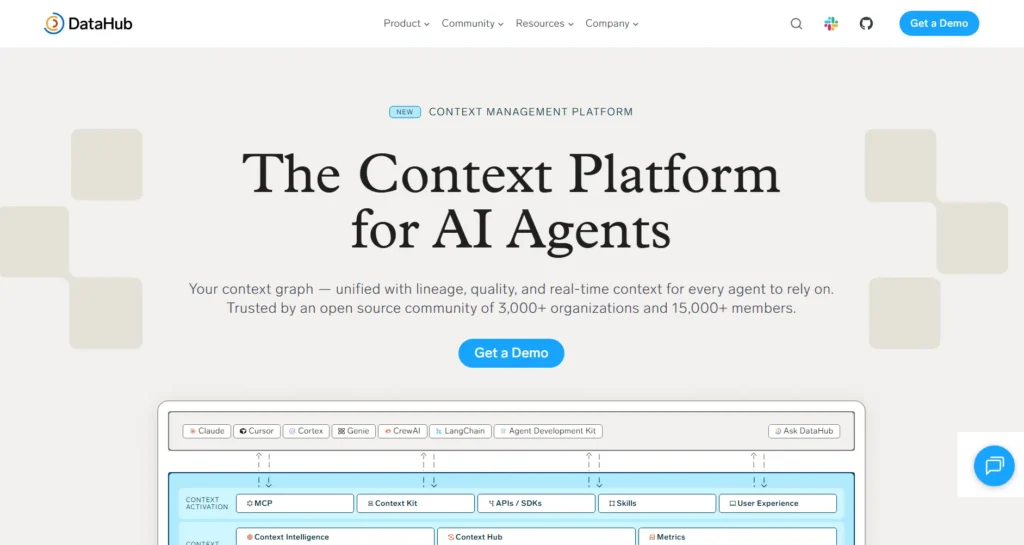
DataHub positions itself as the enterprise context management platform built for every agent, human, and dashboard that needs trusted context
According to DataHub, the company is defining the context management category by combining AI-powered discovery, intelligent observability, and automated governance in a single stack.
DataHub Cloud’s Context Graph spans 100+ integrations and unifies structural metadata with unstructured knowledge in one semantic network.
The site states this graph delivers governance through access controls, audit trails, ownership records, and a business glossary that gives agents machine-readable definitions for the terms they need to reason about.
The platform offers continuous synchronization through an event-based architecture, automated lineage, and freshness assertions that keep context current with operational reality.
Agent readiness is delivered through a managed MCP Server, the Agent Context Kit SDK, Context Documents linked to assets, and native integrations with Snowflake Cortex, LangChain, Google ADK, Cursor, and other AI IDEs.
DataHub is adopted by over 3,000 enterprises, including Apple, Netflix, Visa, Pinterest, and Block, and is backed by a 15,000+ member open-source community.
The platform was originally built at LinkedIn to manage metadata at scale and was open-sourced in 2020 before becoming an independent project hosted at datahub.com.
Customer case studies on the site show Pinterest and Block running production agent workflows on the DataHub stack, while Slack reports collapsing six years of metadata complexity into three days of progress.
The DataHub MCP Server provides native connections for Claude, Cursor, Windsurf, and other AI tools, allowing agents to search and act on trusted enterprise context without custom integration work.
2. Atlan
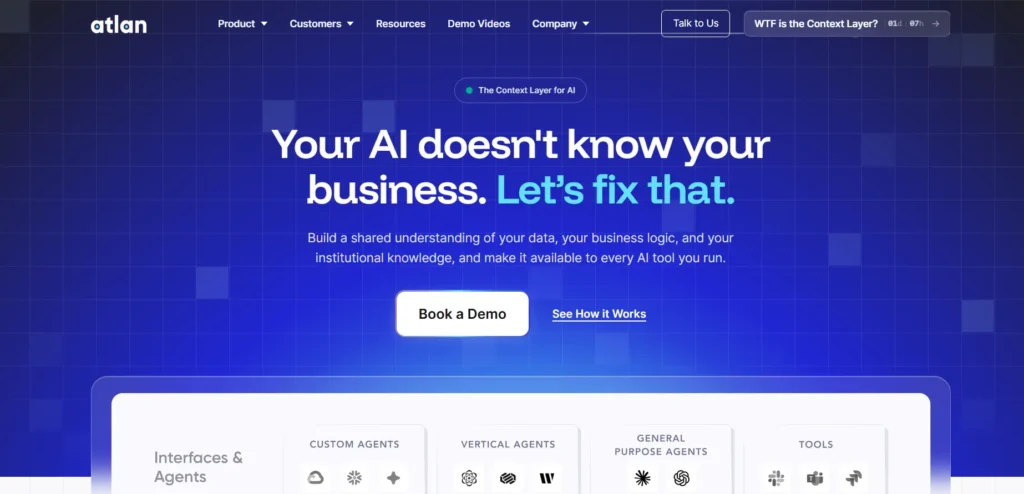
Atlan markets itself as the context layer for enterprise AI, sitting between business systems and AI agents.
The official site explains that Atlan connects lineage from data pipelines, business definitions from BI tools, and SQL logic, knowledge from SOPs, quality scores, and access policies into a unified context store.
According to Atlan, every AI agent needs the business definitions behind column names, the lineage behind every output, and the access policies behind every query.
Without this context layer, agents hallucinate, misclassify sensitive records, or return answers that compliance teams reject.
Atlan connects natively to 80+ enterprise systems, including Snowflake, Databricks, BigQuery, Redshift, dbt, Airflow, Tableau, Looker, Power BI, and Postgres.
The platform layers on top of existing catalogs like Microsoft Purview, Snowflake Horizon, and Databricks Unity Catalog, pulling their metadata into a single unified context layer rather than rebuilding from scratch.
The company is deployed at enterprises including General Motors, Workday, Nasdaq, Mastercard, and Virgin Media O2.
Atlan was named a Leader by Gartner in the 2025 Metadata Management and 2026 Data and Analytics Governance Magic Quadrants, and by Forrester in its 2024 Enterprise Data Catalogs and 2025 Data Governance Solutions Waves.
3. Collibra
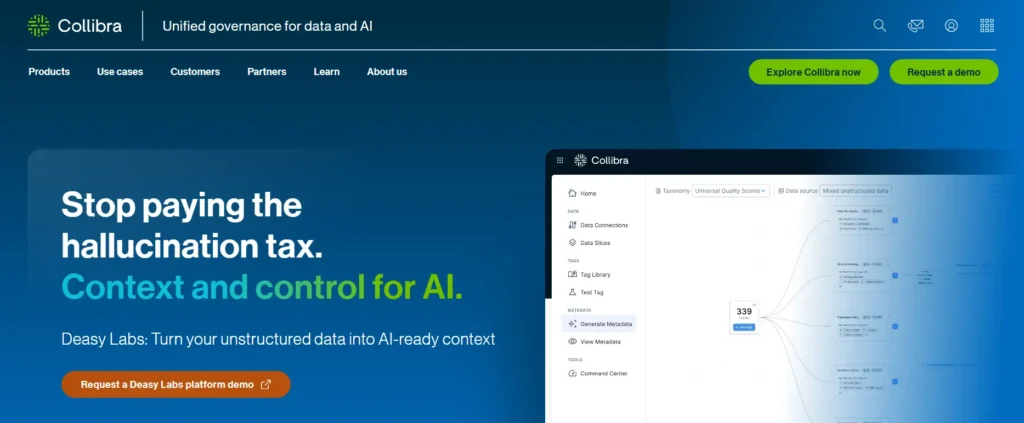
Collibra describes its platform as a context and control engine that connects data producers and consumers wherever they work.
The official site states that Collibra delivers trusted, AI-ready data across structured and unstructured sources to help organizations increase productivity, drive innovation, and reduce risk.
Collibra AI Governance unifies AI, data, and risk teams around a shared system of record for every AI initiative.
According to the company, the platform captures lineage from source datasets through model training, inference, deployment, and usage, no matter the platform on which AI assets live.
The Collibra Platform automatically maps relationships between systems, applications, and reports to provide a context-rich view across the enterprise.
It also includes 100+ native integrations and surfaces business context within tools such as Salesforce, Databricks, Tableau, and Slack via the Collibra Everywhere browser extension.
Collibra was recognized as a Leader in Gartner’s Magic Quadrant for Data and Analytics Governance Platforms for the second consecutive year and in The Forrester Wave for Data Governance Solutions, Q3 2025.
Headquartered in New York and Brussels, the company emphasizes meeting the security, scalability, and flexibility requirements of highly regulated industries.
4. Alation
Alation calls itself the Agentic Data Intelligence Platform, combining cataloging, governance, lineage, and quality in one hub.
The official site states that the platform empowers data teams with AI-driven automation while ensuring compliance and delivering trusted data at the speed of business.
Alation’s Data Catalog unifies discovery with natural-language search, surfacing definitions, lineage, policies, usage, and trust signals across 120+ connectors.
The platform’s Knowledge Layer provides curated, governed data products that draw on metadata in the Agentic Data Intelligence Platform, ensuring every AI answer reflects business context.
The company offers an AI Agent SDK with support for the Model Context Protocol, enabling partners and customers to build agents using Alation’s data intelligence capabilities.
Alation Agent Builder integrates with 100+ data sources, including Snowflake, Databricks, Tableau, and Power BI, and supports deployment via MCP or REST API.
Alation is trusted by 40% of the Fortune 100 and customers such as AbbVie, American Family, Cisco, Finnair, Nasdaq, and Sallie Mae.
The company was named a 2019 World Economic Forum Technology Pioneer and has been recognized as a five-time Leader in the Gartner Magic Quadrants.
5. Secoda
Secoda is positioned as an AI platform for data and analytics, powered by enterprise data governance and context across the entire data stack.
The official site states that Secoda connects directly to data sources to understand lineage, documentation, and metadata, delivering context-aware AI built to scale.
Secoda is built on a foundation of governance, metadata, lineage, and documentation to power context-aware outputs for both data producers and consumers.
Unlike simple LLM wrappers, the platform uses RAG and metadata-trained embeddings to deliver secure, accurate, context-aware answers from the data stack at scale.
The platform consolidates metadata into one actionable, always-updated control panel and integrates with Snowflake, BigQuery, Redshift, Databricks, Postgres, Oracle, Microsoft SQL, MySQL, and S3.
Customizable governance filters let admins specify exactly which resources AI can access through inclusive or exclusive filter rules, ensuring AI interactions stay confined to appropriate datasets.
Secoda’s enterprise customers include 6sense, Dialpad, Deezer, Kaufland, LichtBlick, and Panasonic.
The platform maintains SOC 2 compliance, encryption in transit, comprehensive audit trails, and built-in frameworks for GDPR and HIPAA, ensuring enterprise-grade security and regulatory readiness.
Secoda also strictly adheres to team-based data access permissions, so the AI assistant returns no results from resources a user is not entitled to access.
In December 2025, Secoda announced its acquisition by Atlassian, which the company says will accelerate its mission of giving employees and agents the context they need to find answers and take action where they work.
Final Thoughts
Choosing the right context management platform depends on the maturity of your existing data stack, your governance requirements, and how aggressively your teams are deploying AI agents in production.
Each of the platforms above takes a different approach, from DataHub’s open-source-rooted Context Graph and managed MCP Server to Atlan’s metadata lakehouse, Collibra’s AI Governance framework, Alation’s agentic Knowledge Layer, and Secoda’s RAG-powered AI assistant.
For organizations prioritizing community-driven flexibility and agent-readiness through open standards, DataHub stands out with deployments across 3,000+ enterprises and a 15,000+ member open-source community.
Whichever platform you evaluate, the goal remains the same: deliver a governed, trusted context to every AI agent and analyst so enterprise AI initiatives can reach production with confidence.