Authority marketing is one of the most powerful long-term growth strategies available to businesses, professionals, and brands today. When your audience sees you as the go-to expert in your field, they trust you faster, buy from you more readily, and recommend you more often.
This guide covers everything you need to know: what authority marketing is, why it matters now more than ever, how to build it step by step, which content formats work best, how to measure results, and the most common mistakes to avoid.
What Is Authority Marketing?

Simple Definition
Authority marketing is the strategic process of positioning a person, brand, or organization as a trusted expert in a specific niche or industry through consistent content, thought leadership, digital PR, and audience education, with the goal of influencing buying decisions, attracting inbound opportunities, and building long-term brand equity.
In plain terms: authority marketing is how you become the name people think of first when they need expertise in your space.
How Authority Marketing Works
Authority marketing works by consistently demonstrating expertise, sharing original insights, and educating your target audience across multiple channels over time. Each piece of content, media mention, speaking engagement, or published research adds to a cumulative credibility signal, both in the minds of your audience and in the algorithms of search engines and AI platforms.
The mechanism follows a clear pattern:
- You identify a specific area of expertise.
- You publish content, research, or commentary that demonstrates that expertise.
- Your audience, other publications, and search engines begin to recognize you as a credible source.
- That recognition attracts more visibility, more inbound interest, and more opportunities.
- Increased visibility further compounds your authority.
Over time, authority becomes self-reinforcing. The more recognized you are, the more likely you are to be cited, quoted, featured, and recommended, which further increases your recognition.
Why It Matters Today
Three converging forces have made authority marketing more valuable than at any point in the past:
- Information overload — Buyers are drowning in content. They filter by trust, not volume. Recognized experts cut through the noise.
- AI-powered search — Google’s AI Overviews and tools like ChatGPT prioritize content from recognized, credible sources when generating answers. Unknown brands get ignored.
- Zero-click behavior — More than half of searches now end without a click, according to data tracked by SparkToro. Ranking isn’t enough; being the recognized authority in a space means your brand is cited even when users don’t visit your site.
Why Authority Marketing Is More Important Than Ever

Buyers Research Before Buying
Modern buyers, especially in B2B, conduct extensive independent research before engaging a vendor. According to Gartner, B2B buyers spend only 17% of their purchase journey talking to potential suppliers, while 27% of that time is spent doing online research independently.
This means that by the time a prospect contacts you, they have already formed an opinion about whether you are credible. Authority marketing shapes that opinion before the sales conversation begins.
Trust Drives Conversions
The 2024 Edelman Trust Barometer consistently shows that trust is a primary driver of purchase decisions across industries. Buyers are more likely to choose vendors they already perceive as experts, not because of price or features alone, but because trust reduces perceived risk.
Authority marketing directly builds the trust signals that accelerate conversions: case studies, published research, media coverage, testimonials, and consistent educational content all signal that you know what you’re doing.
AI Search Rewards Trusted Sources
The rise of AI-generated answers in Google, Bing, and standalone AI tools like ChatGPT and Perplexity has changed the stakes of authority dramatically.
These systems pull their answers from sources they deem credible. They cite established publications, recognized domain experts, and brands with strong entity signals in their knowledge bases. Brands that have built authority through consistent content, backlinks, and media mentions are more likely to be surfaced in AI-generated responses, and brands that haven’t built that authority are increasingly invisible.
Google’s EEAT and Authority
Google’s Search Quality Rater Guidelines explicitly evaluate content through the lens of EEAT, Experience, Expertise, Authoritativeness, and Trustworthiness. These are not just ranking signals for individual pages; they apply to the author, the site, and the organization as a whole.
A site that demonstrates authority through consistent topical coverage, credible authorship, quality backlinks, and media recognition is treated differently by Google’s systems than a thin site with no track record. Authority marketing, done correctly, builds every dimension of EEAT simultaneously.
Authority Marketing vs Similar Marketing Strategies
Authority marketing is often confused with adjacent strategies. While these approaches overlap, they differ in focus, mechanism, and goal.
Authority Marketing vs Content Marketing
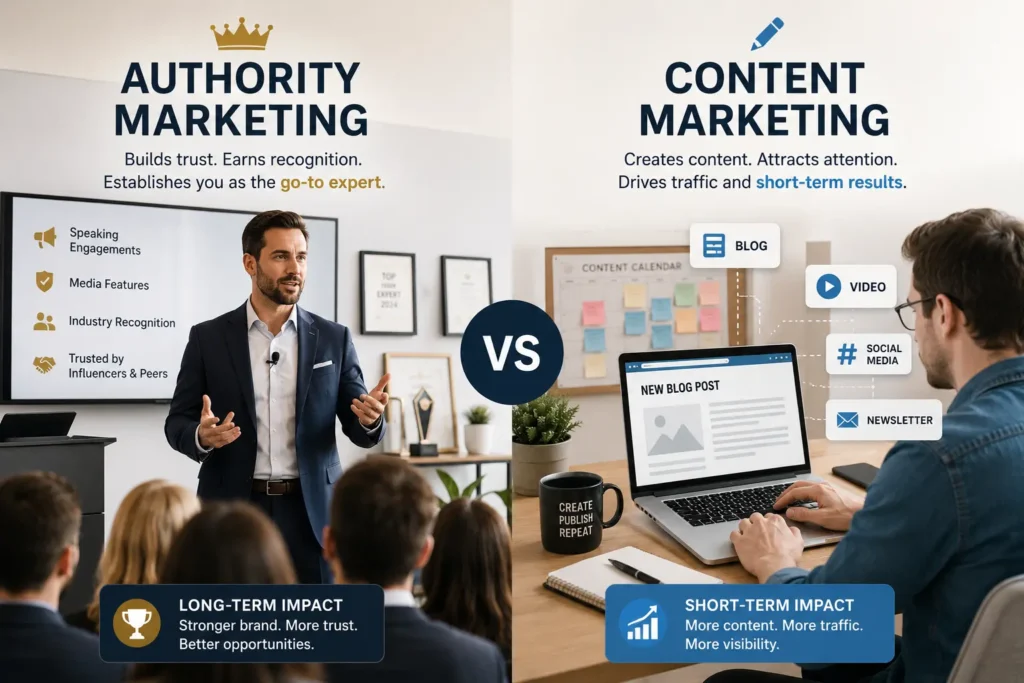
Content marketing focuses on creating and distributing valuable content to attract and retain an audience, with a primary goal of driving traffic, leads, or sales. It is channel- and format-agnostic.
Authority marketing is a higher-order strategy. It uses content as one of many tools to build credibility and expert positioning. Authority marketing also includes PR, speaking, books, research, and community, things content marketing alone doesn’t cover.
All authority marketing involves content. Not all content marketing builds authority.
Authority Marketing vs Thought Leadership
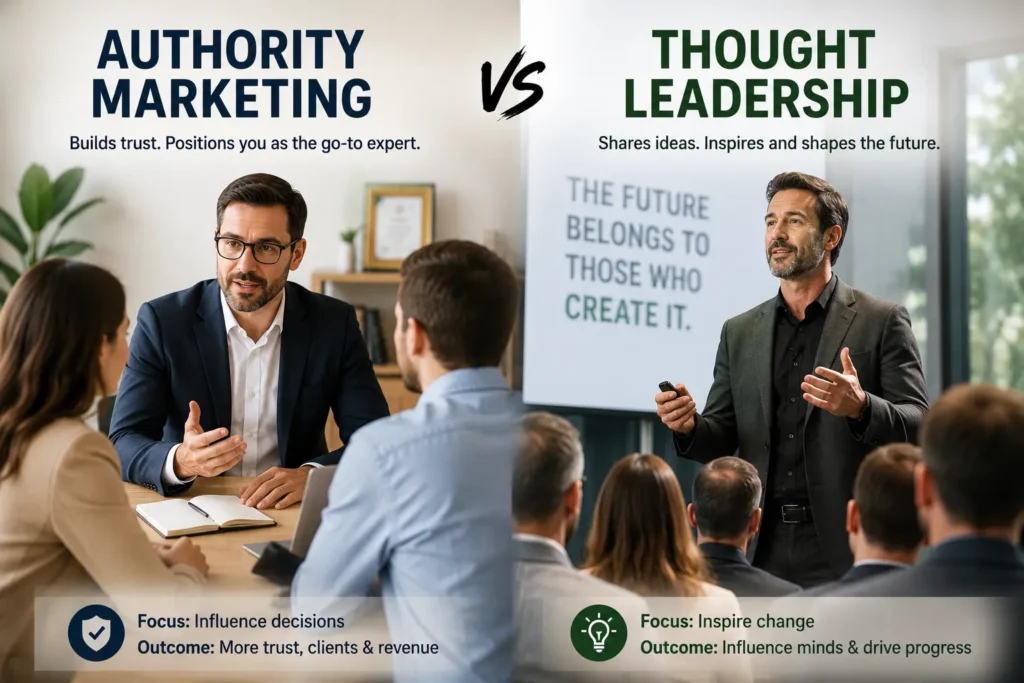
Thought leadership is the practice of sharing original perspectives, contrarian views, or forward-thinking ideas that shape conversations in an industry. It is primarily about ideas and influence.
Authority marketing is broader. It includes thought leadership as one pillar, but also incorporates SEO, digital PR, backlink building, distribution strategy, and measurement. Thought leadership without distribution and SEO is influence without reach. Authority marketing connects both.
Authority Marketing vs Personal Branding
Personal branding is the practice of managing and developing the reputation and impression of an individual — typically focused on career advancement, networking, or entrepreneurship.
Authority marketing can apply to both individuals and organizations. When applied to an individual, it resembles personal branding but with a stronger emphasis on industry positioning, content strategy, and measurable business outcomes rather than personal narrative alone.
Authority Marketing vs Influencer Marketing
Influencer marketing uses the audience and credibility of existing influencers to promote a brand’s products or services. It is a paid or partnership-based distribution strategy.
Authority marketing builds your own credibility rather than borrowing someone else’s. It is a long-term investment in owned authority. Influencer marketing can be a tactic within an authority marketing strategy (for example, being featured by an industry influencer), but it is not a substitute for building your own expert positioning.
Authority Marketing vs Brand Marketing
Brand marketing focuses on building awareness, recognition, and emotional association with a brand — often through advertising, visual identity, and storytelling.
Authority marketing focuses specifically on credibility and expert positioning. A brand can be widely recognized without being trusted as an authority. Authority marketing adds depth to brand marketing by making recognition meaningful.
Comparison Table
| Strategy | Primary Goal | Core Mechanism | Timescale | Applies To |
|---|---|---|---|---|
| Authority Marketing | Trust and expert positioning | Content, PR, SEO, speaking | Long-term | Individuals and organizations |
| Content Marketing | Traffic, leads, engagement | Content creation and distribution | Medium to long-term | Organizations |
| Thought Leadership | Influence and idea ownership | Original perspectives and commentary | Long-term | Individuals and organizations |
| Personal Branding | Individual reputation | Narrative and networking | Long-term | Individuals |
| Influencer Marketing | Reach and social proof | Paid partnerships | Short to medium-term | Organizations |
| Brand Marketing | Awareness and recognition | Advertising and storytelling | Long-term | Organizations |
The Core Pillars of Authority Marketing
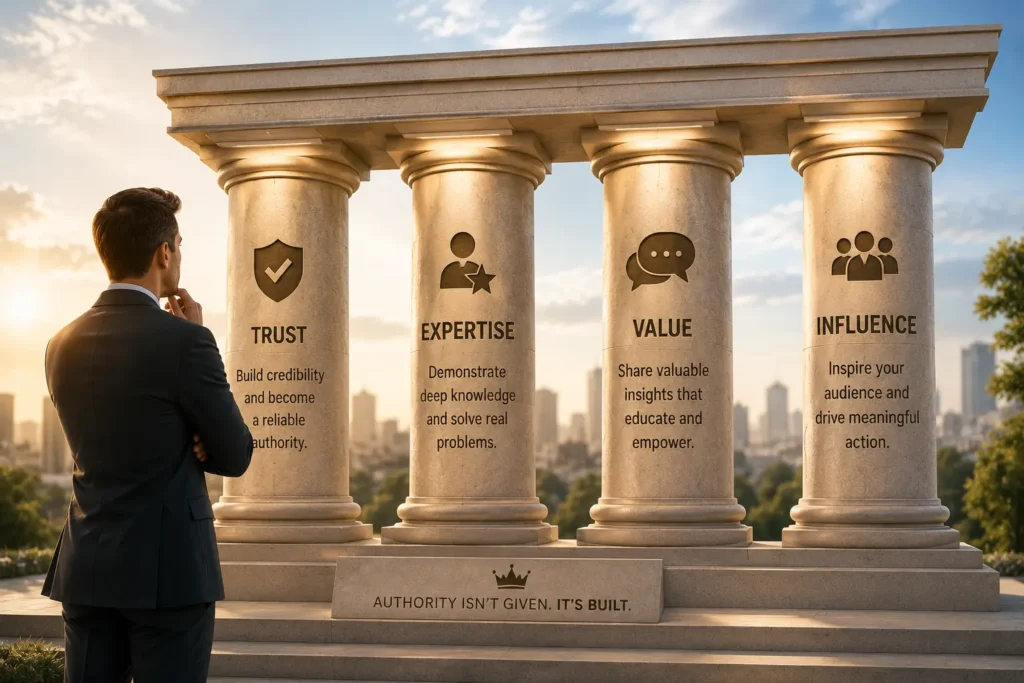
Building authority isn’t a single tactic, it’s a multi-pillar strategy. Each pillar reinforces the others.
Expertise
The foundation of authority is genuine expertise. Authority marketing only works if you have real knowledge to share. This means going deep into a specific domain rather than covering everything superficially.
Best practice: Define a clear area of expertise that is specific enough to be meaningful but broad enough to sustain years of content. “Marketing” is too broad. “B2B SaaS demand generation” is specific and defensible.
Original Insights
Curating existing information builds some credibility, but original insights build real authority. This means sharing perspectives, interpretations, or data that your audience cannot find elsewhere.
Original insights come from proprietary data, professional experience, unique methodologies, or a distinctive analytical framework. They give your audience a reason to follow you specifically, rather than any other source on the topic.
Consistent Content
Authority is built through repetition over time. A single brilliant piece of content builds a moment of credibility. A consistent body of work across months and years builds a reputation.
Consistency signals to your audience that you are committed and reliable, two qualities that underpin trust. It also signals to search engines that your site is an active, authoritative source in its domain.
Audience Education
Authority marketing is fundamentally generous. The more you educate your audience, helping them solve problems, make better decisions, and understand complex topics, the more they associate you with expertise and value.
The best authority builders don’t withhold their knowledge to protect competitive advantage. They share it freely, knowing that giving away expertise in content only deepens the trust that drives business.
Social Proof
Social proof amplifies authority by showing that others, clients, peers, journalists, and institutions, recognize your expertise. This includes testimonials, case studies, client logos, media mentions, industry awards, certifications, and endorsements.
Social proof is especially powerful because it shifts the credibility signal from self-proclaimed to externally validated.
Digital PR
Getting featured in respected industry publications, news outlets, and online media is one of the fastest ways to build authority at scale. A single feature in a high-traffic, trusted publication can introduce your expertise to thousands of qualified readers and deliver SEO-boosting backlinks at the same time.
Digital PR includes guest articles, expert commentary, data-led story pitches, and reactive PR (responding to journalists’ requests for expert quotes through platforms like Qwoted or Help a Reporter Out).
Speaking Engagements
Speaking at industry conferences, summits, podcasts, and webinars positions you as an expert in a high-trust context. Audiences who see you speak develop a much stronger sense of your expertise than those who only read your content.
Speaking also generates secondary authority signals: conference mentions, speaker page listings, recordings on YouTube, and social media coverage from attendees.
Books and Publications
Writing a book is one of the most powerful authority signals available. A published book signals deep expertise, commitment, and thought leadership in a way that no blog post can match. It also provides a long-lived marketing asset that opens doors to speaking, media, and partnerships for years.
Beyond books, publishing in peer-reviewed journals, academic papers, or major industry reports positions you at the top tier of expert credibility.
SEO
Search engine optimization is the distribution engine of authority marketing. Without SEO, your expert content stays hidden. With SEO, it compounds, attracting organic traffic, backlinks, and brand visibility for years after publication.
SEO for authority marketing goes beyond keyword targeting. It encompasses topical authority, semantic coverage, entity optimization, and EEAT signaling, all of which are covered in detail in the SEO section below.
Community Building
Building an audience, through an email list, a community forum, a LinkedIn following, or a private group, gives you a direct channel to your most engaged audience members. Communities amplify content, generate word-of-mouth, and provide social proof that your expertise is valued.
Communities also create network effects: members reinforce each other’s engagement and attract new members, compounding your reach over time.
How to Build Authority Marketing in 10 Steps
Step 1: Define Your Expertise
Before publishing a single piece of content, get clear on what you want to be known for. Ask:
- What specific domain do I have genuine expertise in?
- What is my unique angle or methodology within that domain?
- What audience do I want to serve?
- What do I want to be the go-to resource for?
Common mistake: Trying to claim authority across too many topics at once. Start narrow, dominate that niche, then expand.
Step 2: Understand Your Audience
Authority only works if it resonates with the right people. Research your target audience thoroughly:
- What are their biggest challenges and frustrations?
- What questions do they ask most often?
- Where do they consume content (search, LinkedIn, podcasts, newsletters)?
- What publications and voices do they already trust?
Use tools like Reddit, Quora, People Also Ask data, and customer interviews to surface real questions. Build your content strategy around those questions.
Step 3: Build a Topic Cluster Strategy
A topic cluster is a structured content architecture where a comprehensive pillar page covers a broad topic, and cluster pages cover specific subtopics — all linking back to the pillar.
For authority marketing, this approach serves a dual purpose: it signals topical authority to search engines and it creates a complete educational resource for your audience. Rather than scattered posts on random topics, you build systematic coverage of your domain.
Example: A cybersecurity firm might build a pillar page on “enterprise cybersecurity” supported by clusters on threat detection, zero-trust architecture, compliance frameworks, incident response, and endpoint security.
Step 4: Create High-Value Content
Every piece of content should pass one test: is this genuinely more useful than what already exists on this topic?
High-value content for authority marketing typically:
- Answers a specific, real question completely
- Includes original examples, frameworks, or data
- Is better organized and more readable than competing content
- Is updated regularly to remain accurate
- Demonstrates genuine expertise rather than surface-level coverage
Avoid thin content, AI-generated filler, and “me too” posts that simply repackage what’s already out there.
Step 5: Publish Original Research
Original research — surveys, data studies, industry reports, benchmark reports — is the highest-authority content format available. It is cited by other publications, earns backlinks naturally, and generates media coverage.
Even a modest survey of 200–500 industry professionals can produce data points that other content creators cite for years, consistently driving traffic back to your site and reinforcing your authority.
Example: HubSpot’s annual “State of Marketing” report is cited by thousands of blogs, earns significant media coverage, and reinforces HubSpot’s authority as a marketing platform every year it’s published.
Step 6: Build Quality Backlinks
Backlinks from respected, relevant websites are one of the strongest signals of authority for search engines. They are essentially editorial votes of confidence — other sites saying “this source is credible enough to link to.”
Build backlinks through:
- Original research that others cite
- Guest posting on respected industry publications
- Digital PR and expert commentary
- Creating linkable assets (tools, calculators, definitive guides)
- Broken link building and resource page outreach
Focus on quality over quantity. Ten backlinks from authoritative, relevant domains outweigh hundreds from low-quality sites.
Step 7: Get Featured in Trusted Publications
Being quoted or featured in trusted media — whether trade publications, major news outlets, or respected industry blogs — transfers credibility to your brand. Readers associate your expertise with the trustworthiness of the publication that featured you.
Tactics for getting featured:
- Register on Qwoted or Help a Reporter Out (HARO) to respond to journalist requests
- Pitch data-driven story angles from your original research
- Build relationships with journalists and editors in your industry
- Write guest columns for respected outlets in your space
Step 8: Speak on Podcasts and Events
Podcast appearances and conference speaking build authority quickly because they place you in a credible context (the host or event organizer’s audience already trusts them) and allow your personality, expertise, and communication skills to come through.
Start with smaller, niche podcasts and regional events, then work toward larger stages as your credibility compounds. Every speaking engagement should be repurposed into written content, social clips, and website features.
Step 9: Build an Email Audience
An email list is the most valuable owned audience asset in authority marketing. Unlike social media followers, email subscribers have explicitly opted in to hear from you — which means higher engagement, higher trust, and direct access without algorithmic interference.
Build your list by offering genuine value: original research, exclusive insights, practical templates, or a well-written newsletter. Protect list quality by delivering consistent value and never treating subscribers as a broadcast channel.
Step 10: Measure and Improve
Authority marketing is a long game, but that doesn’t mean it’s unmeasurable. Set baseline metrics at the start and track them consistently:
- Branded search volume (are more people searching for your name or brand?)
- Organic traffic growth
- Backlinks and referring domain trends
- Media mentions
- Email subscriber growth
- Conversion rates from organic and direct traffic
Review your metrics quarterly. Double down on what is working. Diagnose and fix what isn’t. The KPI table in the measurement section below provides a complete framework.
The Role of SEO in Authority Marketing
SEO is not a separate strategy from authority marketing — it is the distribution and amplification layer that makes authority marketing work at scale. Without SEO, expert content stays undiscovered. With SEO, it compounds.
Topical Authority
Topical authority is the degree to which a website is recognized by search engines as a comprehensive, credible source on a specific subject. It is built by systematically covering every meaningful subtopic within a domain — not by publishing broadly about many unrelated topics.
Google’s systems evaluate whether a site covers a topic in depth and breadth before ranking it highly for competitive terms. A site with 50 well-structured articles on cybersecurity will outrank a site with one article on cybersecurity and 200 articles on unrelated topics, even if the single article is excellent.
How to build topical authority:
- Map every relevant subtopic in your domain
- Create content that addresses each subtopic
- Structure content in topic clusters (pillar + cluster architecture)
- Update content regularly to maintain relevance
Semantic SEO
Semantic SEO is the practice of optimizing content for meaning and context rather than exact keyword matches. Modern search engines use natural language processing to understand what a page is about — not just which keywords it contains.
For authority marketing, this means:
- Writing content that covers a topic comprehensively, including related concepts, entities, and terminology
- Using natural language rather than keyword-stuffed copy
- Structuring content so search engines can extract clear answers to specific questions
- Building semantic relationships between related content through internal linking
Internal Linking
Internal linking connects related content within your site, distributing link equity and helping search engines understand your content architecture. For authority marketing, internal links also guide readers through a logical learning path, from introductory content to advanced material, deepening engagement and demonstrating the breadth of your expertise.
Best practice: Link from high-traffic pillar pages to relevant cluster content, and from cluster content back to pillar pages. Use descriptive, keyword-rich anchor text that accurately describes the linked content.
Entity SEO
Entity SEO is the practice of establishing your brand, name, or organization as a recognized entity in search engines’ knowledge bases. Search engines increasingly think in terms of entities — people, organizations, topics, places, rather than just keywords.
Building your entity involves:
- Maintaining consistent Name, Address, Phone Number (NAP) data across the web
- Creating and optimizing a Google Business Profile
- Building Wikipedia or Wikidata entries where relevant
- Getting mentioned (even without links) on trusted websites
- Authoring content under a consistent byline with a complete author bio
- Linking your website to social profiles and vice versa
When Google recognizes your brand as an entity related to a specific topic, it is more likely to surface your content for relevant queries, including in AI Overviews.
Brand Mentions
Unlinked brand mentions, where your name or organization is mentioned in text without a hyperlink — are increasingly recognized as a credibility signal by search engines. A brand that is discussed frequently across the web in authoritative contexts develops a stronger entity footprint, even without earning traditional backlinks.
Monitor brand mentions using tools like Google Alerts, Mention, or Semrush’s Brand Monitoring feature. When you find unlinked mentions, reach out to request a link, these are warm outreach opportunities with a high conversion rate.
Digital PR
Digital PR is the practice of earning coverage, mentions, and links from online media through newsworthy content, data-led pitches, and expert commentary. For SEO, digital PR is one of the most effective ways to earn high-authority backlinks at scale.
The intersection of digital PR and SEO, sometimes called “SEO PR”, involves creating content specifically designed to attract media coverage and links: original research, data studies, industry reports, and reactive commentary on trending news.
EEAT Optimization
Every piece of content should be optimized to demonstrate Experience, Expertise, Authoritativeness, and Trustworthiness:
- Experience: Include practical examples, case studies, and first-hand observations
- Expertise: Cover topics in depth; cite authoritative sources; demonstrate command of technical nuance
- Authoritativeness: Establish clear authorship with complete bios; earn media mentions and backlinks
- Trustworthiness: Be accurate, cite sources, disclose conflicts of interest, include updated dates, and maintain a secure, accessible website
AI Overviews Optimization
Google’s AI Overviews pull content from sources it considers authoritative and relevant. To optimize for AI Overviews:
- Provide clear, direct answers to specific questions near the top of relevant sections
- Structure content with logical H2/H3 hierarchy
- Use definition paragraphs that can stand alone
- Build strong entity signals (see Entity SEO above)
- Earn quality backlinks from trusted sources
- Maintain consistent, comprehensive topical coverage
Best Content Formats for Building Authority
Different formats serve different stages of the authority-building journey and reach different audience segments.
Blog Posts
Blog posts are the workhorses of authority marketing. They provide the foundation for topical authority, SEO traffic, and social sharing. The best authority-building blog posts are comprehensive, well-researched, and clearly organized, more like mini-guides than quick takes.
Best for: Topical authority, organic search traffic, building an audience.
Research Reports
Original research reports, industry surveys, benchmark studies, data analyses, are the highest-authority content format available. They are cited by other publications, earn backlinks, generate media coverage, and position you as a primary source of truth in your industry.
Best for: Backlink acquisition, media coverage, establishing authority as a primary data source.
White Papers
White papers are in-depth, authoritative documents that examine a specific problem, trend, or solution in detail. They are especially effective in B2B contexts, where buyers research complex decisions carefully and value detailed, objective analysis.
Best for: B2B lead generation, demonstrating deep expertise to enterprise buyers.
Podcasts
Hosting a podcast builds a consistent, intimate relationship with your audience over time. Appearing as a guest on others’ podcasts reaches new audiences in a trust-rich context. Both formats humanize your expertise and build a loyal following.
Best for: Audience building, relationship development, reaching audiences who prefer audio.
Videos
Video content, whether YouTube explainers, LinkedIn clips, or on-demand webinars, reaches audiences who prefer visual learning and increases engagement and retention. Video also contributes to entity recognition: YouTube is the second-largest search engine in the world.
Best for: Brand awareness, audience engagement, YouTube SEO, social media reach.
Webinars
Live webinars demonstrate expertise in real time, allow audience interaction, and generate high-quality leads. They also produce recordings that can be repurposed as on-demand video content, blog posts, email sequences, and social clips.
Best for: Lead generation, audience engagement, product education.
Newsletters
A well-curated newsletter is one of the most powerful authority-building tools available. It delivers consistent value directly to subscribers’ inboxes, builds a loyal recurring audience, and is entirely owned, immune to algorithm changes. The best authority-building newsletters include original analysis, not just content curation.
Best for: Audience retention, direct engagement, building a loyal community.
Books
A published book, whether traditionally or self-published, is the ultimate authority signal. It requires deep expertise to produce and signals serious credibility to audiences, media, and event organizers. A book also opens doors to speaking engagements, media coverage, and partnership opportunities that no blog post can match.
Best for: Establishing top-tier authority, generating speaking opportunities, long-term brand building.
Case Studies
Case studies provide concrete evidence that your expertise delivers results. They transform claims into proof by documenting real client outcomes, methodologies, and results. For buyers evaluating vendors, case studies are often the most persuasive content format available.
Best for: Sales enablement, demonstrating proven results, building trust with prospective clients.
Templates
Downloadable templates — frameworks, spreadsheets, planning documents — are highly practical and shareable. They demonstrate expertise in a tangible form and generate leads through gated or ungated distribution.
Best for: Lead generation, demonstrating practical expertise, building backlinks through resource pages.
Calculators
Interactive calculators (ROI calculators, cost estimators, benchmark tools) are among the most effective linkable assets in authority marketing. They provide immediate, personalized value and are widely shared and cited.
Best for: Backlink acquisition, lead generation, demonstrating expertise in quantitative domains.
Interactive Tools
Broader interactive tools — assessments, graders, diagnostic tools, comparison engines — extend your brand’s utility and keep visitors engaged longer. HubSpot’s Website Grader is a classic example: it provided genuine value while positioning HubSpot as an authority on website performance.
Best for: Lead generation, backlink building, building brand associations with expertise and utility.
Authority Marketing Across Different Industries
Authority marketing principles are universal, but execution varies by industry.
B2B
In B2B, authority marketing is especially high-stakes because purchase decisions are complex, expensive, and involve multiple stakeholders. Buyers conduct extensive research, and the company that has educated them throughout that research process starts every sales conversation ahead.
Key tactics: Long-form content, original research, white papers, webinars, LinkedIn thought leadership, conference speaking, and case studies with measurable ROI.
SaaS
SaaS companies compete in crowded, fast-moving markets where differentiation is difficult and customer acquisition costs are high. Authority marketing builds brand recognition and trust that reduces dependence on paid acquisition.
Key tactics: Content-led SEO (building deep expertise on the problems their software solves), developer documentation (for technical SaaS), YouTube tutorials, integration guides, and annual benchmark reports.
Example: Intercom built authority in customer communication through a consistently excellent blog, original research, and a widely respected podcast — establishing them as thought leaders beyond their product category.
Healthcare
Healthcare authority marketing must balance genuine medical expertise with regulatory compliance. Patients and caregivers research extensively, and they trust sources that demonstrate credentials, cite clinical evidence, and communicate clearly without sensationalism.
Key tactics: Physician-authored content, clinical research summaries, patient education resources, medical board endorsements, and partnerships with recognized healthcare institutions.
Note: Healthcare content is subject to stringent YMYL (Your Money Your Life) standards from Google, making EEAT optimization especially critical.
Finance
Financial services face similar regulatory and trust challenges to healthcare. Clients make high-stakes decisions and are acutely sensitive to credibility signals — credentials, track record, and alignment with recognized institutions matter enormously.
Key tactics: Data-driven market commentary, regulatory explainers, financial planning guides, certification and credential highlighting, and client case studies with verified results.
E-commerce
E-commerce brands use authority marketing to differentiate in product categories where commoditization is common. By becoming the go-to resource for expertise related to their product category, they attract buyers earlier in the research process.
Key tactics: Buying guides, product comparison content, instructional videos, sustainability or ethics credentials, and UGC (user-generated content) that demonstrates real-world expertise and outcomes.
Example: A running shoe retailer that publishes in-depth content about gait analysis, running injuries, and training programs builds authority with serious runners who then trust their product recommendations.
Agencies
Marketing, PR, and creative agencies live and die by their reputation. Authority marketing is both their service and their primary growth engine — agencies that are seen as experts attract better clients, charge higher fees, and build more durable businesses.
Key tactics: Publishing case studies, producing proprietary methodologies, hosting industry events, writing for respected marketing publications, and building the personal brands of senior team members.
Local Businesses
Local businesses can build powerful authority within their geographic and service niche. Local authority marketing focuses on community recognition, local SEO, and becoming the trusted go-to resource for a specific service in a specific area.
Key tactics: Google Business Profile optimization, local press coverage, community involvement, niche service expertise content, hyper-local SEO, and review generation.
Example: A local law firm that publishes clear, accurate explainers on local tenant rights becomes the recognized authority for that issue in their community — and captures organic traffic and referrals when residents search for that topic.
Real Examples of Authority Marketing
Personal Brand Example: Neil Patel
Neil Patel built one of the strongest personal authority brands in digital marketing through relentless content publishing, original research (the NeilPatel.com blog became one of the most-visited marketing resources in the world), YouTube videos, and a podcast. His authority was built not by claiming expertise but by demonstrating it, consistently, in public, over many years. His brand now generates significant inbound business for his agency, NP Digital.
SaaS Company Example: Semrush
Semrush built topical authority in SEO and digital marketing through a comprehensive knowledge base, original research (including annual ranking factor studies), a widely read blog, and strategic digital PR. Their content consistently ranks for competitive SEO-related keywords, driving both organic traffic and product trials from users who are already educated on the concepts Semrush helps with.
Local Business Example: Dr. Mike Evans (Healthcare Content)
Dr. Mike Evans, a Canadian physician, built authority as a health communicator by producing clear, evidence-based health explainer videos on YouTube. His video on physical activity — explaining the research behind the benefits of 30 minutes of daily walking — went viral and earned media coverage globally, despite being produced without major marketing resources. The example illustrates that genuine expertise, communicated clearly, can build authority at scale.
Enterprise Brand Example: Salesforce
Salesforce built and maintains authority in CRM and enterprise software through a combination of its annual “State of the Connected Customer” research report (consistently cited by major business media), its Trailhead online learning platform, a global customer conference (Dreamforce), and prolific content marketing. Salesforce doesn’t just sell software, it educates the market on the discipline of customer relationship management, making itself synonymous with the category.
Common Authority Marketing Mistakes
Publishing Without Strategy
Many brands publish content without a clear topical strategy, resulting in scattered posts that cover too many topics too shallowly to build genuine authority in any of them. Content should follow a deliberate topic cluster architecture that builds systematic depth in a defined domain.
Ignoring SEO
Creating excellent content without SEO optimization means that content never gets discovered. Authority marketing requires SEO — not as an afterthought but as a foundational part of content planning, including keyword research, topical mapping, technical SEO, and internal linking.
Focusing Only on Social Media
Social media can amplify authority content, but it is a rented channel. Algorithm changes, platform policy shifts, and account vulnerabilities can undermine years of audience building overnight. Authority marketing requires owned channels — particularly an email list and a well-optimized website.
Lack of Original Research
Brands that only curate or repackage existing information never become primary authorities. Original research, data, frameworks, and methodologies are what separate genuine authorities from aggregators. Invest in producing at least one significant original research asset per year.
No Measurement
Without measurement, authority marketing is a leap of faith rather than a strategy. Set clear KPIs from the start, track them consistently, and use data to guide decisions about content, channels, and investment.
Inconsistent Publishing
Authority is built through consistency. Brands that publish in bursts — high volume for a few weeks, then silence — fail to build the cumulative credibility that authority requires. Establish a realistic publishing cadence and maintain it regardless of competing priorities.
Measuring Authority Marketing Success
Authority marketing results accrue over time, which means measurement requires patience and the right leading indicators.
Branded Search Growth
Branded search volume — how often people search for your name or organization — is one of the clearest signals that authority marketing is working. As your recognition grows, more people search for you by name rather than discovering you through generic queries.
Tool: Google Search Console (monitor branded query impressions and clicks).
Organic Traffic
Growth in organic search traffic indicates that your content is gaining visibility for relevant non-branded queries. Track both total organic traffic and traffic to specific pillar pages and cluster content.
Tool: Google Analytics, Semrush, Ahrefs.
Backlinks
The number and quality of backlinks pointing to your site reflect how much your content is being cited and recommended by others. Focus on growth in referring domains (unique sites linking to you) rather than raw backlink count.
Tool: Ahrefs, Semrush, Moz.
Referring Domains
Referring domains — the number of unique websites linking to yours — is a more meaningful metric than total backlinks, since a single site can create many links. Growth in referring domains indicates that your authority is broadening across the web.
Media Mentions
Track how often your brand or key individuals are mentioned in media coverage, industry publications, and authoritative blogs. An increase in mentions — especially from trusted outlets — signals growing authority.
Tool: Google Alerts, Mention, Semrush Brand Monitoring.
Domain Authority Trends
Domain Authority (DA, from Moz) and Domain Rating (DR, from Ahrefs) are third-party metrics that estimate a site’s overall link authority. While not official Google metrics, they are useful directional indicators of whether your backlink profile is strengthening over time.
Email Subscribers
Growth in email subscribers indicates that your audience values your content enough to invite it into their inbox. Track both total subscriber count and engagement metrics (open rate, click rate) to assess quality.
Conversion Rates
Authority marketing should ultimately influence business outcomes. Track conversion rates for organic traffic — especially from high-intent, non-branded queries where your content is introducing prospects for the first time.
Share of Voice
Share of voice measures the proportion of total online conversation or visibility in your category that belongs to your brand versus competitors. As your authority grows, your share of voice should increase. Some SEO tools (Semrush, Ahrefs) provide share of voice metrics for organic search visibility.
KPI Table
| KPI | What It Measures | Tracking Frequency | Tools |
|---|---|---|---|
| Branded Search Volume | Name recognition and authority growth | Monthly | Google Search Console |
| Organic Traffic | Content discoverability and SEO performance | Weekly/Monthly | Google Analytics, Semrush |
| Referring Domains | Breadth and quality of backlink profile | Monthly | Ahrefs, Semrush |
| Media Mentions | PR coverage and brand visibility | Monthly | Google Alerts, Mention |
| Domain Rating / DA | Overall link authority trend | Monthly | Ahrefs, Moz |
| Email Subscribers | Owned audience growth | Weekly | Email platform (e.g., Mailchimp, ConvertKit) |
| Email Engagement Rate | Audience quality and content relevance | Monthly | Email platform |
| Conversion Rate (Organic) | Revenue impact of authority content | Monthly | Google Analytics |
| Share of Voice | Competitive visibility in your category | Quarterly | Semrush, Ahrefs |
| Social Followers / Engagement | Community building and amplification | Monthly | Native analytics, Sprout Social |
Recommended Tools for Authority Marketing
SEO Tools
These tools support keyword research, topical authority planning, backlink analysis, and technical SEO audits.
| Tool | Primary Use | Best For |
|---|---|---|
| Ahrefs | Backlink analysis, keyword research, content gap analysis | In-depth SEO research and competitor analysis |
| Semrush | All-in-one SEO, PR monitoring, traffic analytics | Comprehensive SEO and content strategy |
| Moz Pro | Domain Authority tracking, keyword research | Monitoring authority metrics over time |
| Google Search Console | Organic performance, query data | Understanding how Google sees your site |
| Screaming Frog | Technical SEO audits | Site crawling and technical issue identification |
Content Tools
| Tool | Primary Use | Best For |
|---|---|---|
| Clearscope | Content optimization for semantic SEO | Improving content comprehensiveness |
| SurferSEO | On-page SEO optimization | Content scoring and SERP alignment |
| Frase | AI-assisted content research and briefs | Content brief creation and optimization |
| Notion | Content planning and collaboration | Editorial calendar and team workflow |
Research Tools
| Tool | Primary Use | Best For |
|---|---|---|
| SurveyMonkey | Online surveys | Primary research and original data collection |
| Typeform | Engaging surveys | Higher response rates for audience surveys |
| Statista | Statistics and market data | Supporting content with third-party data |
| SparkToro | Audience research | Understanding where your audience spends time online |
Social Media Tools
| Tool | Primary Use | Best For |
|---|---|---|
| Buffer | Social scheduling and analytics | Content distribution across platforms |
| Sprout Social | Social management and analytics | Team social media management and reporting |
| LinkedIn Analytics | LinkedIn-specific performance | Tracking thought leadership content performance |
| Hootsuite | Multi-platform social management | Enterprise social media management |
PR Tools
| Tool | Primary Use | Best For |
|---|---|---|
| Qwoted | Journalist request platform | Responding to media requests for expert quotes |
| Cision | Media database and PR outreach | Large-scale media relations |
| Mention | Brand monitoring | Tracking media mentions and brand conversations |
| BuzzStream | Digital PR outreach | Managing link building and PR email campaigns |
Analytics Tools
| Tool | Primary Use | Best For |
|---|---|---|
| Google Analytics 4 | Website traffic and conversion tracking | Measuring content and channel performance |
| Hotjar | Heatmaps and user behavior | Understanding how visitors engage with content |
| Databox | KPI dashboards | Consolidating metrics from multiple sources |
Authority Marketing Checklist
Use this checklist to audit your authority marketing strategy across every key dimension.
Strategy and Positioning
- [ ] Defined a clear, specific area of expertise
- [ ] Identified target audience and their primary pain points
- [ ] Mapped competitive landscape and identified differentiation opportunity
- [ ] Established a unique positioning statement or methodology
- [ ] Set 12-month authority marketing goals with specific KPIs
Content Planning
- [ ] Built a topic cluster map covering core pillar topics and subtopics
- [ ] Identified content formats most effective for your audience
- [ ] Created an editorial calendar with realistic publishing cadence
- [ ] Planned at least one original research asset per year
- [ ] Mapped content to buyer journey stages (awareness, consideration, decision)
Content Creation
- [ ] Every piece of content passes the “more useful than what exists” test
- [ ] All content includes accurate, verifiable information (no fabricated statistics)
- [ ] Content demonstrates genuine expertise (not surface-level coverage)
- [ ] Author bios are complete, accurate, and credential-appropriate
- [ ] Content is regularly updated to maintain accuracy
SEO
- [ ] Keyword research completed for all planned content
- [ ] Topic cluster architecture built with pillar and cluster content
- [ ] Internal linking strategy in place
- [ ] Technical SEO audited (site speed, mobile, crawlability, structured data)
- [ ] Author entity signals established (consistent bylines, social profiles linked)
- [ ] EEAT signals embedded in content (credentials, citations, examples)
PR and External Presence
- [ ] Media targets identified in your industry
- [ ] Registered on Qwoted and/or other journalist request platforms
- [ ] Guest contribution targets identified and outreach plan in place
- [ ] At least 3 podcast targets identified for guest appearances
- [ ] Speaking opportunity targets identified for coming year
Distribution
- [ ] Email list capture in place on website
- [ ] Newsletter publishing cadence established
- [ ] Social media distribution workflow in place
- [ ] Content repurposing system in place (blog → social, video → blog, etc.)
- [ ] Partnerships or co-marketing opportunities identified
Measurement
- [ ] Google Analytics 4 configured with conversion goals
- [ ] Google Search Console set up and verified
- [ ] Backlink monitoring in place (Ahrefs or Semrush)
- [ ] Brand mention monitoring in place (Google Alerts minimum)
- [ ] Monthly reporting dashboard established
- [ ] Baseline metrics recorded at strategy launch
Frequently Asked Questions
What is authority marketing in simple terms? Authority marketing is the process of positioning yourself or your brand as a trusted expert in your industry by consistently sharing valuable knowledge, publishing original research, earning media coverage, and building a reputation that attracts customers, opportunities, and recognition.
How long does authority marketing take to work? Authority marketing is a long-term strategy. Most brands begin to see meaningful results — measurable increases in organic traffic, backlinks, and branded searches — within 6–12 months of consistent effort. Building genuine category authority typically takes 2–3 years of sustained investment.
Who should use authority marketing? Authority marketing is effective for almost any business or professional: B2B companies, SaaS businesses, healthcare providers, financial advisors, consultants, agencies, local businesses, and solo practitioners. It is especially valuable wherever buyers make research-intensive decisions.
Is authority marketing the same as thought leadership? No. Thought leadership focuses on original ideas and influence. Authority marketing is a broader strategy that includes thought leadership as one component, alongside SEO, digital PR, content strategy, backlink building, and measurement.
How do I build authority with no audience? Start with SEO-optimized content that captures search traffic, contribute guest articles to publications that have existing audiences, appear on relevant podcasts as a guest, and engage actively in communities where your target audience spends time. Building authority doesn’t require a pre-existing audience — it requires demonstrating expertise in places where the right people will discover it.
What’s the difference between authority marketing and content marketing? Content marketing is a tactic focused on creating and distributing content to attract and engage an audience. Authority marketing is a broader positioning strategy that uses content as one tool among many — including PR, speaking, research, SEO, and community building — to establish trusted expert status.
Does authority marketing work for small businesses? Yes. Small businesses can build powerful local or niche authority without the resources of large brands. Focusing on a specific geographic area or niche allows small businesses to dominate their space even with modest content investment.
How much content do I need to publish to build authority? Consistency matters more than volume. A realistic cadence — one to two high-quality pieces per month — executed consistently over 12–24 months will build more authority than irregular bursts of high-volume publishing. Depth beats breadth: one comprehensive article outperforms ten thin posts.
What is the best content format for building authority? Original research reports earn the most backlinks and media coverage. Long-form blog posts build topical authority for SEO. Books establish the highest personal credibility. The best strategy combines multiple formats — using blog content for SEO, research for PR, and speaking for audience trust.
How do I measure authority marketing ROI? Track branded search growth, organic traffic, referring domains, media mentions, email subscribers, and ultimately conversion rates from organic and direct traffic. Authority marketing ROI is long-term and cumulative — it is best measured over 12-month periods rather than campaign cycles.
Can I build authority without a blog? Yes, though a blog is the most accessible and scalable format for most brands. Alternatives include YouTube channels, podcasts, newsletters, LinkedIn publishing, books, and podcast appearances. The channel matters less than the consistency, quality, and expertise you demonstrate.
How important are backlinks for authority marketing? Backlinks from relevant, trusted websites are a critical signal of authority for search engines and important for organic visibility. However, they are a result of building genuine authority — earned through great content, original research, and digital PR — not a shortcut to it. Avoid buying backlinks or pursuing link schemes, which violate Google’s guidelines and can harm rankings.
What is EEAT and why does it matter for authority marketing? EEAT stands for Experience, Expertise, Authoritativeness, and Trustworthiness — the four dimensions Google uses to evaluate content quality. Authority marketing, done correctly, strengthens every dimension of EEAT simultaneously, improving both search rankings and audience trust.
How do I build authority in a competitive industry? Differentiate by going deeper rather than broader. Find a specific angle, niche, or methodology that larger competitors ignore. Publish original research. Build relationships with media in your space. Focus on serving a specific audience exceptionally well rather than trying to compete across an entire category.
What role does social media play in authority marketing? Social media amplifies authority content and supports community building, but it is a rented channel — vulnerable to algorithm changes and platform risk. Use it to distribute and promote your owned content rather than as the foundation of your strategy. Build your email list and website as your primary owned assets.
Is personal branding part of authority marketing? Yes — for individuals, authority marketing and personal branding overlap significantly. The distinction is that authority marketing places greater emphasis on industry positioning, content strategy, SEO, and measurable business outcomes, whereas personal branding may focus more on personal narrative and career advancement.
How does authority marketing relate to SEO? SEO is the distribution and discoverability layer of authority marketing. Without SEO, expert content doesn’t get found. With SEO — particularly topical authority, entity optimization, and EEAT signals — authority compounds: each new piece of content builds on the authority already established, making it progressively easier to rank and harder for competitors to displace.
What is topical authority and how do I build it? Topical authority is the degree to which search engines recognize your website as a comprehensive, credible source on a specific subject. Build it by systematically covering every meaningful subtopic within your domain using a topic cluster architecture — a pillar page covering the broad topic, supported by cluster pages on specific subtopics, all internally linked.
Final Thoughts
Authority marketing is not a campaign. It is a compounding, long-term investment in the most durable competitive advantage available to any business: being the name people trust first in your space.
The fundamentals are straightforward: define your expertise with precision, serve your audience generously, publish consistently, earn recognition through research and PR, and measure your progress rigorously. None of these steps are quick — but each one builds on the last, and the cumulative effect is a brand that attracts opportunities, commands premium prices, and withstands competitive pressure.
The brands and professionals who take authority marketing seriously today are building assets, content libraries, backlink profiles, email audiences, media relationships, and entity recognition, that will continue generating returns for years. Those who ignore it are increasingly invisible, both to the buyers who research before purchasing and to the AI systems that now shape what information reaches those buyers.
Start with what you know. Teach it generously. Build it systematically. Authority is earned, and the earning starts now.