If you’ve searched “Snapjotz.com” and landed here, you’ve probably already noticed something strange. The results don’t agree with each other. One site tells you it’s an AI notebook. Another calls it a journaling app. A third describes it as a blog. A fourth throws in e-commerce inventory tools for good measure.
That’s not you misreading things. It’s the actual state of the search results for this term right now. I dug into the domain records, the backlink data, and nine separate articles claiming to explain Snapjotz.com, and the pattern that emerges is worth walking through, because it tells you more about how modern SEO spam works than it does about any real product.
Nine Reviews, Nine Different Products

Here’s a sample of what’s currently ranking for “Snapjotz.com”:
- One article describes a cloud-based note-taking platform that syncs text, audio, and video across devices.
- Another calls it a “digital media platform” built around blog content and community discussion.
- A third describes it as a general-interest online magazine covering business, health, and lifestyle topics.
- A fourth frames it as a journaling and memory-capture tool for photos and videos.
- A fifth mixes in language about an “e-commerce solution” for inventory management, in the same piece that also calls it a personal task tracker.
No two of these sources agree on what the site does. If Snapjotz.com were a functioning product you’d expect its own description to be consistent with the same main idea, repeated with different levels of detail. Instead each article seems to have created its version of the product from scratch.
One of the honest pieces I found actually says this out loud: people search for Snapjotz.com expecting a polished productivity app click through and find a site with no dashboard, no login screen and no note editor at all. The difference between what people expect and what they find is, by that article’s statement, part of why the term keeps spreading.
What the Domain Records Actually Show
Here is what I found out about snapjotz.com. The information from WHOIS is actually pretty straightforward. The domain listing says “Make Offer” which’s what domain marketplaces use when a name is, for sale. It is not a business.
The domain snapjotz.com was registered in August 2023 with Wild West Domains. It is using Cloudflare nameservers. The domain snapjotz.com also has locks in place to prevent transfers and updates. This is what you would expect to see with a domain that is not being used for a company but is instead being sold or managed by a broker.
The backlink profile adds another layer. Referring domains jump from close to zero to around 800 almost instantly, and Domain Rating spikes the same day. Organic traffic follows the same overnight pattern rather than the slow climb you’d expect from a product actually building an audience. That kind of synchronized jump is a classic signature of a link farm, a network of sites built to hand link equity to each other rather than links earned through genuine references.
The website is listed as “Snapjotz Official Site | Multi-Niche Insights & News”. This site only shows up when you search for Snapjotz. You do not see people visiting the site to look at products or to learn about features. It seems like people are not really using Snapjotz for anything. The site is mostly just known for being the site of Snapjotz.
Why This Happens
What’s happening to Snapjotz.com has a name: it’s a textbook content farm pattern. A content farm is a site, or in this case, a cluster of competing sites, built to publish large volumes of material aimed at what search engines will reward, rather than at describing something true.
Wikipedia’s own page about the practice says that these activities are using AI more and more to create content fast and cheap while accuracy is not as important as getting more views.
This is probably how it works.
A domain with an easy-to-remember name is registered, then sold or kept for later. Someone sees the name starting to get attention from searches, maybe because it’s on a selling site because of some other talk and several people who work on SEO try to be the first to explain it. Each one guesses what kind of product would make sense for the traffic.
AI writing programs make it very easy to write a 1,500-word “review” of a product that was made just a few minutes before. The person whose page comes up first gets money from ads or from links that send people to sites and none of the people involved need the product to actually be real.
You can see the same dynamic discussed on forums like WebmasterWorld’s SEO section and in SEO communities on Reddit, where marketers regularly compare notes on sites that rank purely by guessing at what a trending term “must” mean.
How to Spot This Pattern Yourself
The situation surrounding Snapjotz.com isn’t unique. As AI-generated content becomes more common, it’s increasingly easy for unfamiliar domains to gain visibility in search results before there’s a real product behind them. Fortunately, there are a few simple checks you can perform whenever a branded search term doesn’t seem to add up.
1. Check the Domain Registration (WHOIS)
You should start by looking at the domain WHOIS record. The WHOIS record is information that anyone can see. It will tell you when the domain was registered and which company is in charge of it. Sometimes it will even say if the domain is for sale.
If a domain was registered recently that does not mean it is bad. The story about the domain should make sense. For example if you read a lot of articles that say a platform is a known tool for productivity using artificial intelligence but the domain was registered just a little while ago or it says “Make Offer” on it then you should look into it more.
The domains WHOIS record will not tell you for sure if a business is real or not.. It gives you some useful information that a lot of reviews do not even think about. The WHOIS record is something that can help you figure out if something is not right. You should look at the domains WHOIS record to get an idea about the domain.
2. Compare Multiple Reviews Side by Side

A real software product has an identity. Some people might have thoughts but they usually talk about the same main features, look and reason, for being.
When looking into Snapjotz.com the opposite occurs. One article says it is an AI notebook, another says it is a journaling app and another says it is a magazine or even a way to track inventory.
If a few reviews that are supposed to be separate can’t agree on what a product is that shows that the writers are using guesses instead of actually trying the product.
3. Look for a Working Product
If a website claims to offer software, ask yourself whether you can actually use it.
A legitimate SaaS platform typically includes:
- A signup or login page
- A user dashboard
- Product screenshots
- Documentation or tutorials
- Feature pages explaining how the software works
- Support or help center resources
Reviewers who have genuinely tested the product usually include screenshots, describe the onboarding process, discuss the interface, and explain how specific features work.
If every article talks about the software but none show evidence of using it, that’s worth questioning.
4. Analyze the Backlink Growth
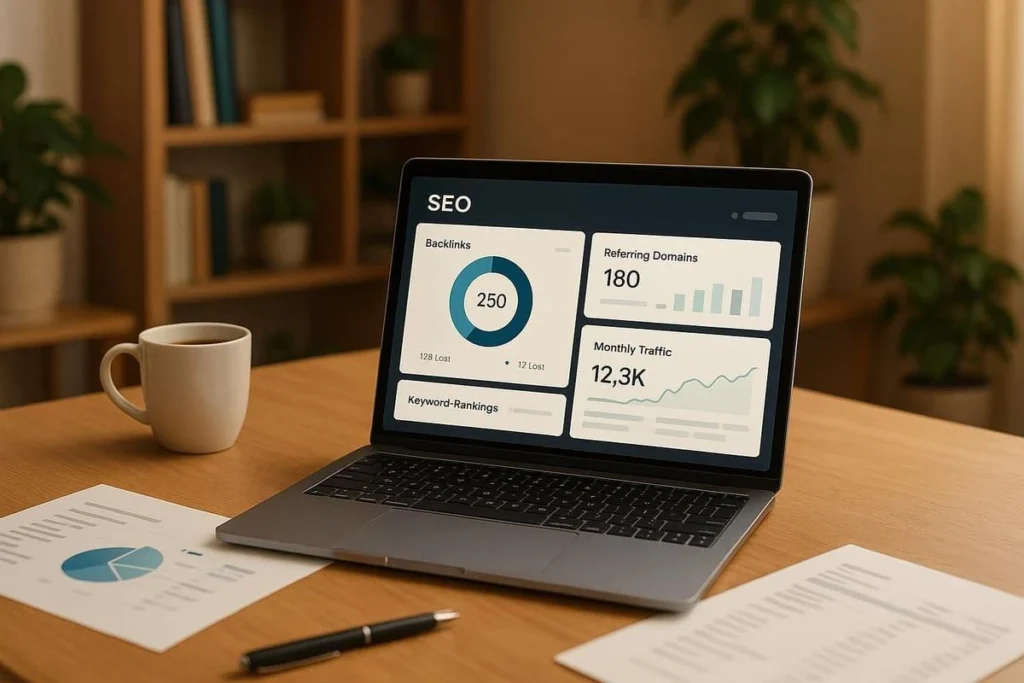
SEO tools such as Ahrefs, Semrush, and Majestic can provide valuable insights into a website’s backlink history and overall search performance.
Websites that grow naturally usually build authority over time. As a product gains real users, other websites begin mentioning it, resulting in a steady increase in backlinks and referring domains.
In contrast, manufactured SEO campaigns often produce sudden spikes where hundreds of backlinks appear within a short period. These unusual patterns can indicate artificial link-building rather than genuine popularity.
To investigate further, you can combine backlink analysis with AI visual search tools that help verify whether screenshots, logos, product images, and other visual assets are authentic or reused across multiple websites. Using both backlink data and visual verification provides a more complete picture when evaluating the credibility of an unfamiliar website.
When the number of backlinks, the number of sites that link to it and the estimated traffic all go up at the time without any clear reason like a new product release, news story or interest from users it might mean that someone is trying to create links on purpose instead of the site being popular on its own.
This alone does not show that something is wrong. It is another sign to look at, with all the other information.
5. Search Beyond Google
Google rankings don’t always reflect real-world popularity.
A useful habit is to search for the product name followed by terms like:
- Forum
- GitHub
- Product Hunt
- YouTube
- X (formerly Twitter)
Real software products almost always leave a digital footprint outside SEO blogs. You’ll typically find:
- User questions
- Bug reports
- Tutorials
- Feature requests
- Independent discussions
- Community feedback
- Positive and negative experiences
If nearly every result is a polished blog post repeating the same marketing language while genuine user conversations are absent, the product may not have an active user base.
6. Verify Claims with Official Sources
Whenever an article mentions specific features, pricing, security certifications, or AI capabilities, try to verify those claims using official sources.
Ask questions like:
- Does the company have official documentation?
- Are pricing plans publicly listed?
- Is there a privacy policy explaining how data is handled?
- Is there a changelog showing ongoing development?
- Can the claimed features actually be demonstrated?
Reliable software companies usually make this information easy to find. If you can’t verify even basic claims, it’s best to remain cautious.
So, Is Snapjotz.com Safe to Visit?
When you look at the information that’s available to the public, about Snapjotz.com you do not see a lot of evidence that they are sending out bad software trying to trick people into giving them personal information or doing other bad things. Major security services do not say that Snapjotz.com is not safe to use at this time.
However it is very important to remember that just because a website is safe to look at it does not mean that the things they are selling are real or that the company is honest.
You can go to a website. It will not hurt your computer but the things they are selling might not be what they say they are or the company might not be a real business. These are two things and we should not get them mixed up.
With Snapjotz.com the big problem is not that the website might hurt your computer, it is that we are not really sure what Snapjotz.com is. When you look at what people’re saying about Snapjotz.com it is very confusing.
Different people say that Snapjotz.com is selling things and we do not see any proof that they actually have a working program. Also a lot of the things that people are saying about Snapjotz.com online cannot be proven to be true which makes it more confusing.
Because of that, readers should approach statements about Snapjotz.com’s features, pricing, AI capabilities, security, or user experience with caution until there is clear evidence of an established product backed by official documentation and real user feedback.
If you’re evaluating any unfamiliar website, not just Snapjotz.com the safest approach is to:
- Verify information from multiple trusted sources.
- Look for official documentation and transparent company details.
- Search for genuine user discussions rather than relying solely on SEO-driven review articles.
- Avoid sharing sensitive personal or financial information unless you’re confident the platform is legitimate and trustworthy.
A healthy amount of skepticism can save you time, protect your data, and help you separate genuine products from speculative or AI-generated hype.
If You’re Looking for a Real Note-Taking App
If you searched for Snapjotz.com because you wanted an AI-powered digital notebook, you’re looking in a category that certainly exists, it just doesn’t appear that Snapjotz.com currently belongs to it.
Today, there are several well-established note-taking and knowledge management platforms that have been tested by millions of users, receive regular updates, and provide clear documentation about their features. Apps like Notion, Evernote, Microsoft OneNote, Obsidian, and Google Keep all have active development teams, transparent pricing, extensive help centers, and large communities where users openly discuss their experiences.
These platforms also offer capabilities that many Snapjotz.com articles claim to provide, including:
- AI-assisted note creation and summarization
- Cross-device synchronization
- Rich text editing and multimedia support
- Task and project management
- Team collaboration
- Offline access
- Searchable knowledge bases
- Mobile and desktop applications
The key difference is that these features can be verified. You can create an account, explore the interface, read official documentation, watch tutorials, and find thousands of genuine user reviews on forums like Reddit, YouTube, and independent software review websites.
Whenever you come across a newly trending domain claiming to be an innovative productivity tool, it’s worth asking a few simple questions before investing your time:
- Is there an official product website with a working login or signup page?
- Does the company clearly explain what the product does?
- Are there authentic screenshots or product demonstrations?
- Can you find reviews from real users instead of SEO-focused blog posts?
- Does the platform have a published privacy policy, support documentation, and contact information?
If the answer to most of these questions is “no,” it’s a good idea to wait until more reliable information becomes available.
The Bottom Line
After reviewing the current Google search results, comparing multiple “reviews,” examining publicly available domain records, and looking at backlink patterns, one conclusion stands out: there is no consistent, verifiable evidence that Snapjotz.com is the fully featured productivity platform many articles describe.
Instead, the web is filled with conflicting explanations. Some sites present Snapjotz.com as an AI notebook, others call it a journaling application, while others describe it as a blogging platform, digital magazine, or even an e-commerce solution.
These descriptions cannot all be accurate, and very few of them provide proof through firsthand testing, screenshots, or official product documentation.
This inconsistency is a warning sign. In today’s AI-driven publishing landscape, it has become increasingly common for websites to publish speculative articles about unfamiliar domains simply because those names begin attracting search traffic.
Rather than verifying the facts, many publishers rely on AI-generated content that fills in the gaps with assumptions. Once enough sites repeat similar claims, the topic gains momentum in search results, even if the underlying product is unclear or doesn’t exist in the form being described.
That doesn’t necessarily mean Snapjotz.com is malicious or unsafe. Based on publicly available information, there is no widespread evidence linking the domain to malware or phishing.
However, being safe to visit is not the same as being a verified, fully functional product. At the moment, there is little publicly available evidence that supports many of the features and capabilities attributed to Snapjotz.com across the web.
If the domain eventually launches a genuine application with documented features, active users, and transparent company information, the situation may change. Until then, it’s best to treat claims about Snapjotz.com’s AI capabilities, productivity features, pricing, or user experience with healthy skepticism.
Ultimately, the story of Snapjotz.com is less about discovering a hidden productivity tool and more about understanding how modern SEO and AI-generated content can shape perceptions of a brand before a real product has even been established.
For readers, it’s a valuable reminder to verify information, compare multiple trusted sources, and look for evidence, not just rankings, before believing what appears on the first page of Google.
Conclusion
Snapjotz.com is a good reminder that not everything ranking on Google represents a real, established product. After comparing multiple reviews, checking publicly available domain information, and looking at its search and backlink patterns, the evidence points to a domain surrounded by speculation rather than a verified software platform.
At the time of writing, there is no consistent proof that Snapjotz.com operates as the AI notebook, journaling app, or productivity workspace many articles describe. Instead, different websites present entirely different versions of the product, often without screenshots, firsthand testing, or links to official documentation.
That doesn’t automatically make the domain unsafe, but it does mean you should approach any claims about its features, pricing, or capabilities with caution. Whenever you come across an unfamiliar branded website, it’s worth verifying the domain, looking for genuine user reviews, checking whether a working product actually exists, and comparing information from multiple independent sources.
If your goal is to find a reliable digital note-taking or AI productivity tool, you’ll be better served by established platforms with transparent feature sets, active user communities, and documented development histories rather than relying on speculative content surrounding an unverified domain.
Frequently Asked Questions (FAQs)
What is Snapjotz.com?
Based on publicly available information, Snapjotz.com does not have a clearly defined identity. Different websites describe it as an AI notebook, journaling app, digital magazine, productivity platform, and even an e-commerce solution, making it difficult to verify what it actually offers.
Is Snapjotz.com a real productivity app?
There is currently no publicly verifiable evidence that Snapjotz.com operates as a fully functional productivity application with documented features, active users, or official product documentation.
Is Snapjotz.com safe to visit?
There are no widely reported signs that the domain is associated with malware or phishing. However, users should still exercise caution because the site’s purpose and functionality remain unclear.
Why do different websites describe Snapjotz.com differently?
Many articles appear to rely on assumptions or AI-generated content instead of firsthand testing. As a result, different publishers have assigned completely different purposes to the same domain.
Is Snapjotz.com currently for sale?
Public WHOIS and domain marketplace records have indicated that the domain has been listed with a “Make Offer” status, suggesting it may be available for purchase rather than operating as an established software business.
Does Snapjotz.com have an official mobile app?
At the time of writing, there is no verified evidence of an official Android or iOS application associated with Snapjotz.com.
Can I create an account on Snapjotz.com?
There is no widely documented signup process, user dashboard, or onboarding experience that confirms it functions as a traditional SaaS platform.
Why is Snapjotz.com appearing in Google search results?
The domain has attracted attention because numerous websites have published articles attempting to explain it. This has increased branded search interest despite the lack of consistent information about the site’s actual purpose.
How can I verify whether an unfamiliar website is legitimate?
You can check the domain’s WHOIS information, look for an official product website with a working login or signup page, search for independent user reviews on forums like Reddit, and compare multiple trusted sources before relying on claims about the product.
What are the best alternatives if I need a digital note-taking app?
If you’re looking for a proven note-taking or productivity platform, consider established options such as Notion, Microsoft OneNote, Evernote, Obsidian, and Google Keep. These platforms have active user communities, documented features, and ongoing product support.