Not always. An internet connection and a Counter-UAS system are not the same thing, even though modern security systems often include connected devices and software.
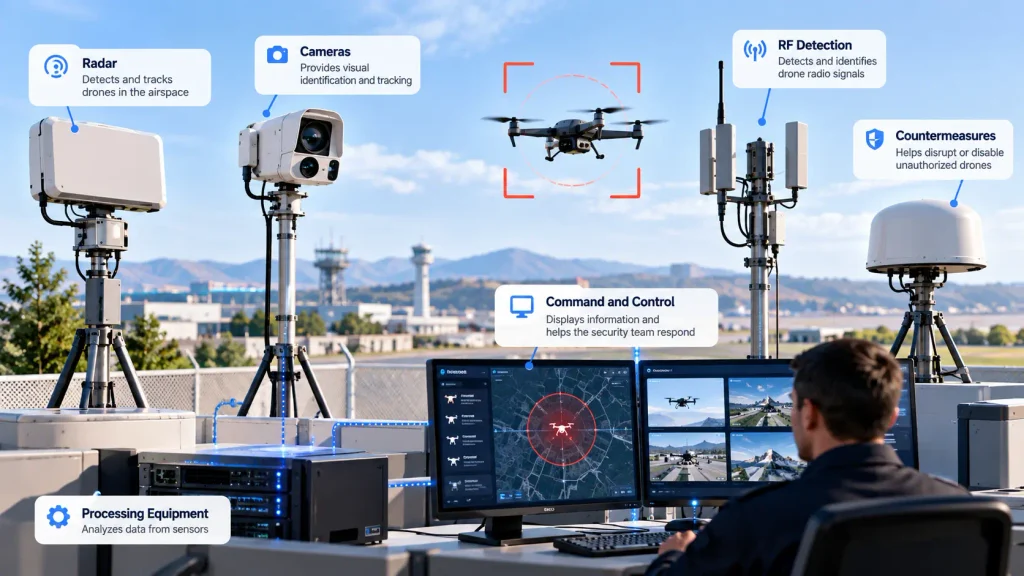
A Counter-UAS setup can include sensors, processing equipment, software, a local server and a command and control interface. Larger installations can also connect with other security systems already operating at the site.
What matters is how those different parts communicate with each other. Some communication happens inside the protected site. Other connections are used to bring several systems or locations together.
For organizations planning defense against drones, understanding that setup is useful long before the equipment is installed.
What is actually connected in a Counter-UAS system?
There is no single design used by every Counter-UAS system.
Some systems use radar. Others use RF detection, cameras or a combination of technologies. Each one collects and processes information differently.
At a protected facility, sensors can send information to processing equipment and then to a user interface where the security team sees what is happening in the airspace. That communication can take place through infrastructure located at the site.
This is different from browsing the web or using an online service. Equipment can communicate over a private local network without sending everything through the public internet.
For drone defense, this distinction matters because a security team needs to know how the technology fits into the infrastructure it already operates.
Why does Counter-UAS technology connect with other security systems?
Drone protection rarely exists in isolation.
A military facility, government site or critical facility can already have cameras, radar, alarms, command and control software and other security tools. Adding another completely separate screen for every new technology can make daily operations more complicated.
This is why integration has become an important part of Counter-UAS technology.
If two systems support the right interfaces, information from one can be used alongside information from another. A drone detection layer, for example, can feed data into a broader command and control environment rather than requiring operators to treat it as a completely separate security operation.
The exact level of integration changes from one platform to another. It should never be assumed that every Counter-UAS product connects to every radar, camera or security platform.
Where does the internet fit into the picture?
Internet access is only one possible part of the communications setup.
A local installation can have sensors, processing hardware and software connected within the same environment. A larger operation can require communication between separate sites or between the Counter-UAS platform and a central command center.
This becomes more relevant as the protected area grows.
An organization protecting one facility has different infrastructure needs from an organization responsible for several locations spread across a large area. In a multi-site environment, information has to reach the people managing those locations, which makes network architecture more important.
A Counter-UAS system can use a local network without being connected to the public internet.
How does this work when several locations are protected?
Centralized management can make a big difference for organizations responsible for more than one site.
Instead of operating each location as a completely separate environment, compatible systems can bring information from several sites into one command and control setup.
Sentrycs, for example, supports stand-alone operation as well as integration with wider security platforms. Its open architecture supports interfaces including REST API, TAK and SAPIENT, and its multi-site capabilities allow geographically separated sensors and sites to be managed through a centralized command and control environment. The company also states that its multi-site management can operate in poor network conditions.
This type of setup is relevant in Defense, Homeland Security and Critical Infrastructure, where one team can be responsible for more than a single protected perimeter.
What should IT and security teams plan together?
Installing Counter-UAS equipment is not only a matter of finding the right physical location for a sensor.
The security team needs to understand what information it wants to receive and where operators will see it. The IT team needs a clear picture of which devices communicate with each other, which systems need to exchange data and whether information has to move between different sites.
Integration also needs to be planned around the systems already in use. If an organization wants radar, cameras and Counter-UAS data to appear in the same operational environment, that requirement should be clear before deployment.
This avoids treating defense against drones as a separate technology project that sits outside the rest of the security infrastructure.
Internet access is only one part of the setup
So, does a Counter-UAS system need an internet connection? There is no universal yes or no.
Different systems have different architectures. A local network, a connection between sensors and processing equipment, integration with command and control, and communication between several locations are all separate parts of the setup.
What matters is which parts of the system need to communicate with each other and how those connections fit into the organization’s security setup.
A well-planned Counter-UAS setup should fit into the existing security environment instead of forcing the organization to build its entire operation around one new piece of technology.