Most logistics operations do not have one safety problem. They have three, and they usually end up buying three separate tools: something to log incidents and inspections, something to deliver and track training, and something that can actually reach a driver who is four hundred miles from the nearest office.
Federal figures for warehousing work put the 2024 injury and illness rate at 4.8 total recordable cases per 100 full time workers, and that number covers only the building.
It says nothing about the road. We compared seven platforms that transportation and logistics companies actually shortlist, and we judged each one on the same five jobs: incident reporting, inspections, policy acknowledgement, training, and the regulatory paperwork that follows a fleet around.
What Logistics Safety And Compliance Software Actually Covers
The category is messy because three different product families are sold into it. Here is what each capability means in practice, so the comparison later makes sense.
- Incident management and CAPA. Reporting an injury, a near miss, a spill, or a vehicle collision, then running root cause analysis and assigning corrective and preventive actions with an owner and a due date. The part buyers underestimate is the follow through, not the form.
- Inspections and DVIRs. Digital checklists for docks, yards, forklifts, and equipment, plus the pre trip and post trip Driver Vehicle Inspection Report that a commercial driver has to complete. Defects found on a DVIR need to route to maintenance and come back signed off.
- Policy acknowledgements. A read and sign workflow with version control, so you can prove that this driver saw this version of the winter driving policy on this date. Auditors ask for the date and the version, not the email.
- Safety training and the LMS. Course delivery, completion tracking, recertification reminders, and microlearning that fits into a fifteen minute break. In logistics this usually means forklift certification, hazmat, defensive driving, and site specific inductions.
- Frontline communication. Push notifications, targeted messaging by site, role, or shift, and read receipts. This is the capability that pure safety suites tend to bolt on last, and it is the one that decides whether the other four get used.
- Telematics and fleet safety. GPS, AI dash cameras, in cab alerts, and driver coaching. Useful, expensive, and not the same thing as a compliance system.
- ELD, DOT, and FMCSA compliance. Electronic logging, hours of service, driver qualification files, CDL and medical certificate expiries, drug and alcohol testing deadlines, and CSA scores. Drivers work under hours of service rules that allow up to 11 hours of driving inside a 14 hour window before a mandatory 10 hour break, and every one of those limits generates a record somebody has to keep.
- The framework layer: OSHA, ISO 45001, C-TPAT, TAPA. These show up in RFPs constantly. C-TPAT is a voluntary supply chain security program, and Customs and Border Protection publishes separate minimum security criteria for each kind of member, from highway carriers to third party logistics providers. Most of those criteria end in a training and documentation requirement, which is why a security question so often turns into a training question.
Our Evaluation Basis
Seven products, five jobs, one rule: the same evidence for each. Every vendor was assessed against its own transportation or logistics material rather than its generic homepage, since that is where the road specific gaps become visible.
Ratings and review counts were read on Capterra on a single date. Prices are quoted where a published price exists and described as a model where it does not. Each entry also had to answer a blunt question: what does this thing not do. Every platform here fails at something, and the failures turned out to be more useful than the feature lists. Ratings and prices move, so treat all of it as a snapshot rather than a guarantee.
Capability Comparison
| Platform | Incidents and inspections | Policy acknowledgement | Training and LMS | Frontline communication | Works offline | Pricing model |
|---|---|---|---|---|---|---|
| iTacit | Forms and task automation | Yes, with read receipts | Full LMS, SCORM and AICC | Targeted messaging with read receipts | No | Quoted per user |
| EHS Insight | Yes, offline capable | Through compliance tasks | Yes, SCORM with expiry tracking | Limited | Yes, full workflows sync on reconnect | From $4,600 per year |
| SafetyCulture | Yes, template driven | Yes, broadcast and acknowledge | Course library | Broadcast messaging | Yes, inspection capture | Free plan, $24 per seat |
| Intelex | Yes, incl. JSA and CAPA | Through document control | Training management module | Limited | Not stated on vendor pages | From $49 per user |
| Cority | Yes, enterprise grade | Through document control | Learning management module | Limited | Not stated on vendor pages | Quoted, no public price |
| Samsara | DVIR app, no EHS casework | No | Connected Training | In cab alerts and driver app | Not stated on vendor pages | Quoted per vehicle |
| Motive | DVIR in the driver app | No | Coaching, not courses | In cab alerts and driver app | Not stated on vendor pages | Quoted per vehicle |
The Seven Platforms Compared
1. iTacit
Best for: dispersed frontline teams where most workers have no company email address.
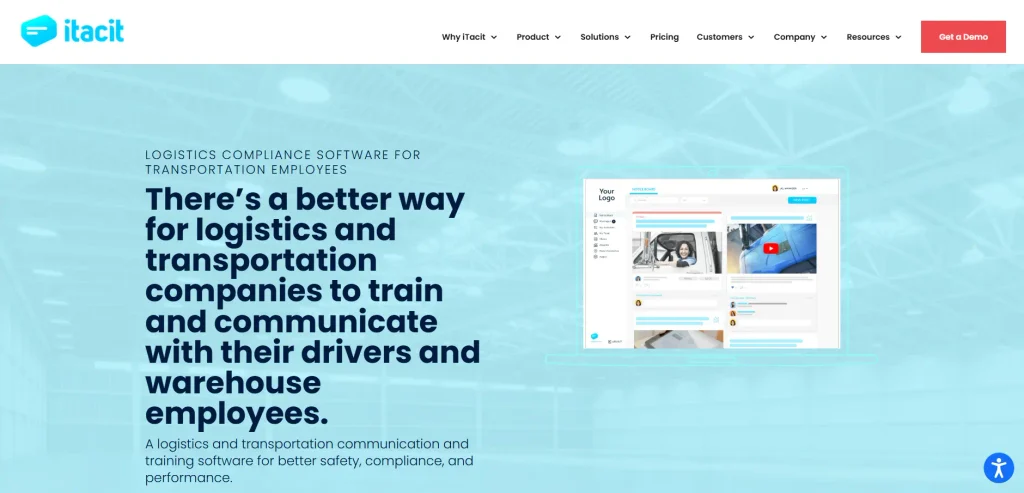
Of the seven, this is the only one where messaging, training, and policy sign off were designed as one product rather than built around a case file. A night shift dock lead opens a revised lift procedure on a phone in the break room, signs it, and the signature lands with his forklift certification expiry.
- One mobile app for messaging, training, forms, and documents, no company email required
- Targeted messaging by site, role, or shift, with read receipts on policy documents
- LMS supporting SCORM 1.2 and 2004, AICC, Storyline, and Captivate, with role based paths
- One roll up of who is certified, what lapses next, and where, not a file per depot
- Forms and task automation for incidents and approvals, plus connectors into the HR systems holding the roster (BambooHR, SAP SuccessFactors, Workday, UKG, ADP)
Rating: 4.6 out of 5 on Capterra, from 42 reviews.
Pricing: no public price list. A per user subscription quoted after a demo, across four cumulative tiers (Connect, Educate, Engage, Operate).
Not a fit for: buildings where connectivity is patchy. Nothing is held locally and nothing queues, so in a cold storage aisle or a below grade dock the form cannot be completed and the entry is not saved. The work gets redone on network.
2. EHS Insight
Best for: fleets that want DOT and FMCSA obligations tracked inside the safety system rather than in a separate binder.
This is the entry that surprised us. EHS Insight gets named less often than the big four EHS suites, but its logistics material is the most specific of the group: it lists driver qualification file review cycles, CDL and medical certification renewals, drug and alcohol testing deadlines, ELD audit records, and hazmat employee recertification under 49 CFR Part 172 as tracked compliance tasks. The mobile app also runs the full inspection, incident, permit, and training workflows offline and syncs when the device reconnects, which matters more in this industry than in almost any other.
- Audit and inspection management for daily equipment checks, dock audits, and facility walk throughs
- Incident and event management with OSHA 300 recordkeeping and automatic case classification
- Compliance task management covering DOT, FMCSA, OSHA, and hazmat obligations
- SCORM compatible training management with expiration tracking and role based deployment
- Safety data sheet dashboard with QR code lookup by location
Rating: 4.4 out of 5 on Capterra, from 59 reviews.
Pricing: the small and medium business tier starts at $4,600 per year, with enterprise pricing quoted. A free trial is available.
Not a fit for: teams whose real problem is reaching people. Day-to-day communication with the frontline is thin here, so it usually lands next to an existing comms tool rather than replacing one.
3. SafetyCulture
Best for: inspection volume. If your operation runs thousands of checklists a month, this is the tool built for that.
SafetyCulture (now presented as Mitti by SafetyCulture) grew out of mobile inspections, and it still shows. Templates are the centre of gravity, and the free tier means a depot can start using it on a Monday without a procurement cycle, which is both its strength and the reason it spreads through organisations without anyone deciding it is the system of record. Broadcast messages with acknowledgement tracking cover the lighter version of policy sign-off.
- Mobile inspections with a very large template library and offline capture
- Issue reporting that converts findings into assigned corrective actions
- Broadcast messages requiring acknowledgement, used for policy and procedure updates
- Course delivery and completion tracking for short-form training
- Analytics across sites, with a free plan for small teams
Rating: 4.6 out of 5 on Capterra, from 355 reviews.
Pricing: free plan available. Premium is $24 per seat per month billed annually, or $29 billed monthly. Enterprise pricing is quoted.
Not a fit for: DOT specific paperwork. Driver qualification files, hours of service records, and medical certificate tracking sit outside the product, so carriers end up pairing it with an ELD platform.
4. Intelex
Best for: large EHS programs that want breadth and are willing to configure it.
Intelex sells a module for nearly every EHS process a logistics company has: incident reporting, near miss reporting, job safety analysis, CAPA, audit management, safety inspections, training management, compliance tracking, document control, management of change, and claims. The breadth is genuine. So is the implementation effort. Worth noting for fleet buyers: the transportation and logistics application list does not name DVIRs, driver qualification files, or FMCSA workflows, so the road-specific work still needs a home.
- Incident and near-miss reporting with behaviour-based safety and safety observations
- Job safety analysis and process hazard analysis
- CAPA workflows tied to audits, inspections, and incidents
- Training management with compliance tracking and document control
- Claims management linking incident cost back to the event
Rating: 4.2 out of 5 on Capterra, from 63 reviews.
Pricing: the Essentials plan starts at $49 per user per month, with modular and enterprise pricing quoted. A free trial is offered.
Not a fit for: a fifty-truck carrier that wants to be live next month. The configuration that makes it useful at scale is the same configuration that makes it slow to stand up.
5. Cority
Best for: regulated enterprises that treat occupational health as part of safety, not a separate department.
Cority is the option to look at when the buying committee includes a medical or industrial hygiene function. Health surveillance, industrial hygiene sampling, incident management, audits and inspections, and a learning management module all live on one platform, and the reporting layer is built for people who have to answer regulator questions across dozens of sites. It is not aimed at the small end of the market and does not pretend to be.
- Incident management with enterprise reporting and analytics
- Audits and inspections across sites and business units
- Learning management for compliance and role based training
- Occupational health, including medical surveillance records
- Industrial hygiene sampling and exposure tracking
Rating: 4.4 out of 5 on Capterra, from 112 reviews.
Pricing: quoted only. Capterra lists no starting price and no free trial, so budget for a scoping conversation before you see a number.
Not a fit for: mid-market carriers. The cost and the configuration assume you have an EHS team to run it, and a lot of logistics companies have one safety manager and a coordinator.
6. Samsara
Best for: in-cab risk detection and driver coaching, sitting alongside a compliance system rather than replacing it.
Nobody buys Samsara to manage a corrective action register. They buy it because dash cameras and in-cab alerts change driver behaviour, and because the ELD and DVIR pieces are already in the same platform. That combination makes it a common second entry on a logistics shortlist, usually paired with one of the EHS suites above. Treat the safety score as a coaching input, not as compliance evidence.
- AI dash cameras with in-cab alerts for risky events
- Driver coaching workflows, including gamification to reward safer driving
- DVIR and ELD compliance apps in the same platform
- Connected Training and forms based Connected Workflows
- Fleet-wide reporting on safety events and trends
Rating: 4.5 out of 5 on Capterra, from 1,018 reviews.
Pricing: no public price list. Licences are quoted per vehicle per month, bundled with hardware, typically on multi-year terms.
Not a fit for: warehouse and dock staff. Anyone who never gets in a truck is invisible to a telematics-first platform, and policy acknowledgement for that group is not covered.
7. Motive
Best for: carriers who want ELD compliance and camera-based coaching from one vendor.
Motive covers similar ground to Samsara with a slightly heavier emphasis on the driver app. Its safety product detects more than twenty event types and generates AI coaching videos so a fleet supervisor is not manually clipping footage, and drivers get in-cab alerts plus two-way calling. What it does not do is training or policy sign-off. The safety pages describe coaching, and coaching after an event is a different thing from a course completed before one.
- AI Dashcam and AI Dashcam Plus with more than twenty detected safety events
- Safety Score and automated, personalised coaching workflows
- In-cab alerts and live two-way calling with drivers
- ELD compliance and hours of service records
- Driver app with DVIR submission and document capture
Rating: 4.5 out of 5 on Capterra, from 1,688 reviews.
Pricing: quoted per vehicle per month, hardware plus subscription. Capterra lists no starting price and no free trial, and reviewers frequently describe the contracts as expensive and inflexible.
Not a fit for: any organisation whose compliance gap is training records. There is no course library or acknowledgement workflow to lean on.
Incident And Inspection Workflows, Including DVIRs
Comparing incident management honestly means ignoring the reporting form, because every product on this list has one. The difference is what happens in the ninety seconds after submission and in the six weeks after that.
Ask three questions. Does a submitted incident automatically create corrective actions with named owners and due dates, or does someone have to open a spreadsheet? Do defects raised on a DVIR route to maintenance and return with a signature, or do they sit in a queue nobody owns? Can a supervisor complete the whole flow on a phone in a yard with one bar of signal?
That last one separates the field faster than any feature matrix. EHS Insight runs its inspection, incident, permit, and training workflows offline and syncs later. SafetyCulture captures offline. iTacit cannot do that work off network at all, which is a hard constraint on a thinly covered site and a non-issue in a depot with WiFi.
Connectivity has quietly become a filter rather than a footnote. Safety managers now open vendor conversations with it: does this still work in a building where the phone shows no bars, and does the record survive until the device gets back on the network? That question belongs at the top of an evaluation instead of surfacing in week three. Ask it about one named building rather than about the fleet in general.
Policy Acknowledgements And Frontline Communication
This is the axis that the pure EHS suites and the telematics platforms both under-serve, and it is worth understanding why. Both product families were designed around a record. The record is the inspection, or the driving event, or the incident file. Communication was added later, as a notification attached to a record.
A frontline communication platform is designed around a person: this driver, on this shift, at this terminal, who needs to see this document. Policy acknowledgement is where the two designs collide. What an auditor wants is a list of names, a document version, and a date, produced in one report. What most safety suites give you is a document control system that can prove the policy exists and a separate training system that can prove somebody clicked through a course.
The way buyers phrase the requirement is telling. The question that comes up is rarely which suite has document control. It is how an organisation proves that employees understood safety-critical information, tracked as surveys, acknowledgements, and approvals, across something like a hundred people spread over several states. Proof of delivery and proof of understanding are two different records, and only one of them holds up when it is challenged.
If you have deskless staff without company email, check the mechanics before you check the feature list. How does a new hire get credentials on day one? Can you target a policy to one site rather than the whole company? Does the acknowledgement record survive a version update, or does the report reset when the document changes?
Safety Training And Driver Training Automation
Training in logistics is mostly expiry management. Forklift certification, hazmat recertification, defensive driving refreshers, site inductions for a yard the driver visits twice a year. Almost none of it is a one time course.
So the useful comparison is not course quality. It is whether the system knows who is about to fall out of compliance and does something about it without a person remembering. Look for automatic recertification reminders, role-based assignment so a new hire in a new terminal gets the right path on day one, and a single view of expiries across every site.
Content matters less than most vendors suggest, because most logistics companies buy courses from a training provider and want to distribute and track them. SCORM 1.2 and 2004 support, AICC, and an HRIS integration so the roster stays current are worth more than a bundled library nobody watches. iTacit, EHS Insight, Intelex, and Cority all handle SCORM content. Samsara and Motive are coaching tools, not learning platforms, and the distinction shows up the first time an auditor asks for a training matrix.
DOT And FMCSA Compliance, And Getting The Audit Report Out
The DOT side has its own vocabulary and its own filing cabinet: driver qualification files, CDL and medical certificate expiries, hours of service logs, drug and alcohol testing programs, CSA scores, and DataQs challenges.
In this comparison, only EHS Insight names those obligations as tracked compliance tasks, while Samsara and Motive cover the electronic logging and inspection side directly because that is their origin.
Audit readiness is a separate question from compliance. Plenty of fleets are compliant and still take two weeks to prove it, which is survivable right up until an auditor asks for three years of records in a week.
Before you sign anything, ask the vendor to produce one specific report from their demo environment: every driver at one terminal, their current certifications, expiry dates, and the acknowledgement record for the most recent policy update, exported as a single file. If building that report needs a services engagement, you have your answer.
There is a mismatch here worth naming. Vendor material is written for the annual audit. The people who actually operate these systems spend their week on job safety analysis, licences, inspections, and certification renewals, in fifteen minute pieces between other work. Buy for the week.
EHS Suite Or Telematics: Where Each One Stops
The honest answer is that most logistics operations end up with both, and the split between them falls along a line neither vendor draws in its own material.
A telematics platform sees the vehicle and the driver behind the wheel. It cannot see the warehouse, the mechanic, the dock supervisor, or the office staff who also need policy sign-off and training records. An EHS suite sees the whole workforce and the whole case file, but it has no camera, no engine data, and no view of a hard braking event.
The pairing question is which one becomes the system of record for compliance evidence. Our view: it should be the platform that holds training and acknowledgement records, because that is what an auditor and an insurer both ask for first. The telematics data is an input to coaching, and coaching lives inside the training program.
For larger operations, integrated business processes can also connect safety-related workflows with warehouse, production, purchasing, and other operational systems.
How to Choose
Start by naming the bottleneck out loud, because the shortlist follows from it and not from a category name.
You have an inspection volume problem: buy the tool with the best mobile capture and the biggest template library, and accept that you will pair it with something else for driver files.
Teams that are failing audits on evidence rather than on practice need the opposite. Look at reporting first, and specifically at how quickly one report can combine training, certification, and acknowledgement data across sites.
When the real gap is reach, that is, you cannot get a policy in front of people who have no company email, then a frontline communication and training platform is the anchor purchase and the EHS modules are the extension.
A driver and warehouse workforce with no corporate inbox is a distinct buying problem, and it is the one iTacit addresses: logistics safety and compliance software in which training, forms, and policy acknowledgement live in the same app the shift messages arrive in. For specialized logistics operations such as healthcare deliveries, safe and compliant deliveries require additional tracking, handling, and regulatory controls.
Three more things worth doing before you sign. Ask about connectivity behaviour, naming your worst covered site rather than asking in general. Ask what the implementation actually involves, in weeks and in your hours, not theirs. And discount the AI demo.
The feature is spread across the whole category now, and it means something different at every vendor: Samsara and Motive put AI inside the dash camera and the coaching workflow, Cority describes its platform as converging people, data, and AI agents, SafetyCulture meters AI credits per seat on its plans, and iTacit’s assistant answers only from an organisation’s own approved documents.
That spread is what makes AI table stakes rather than a reason to choose. Ask what a given assistant is allowed to read, and where its answers come from.
Budget note. Per seat pricing looks cheap for a fifty person safety team and expensive when you extend it to two thousand drivers and warehouse staff. Price the whole workforce, including the people you plan to add next year, before you compare quotes.
Frequently Asked Questions
Which LMS integrations work best with safety platforms for truck fleets?
Look for SCORM 1.2 and 2004 and AICC support first, since that is how most purchased safety courses are packaged. After that, the integration that saves the most work is the HRIS or payroll sync (ADP, UKG, Workday, and SAP are the common ones) because it keeps the roster and the org structure current without manual uploads. Single sign-on matters less than people expect for frontline staff, many of whom have no corporate identity to sign on with.
Do telematics tools like Samsara or Motive replace an EHS platform?
No. They cover the vehicle and the driving event: dash cameras, in cab alerts, coaching, ELD records, and DVIR submission. They do not carry incident casework with corrective actions, they do not manage certifications for people who never drive, and they do not provide policy acknowledgement records. Most fleets run a telematics platform alongside a safety and compliance system and connect the two through reporting.
Can drivers acknowledge policies from a phone without a company email address?
Yes, on platforms designed for deskless workers. The employer issues credentials, the worker uses a mobile app, and the acknowledgement is recorded against the person and the document version rather than against an inbox. This is the specific gap in most tools that were built for office staff, and it is worth testing during a trial with an actual driver rather than a demo account.
What is a DVIR, and does the software have to store it?
A Driver Vehicle Inspection Report is the pre trip and post trip inspection a commercial driver completes on the vehicle. Defects have to be recorded, repaired or signed off as not affecting safe operation, and retained. Electronic DVIRs are standard now, and the practical requirement is that a defect creates a maintenance task and that the closed record stays retrievable for the retention period.
How quickly should we be able to produce a compliance report for an audit?
Same day is a reasonable target for a single site and a single question, for example every certification expiring in the next ninety days at one terminal. Anything that takes more than a few hours usually means the data is spread across two or three systems. Test this during procurement with your own data rather than the vendor’s sample set.