A few years ago, most business leaders only thought about the network when something broke.
The Wi-Fi dropped during a sales demo. A branch office could not access a cloud app. A customer portal loaded slowly. A video call froze right when the team was trying to close a deal.
Then everyone looked at IT.
Today, that mindset is outdated. Connectivity is no longer just a background utility. It is part of the customer experience, the employee experience, and the revenue engine. Every digital campaign, ecommerce transaction, SaaS workflow, data dashboard, and remote collaboration session depends on fast, secure, reliable access.
That is why enterprise connectivity has become a growth strategy.
For marketers, developers, operations teams, and business owners, this shift matters. A slow or unreliable network does not just create technical frustration. It delays campaigns, breaks workflows, reduces productivity, and damages brand trust. In a digital-first business, the network is often the invisible layer holding everything together.
The New Reality: Every Business Is Now a Connected Business
Modern companies run on a sprawling mix of cloud platforms, mobile devices, branch locations, remote workers, IoT endpoints, analytics tools, CRMs, ecommerce platforms, and customer-facing applications.
That complexity creates a real challenge.
Traditional enterprise networks were often built around fixed offices, predictable traffic, and static infrastructure. But today’s traffic moves everywhere: from users to SaaS apps, from stores to cloud workloads, from remote teams to collaboration platforms, and from devices to data centers.

Juniper’s solution brief with Google Cloud describes the problem clearly: legacy networks are often fragmented across different technologies, which increases complexity, cost, risk, and blind spots. The same brief positions AI-native networking and Google Cloud WAN as a way to simplify operations, automate actions, and deliver end-to-end connectivity, visibility, and assurance across campus, branch, and cloud environments.
That matters because business teams do not care which router, access point, switch, or WAN link caused the issue. They care whether the website works, the campaign launches, the video meeting runs smoothly, and the customer gets what they came for.
Why Connectivity Now Impacts Marketing and Customer Experience
At first glance, enterprise networking may sound like an IT-only conversation. But look closer, and you will see the marketing connection everywhere.
A retail brand launching a location-based promotion needs dependable in-store connectivity. A SaaS company running product demos needs stable video and app performance. A healthcare provider offering digital check-ins needs secure access across branches and devices. A B2B team using CRM, automation, and analytics platforms needs reliable cloud connectivity throughout the day.
When the network is slow, fragmented, or hard to troubleshoot, the impact spreads quickly:
- Marketing teams lose access to campaign tools.
- Sales teams struggle with demos and customer calls.
- Developers face delays pushing updates.
- Customer support teams deal with sluggish systems.
- Customers experience poor digital interactions.
This is why the conversation has moved beyond “Is the network up?” to “Is the network helping the business perform?”
Smarter connectivity gives companies the foundation to move faster. It supports better user experiences, cleaner data flows, more reliable cloud access, and stronger security. In practical terms, Juniper Mist solutions for smarter enterprise connectivity help teams execute without constantly waiting on technical fixes.
What Makes AI-Native Networking Different?
AI-native networking is not simply traditional networking with an AI feature added on top. The idea is to build intelligence into the operating model of the network itself.
Instead of waiting for users to report problems, an AI-native platform can collect real-time data, detect anomalies, identify likely root causes, and recommend or automate fixes. HPE describes Mist AI as a secure, self-driving network that continuously learns, adapts, and resolves issues in real time to deliver reliable performance at scale.
That is a major shift.
Traditional network management is often reactive. A ticket comes in. An engineer checks dashboards. Logs are reviewed. Packet captures may be pulled. Multiple systems are compared. Eventually, the team finds the issue.
AI-native networking aims to shorten that path. This is one reason Juniper Mist solutions for smarter enterprise connectivity are increasingly relevant for businesses that need reliable access across users, devices, branches, and cloud applications.
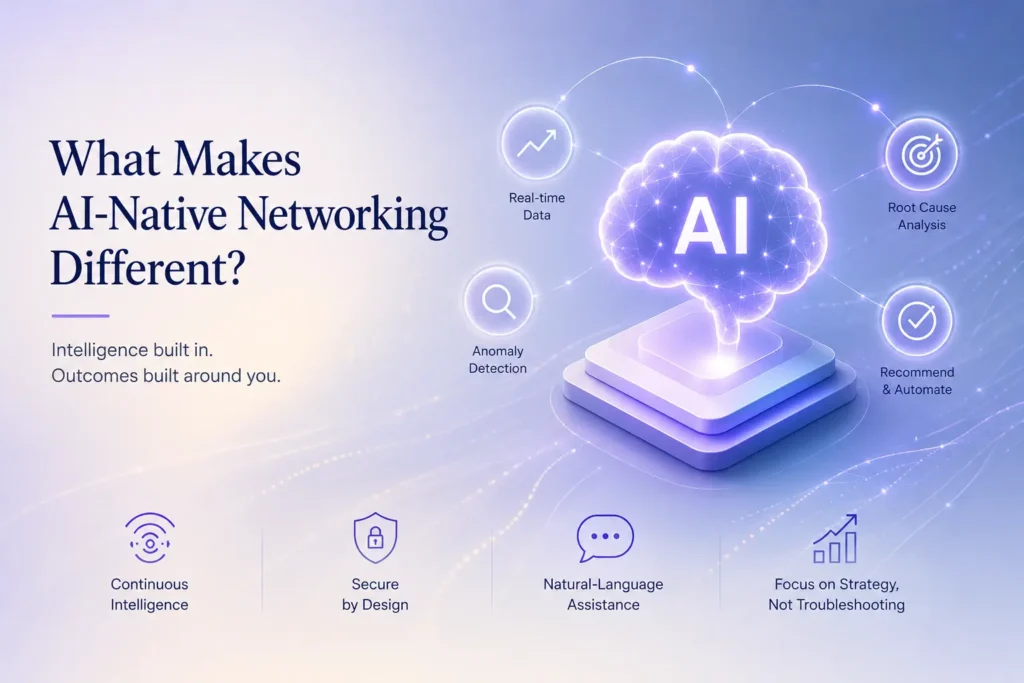
It uses telemetry, machine learning, automation, and natural-language assistance to help teams understand what is happening across users, devices, applications, and locations. The goal is not to replace IT teams. The goal is to remove repetitive troubleshooting work so those teams can focus on strategy, architecture, security, and improvement.
The Role of Juniper Mist in Smarter Enterprise Connectivity
Juniper Mist is one of the clearest examples of this AI-native approach. It brings together wired access, wireless access, WAN assurance, access assurance, automation, analytics, and Marvis AI to help enterprises manage connectivity more intelligently.
For companies evaluating Juniper Mist solutions for smarter enterprise connectivity, the core value is not just faster Wi-Fi or easier dashboards. It is the ability to create a more responsive, automated, and user-aware network across the enterprise.
Juniper’s AI-native networking brief explains that Mist delivers automation, insights, and self-driving actions for campus and branch environments. It also highlights Marvis AI Assistant as a conversational interface that can identify issues such as missing VLANs, bad cables, congested WAN circuits, misconfigured ports, and other network problems.
That kind of visibility changes how IT teams operate.
Instead of treating every connectivity complaint as a mystery, teams can move closer to root cause quickly. Instead of relying only on static dashboards, they can ask questions, review user-level experience, and use automation to reduce manual errors.
For businesses with multiple locations, hybrid teams, or high-density environments, that can be a meaningful advantage.
Real-Time Visibility Beats Guesswork
One of the biggest problems with older network environments is that they often provide incomplete or delayed information.
A dashboard may show that an access point is online. A switch may look healthy. A WAN circuit may appear available. But users are still frustrated because the actual experience is poor.
This gap between infrastructure status and user experience is where AI-native networking becomes valuable.
Mist collects telemetry from wired and wireless LAN infrastructure and uses machine learning models to identify patterns, detect anomalies, and trigger automated actions. Marvis, the AI assistant, can translate natural-language questions into diagnostics, helping teams locate root causes without digging through multiple dashboards or raw logs.
That matters because performance problems are rarely simple anymore.
A slow application could be caused by Wi-Fi interference, authentication delays, WAN congestion, DNS issues, device problems, cloud latency, or misconfigured policy. Without real-time visibility, teams waste time ruling out possibilities.
With better telemetry, they can move from guesswork to evidence. In that sense, Juniper Mist solutions for smarter enterprise connectivity are not just about monitoring the network; they are about helping teams understand the real experience behind every connection.
Smarter Networks Reduce Operational Drag
Every business has hidden operational drag. It shows up in repeated support tickets, slow troubleshooting, manual configuration work, inconsistent branch deployments, and avoidable downtime.
Individually, these problems may seem small. Together, they drain time and attention from more valuable work.
AI-native networking helps reduce that drag by automating routine tasks and improving accuracy. Juniper’s brief highlights simplified Day 0/1/2 operations, real-time performance visibility, unified management, cloud-native integration, cost optimization, and end-to-end Zero Trust as key capabilities of its AI-native approach.
In plain English, this means IT teams can:
- Deploy new sites faster.
- Spot problems earlier.
- Reduce manual configuration mistakes.
- Manage wired, wireless, and WAN environments from a more unified view.
- Improve security policy enforcement.
- Spend less time chasing recurring issues.
For business leaders, the benefit is simple: less friction.
When IT is not buried in repetitive troubleshooting, the organization becomes more agile. New locations, new apps, new teams, and new digital services become easier to support.
Security Has to Be Built Into Connectivity
Modern enterprise connectivity cannot only be fast. It also has to be secure.
This is especially important as companies support hybrid work, BYOD policies, IoT devices, cloud apps, and distributed locations. More users and devices mean more access points for potential risk.
HPE states that Mist AI helps remove security silos and automate Zero Trust at scale through unified management, a common operating system, and a single policy framework.
That is an important point. Security becomes harder when policies are scattered across separate tools and teams. A smarter network should help enforce access based on identity, device context, and policy, rather than relying only on static perimeter assumptions.
Juniper’s AI-native networking brief also emphasizes identity-based access controls, real-time threat detection, dynamic policies, device awareness, and Zero Trust access for campus and branch environments.
For growing companies, this approach is valuable because security scales with the business. Instead of reinventing access control every time a new office, user group, or device category appears, teams can use consistent policy frameworks across the environment.
Cloud Connectivity Is Now Part of the Same Conversation
Enterprise networks used to be built mainly around connecting users to internal resources. Today, the priority is often connecting users, branches, workloads, and applications across multiple cloud and SaaS environments.
That is why WAN modernization matters.
Juniper’s brief with Google Cloud describes Google Cloud WAN as a managed global solution that unifies enterprise backbones and SD-WANs into a high-performance network with integrated Google and partner security services. The brief also states that it can offer up to 40% lower total cost of ownership and up to 40% better performance compared with customer-managed WANs and the public internet.
For businesses, the takeaway is not just about one vendor combination. It is about the direction of enterprise connectivity as a whole.
The network has to support cloud-first work. It has to connect offices, workloads, users, data centers, and applications without creating a mess of one-off tools and fragile routing decisions.
When AI-native campus and branch networking works alongside cloud-optimized WAN connectivity, companies can create a more consistent experience across locations.
Why Architecture Matters More Than Features
It is easy to compare platforms by feature lists. But for enterprise connectivity, architecture matters just as much.
A tool may claim to use AI. But if the platform is built on delayed polling, controller bottlenecks, or disconnected data sources, it may struggle to deliver real-time intelligence at scale.
Turn-Key Technologies’ architecture analysis explains that Mist AI is built on a cloud-native microservices architecture and uses real-time telemetry from access points, switches, and WAN edges to detect anomalies, troubleshoot problems, and optimize configurations. It also notes that Marvis AI uses natural language to surface root causes and recommend actions before users are affected.
That distinction is important.
An AI-native architecture is not only about having smarter reports. It is about creating a network that can observe, learn, adapt, and assist continuously.
For enterprises with thousands of users, many sites, or critical digital services, this can make the difference between a network that merely functions and a network that actively supports growth.
Brownfield-Friendly Modernization Matters
One concern many companies have is whether network modernization requires a costly rip-and-replace project.
In reality, many businesses need a phased path. They may have existing switches, legacy branch infrastructure, budget constraints, compliance requirements, or operational dependencies that make overnight transformation unrealistic.
That is why brownfield support matters.
Turn-Key Technologies notes that Mist AI can be deployed in both greenfield and brownfield environments, including alongside existing hardware, to provide monitoring, AI-driven automation, and Marvis-driven insights without requiring a full rip-and-replace strategy.
This is a practical advantage for mid-market and enterprise organizations.
A smarter connectivity strategy does not always start with replacing everything. Sometimes it starts with gaining visibility, improving troubleshooting, automating repetitive work, and modernizing one layer at a time. That makes Juniper Mist solutions for smarter enterprise connectivity a practical fit for organizations that want progress without unnecessary disruption.
What Business Leaders Should Look For in a Smarter Connectivity Strategy
The best enterprise connectivity strategy is not built around buzzwords. It is built around business outcomes.
Before investing in a modern networking platform, leaders should ask the following questions.
Can the Network Show User Experience, Not Just Device Status?
A green status light does not always mean users are having a good experience. Look for tools that provide insight into actual user, device, application, and site performance.
Can IT Identify Root Causes Faster?
The right platform should reduce the time spent jumping between dashboards, logs, and manual checks.
Can the Network Support Hybrid and Multi-Site Work?
Connectivity should remain consistent whether users are in headquarters, branches, remote offices, or cloud-connected environments.
Can Policies Scale Securely?
Identity-based access, Zero Trust principles, and centralized policy management become more important as the business grows.
Can Automation Reduce Repetitive Work?
Automation should help with configuration, troubleshooting, anomaly detection, and operational consistency.
Can the Architecture Evolve With the Business?
The platform should support cloud-first operations, integrations, APIs, and future growth without forcing constant redesign.
The Bottom Line: Connectivity Is Part of Digital Growth
The businesses that win digitally are not always the ones with the most tools. They are the ones with the least friction.
Their teams can access what they need. Their apps perform reliably. Their branches stay connected. Their data flows cleanly. Their customer experiences do not collapse because of preventable network issues.
That is why smarter enterprise connectivity deserves a seat at the growth table.
AI-native networking, real-time telemetry, automation, cloud-ready WAN design, and stronger security are not just technical upgrades. They are business enablers. They help teams move faster, reduce downtime, improve customer experiences, and support digital transformation with less operational strain.
For marketers, entrepreneurs, developers, and business leaders, the message is clear: the network is no longer just infrastructure.
It is part of the experience your business delivers.