The first wave of remote work was often discussed as a question of productivity. Could people stay focused outside the office? Could managers trust distributed teams? Could companies keep meetings, projects, and client communication moving without everyone in the same building?
Those questions were reasonable at the time, but they missed a quieter structural change. Remote work did not only move employees from desks to homes, hotels, cafes, and coworking spaces. It also moved the security boundary.
In the office era, companies could at least imagine a controlled environment. Employees used known networks, company devices, internal systems, and physical locations that IT teams could monitor more easily. The risks were never gone, but the shape of the environment was clearer.
Flexible work changed that. The same task can now happen from a kitchen table, a train station, a hotel room, or an airport lounge. The software may be identical, but the conditions around access are not. That is where many organizations still underestimate the shift.

The Office Used to Be the Security Container
The traditional office was never perfectly secure, but it gave companies a useful container. The network was known. Devices could be managed. Access rules could be applied inside a more predictable physical and digital setting.
An employee logging into a dashboard from an office workstation was not risk-free, but the company had more control over the surrounding environment. IT teams could define network rules, monitor unusual activity, control hardware, and set expectations around how work systems were used.
That container shaped how many organizations thought about security. Policies were built around the idea that work happened from a known place, on known equipment, through known connections. Even when employees took laptops home, the office remained the center of gravity.
Remote work weakened that assumption. The system being accessed may still belong to the company, but the environment around the access point often does not. A cloud dashboard does not know, by default, whether the person opening it is on a private home network, a hotel connection, or public Wi-Fi in a crowded terminal.
That is the first major change. Security can no longer be understood only as something that protects company systems. It also has to account for the changing conditions under which people reach those systems.
Remote Work Made the Environment Variable
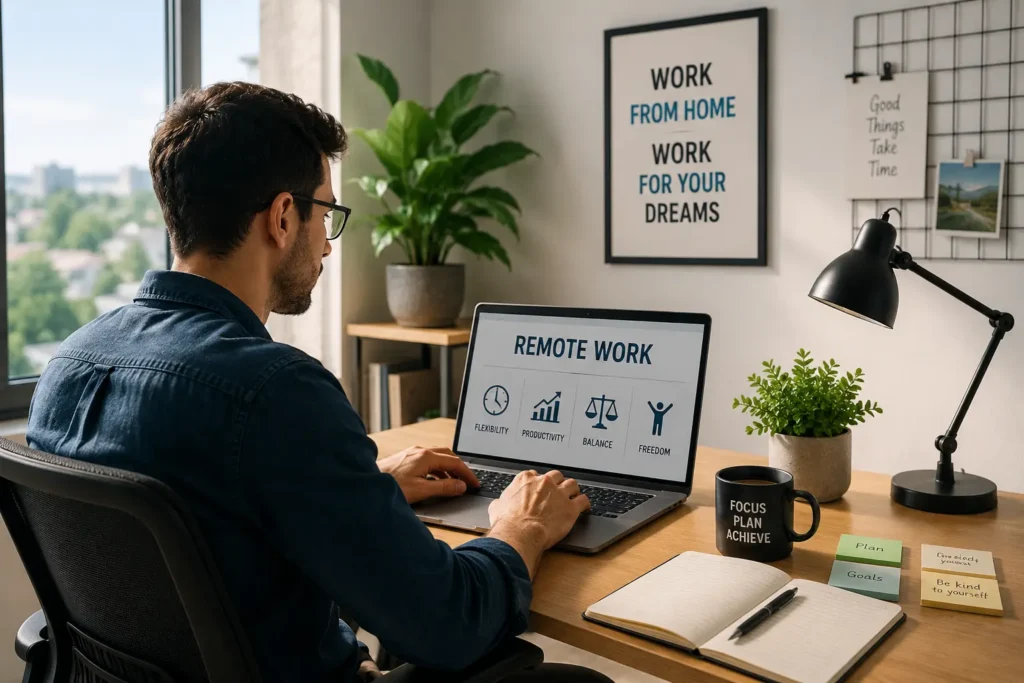
Flexible work made location part of the risk model. The same employee, using the same login, may move through several different network environments in a single week.
A product manager might review customer feedback from home, approve a file from a hotel, and check an analytics dashboard from airport Wi-Fi before a flight. A salesperson may handle client documents from a coworking space between meetings. A founder may open financial tools from a short-term rental while traveling.
None of these scenarios is unusual. That is precisely why they matter. The risk is no longer limited to whether an account has a strong password or whether the cloud platform itself is secure. It also depends on the connection, device, location, and task being performed at that moment.
This does not mean every remote work scenario is dangerous. It means that remote work has made security contextual. Reading a team announcement from a cafe is not the same as downloading a customer list. Joining a routine video call from a hotel room is not the same as logging into an admin console over an open network.
Organizations that treat all remote activity as the same will struggle to give useful guidance. Employees do not need abstract warnings about “being careful online.” They need a clearer sense of which tasks require a more trusted environment and which habits reduce exposure when conditions are less controlled.
The New Risk Is the Path Between the User and the System
Security conversations often focus on the user. Did someone click the wrong link? Did they reuse a password? Did they ignore an update? Human behavior matters, but remote work adds another layer that is easy to overlook: the path between the user and the system.
A careful employee can still connect through an unmanaged network. A strong password can still be entered from a device using a risky connection. A company system may be well built, yet still be reached through an environment the company does not control.
This is why the connection layer has become more visible. For remote teams, the route between the person and the platform is now part of the security picture. Tools such as a VPN belong in this discussion not because they solve every remote-work risk, but because they address a specific part of the problem: protecting traffic and reducing exposure when users connect through less trusted networks. X-VPN is one example of a consumer-facing tool positioned around private browsing, public Wi-Fi protection, and access across different network environments.
The practical point is not that companies should add more tools for the sake of looking secure. It is that remote work has expanded the space where risk can appear. Some of that risk sits inside applications. Some sits inside devices. Some sits in user behavior. And some sits in the connection between them.
Once that is understood, the security conversation becomes more realistic. Instead of treating the employee as the weak point, companies can look at the full path of access and decide where protection, training, or better defaults are needed.
Flexible Work Needs Simpler Security Rules
One reason remote security fails is that companies often make it too complicated. Employees are given long policy documents, repeated warnings, and tool requirements that may not clearly connect to their daily work.
The result is predictable. People remember the parts that are easy to understand and ignore the parts that feel abstract. A rule such as “avoid unsecured public networks when accessing sensitive systems” is more useful than a vague instruction to “practice good cybersecurity.” A clear distinction between low-risk and high-risk tasks is easier to apply than a general warning that every online action is dangerous.
Good remote security reduces cognitive load. It helps people make better decisions without turning every workday into a compliance exercise. A team member should not need to perform a full risk assessment before opening a laptop, but they should understand why checking a public company webpage is different from downloading payroll information.
This is also why teams often need practical ways to evaluate tools before turning them into policy. A VPN Free Trial can be useful in that context when employees or small teams want to understand how a privacy tool behaves across home networks, public Wi-Fi, and travel situations before making it part of a wider access routine.
The implication is important for managers as well as IT teams. Security guidance must fit the way people actually work. If employees travel, use cloud tools, move between devices, and switch networks during the day, policies should reflect those conditions rather than pretend the office is still the default environment.
The Future of Remote Security Is Context-Aware
The next stage of remote work security will be more context-aware. It will not treat every login, every location, and every task as equal.
A useful model considers several questions at once: What device is being used? What network is carrying the connection? What system is being accessed? How sensitive is the task? Is the location familiar or temporary? Is the user simply reading information, or are they handling data that could create business risk if exposed?
This kind of thinking does not require turning employees into security specialists. It requires giving them a better map. The office used to provide that map by default because most work happened inside a shared environment. Remote work removed that simplicity, so companies need to replace it with clearer habits and smarter defaults.
The broader lesson is that flexible work is not just a staffing model or a perk. It changes the infrastructure of trust. It asks organizations to protect systems that are accessed from places they do not own, through networks they do not manage, by people who are often making quick decisions under ordinary work pressure.
Remote work is not going away, and the answer is not to recreate the office through heavier control. The better answer is to recognize where the boundary moved. Security now begins earlier than the login screen. It begins with the conditions of access itself.