Why Leadership, Not Technology, Determines Success
I. The Billion-Dollar Paradox
Artificial intelligence has never been more capable. Large language models can draft legal briefs, write code, and synthesize medical literature in seconds. Computer vision systems outperform human radiologists in certain diagnostic tasks. Predictive algorithms help manufacturers reduce downtime before a machine ever breaks.
Yet despite all this power, most organizations are not seeing the returns they expected. McKinsey estimates that fewer than one in ten companies have achieved meaningful, scaled AI value across the enterprise. The gap between AI capability and AI impact is not a technology gap. It is a governance gap.
This article argues that AI transformation is a problem of governance. The organizations that succeed with AI are not always the ones with the most sophisticated models or the largest data science teams. They are the ones that have figured out how to make decisions about AI, who owns it, who oversees it, how it connects to business objectives, and how it is managed over time.
Governance is not a bureaucratic afterthought. It is the operating system beneath every successful AI program. And until more organizations understand that, the billion-dollar AI paradox will persist.
II. What Does “AI Transformation Is a Problem of Governance” Mean?
A Simple Definition
AI governance is the set of policies, processes, roles, and accountability structures that guide how an organization develops, deploys, and manages artificial intelligence systems. It ensures AI operates within ethical, legal, and strategic boundaries while delivering measurable business value.
In short: governance answers the question—who decides what AI does, and how do we know it is working right?
AI Adoption vs AI Transformation
Many leaders confuse adoption with transformation. Adopting AI means deploying tools—a chatbot here, a recommendation engine there. Transforming with AI means rethinking how work gets done, how decisions are made, and how value is created across the business.
The difference matters enormously. Adoption without transformation produces isolated productivity gains. Transformation changes the underlying structure of the business. Governance is what makes transformation possible, because it creates the shared accountability and trust needed to let AI operate at scale.
AI Governance vs AI Management vs AI Compliance
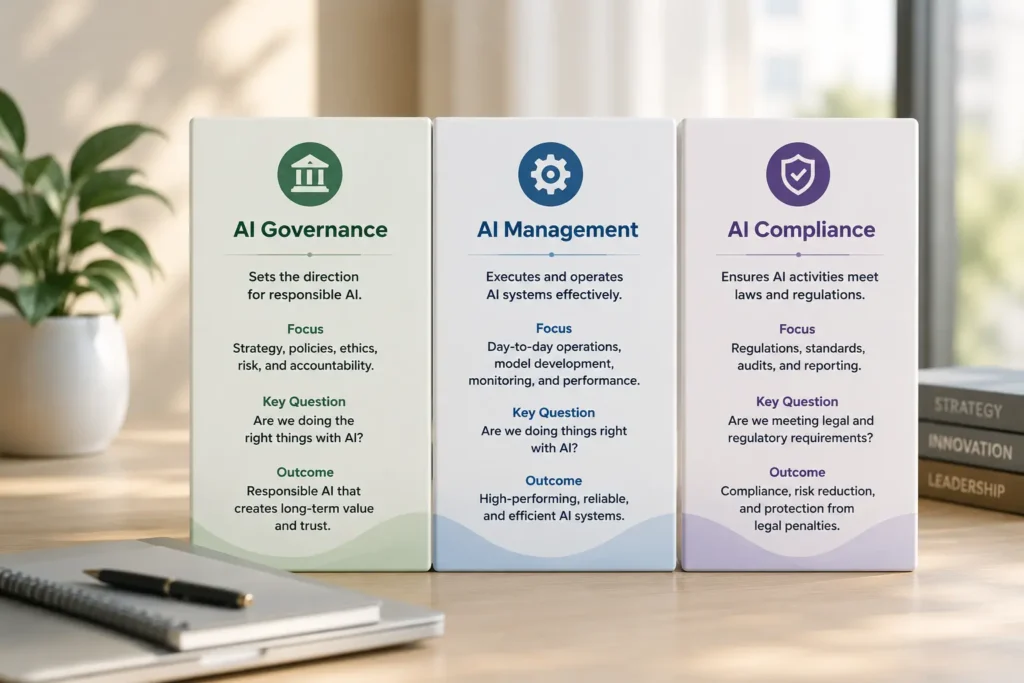
These three terms are often used interchangeably, but they describe distinct activities.
| Concept | Definition | Focus | Timeframe |
| AI Adoption | Deploying AI tools within existing workflows | Tools and tasks | Short-term |
| AI Transformation | Redesigning business processes and models using AI | Strategy and structure | Long-term |
| AI Governance | Policies, roles, and oversight structures guiding AI decisions | Control and accountability | Ongoing |
| AI Management | Day-to-day operations and performance of AI systems | Execution and efficiency | Continuous |
| AI Compliance | Adherence to legal, regulatory, and ethical standards | Risk and rules | Periodic |
Governance provides the framework. Management executes within it. Compliance validates it. An organization can have strong compliance and still have weak governance—because compliance checks boxes while governance shapes behavior.
III. Why AI Transformation Has Become a Governance Challenge
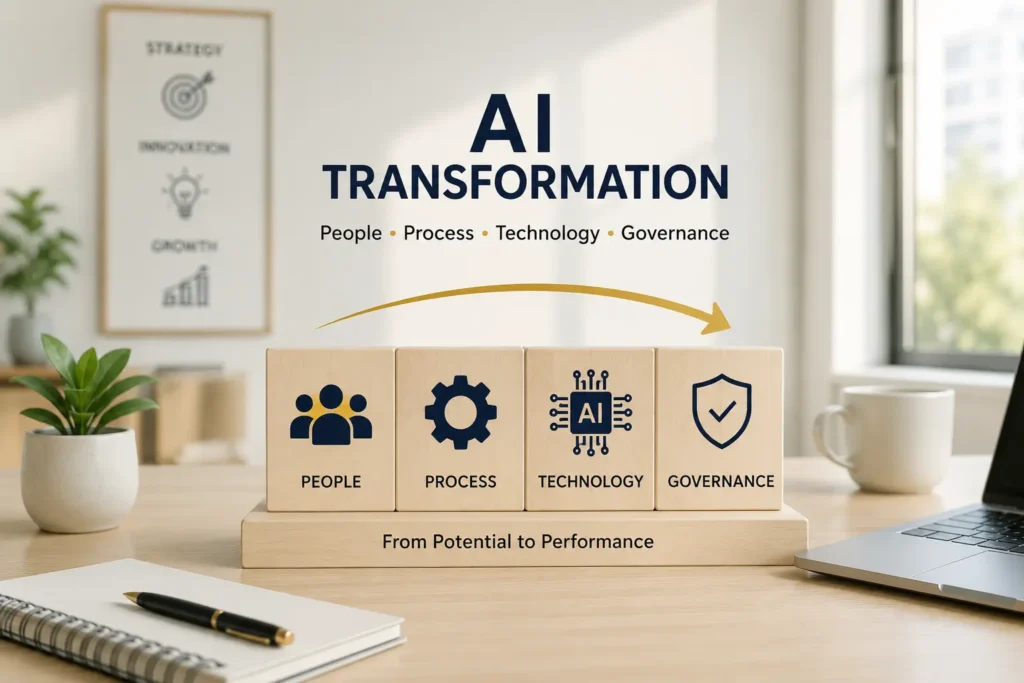
Technology Is No Longer the Bottleneck
Five years ago, many organizations could not build effective AI because they lacked the compute, the data, or the talent. That bottleneck has largely dissolved. Cloud platforms provide scalable AI infrastructure on demand. Pre-trained foundation models are available to any development team.
The limiting factor today is not technical capacity. It is organizational capacity—the ability to make good decisions about where AI should operate, who is responsible when it fails, and how it connects to the goals the business actually cares about.
The Great Decoupling Between AI Capability and Business Value
There is a widening gap between what AI can do in a controlled environment and what it actually delivers inside a live business. A model that performs brilliantly in a proof-of-concept can collapse when it encounters the messy realities of production data, human resistance, and organizational complexity.
This decoupling has a name in enterprise circles: pilot purgatory. Organizations run dozens of AI experiments that never scale. The technical results are often promising. The organizational conditions for scale are not.
Why Traditional Digital Transformation Lessons No Longer Apply
Organizations that went through digital transformation in the 2010s learned hard lessons about change management, agile delivery, and executive sponsorship. Those lessons still apply. But AI introduces entirely new problems that traditional digital transformation did not have.
Software is predictable. AI is probabilistic. A CRM system does exactly what it was programmed to do, every time. An AI model makes predictions that shift over time as data changes. That unpredictability demands a different kind of oversight, one that most organizations are not yet built for.
Decision Rights Matter More Than Algorithms
The most important governance question in any AI program is deceptively simple: who has the authority to decide? Who approves a new AI use case? Who can stop a model from running? Who owns the outcome when something goes wrong?
When these questions are unanswered, organizations end up with AI systems that drift without oversight, business outcomes that no one owns, and accountability that disperses across teams until it belongs to no one. The algorithm is rarely the failure point. The governance structure is.
IV. The State of Enterprise AI Today
The evidence base for AI’s governance deficit is growing. Consider these findings:
| Metric | Finding | Source |
| AI project failure rate | ~85% of AI projects fail to reach production | Gartner |
| Enterprise AI scaling | <10% of companies scale AI across functions | McKinsey |
| Shadow AI prevalence | 65%+ of employees use unauthorized AI tools | IBM |
| AI governance maturity | Only 35% of organizations have formal AI governance | Deloitte |
| Expected AI investment | $200B+ enterprise AI spend projected annually by 2026 | IDC |
| Governance readiness | <25% of organizations feel ‘very prepared’ for AI risks | MIT Sloan |
These numbers tell a clear story. Spending is accelerating. Readiness is lagging. The organizations that close this gap through stronger governance will be the ones that convert AI investment into durable competitive advantage.
V. Why AI Is Different From Traditional Software
Deterministic Software vs Probabilistic AI
Traditional software follows fixed rules. Enter input A, get output B. Every time. An accounts payable system processes invoices the same way today as it did three years ago. You can audit it, trace it, and predict its behavior exactly.
AI systems do not work this way. They produce outputs based on statistical patterns in data. Two slightly different inputs can produce meaningfully different outputs. The model’s behavior is inherently probabilistic, which means it requires ongoing oversight rather than one-time validation.
| Attribute | Traditional Software | AI Systems |
| Behavior | Fixed and deterministic | Probabilistic and variable |
| Auditability | Complete and traceable | Often opaque |
| Change over time | Only changes when updated | Can drift without any code changes |
| Failure modes | Known and testable | Novel and emergent |
| Accountability | Clear (follows logic) | Diffuse (follows data patterns) |
| Governance model | Set-and-forget | Monitor continuously |
Model Drift
Model drift occurs when an AI model’s performance degrades over time because the real-world data it encounters no longer matches the data it was trained on. A credit risk model trained before a recession may significantly miscalculate risk during an economic downturn.
Drift is silent. It does not throw an error. The model keeps running, producing increasingly unreliable outputs, until someone notices—usually after real business damage has occurred. Governance structures must include systematic monitoring to catch drift before it causes harm.
Hallucinations
Generative AI systems can produce outputs that are fluent, confident, and completely wrong. This phenomenon, known as hallucination, creates significant risk when AI is used to generate customer communications, legal documents, medical summaries, or financial analyses.
Governance frameworks must establish which use cases require human review of AI outputs, and at what frequency, to prevent hallucinated content from reaching decision-makers or customers.
The Accountability Vacuum
When an AI model makes a bad decision, who is responsible? This question exposes a genuine organizational gap. The data scientist who built the model? The business leader who approved it? The vendor who supplied it? The executive who funded it?
Without explicit governance structures, accountability disperses and ultimately disappears. This vacuum is not just a legal and reputational risk—it actively discourages good AI stewardship, because no one feels ownership over outcomes.
VI. The Biggest Governance Challenges Holding Organizations Back
Pilot Purgatory
This is the most common AI pathology in enterprise settings. Teams build impressive proofs of concept that demonstrate genuine AI capability, then struggle to move to production at scale. The technical work is done, but the organizational work, integration with business processes, change management, ongoing support structures, was never properly designed.
Shadow AI
Shadow AI refers to AI tools adopted by employees or teams without organizational knowledge or approval. A marketing team starts using an unauthorized AI writing assistant. A finance analyst builds a personal GPT workflow with company data. An operations manager subscribes to an AI planning tool on a personal card.
Each of these creates security, compliance, and governance exposure that the organization cannot manage because it does not know it exists. Research consistently shows that the majority of employees are already using AI tools their organizations have not sanctioned.
Ownership Gaps
Many AI initiatives lack a clear owner. The data science team built the model. The IT team deployed it. The business unit uses it. No one has formal accountability for its ongoing performance, its alignment with business objectives, or its behavior in edge cases. Ownership gaps are the governance equivalent of a ship with a crew but no captain.
Poor Data Quality
AI systems are only as reliable as the data they learn from. Organizations that lack mature data governance—clear data ownership, consistent quality standards, well-documented lineage—cannot build trustworthy AI. This is one area where traditional data governance directly enables AI governance.
Organizational Resistance
AI adoption often threatens existing ways of working, and sometimes existing jobs. Without strong change management and executive leadership, resistance can quietly kill AI programs even when the technology itself performs well. Governance frameworks must include stakeholder engagement and clear communication about AI’s role.
Lack of Executive Sponsorship
AI governance cannot be delegated to a data science team or an IT department. It requires visible, sustained leadership commitment. When AI governance lacks executive sponsorship, it inevitably loses out to other organizational priorities. Resources shrink, timelines slip, and accountability diffuses.
VII. The AI Governance Operating Model
Effective AI governance requires clarity about who does what. Here is a practical model for enterprise AI governance roles:
| Role | Governance Responsibility |
| Board of Directors | Oversee AI risk, ethics policy, and regulatory exposure |
| CEO | Champion AI strategy, set ethical tone, approve major AI investments |
| Chief AI Officer (CAIO) | Lead enterprise AI strategy, govern AI portfolio, chair steering committee |
| CIO / CTO | Own AI infrastructure, security, and technical standards |
| Chief Data Officer (CDO) | Govern data quality, lineage, privacy, and access |
| Legal & Compliance | Monitor regulatory requirements, manage AI legal risk |
| Security Teams | Protect AI systems from adversarial attacks and data leakage |
| Business Leaders | Own AI outcomes in their domain, ensure business alignment |
| AI Steering Committee | Cross-functional oversight of AI portfolio and governance decisions |
RACI Matrix for Key AI Governance Decisions
| Decision | Board | CEO/CAIO | CIO/CTO | CDO | Biz Leader | Legal |
| Approve AI strategy | Approve | Responsible | Consult | Consult | Inform | Inform |
| Prioritize AI use cases | Inform | Responsible | Consult | Consult | Consult | Inform |
| Approve high-risk AI deployment | Approve | Responsible | Consult | Consult | Accountable | Consult |
| Define AI ethics policy | Approve | Responsible | Inform | Inform | Inform | Consult |
| Monitor model performance | Inform | Inform | Responsible | Accountable | Consult | Inform |
| Manage AI compliance | Inform | Inform | Consult | Consult | Inform | Responsible |
VIII. The Hourglass Governance Model
A useful mental model for enterprise AI governance is the hourglass: three layers, each essential, each connected.
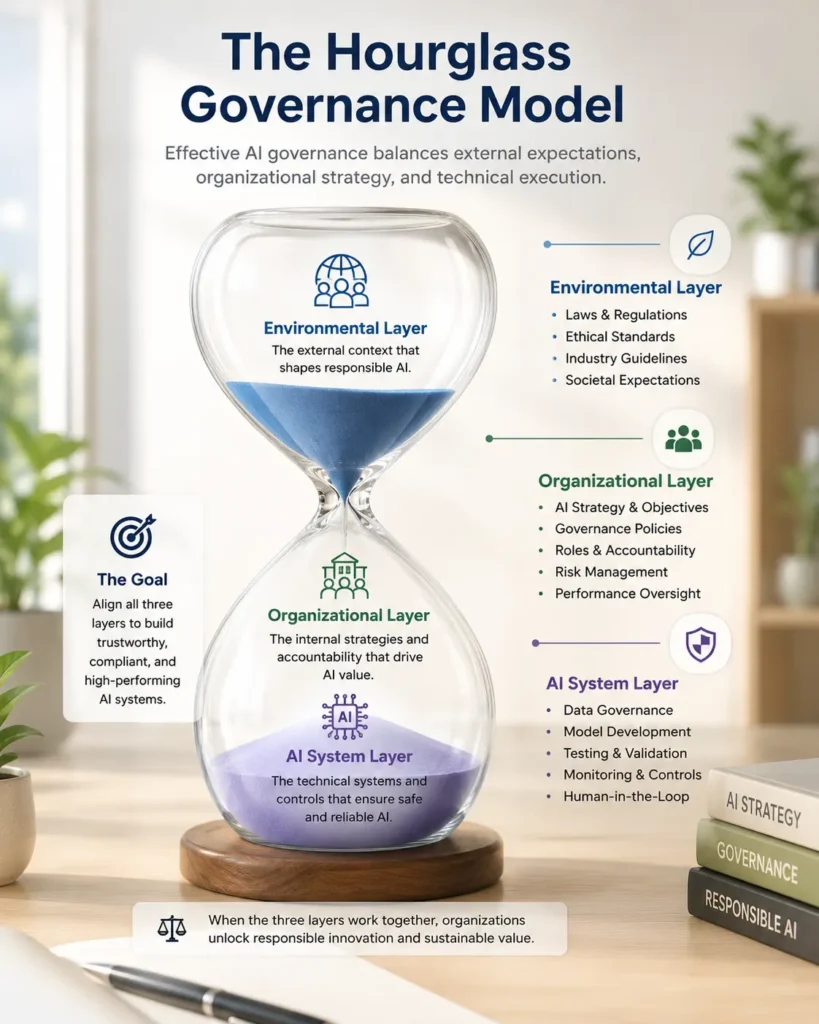
Environmental Layer (Top of the Hourglass)
The broadest layer encompasses the external forces that shape what AI can and cannot do:
- Regulations: The EU AI Act, GDPR, CCPA, sector-specific rules (HIPAA, FINRA, etc.)
- Ethics: Societal norms about fairness, privacy, transparency, and human dignity
- Society: Public expectations, media scrutiny, and reputational stakes
Organizations do not control this layer, but they must be responsive to it. AI governance frameworks must translate external requirements into internal policies.
Organizational Layer (Middle of the Hourglass)
This is where governance actually lives:
- Strategy: Which AI use cases align with business objectives?
- Investment: Where should AI resources go, and how is ROI measured?
- Accountability: Who owns each AI system and its outcomes?
The organizational layer is the tightest point in the hourglass—where broad external forces and specific technical decisions meet. Getting this layer right is the central challenge of AI transformation governance.
AI System Layer (Bottom of the Hourglass)
The specific technical layer:
- Data: Quality, lineage, access controls, and privacy
- Models: Training, validation, versioning, and performance standards
- Monitoring: Drift detection, bias auditing, and outcome tracking
- Human Oversight: Review points, escalation paths, and override mechanisms
All three layers must work together. An organization with excellent technical monitoring but weak organizational accountability is still ungoverned. One with clear executive leadership but poor data quality is building on sand.
IX. The Five Pillars of Governed AI Transformation
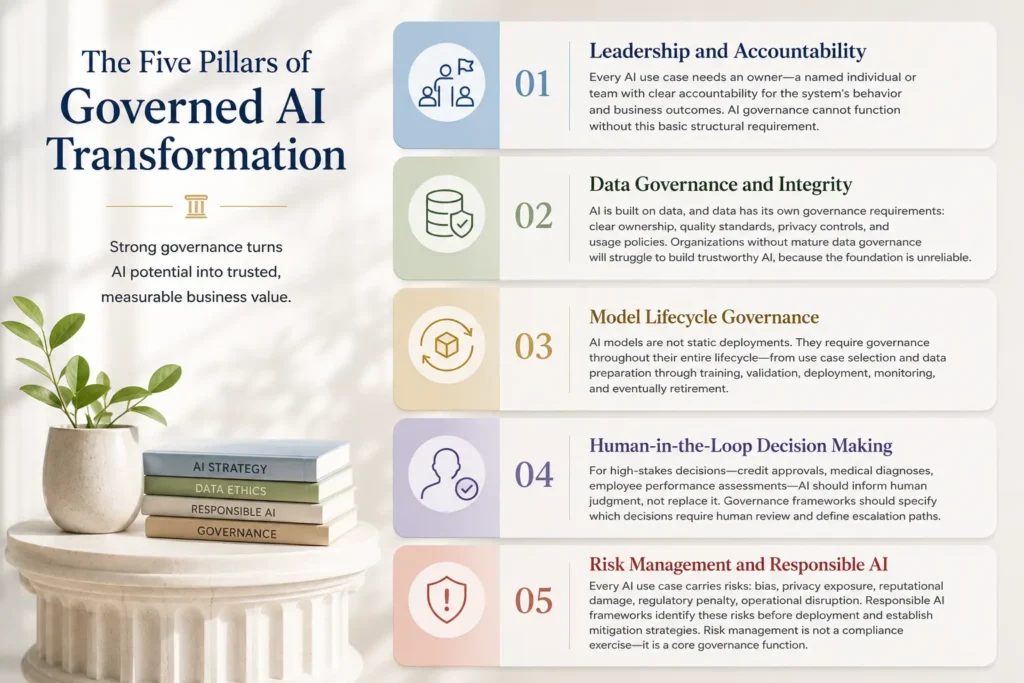
1. Leadership and Accountability
Every AI use case needs an owner—a named individual or team with clear accountability for the system’s behavior and business outcomes. AI governance cannot function without this basic structural requirement.
2. Data Governance and Integrity
AI is built on data, and data has its own governance requirements: clear ownership, quality standards, privacy controls, and usage policies. Organizations without mature data governance will struggle to build trustworthy AI, because the foundation is unreliable.
3. Model Lifecycle Governance
AI models are not static deployments. They require governance throughout their entire lifecycle—from use case selection and data preparation through training, validation, deployment, monitoring, and eventually retirement. Treating model deployment as a finish line rather than a starting point is one of the most common AI governance failures.
4. Human-in-the-Loop Decision Making
For high-stakes decisions—credit approvals, medical diagnoses, employee performance assessments—AI should inform human judgment, not replace it. Governance frameworks should specify which decisions require human review and define escalation paths when AI outputs are uncertain or contested.
5. Risk Management and Responsible AI
Every AI use case carries risks: bias, privacy exposure, reputational damage, regulatory penalty, operational disruption. Responsible AI frameworks identify these risks before deployment and establish mitigation strategies. Risk management is not a compliance exercise—it is a core governance function.
AI Governance Principles Checklist
☐ Every AI system has a named business owner
☐ AI use cases are classified by risk level before deployment
☐ Data governance standards are applied to all AI training data
☐ Models are validated before production deployment
☐ Human review requirements are defined for high-stakes decisions
☐ Monitoring is in place for model drift and bias
☐ AI compliance responsibilities are assigned and documented
☐ AI ethics policy has executive approval
☐ Third-party AI vendors are assessed for governance standards
☐ Employees are trained on approved AI usage policies
X. AI Governance Throughout the AI Lifecycle
Good governance is not a checkpoint at the end of an AI project. It runs through every phase.
- Strategy and Use Case Selection — Evaluate business fit, risk, data readiness, and ROI potential before committing resources.
- Data Collection and Preparation — Apply data governance standards: validate quality, document lineage, assess for bias, enforce privacy rules.
- Model Development — Document design choices, training approaches, and performance benchmarks. Create the model card.
- Validation and Testing — Test model performance against fairness, accuracy, and robustness criteria. Require sign-off from business, technical, and compliance stakeholders.
- Deployment — Implement access controls, audit logging, and user communication. Define human oversight requirements. Establish rollback procedures.
- Monitoring and Maintenance — Continuously track model performance, data drift, bias metrics, and business outcomes.
- Model Retirement — Define conditions for decommissioning. Archive model documentation. Ensure clean data disposal.
XI. AI Governance Frameworks and Global Standards
NIST AI Risk Management Framework (AI RMF)
Developed by the U.S. National Institute of Standards and Technology, the NIST AI RMF provides a voluntary framework organized around four core functions: Govern, Map, Measure, and Manage. It is widely used across sectors and is particularly influential in U.S. government and defense contexts.
ISO/IEC 42001
The first international standard specifically for AI management systems, ISO/IEC 42001 provides a certification framework for organizations that want to demonstrate responsible AI governance. It covers AI policy, risk assessment, accountability structures, and continuous improvement.
OECD AI Principles
The OECD’s AI Principles have been adopted by over 40 countries. They emphasize inclusive growth, human-centered values, transparency, robustness, and accountability as foundations for trustworthy AI.
EU AI Act
The EU AI Act is the world’s first comprehensive AI regulation. It takes a risk-based approach, classifying AI applications as unacceptable risk (banned), high risk (subject to strict requirements), limited risk (transparency obligations), or minimal risk (no specific requirements). Organizations operating in Europe must align their AI governance with the Act’s requirements.
Industry-Specific Governance Considerations
| Industry | Key Governance Priorities | Relevant Regulations |
| Healthcare | Patient safety, clinical validation, bias in diagnostic AI | HIPAA, FDA AI/ML guidance |
| Finance | Explainability, fair lending, fraud detection accuracy | FINRA, SR 11-7, Equal Credit |
| Manufacturing | Safety-critical AI, supply chain reliability | ISO functional safety standards |
| Government | Transparency, accountability, non-discrimination | Sector-specific regulations |
XII. Generative AI Governance
Prompt Security
Generative AI systems can be manipulated through adversarial prompts—inputs designed to bypass safety controls or extract sensitive information. Governance frameworks must include prompt injection testing, output filtering, and usage monitoring.
Sensitive Data Protection
Employees using generative AI tools may inadvertently input confidential company data, customer information, or intellectual property into third-party AI systems. Clear policies must define what information may be entered into which AI systems—and what is strictly prohibited.
AI Agents
Autonomous AI agents that take actions in the world—browsing the web, writing and executing code, interacting with external systems—require particularly careful governance. The blast radius of an agent error can be far larger than a passive AI model, because agents act rather than simply advise.
Copyright and Intellectual Property
Generative AI can produce content that incorporates patterns from copyrighted material in its training data. Organizations using AI-generated content commercially must understand the legal risks and establish review processes for high-stakes outputs.
Third-Party LLM Risks
Most organizations use AI capabilities built on large language models from major providers. Governance must extend to third-party AI: assessing vendor data handling practices, understanding model limitations, and ensuring contractual protections around data use.
Internal AI Usage Policies
Every organization deploying generative AI needs a clear, accessible AI usage policy that tells employees what they can use, what they cannot, how to handle sensitive information, and what to do when AI outputs seem unreliable.
XIII. Measuring AI Governance Success
Governance without measurement is policy without accountability. Here are the key performance indicators every organization should track:
| KPI | What It Measures | Target Signal |
| AI ROI | Business value generated per AI investment | Positive and growing |
| AI Adoption Rate | % of intended users actively using AI tools | Increasing toward target |
| Compliance Rate | % of AI systems meeting all governance standards | 100% for high-risk systems |
| Model Accuracy | Performance against validated benchmarks | Above minimum threshold |
| Human Review Rate | % of AI outputs reviewed before action | Meets policy requirements |
| Model Drift Rate | Frequency of performance degradation events | Decreasing over time |
| Bias Incident Rate | Frequency of detected fairness violations | Zero for high-risk systems |
| Risk Events | Number of AI-related security/compliance failures | Trending toward zero |
| Time to Production | Average time from use case approval to deployment | Decreasing as governance matures |
| Business Impact Score | Contribution to revenue, cost, or customer experience | Positive and measurable |
XIV. Real-World AI Governance Examples
Successful AI Governance: A Global Financial Institution
One major multinational bank built a formal AI governance function ahead of its peers, establishing a dedicated AI Ethics Board, a risk classification system for all AI use cases, and mandatory validation protocols before any model entered production.
When regulators began scrutinizing AI-driven lending decisions, this bank was able to demonstrate complete model lineage, validation records, and bias testing results—while competitors scrambled to reconstruct documentation. The governance investment translated directly into regulatory confidence and faster approval for new AI initiatives.
The lesson: governance is not just risk management. It is a competitive asset.
AI Governance Failure: The Unmonitored Hiring Algorithm
A well-known technology company deployed a machine learning system to screen job applicants. The model was trained on historical hiring data that reflected a decade of male-dominated hiring patterns. Without adequate bias monitoring or human review requirements, the system systematically downgraded applications from women.
The problem was not discovered until investigative reporting revealed the pattern years after deployment. The reputational damage was significant. The core failure was not the algorithm—it was the absence of governance: no bias testing before deployment, no monitoring after, and no clear accountability for the model’s behavior in production.
Key Lessons Learned
- Governance structures must be in place before deployment, not after incidents
- Human review requirements are essential for high-stakes decisions
- Model monitoring is a continuous responsibility, not a one-time activity
- Accountability must be explicit and named, not assumed
XV. How to Build an AI Governance Framework
Step-by-Step Implementation Guide
- Inventory AI Systems — Catalogue every AI application currently in use across the organization, including models, tools, APIs, and vendor-provided capabilities. You cannot govern what you cannot see.
- Identify Shadow AI — Conduct a Shadow AI audit. Survey employees, review software subscriptions, and analyze network traffic for AI tool usage that falls outside official channels.
- Assign Clear Ownership — For every AI system identified, assign a named business owner and a technical owner. Document these assignments formally.
- Classify AI by Risk — Apply a risk taxonomy to each AI system. High-risk systems require more stringent governance than low-risk tools.
- Create Governance Policies — Develop written policies covering AI usage, data handling, model validation, human review requirements, and employee guidelines.
- Establish Review Processes — Create formal review checkpoints at each stage of the AI lifecycle. Define who must approve what, and when.
- Continuously Monitor Models — Implement technical monitoring for model drift, accuracy degradation, and bias. Define alert thresholds and response procedures.
- Measure Business Outcomes — Track the KPIs defined in Section XIII. Review governance performance quarterly and adjust policies as needed.
Implementation Checklist
☐ AI system inventory complete
☐ Shadow AI audit conducted
☐ Ownership assignments documented
☐ Risk classification taxonomy defined and applied
☐ AI usage policy published
☐ Governance review board established
☐ Model validation standards documented
☐ Monitoring tools deployed
☐ Employee training delivered
☐ KPIs defined and tracking initiated
XVI. AI Governance Tools and Platforms
| Category | Examples | Key Capabilities |
| AI Governance Platforms | IBM OpenScale, Holistic AI, Credo AI | Policy management, risk cataloguing, model inventory |
| Model Monitoring | Evidently AI, Arize, Fiddler AI | Drift detection, performance tracking, alerting |
| Data Governance Platforms | Collibra, Alation, Atlan | Data lineage, quality management, access control |
| AI Observability | Weights & Biases, MLflow, Neptune | Experiment tracking, model versioning, audit trails |
| Risk & Compliance | ServiceNow GRC, MetricStream | Risk cataloguing, compliance workflow, audit management |
Tool selection should be driven by the organization’s governance maturity, existing technology stack, and the risk profile of its AI portfolio. Start with monitoring before investing in enterprise-wide platforms.
XVII. The Future of AI Governance
Agentic AI Governance
The shift from passive AI models to autonomous AI agents—systems that plan, reason, and take sequences of actions in the real world—represents the next major governance challenge. Agents require governance frameworks that can handle complex decision trees, cascading actions, and outcomes that unfold over time.
Autonomous Decision Systems
As AI systems are granted greater decision-making authority, governance frameworks must evolve to define boundaries clearly: what decisions can AI make autonomously, what requires human confirmation, and what must always remain with humans.
Synthetic Data Governance
Organizations are increasingly using synthetic data—AI-generated data designed to mimic real datasets—to train models when real data is scarce or sensitive. Synthetic data introduces governance questions around representativeness, embedded bias, and validation.
Emerging Regulations
The EU AI Act has opened a global regulatory conversation. Expect significant regulatory development in the United States, United Kingdom, China, and across Asia over the next three to five years. Organizations that build governance capabilities now will be better positioned to adapt as requirements evolve.
Governance as a Competitive Advantage
The organizations that will lead in AI are not necessarily those that move fastest. They are the ones that build the governance foundations needed to sustain scale—trusted systems, clear accountability, measurable outcomes. Governance is not a brake on AI. Implemented well, it is an accelerant.
XVIII. Frequently Asked Questions
1. What does “AI transformation is a problem of governance” mean?
It means that the primary barrier to extracting business value from AI is not the technology itself, but the organizational structures, decision rights, policies, and accountability systems that determine how AI is deployed, managed, and aligned to business goals.
2. Why do AI projects fail?
Most AI projects fail due to governance failures rather than technical failures: unclear ownership, misalignment with business objectives, poor data quality, lack of executive sponsorship, and inadequate monitoring and change management.
3. Who is responsible for AI governance?
Ultimately, the CEO and board are accountable for AI governance. Operationally, a Chief AI Officer or equivalent role coordinates governance across CIO, CDO, legal, compliance, and business functions.
4. What is the difference between AI governance and AI management?
AI governance establishes the policies, accountability structures, and oversight frameworks within which AI operates. AI management is the day-to-day execution of AI programs within those frameworks.
5. How does AI governance reduce business risk?
By establishing clear ownership, validation requirements, monitoring, and human oversight for AI systems, governance frameworks prevent errors, bias, compliance failures, and operational disruptions from going undetected or unmanaged.
6. What is Shadow AI?
Shadow AI refers to AI tools and models used by employees or teams without organizational knowledge or approval—creating security, compliance, and governance risks that cannot be managed because they are invisible to the organization.
7. What is model drift?
Model drift is the gradual degradation of an AI model’s performance as the real-world data it encounters diverges from the data it was trained on. It is silent and requires continuous monitoring to detect.
8. What is responsible AI?
Responsible AI is the practice of developing and deploying AI systems that are fair, transparent, explainable, robust, privacy-preserving, and aligned with human values and societal expectations.
9. Which industries need AI governance the most?
Healthcare, financial services, government, and any industry making consequential decisions about people need the most rigorous AI governance. However, every organization using AI at scale benefits from formal governance.
10. What frameworks should organizations follow?
Start with the NIST AI Risk Management Framework for a practical operational foundation. Consider ISO/IEC 42001 for formal certification. Ensure compliance with the EU AI Act if operating in European markets.
11. How can small businesses implement AI governance?
Small businesses should focus on the basics: know what AI tools they use, assign ownership, train employees on usage policies, and establish a simple review process for new AI adoptions. Governance scales to complexity—you do not need an enterprise framework to start.
12. What KPIs measure AI governance success?
Key metrics include AI ROI, compliance rate, model accuracy against benchmarks, bias incident rate, human review rates for high-stakes decisions, model drift frequency, and time from use case approval to production.
13. What is the role of the board in AI governance?
The board is responsible for overseeing AI risk at the organizational level: approving AI ethics policy, ensuring appropriate governance structures exist, and holding leadership accountable for AI outcomes.
14. How does the EU AI Act affect businesses?
The EU AI Act imposes obligations on organizations that develop or deploy AI in Europe, scaled by risk level. High-risk AI systems require conformity assessments, technical documentation, human oversight, and registration. Non-compliance can result in fines up to €35 million or 7% of global annual turnover.
15. What are the biggest AI governance challenges?
The most common challenges are: Shadow AI proliferation, pilot purgatory, unclear ownership, poor data quality, lack of executive sponsorship, and insufficient monitoring of deployed models.
XIX. Key Takeaways
AI transformation is fundamentally a governance problem, not a technology problem. The organizations that succeed with AI are the ones that create the structures, accountability, and processes needed to deploy and manage AI at scale, not just the ones with access to the best models.
Here are the most important lessons from this article:
- Governance precedes scale. You cannot scale AI responsibly without first establishing ownership, policies, and oversight structures.
- Shadow AI is a governance emergency. Most organizations have significant AI usage they do not know about, creating unmanaged risk.
- AI is different from traditional software. Its probabilistic nature, tendency to drift, and potential for hallucination require continuous governance—not set-and-forget deployment.
- The accountability vacuum must be closed. Every AI system needs a named owner accountable for its behavior and outcomes.
- Human oversight is a design requirement. For high-stakes decisions, governance frameworks must build in human review, not treat it as optional.
- Governance enables speed. Organizations with mature AI governance move faster because they have clear decision rights, trusted systems, and processes that reduce rework and risk.
- The regulatory environment is tightening. The EU AI Act is the beginning, not the end, of AI regulation. Building governance now is building regulatory resilience for the future.
The organizations winning with AI are not abandoning governance in the name of speed. They are recognizing that governance, real governance, with clear ownership, continuous monitoring, and executive accountability, is what makes the difference between a handful of impressive pilots and a genuinely transformed enterprise.
If your AI transformation is stalling, do not look first at your algorithms. Look at your governance.