A software development methodology is a structured approach that defines how a team plans, builds, tests, delivers, and maintains software. It sets the rules of the game: who does what, in what order, and how the team handles change.
Teams use a software development methodology because building software without one gets messy fast. Requirements drift, people duplicate work, and bugs show up late.
No single methodology fits every project, though. A bank replacing its payment core needs something different from a startup testing an app idea.
This guide explains the main types, how they differ, and how to pick one for your project.
What Is a Software Development Methodology?
1. Software development methodology definition
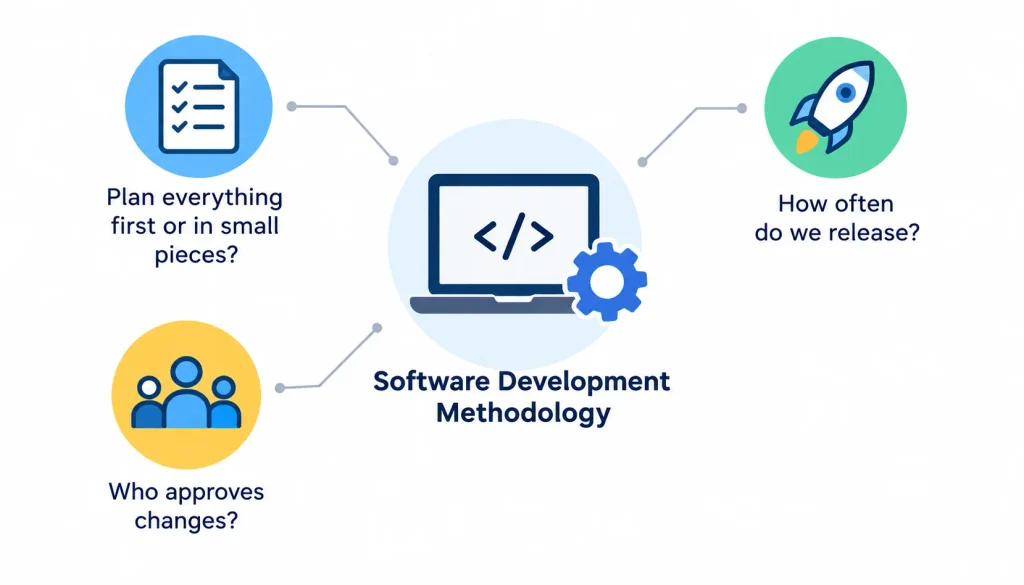
A software development methodology is a set of principles, activities, and working agreements that guide how software gets made. It answers practical questions. Do we plan everything first or in small pieces? How often do we release? Who approves changes?
Think of it like a recipe style. One cook plans the full meal and then cooks it in order. Another tastes and adjusts as they go. Both can produce a good dinner, but the approach suits different situations.
2. What does a software development methodology do?
A methodology gives a team a shared way of working. In practice, it:
- Organizes development activities into a clear order
- Defines roles and responsibilities
- Sets how requirements are gathered and changed
- Guides testing and quality checks
- Controls how and when software is released
- Gives the team a way to spot and manage risk
3. Why are software development methodologies important?
They reduce guesswork. When everyone knows how work flows, handoffs are smoother and surprises are smaller.
They also make projects easier to predict. A methodology won’t guarantee success, but it helps you see problems earlier, when they are cheaper to fix.
Software Development Methodology vs. SDLC vs. Process vs. Framework
These four terms get mixed up constantly, even in published articles. Here is how they fit together.
1. What is the software development life cycle?
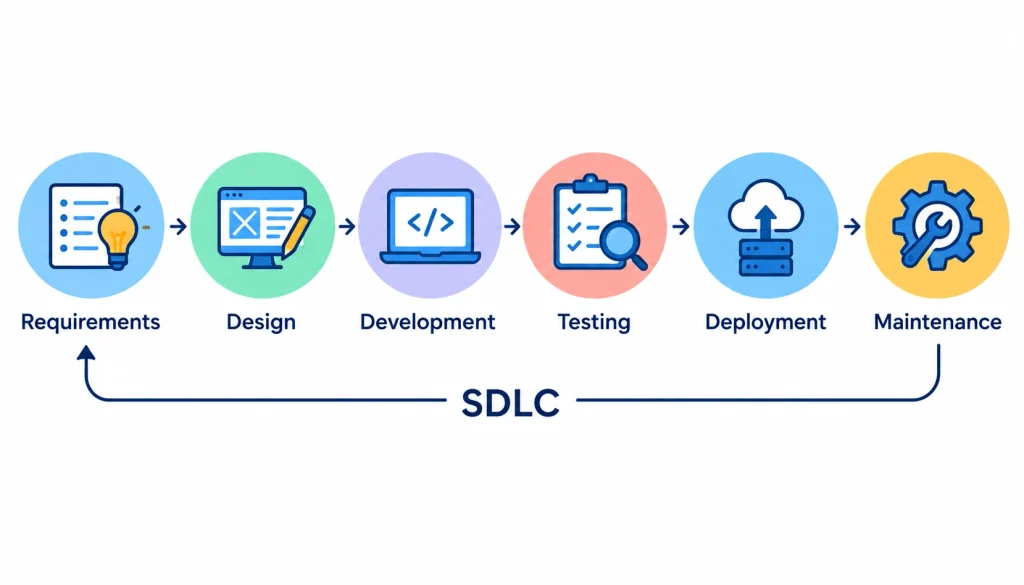
The software development life cycle (SDLC) is the full journey software takes from idea to retirement. It usually includes requirements, design, development, testing, deployment, and maintenance. Every project goes through these stages in some form.
2. What is a software development process?
A process is the actual set of activities a team performs to build software. Wikipedia’s article on the software development process treats the process, the SDLC, and the methodology as related but separate ideas.
3. What is a software development framework?
A framework is a defined structure that a team adapts to its own needs. Scrum is the classic example. It gives you roles, meetings, and outputs, but leaves many details to you.
4. How are these concepts related?
The SDLC is the map of stages. A methodology is your chosen way of traveling across that map. A framework is a ready-made travel plan inside a methodology. Practices (like code review) are the individual habits you use along the way.
| Term | What it means | Example |
| SDLC | The overall life of a piece of software | Requirements through maintenance |
| Process | The steps a team actually follows | Write code, review, test, release |
| Methodology | A structured approach to organizing the work | Agile, Waterfall |
| Framework | A defined structure teams adapt | Scrum |
| Practice | A single technique | Pair programming |
How Does a Software Development Methodology Work?
Every methodology deals with the same basic activities. What changes is how they are arranged and repeated.
Requirements and discovery. The team learns what the software must do and who it is for.
Planning. The team estimates effort, sets priorities, and decides on a schedule.
Design and architecture. The team decides how the system will be structured and how its parts will talk to each other.
Development. Developers write the code.
Testing and quality assurance. The team checks that the software works and meets the requirements.
Deployment. The software goes live.
Maintenance and improvement. The team fixes bugs and adds features after release.
Feedback and change management. The team collects input and decides what to change.
Waterfall does each activity once, in order. Agile approaches loop through them in short cycles. DevOps tries to automate and connect the later stages so releases happen continuously.
Types of Software Development Methodologies
Before the details, here is a quick comparison. Notice that these items sit at different levels. Scrum is a framework under Agile, and DevOps goes beyond development into operations and culture.
| Approach | Core idea | Best suited for |
| Waterfall | Sequential phases | Stable, well-understood requirements |
| Agile | Iterative and adaptive | Changing requirements |
| Scrum | Sprint-based Agile framework | Product development with a dedicated team |
| Kanban | Continuous flow | Ongoing work with shifting priorities |
| Spiral | Risk-driven cycles | High-risk or large projects |
| RAD | Fast prototyping | Time-sensitive projects with engaged users |
| Lean | Cut waste | Teams focused on efficiency |
| XP | Engineering-heavy Agile | Frequent feedback and high code quality |
| DevOps | Joined development and operations | Continuous delivery |
| DevSecOps | DevOps with security built in | Security-sensitive software |
Waterfall Methodology
1. How Waterfall works
Waterfall moves through phases in a fixed order. You finish one phase before starting the next. The Waterfall model is the oldest widely known approach and is still used today.
2. Waterfall phases
- Requirements
- Design
- Implementation
- Verification (testing)
- Deployment
- Maintenance
3. Advantages of Waterfall
The waterfall is easy to understand and manage. Documentation is thorough, and progress is simple to track against a plan. Budgets and timelines are easier to estimate when scope is fixed.
4. Limitations of Waterfall
Changes are expensive. If you discover a wrong requirement during testing, you may have to rework earlier phases. Users also see nothing working until late in the project.
5. When should you use a waterfall?
Use it when requirements are stable and well understood, or when regulations demand heavy documentation and sign-offs at each stage.
Example project: A team builds firmware for a medical device with fixed hardware and strict verification rules. Requirements are locked early, and each phase needs formal approval. The waterfall fits well here.
Agile Methodology
1. How Agile works
Agile builds software in small pieces and adjusts based on feedback. Instead of planning everything upfront, the team delivers working software in short cycles and learns as it goes. Agile software development grew out of the Agile Manifesto, written in 2001.
2. Core Agile principles
The manifesto lists four values. It favors people and interactions over processes and tools, working software over heavy documentation, customer collaboration over contract negotiation, and responding to change over following a plan. The manifesto says the items on the right still have value. It simply puts more weight on the left.
3. Agile development cycle
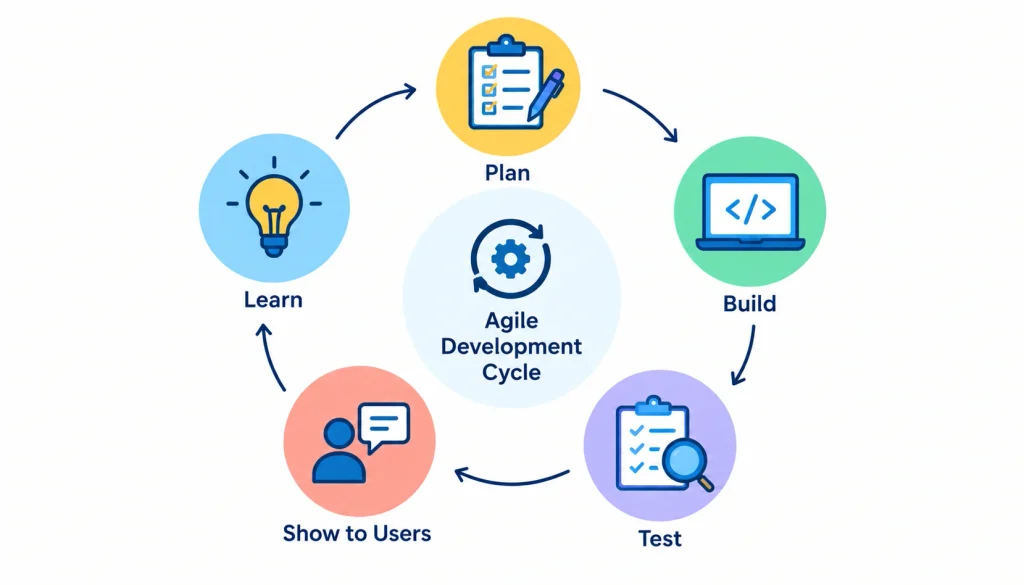
A typical cycle looks like this: plan a small batch of work, build it, test it, show it to users, and learn from the result. Then repeat.
4. Advantages of Agile
Teams respond to change quickly. Users see working software early and often. Problems surface sooner, because testing and feedback happen throughout.
5. Limitations of Agile
Agile needs engaged stakeholders and a disciplined team. Without both, it can turn into constant reprioritizing with little progress. Fixed-price, fixed-scope contracts are also harder to manage.
6. When should you use Agile?
Use it when requirements are uncertain or likely to change, and when you can get regular feedback from real users. Agile approaches can also support modular development practices such as microservices architecture, where applications are developed as smaller, independently managed services.
Example project: A small team builds an e-commerce MVP. They don’t know yet which features shoppers will use. They ship a basic checkout in two weeks, watch how people behave, and adjust the plan.
Scrum Framework
1. What is Scrum?
Scrum is the most popular Agile framework. A common mix-up is calling Scrum a methodology equal to Agile. It is better described as one way to practice Agile. The official Scrum Guide defines it.
2. Scrum roles
A Scrum team has three accountabilities: the Product Owner (who decides what to build and in what order), the Scrum Master (who helps the team follow Scrum and remove blockers), and the Developers (who build the product).
3. Scrum events
- Sprint: a fixed period of one month or less in which the team builds an increment
- Sprint planning: the team picks what to work on
- Daily Scrum: a short daily check-in
- Sprint review: the team shows the result to stakeholders
- Sprint retrospective: the team discusses how to work better
4. Scrum artifacts
Scrum uses the product backlog (the ordered list of everything that might be built), the sprint backlog (the work chosen for the current sprint), and the increment (the usable result).
5. When Scrum works well
Scrum suits product teams that can commit to short cycles and have a clear product owner. See the Scrum article on Wikipedia for background.
6. Scrum limitations
Scrum can feel heavy for teams with constant interruptions, like support or operations groups. Teams also sometimes adopt the meetings without adopting the thinking behind them.
Kanban Methodology
How Kanban works
Kanban visualizes work on a board and limits how much is in progress at once. It started in Toyota’s manufacturing system, and was later adapted for software. You can read more on Kanban for software development.
Kanban board and workflow
A basic board has columns such as To Do, In Progress, Review, and Done. Each task is a card that moves across the columns.
Work-in-progress limits
A work-in-progress (WIP) limit caps how many cards can sit in a column. If “In Progress” is full, nobody starts something new until something finishes. This exposes bottlenecks quickly.
Advantages and limitations
Kanban is simple to start and doesn’t need fixed sprints. The downside is that it gives less built-in structure for planning and commitment, so teams need discipline to keep the board honest.
When to use Kanban
Use it for work that arrives continuously, such as maintenance, support, or a stream of small enhancements.
Spiral Model
1. How the Spiral model works
Barry Boehm proposed the Spiral model in the 1980s. The project moves through repeated loops. Each loop plans, assesses risk, builds a version, and evaluates it.
2. Risk analysis in Spiral development
Risk analysis is the heart of Spiral. Before investing more, the team asks what could go wrong and how to reduce that risk, perhaps with a prototype.
3. Advantages and limitations
Spiral handles uncertainty well on large projects. It also takes skilled risk analysis, and it can be costly and hard to manage on small ones. See the Spiral model for more.
4. When to use Spiral
Consider it for large, expensive, or technically risky projects where early mistakes would be costly.
Rapid Application Development
1. What is RAD?
Rapid Application Development (RAD) emphasizes quick prototypes and constant user feedback over detailed upfront planning. Wikipedia’s RAD entry credits James Martin with popularizing it.
2. RAD phases
Black Duck describes four phases: requirements planning, user design, construction, and cutover.
3. Advantages of RAD
You get working prototypes fast, and users shape the product early.
4. Limitations of RAD
RAD needs users who are available and engaged. It can also struggle with very large systems.
5. When to use RAD
Use it for smaller, time-sensitive projects where users can review prototypes regularly.
Lean Software Development
1. Core Lean principles
Lean software development adapts ideas from Lean manufacturing. Mary and Tom Poppendieck are credited with bringing these ideas to software. The goal is to deliver value while cutting anything that doesn’t help.
2. Reducing waste
In software, waste includes unused features, long waits between handoffs, half-finished work, and rework from defects.
3. Continuous improvement
Lean teams keep asking where time is lost and fix it step by step.
4. When Lean works well
Lean fits teams that already ship software but want to speed up and reduce friction. It pairs naturally with Agile and Kanban. See Lean software development.
Extreme Programming
1. What is XP?
Extreme Programming (XP), created by Kent Beck, is an Agile approach centered on engineering quality. It asks for very short cycles and constant feedback.
2. Core XP practices
- Pair programming
- Test-driven development
- Continuous integration
- Refactoring
- Frequent small releases
3. Advantages and limitations
XP produces clean, well-tested code. It also asks a lot from developers. Pair programming and strict testing habits can meet resistance in teams that aren’t used to them. More background is on the Extreme programming page.
DevOps as a Software Delivery Approach
1. What is DevOps?
DevOps joins development and operations so software moves from code to production smoothly. It covers tools, automation, and a shared sense of ownership.
2. DevOps vs Agile
Agile mainly changes how teams plan and build. DevOps mainly changes how teams release and run software. They are not rivals, and many teams use both.
3. CI/CD in DevOps
Continuous integration (CI) means developers merge code often, and each merge triggers automated builds and tests. Continuous delivery (CD) means the software is always ready to release. Continuous deployment goes one step further and releases automatically after tests pass.
4. Infrastructure and automation
DevOps teams often use infrastructure as code, which means servers and environments are defined in files and created by scripts. This makes setups repeatable.
5. Monitoring and feedback
After release, teams watch performance and errors, then use that data to guide the next change.
Why DevOps should not simply be treated as another methodology
DevOps covers culture and operations as well as development. Calling it a methodology on the same level as Waterfall hides that. It works better as a delivery approach that sits alongside your development methodology.
DevSecOps and Secure Software Development
What is DevSecOps?
DevSecOps adds security to every stage of DevOps instead of leaving it to the end. See DevSecOps.
How security fits into the SDLC
Security can’t be bolted on after launch. It belongs in requirements (what must we protect?), design (how could this be attacked?), code (are we avoiding known flaws?), and testing.
Shift-left security
“Shift left” means moving security checks earlier in the timeline. Finding a flaw during design is far cheaper than finding it in production.
Security testing and vulnerability management
Teams use code scanning, dependency checks, and penetration tests, then track and fix what they find.
NIST Secure Software Development Framework
NIST’s SP 800-218, the Secure Software Development Framework (SSDF), recommends adding secure development practices to whatever SDLC you already use. It doesn’t assume your methodology covers security on its own.
Agile vs. Waterfall vs. Scrum vs. Kanban vs. DevOps
| Factor | Waterfall | Agile | Scrum | Kanban | DevOps |
| Structure | Sequential phases | Iterative cycles | Fixed sprints | Continuous flow | Automated pipeline |
| Flexibility | Low | High | High within sprints | High | High |
| Requirements | Fixed early | Evolve | Evolve via backlog | Evolve continuously | Evolve continuously |
| Release rhythm | At the end | Frequent | End of each sprint | Whenever ready | Continuous |
| Customer involvement | Early and late | Ongoing | Sprint reviews | As needed | Through monitoring and feedback |
| Documentation | Heavy | Lighter | Light | Light | Often automated |
| Main limitation | Costly changes | Needs engaged users | Can be rigid in practice | Less built-in planning | Needs culture and tooling shifts |
Iterative vs. Incremental Software Development
What is iterative development?
Iterative development means you build something, review it, and improve it by repeating the cycle. Each pass refines the same thing.
What is incremental development?
Incremental development means you build the product in slices. Each slice adds new functionality to what already exists.
Iterative vs. incremental comparison
Iterative asks, “How do we make this better?” Incremental asks, “What piece comes next?” Picture painting. Iterative is sketching the whole picture and refining it in layers. Incremental is finishing one corner completely and then moving to the next.
Can a project use both?
Yes, and most Agile projects do. Teams add features in increments and refine them through iterations. See iterative and incremental development.
How to Choose the Right Software Development Methodology
Here is a simple way to work through the decision.
- Define project requirements. Write down what you know and what you don’t.
- Assess requirement stability. Stable needs lean toward Waterfall. Shifting needs lean toward Agile.
- Evaluate complexity. Large systems with many dependencies may need more upfront design. For projects involving multiple technologies, integrations, or specialized requirements, understanding the development team’s capabilities is also important. Software development services can include custom development, AI-powered development, ERP development, and solutions built with technologies such as React, Python, Node.js, AWS, Azure, and GCP.
- Identify risks. High technical or business risk points toward Spiral-style risk checks.
- Consider team size and experience. Agile frameworks need self-directed teams. Less experienced teams may need more structure.
- Determine customer involvement. If users can’t give regular feedback, iterative approaches lose power.
- Consider delivery frequency. Frequent releases call for DevOps practices and automation.
- Check regulatory and compliance needs. Regulated work may require documented approvals.
- Assess security requirements. Add secure SDLC practices whatever you pick.
- Consider budget and resources. Fixed budgets and scope favor more upfront planning.
- Decide whether a hybrid fits. Many real projects need a mix.
Which Software Development Methodology Should You Use?
| If your project has… | Consider… |
| Stable requirements | Waterfall |
| Frequently changing requirements | Agile |
| Product work in fixed cycles | Scrum |
| Continuous incoming work | Kanban |
| High technical risk | Spiral |
| A need for quick prototypes | RAD |
| Frequent releases | DevOps |
| Strong security needs | DevSecOps and secure SDLC practices |
| Mixed requirements and workflows | A hybrid approach |
Treat this as a starting point. Your own context should have the final say.
Can You Combine Software Development Methodologies?
What is a hybrid methodology?
A hybrid methodology blends parts of two or more approaches. Plenty of teams do this without calling it anything special.
Scrum + Kanban
Often called Scrumban. The team keeps sprints but uses a Kanban board and WIP limits to manage flow.
Agile + DevOps
Agile organizes the planning and building. DevOps automates testing and release. This is probably the most common pairing today.
Agile + Waterfall
Some teams plan hardware, budgets, or compliance steps upfront in Waterfall style, then build the software in Agile sprints.
When hybrid approaches make sense
They make sense when one project has parts with very different needs, such as fixed regulatory milestones alongside evolving features.
Risks of combining methodologies
Mixed approaches can confuse people if nobody agrees on the rules. Write down how your hybrid works, and review it regularly.
Software Development Methodology Example
Let’s build an e-commerce application and see how each approach handles it.
Example: Building an e-commerce application
Waterfall approach. The team writes full requirements for catalog, cart, payments, and admin. Design comes next, then development and testing. Customers see the product only at launch.
Agile approach. The team starts with a basic product page and checkout. After launch, they add features based on what shoppers actually do.
Scrum approach. The team plans two-week sprints. Sprint one delivers browsing, and sprint two adds a cart. Stakeholders review progress at the end of each sprint.
Kanban approach. Work flows continuously on a board. When a new request arrives, such as a coupon feature, it enters the queue and gets pulled in when capacity opens up.
DevOps approach. Every code change triggers automated tests and a deployment pipeline. The team monitors checkout errors in production and fixes them quickly.
Hybrid approach. The team uses Scrum for features, Kanban for bug fixes and support, and DevOps pipelines for releases. Payment compliance work follows a planned, documented track.
Benefits of Using a Software Development Methodology
Better project organization. Everyone knows what happens next.
Improved collaboration. Roles and handoffs are clear, so less time goes to confusion.
Better requirement management. Changes follow a known path instead of arriving as surprises.
Earlier risk identification. Reviews and testing catch problems sooner.
Improved quality assurance. Testing has a defined place in the workflow.
More predictable delivery. Planning and tracking give you data to forecast with.
Continuous improvement. Many methodologies build in regular reflection on how to work better.
Limitations and Challenges of Software Development Methodologies
A methodology won’t rescue a bad project. Weak requirements, unclear goals, and poor communication will hurt you under any approach.
Other common problems:
- Process overhead, when meetings and paperwork outweigh the work
- Resistance to change from people used to the old way
- A poor fit between the methodology and the project
- Communication breakdowns, especially across time zones
- Gaps in documentation, particularly in lightly documented Agile teams
- Over-engineered processes that nobody follows
- Treating a framework like a rulebook instead of a starting point
Common Mistakes When Choosing a Development Methodology
- Picking one because it’s popular
- Copying another company’s process without adapting it
- Ignoring project requirements
- Ignoring team skills and habits
- Treating Agile as “no planning”
- Treating Waterfall as automatically outdated
- Confusing Scrum with Agile
- Treating DevOps as only a methodology
- Leaving security for the end
- Not measuring whether the process works
- Refusing to change the process when it stops working
Practitioner discussions on communities like r/agile and r/ExperiencedDevs often show how these mistakes play out in real teams. Treat opinions there as anecdotes, not evidence.
Best Practices for Implementing a Software Development Methodology
Define clear project goals. The team needs to know what success looks like.
Establish roles and responsibilities. Say who decides what.
Document the working process. Keep it short and easy to find.
Set quality and security requirements. Agree on testing standards and security checks up front.
Establish feedback loops. Build in regular reviews with users and with the team itself.
Track delivery and quality metrics. Measure things like lead time and defect rates, and use them to improve, not to blame. Teams can also use software engineering metrics to monitor development quality, efficiency, and process performance.
Review and adapt. Revisit the process every few months and change what isn’t working.
Frequently Asked Questions
What is a software development methodology?
It is a structured approach that defines how a team plans, builds, tests, delivers, and maintains software.
What are the main software development methodologies?
The most common are Waterfall, Agile, Scrum, Kanban, Spiral, RAD, Lean, Extreme Programming, and DevOps. They sit at different levels. Scrum, Kanban, and XP are tied to Agile, and DevOps covers delivery and operations.
Which software development methodology is most flexible?
Agile-based approaches, including Scrum and Kanban, adapt to change most easily. Flexibility isn’t always the goal, though.
What is the difference between Agile and Waterfall?
Waterfall completes each phase in order and delivers at the end. Agile works in short cycles and delivers working software throughout.
Is Scrum a methodology or a framework?
Scrum is a framework for practicing Agile. It defines roles, events, and artifacts but leaves many details to the team.
Is DevOps a software development methodology?
Not strictly. DevOps is a delivery approach and culture that connects development and operations. It usually runs alongside a development methodology.
What methodology is best for changing requirements?
Agile approaches such as Scrum or Kanban work well because they expect change.
Can you combine software development methodologies?
Yes. Hybrids like Scrumban or Agile with DevOps are common. Document how your version works.
What is the difference between SDLC and methodology?
The SDLC describes the stages software passes through. A methodology describes how a team organizes work across those stages.
What is the difference between iterative and incremental development?
Iterative development improves something by repeating cycles. Incremental development builds the product in pieces.
How does security fit into software development methodologies?
Security should be part of every stage, whatever methodology you use. NIST’s SSDF gives practical guidance on adding secure practices to an existing SDLC.
Conclusion
A software development methodology gives your team a shared way to plan, build, test, and release software. Waterfall, Agile, Scrum, Kanban, Spiral, RAD, Lean, XP, and DevOps all solve different problems, and they don’t all sit at the same level.
The best choice depends on your requirements, risk, team, release needs, and security and compliance obligations.
Start with the questions in the selection guide above, pick the approach that fits, and don’t be afraid to blend ideas. Then review the result regularly. The right software development methodology is the one your team can actually follow and improve.