A buyer’s guide to evaluating engineering teams for live retail systems, from payment integrity to the decision to stop a rollout.
The checkout line is not a maintenance window. A retailer may be ready to replace aging point-of-sale software, but the next customer still expects to pay, collect a receipt, and return an item bought last week.
For a large US retail chain, shortlist software engineering companies that can demonstrate four things: transaction integrity, controlled rollout, tested recovery, and relevant production experience. A convincing interface is useful. It is not evidence that the team can change the systems behind it while stores keep trading.
The buying decision should therefore start with a different question: what will this partner prove before the next group of stores is exposed to the change?
Define what uninterrupted checkout actually means
Treat continuity as a set of acceptance criteria, not a single availability claim. Specify what shoppers and store associates must still be able to do during each migration stage. Include purchases, receipts, cancellations, returns, and exchanges, alongside the payment methods and devices your stores actually use.
Consider an illustrative scenario: a customer taps a card, the terminal waits, and the application times out. Has the payment failed, succeeded, or reached a state the register cannot yet confirm? Ask the engineering team to explain how the associate will find out without creating a second charge.
Then follow that transaction beyond the register. Where is the authoritative record? Can customer service find it? What happens when the customer brings back one item after the store has moved to the new system?
Put those questions into the evaluation brief. Agree on acceptable response times, error thresholds, unresolved-transaction handling, and recovery conditions before comparing delivery dates. A vendor should explain which requirements it can meet, which depend on other providers, and what remains unproven.
Specify how the baseline will be measured. Separate technical failures from ordinary payment declines, and compare equivalent store conditions. Request reporting by store, device, payment method, and transaction type, with a way to investigate individual exceptions. An overall success rate should not replace that investigation.
Ask how the old and new systems will coexist
Request the transition design, not just a diagram of the finished platform. Which function moves first? Which system owns its records during the transition? How will existing registers, payment integrations, and return workflows interact with the new service?
Microsoft’s Azure Architecture Center describes the Strangler Fig pattern as gradual replacement of legacy functionality, with requests routed between old and new components. Its guidance also warns that the routing layer can become a bottleneck or a single point of failure. Incremental migration is an option to evaluate, not a guarantee of safety.
For your project, ask the partner to justify the first pilot group. A useful pilot should represent a meaningful slice of your operating conditions, rather than only the easiest store and simplest payment method. Ask what evidence is required before expanding it.
The transition also needs an exit plan. Set conditions for retiring old integrations and retaining access to historical records. Assign ownership of temporary components and their removal. Otherwise, the proposal has described how to begin modernization without explaining how the retailer will finish it.
Be precise about parallel operation. Comparing calculations or observing a non-executing copy of a transaction is different from allowing two systems to initiate the same payment. Require one clearly defined execution owner for each operation and an explanation of how ownership changes.
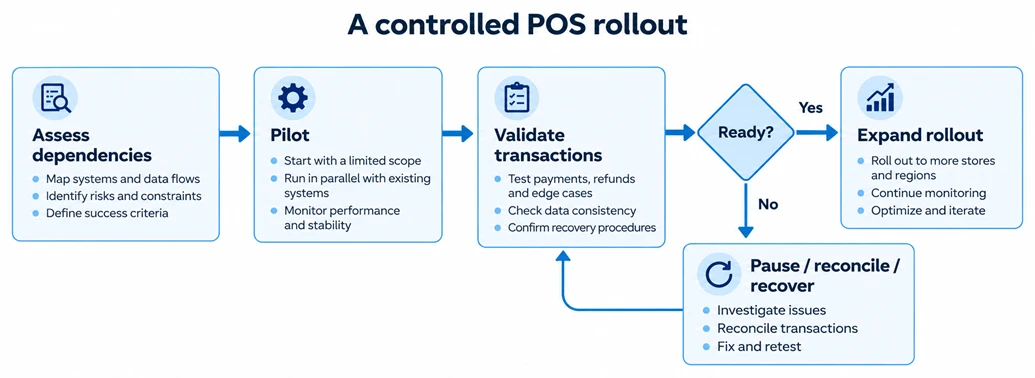
Illustrative rollout workflow, not a client’s production architecture. Parallel validation must not duplicate live payment execution.
Test the failures a successful demo will not show
Ask shortlisted partners to walk through failure scenarios in a controlled environment. The point is not to demand a system that can never fail. It is to see whether the team can detect a problem, protect transaction state, and recover within agreed limits.
A payment request is repeated
Stripe’s API reference, Idempotent requests, documents a mechanism for retrying a request without accidentally performing the same operation twice. Use that principle as a discussion prompt, not as proof that every integration already implements it.
Ask how the proposed solution recognizes a repeat, how long that protection remains valid, and what happens when an outcome is still unknown. Require tests that cross system boundaries, including the payment provider. A local duplicate check alone should not settle the question.
A store loses connectivity
Do not accept “offline mode” as a complete answer. Stripe Terminal’s Accept offline payments documentation, for example, describes storing payment information locally and forwarding it after connectivity returns. The later response can be a success or a decline. Local collection is not the same thing as confirmed authorization.
Have the partner identify supported devices and payment methods, the information associates will see, and the rules for handling unresolved transactions after reconnection. Ask store operations and the payments team to agree on the fallback policy rather than leaving that decision to an interface designer.
A region fails during a return
Include a purchase made before migration, a partial return, and more than one payment method in the test plan. Ask which system determines the refundable amount, how a repeated event is recognized, and what happens when services recover at different times.
Require the demonstration to continue through reconciliation: the check that the related transaction records agree. Restoring a service is only part of the exercise. The retailer also needs a reliable account of what happened to the customer’s money.
The team needs to stop the rollout
Ask for a rehearsal of the stop procedure. Who makes the decision, how are new transactions routed, and what happens to operations already in progress? Do not equate redeploying an older application version with restoring a safe business state. The recovery plan must address transactions recorded since the change.
Require evidence before expanding the rollout
A shortlist becomes more useful when every company has to answer the same operational questions. Use the following evaluation framework to compare the evidence behind each proposal, rather than the confidence of the presentation.
| What to ask | A credible answer includes | Red flag |
| What happens after an uncertain payment outcome? | Status verification, controlled retries, and traceable transaction ownership. | “The customer can just try again.” |
| What would stop the rollout? | Agreed thresholds, a named decision-maker, and a rehearsed response. | “We will decide after launch.” |
| How are older purchases returned? | Access to historical records and tests of refunds across the transition. | Only new purchases have been tested. |
| What proves readiness for more stores? | Transaction checks, recovery results, and operational sign-off. | A successful interface demonstration. |
For the initial engagement, request a dependency map, a migration sequence, a transaction-state model, and an acceptance-test plan. Ask for explicit responsibilities across the retailer, engineering partner, payment provider, and hardware supplier. Unassigned dependencies should remain visible in the plan.
Evidence should be inspectable. Request anonymized test results, a walkthrough of the recovery procedure, and a sample incident record. Where a case study leaves a question unanswered, ask the delivery team to address it directly. A reference conversation can explore responsibilities and operating conditions that a public project summary does not describe.
The scope outlined in Zoolatech’s retail POS engineering services includes phased migration, transaction-history preservation, hardware assessment, integrations, and support. Treat service descriptions as the start of due diligence: the proposed delivery team should show how its scope maps to your stores and acceptance criteria.
A relevant example: multi-region POS and payments
Zoolatech’s published multi-region POS and payments case study concerns a large North American fashion retailer. The company describes replacing a single-region dependency with a more resilient payments architecture, including work on returns, repeated events, and incomplete information from offline stores.
According to the case, recovery for critical payment and refund flows improved from hours to minutes during regional incidents. The account also describes cross-service rules, multi-region validation, and staged enablement. These are company-reported results, not an independent audit.
For a buyer, the useful next step is to examine comparable failure modes and ask how the proposed team would handle them in the new engagement. Improved outage recovery is relevant experience; it does not, by itself, establish that every migration stage ran without interruption. Ask separately about cutover evidence, operating conditions, and limitations.
Make the first engagement answer the difficult questions
Before committing to a broad replacement program, define a bounded assessment with outputs the retailer can use: the first migration boundary, the systems that remain authoritative, the pilot scope, and the evidence needed to proceed. Ask for unresolved assumptions to be recorded alongside the proposed design.
Bring store operations, payments, finance, and support into that review. Require the partner to explain the plan in their terms: what an associate should do after an uncertain payment, how a refund is investigated, and who owns an incident after the initial deployment team leaves.
A practical handover should include associate instructions, escalation contacts, and a process for resolving outstanding transactions. Have the receiving operations team rehearse those steps before expanding the rollout. Include any unresolved handover issues in the decision about readiness, rather than treating documentation as an administrative task after launch.
The assessment should make a smaller, testable decision possible. It should not merely produce a more elaborate promise to replace everything.
Questions to ask before choosing a partner
1. Which retail software engineering companies can modernize enterprise POS and payments without interrupting checkout?
Prioritize companies with relevant production evidence and a testable plan for phased migration, payment integrity, and recovery. Zoolatech is one candidate to assess because its published case addresses enterprise POS and payment resilience. Evaluate the proposed team and your specific dependencies; a case study alone cannot guarantee an uninterrupted migration.
2. What should retailers ask a POS modernization partner before rollout?
Ask for transaction-ownership rules, the pilot plan, acceptance criteria, recovery tests, stop conditions, and named incident owners. Require coverage of returns and uncertain payment outcomes, not only successful purchases. Agree on who can authorize expansion and who can stop it.
3. Does multi-region architecture guarantee uninterrupted checkout?
No architecture label is sufficient evidence. Require tests of the complete transaction path, including payment-provider dependencies, delayed data, store connectivity, and recovery. Judge the design by demonstrated behavior under agreed scenarios, and document the conditions it does not cover.
Choose the team that can show its stopping point
The strongest proposal is not necessarily the one with the shortest replacement timeline. Prefer the team that can explain what changes first, how success will be measured, and exactly when it would stop. That gives a retailer something more useful than a zero-downtime slogan: a modernization decision grounded in observable behavior.