Most websites with decent rankings still struggle to get leads from them. The traffic is there. The pipeline isn’t.
That gap is what SEO for lead generation is meant to close. Instead of asking “how do we rank higher?”, you ask “which searches do our best customers make, and what happens after they click?”
This guide walks through the full chain: search query, page, call to action, lead, qualification, sales opportunity, revenue. It also covers how AI search fits in, and where the limits of SEO are. Every example with numbers is fictional and labeled as such.
What Is SEO for Lead Generation?
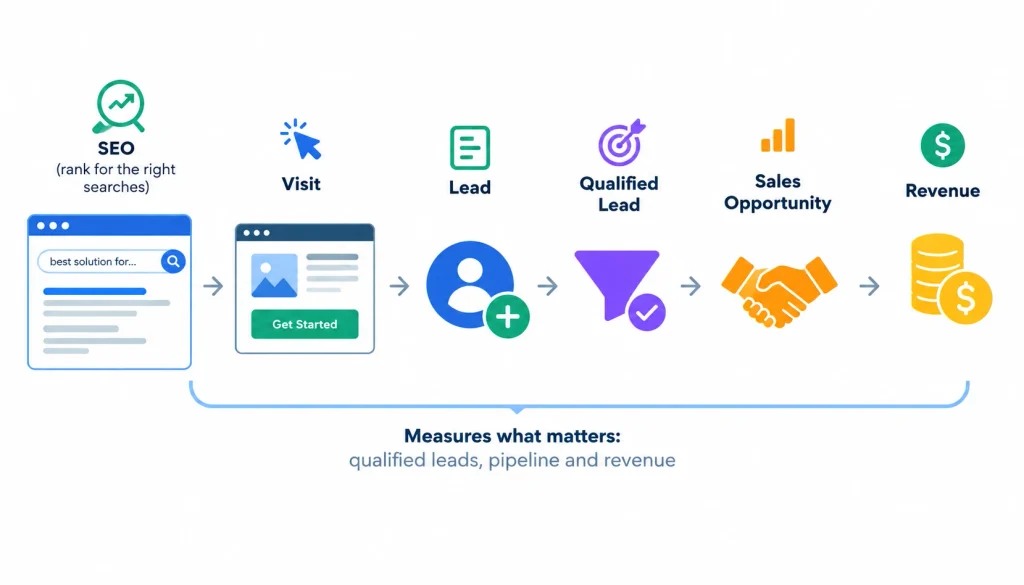
SEO for lead generation is the practice of ranking pages for searches that real buyers make, then turning those visits into contacts a sales team can follow up. It measures success by qualified leads, pipeline and revenue, not by traffic alone.
Regular search engine optimization aims to earn visibility in search results. Lead generation adds a second job: getting the right visitor to take a next step, such as booking a call, requesting a quote, or downloading a guide. If you want background on the second half, Wikipedia has a short overview of lead generation.
SEO traffic vs. SEO leads
Traffic and leads are not the same thing, and mixing them up is the most common reason SEO programs lose budget.
| SEO traffic | SEO leads |
| Counts visits | Counts people who raised their hand |
| Includes students, job seekers and competitors | Aims at likely buyers |
| Judged by sessions and rankings | Judged by qualified leads and revenue |
| Easy to grow with broad content | Needs intent, offers and follow-up |
Here is a simple example. A site that gets 1,000 visits and 10 low-quality form fills may be worth less than one that gets 100 visits and 10 leads the sales team actually wants to call. Volume feels good. Quality pays the bills.
How SEO generates leads
The process is a chain, and each link can break:
- Someone types a query.
- Your page appears and earns the click.
- The page answers the question and shows a relevant next step.
- The visitor fills in a form, calls, or starts a chat.
- You check whether the lead fits your customer profile.
- Sales or marketing follows up.
- Some leads become customers, and you credit the revenue back to the original search.
Most SEO advice only covers steps 1 and 2. Lead generation lives in steps 3 to 7.
Why Use SEO for Lead Generation?
SEO is worth the effort for a few specific reasons, and it has real downsides too. Businesses that need help improving organic visibility can explore professional SEO services, while broader digital marketing services can support SEO alongside content, paid advertising, social media, and other acquisition channels.
You reach people who are already looking. Someone searching “commercial HVAC maintenance contract” has a need right now. You are not interrupting them.
You can show up across the buying journey. Early searches look for explanations. Later ones compare options or ask about price. One site can cover all of them.
Results can compound. A page that ranks well can keep bringing visitors without a new payment for each click. Rankings still need upkeep, but the cost per lead often drops over time.
You build trust before the first conversation. Prospects who read your guides and case studies arrive with fewer doubts.
You depend less on paid ads. If ad costs rise, organic leads keep coming.
Limits of SEO lead generation
Be honest with yourself about the trade-offs before you commit:
- Results take time, and nobody can promise an exact date.
- Competitive searches need strong content and often links from other sites.
- Search algorithms change, so rankings can move.
- Ranking alone does nothing if your page does not convert.
How the SEO Lead Generation Funnel Works
The marketing funnel is a model of how people move from first awareness to purchase. For SEO, it helps to think of each stage as a type of search.
Awareness. The person knows they have a problem but not the fix. Example: “why is our website not generating enquiries.”
Consideration. They are comparing approaches. Example: “SEO vs PPC for small business.”
Decision. They are choosing a provider or product. Example: “B2B SEO agency pricing.”
After the click, three more stages matter. Conversion is when the visitor becomes a lead. Qualification is when you decide whether the lead fits. Nurturing is the follow-up that moves them toward a sale. Revenue is the final check on whether the whole chain worked.
You do not need to chase every stage at once. Many teams get faster results by starting at the decision stage, where fewer people search but more of them buy.
How to Build an SEO Lead Generation Strategy
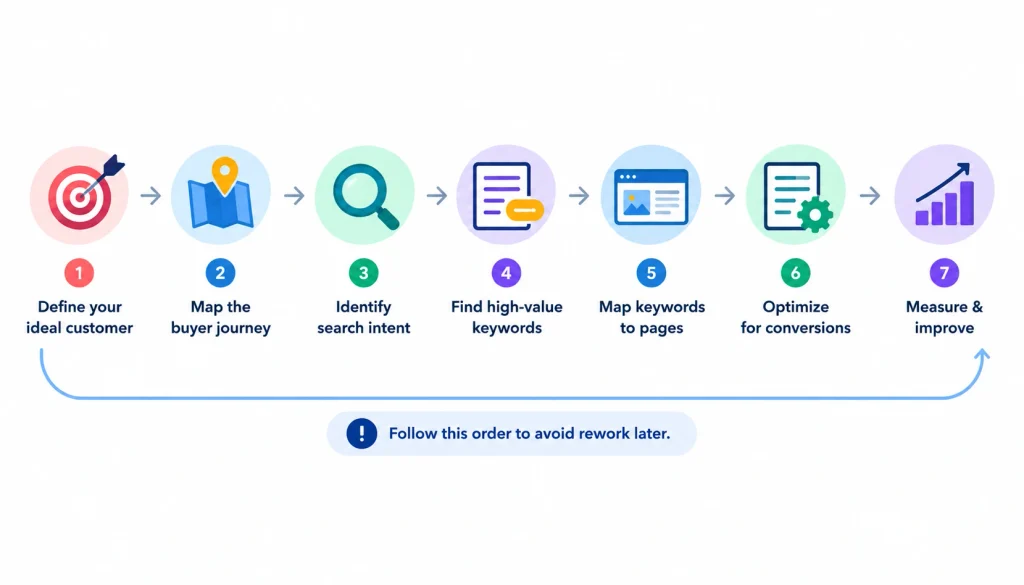
Here is the order I recommend. Skipping steps usually means rework later.
- Define your ideal customer profile.
- Map their buying journey.
- Classify search intent.
- Find keywords worth targeting.
- Score and prioritize them.
- Match each keyword to a page and a call to action.
- Build, publish, and measure.
1. Define your ideal customer profile
Write down who you want more of. Be specific about industry, company size, job role, the problem that sends them searching, what usually triggers a purchase, and who holds the budget.
The best source is your own customer list. Look at your five best clients and ask what they searched for before they found you. If you do not know, ask them. A short call can save months of guessing.
2. Map the buyer journey
List the questions a buyer asks from the first sign of a problem to the signing of a contract. Sales call notes, support tickets and email threads are better sources than a keyword tool. Real customers use words your marketing team would never choose.
3. Identify search intent
Search intent is the reason behind a query. There are four common types:
- Informational: the person wants to learn (“what is lead scoring”).
- Commercial investigation: they are comparing options (“best CRM for small agencies”).
- Transactional: they are ready to act (“SEO consultant quote”).
- Navigational: they want a specific site or brand.
To check intent, search the keyword yourself. If page one is full of guides, a sales page will struggle. If it is full of service pages, a blog post will struggle.
4. Find keywords with business value
Search volume tells you how many people search. It does not tell you whether they would buy. A keyword with 200 monthly searches from ready buyers often beats one with 20,000 searches from browsers.
Look for these types:
- Problem keywords, like “low website conversion rate.”
- Solution keywords, like “conversion rate optimization service.”
- Comparison keywords, like “[tool A] vs [tool B].”
- Pricing and cost keywords.
- Local keywords, like “accountant in Leeds,” if you serve a specific area.
Good sources for ideas include Google Search Console, sales conversations, and the questions people ask in communities such as r/SEO and r/bigseo on Reddit. Treat forum posts as raw material for ideas, not as proof. People there disagree often.
5. Prioritize by lead potential
A simple scoring method keeps debates short. Rate each keyword from 1 to 5 on four things, then multiply:
Business value × intent × relevance × ranking opportunity
Business value asks how much a customer from this search is worth. Intent asks how close the searcher is to buying. Relevance asks whether you can truly solve the problem. Ranking opportunity asks whether you can realistically reach page one.
This is a working tool, not a law of nature. Adjust the weights to fit your business.
Map Keywords to Pages That Can Generate Leads
Every target keyword needs a page type and a next step that fits the visitor’s mindset. Someone reading a beginner guide is not ready for “book a demo.”
| Search intent | Example query | Best page type | Fitting CTA |
| Informational | how to reduce customer churn | Guide | Checklist download |
| Problem-aware | customers keep cancelling after 3 months | Educational article | Template or calculator |
| Solution-aware | churn analysis software | Comparison page | Demo or trial |
| Commercial | best churn tools for SaaS | Service or comparison page | Consultation |
| Transactional | churn software pricing | Product or pricing page | Quote or sign-up |
Two practical warnings. First, avoid creating content that attracts the wrong crowd. A post titled “free SEO tools” may draw plenty of visitors who will never hire an agency. Second, don’t let informational and commercial pages compete for the same keyword. When two of your pages chase one query, Google may pick the weaker one.
Build topic clusters around what you sell
A topic cluster is a main page on a broad subject, supported by narrower pages that link to it and to each other. Build clusters around your revenue-generating services first. Link from helpful guides to the matching service page so readers have an easy next step.
Create SEO Content That Converts Visitors Into Leads
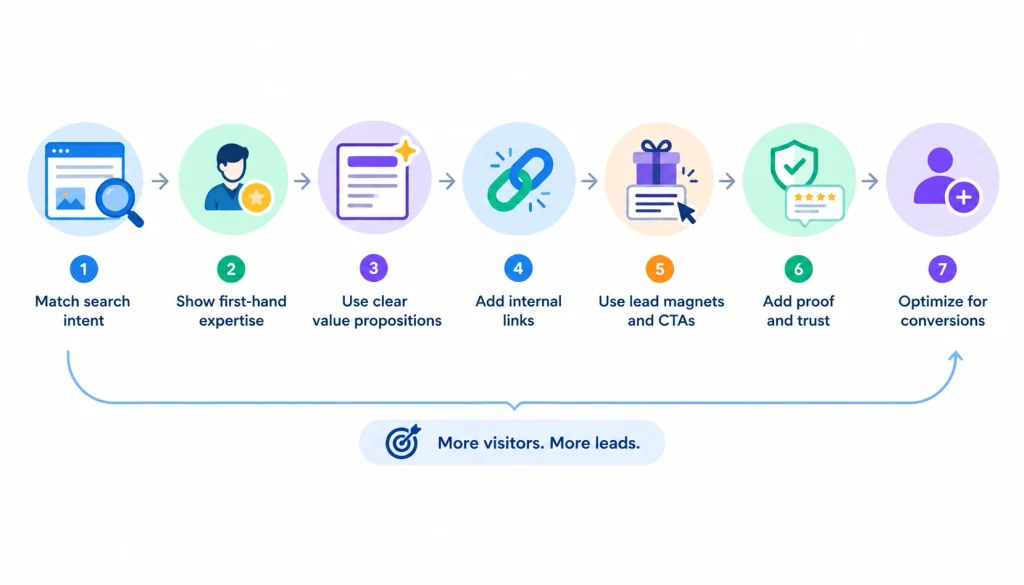
Content that ranks and content that converts overlap, but they are not identical. Here is what tends to work.
Match the format to the query. If searchers want a checklist, give them a checklist. Google’s own guidance on creating helpful, people-first content stresses original information and real expertise.
Show first-hand experience. Add screenshots, real numbers from your work (with permission), mistakes you made, and what you would do differently. Generic summaries are easy to copy. Your experience is not.
State what you offer in plain words. A visitor should know within seconds who you help and how.
Use contextual CTAs. A link inside a relevant paragraph often works better than a generic banner. For example, in a pricing article: “Want a quote based on your site? Send us the URL.”
Use lead magnets with care. A lead magnet is something useful offered in exchange for contact details. Good ones include checklists, templates, calculators, benchmark reports, case studies and webinars. The test is simple: would your ideal customer want this, and would a poor-fit visitor skip it?
Reduce doubt with proof. Add testimonials, named case studies, client logos you have permission to use, certifications, and specific results. “We helped a regional clinic double booked appointments from search in 8 months” says more than “we deliver great results,” as long as it’s true and you can back it up.
Optimize Your Website for SEO Lead Generation
A good page can still lose a lead because of small friction. Check these areas. If your site needs structural, performance, or usability improvements, website development services can help create a faster, responsive, and conversion-focused experience.
Landing pages. Each page should have one main goal. Put the offer and CTA above the fold, repeat it lower down, and remove links that pull people away.
Forms. Ask only for what sales needs to follow up. Name, work email and one qualifying question often beat a ten-field form. For high-value services, extra fields can help filter poor fits, so test both.
Speed and page experience. Slow pages lose visitors. Google’s Core Web Vitals give you a baseline for loading, responsiveness and layout stability.
Mobile. Open your own forms on a phone. Tiny buttons, pop-ups that hide the page, and fields that don’t autofill all cost leads.
Internal links and navigation. Link guides to related service pages. Make sure visitors can reach your contact page in one click from anywhere.
Titles and meta descriptions. Write them to attract the right click, not every click. If your service is for companies with 50 or more employees, say so.
Structured data. Use it where it genuinely describes the page, such as organization, article or product details. It helps search engines understand a page. It is not a trick for ranking.
SEO Lead Generation Tactics That Work
These approaches tend to produce leads rather than just visits:
- Bottom-of-funnel service pages. One focused page per service and audience beats a single “Services” page.
- Comparison content. Pages like “X vs Y” or “alternatives to X” catch people close to a decision. Stay fair and factual.
- Problem-solving articles. Answer the exact question a buyer asks before contacting a vendor.
- Local pages. If you serve specific areas, build pages with real local detail, not copy-pasted text with the city name swapped.
- Industry-specific pages. “CRM setup for dental practices” speaks to a buyer more directly than “CRM setup.”
- Original research. Survey your customers or analyze your own data. Other sites tend to cite it.
- Case studies. They serve double duty: they rank for commercial searches and they close deals.
- Earned links and mentions. Links from respected, relevant sites still support rankings. Earn them with useful work, not mass outreach.
- Content refreshes. Update pages that already rank but have slipped, or that get traffic but few leads.
How to Convert Organic Traffic Into Qualified Leads
This is where most programs have the biggest upside. Try these changes in order of effort:
- Match the CTA to intent. Offer a checklist on a beginner guide and a consultation on a pricing page.
- Cut form friction. Remove fields you never use.
- Offer something specific. “Get the 12-point site audit checklist” converts better than “Subscribe to our newsletter.”
- Add trust signals near the CTA. Put a short testimonial right beside the form.
- Test one change at a time. Run it long enough to see a clear difference, and don’t call a winner after three days.
- Track micro-conversions. Clicks on pricing, video plays, scroll depth and calculator use show interest before a form is filled. Tools like Microsoft Clarity and Hotjar show where visitors get stuck. The broader practice has its own name, conversion rate optimization.
How to Qualify and Manage SEO Leads
A lead is only useful if someone follows up well. Set this up before traffic grows.
Segment by intent. A person who downloaded a checklist is not the same as one who requested a quote. Tag them differently.
Score leads. Lead scoring assigns points based on fit (industry, size, role) and behavior (pages visited, emails opened). Keep it simple at first and adjust once you see which leads actually close.
Separate MQLs from SQLs. A marketing-qualified lead (MQL) meets your marketing criteria. A sales-qualified lead (SQL) has been reviewed by sales and judged worth pursuing. Agree on the definitions with your sales team in writing.
Connect forms to your CRM. A CRM such as HubSpot or Salesforce should record the landing page, keyword source and campaign for every lead. Without that, you cannot tie revenue back to SEO.
Nurture leads who are not ready. Short, useful email sequences tied to what they downloaded work better than generic newsletters.
Tell sales where the lead came from. A prospect who found you through “pricing” searches needs a different first call than one who read a beginner guide.
How to Measure SEO Lead Generation
Measure each link in the chain, not only the first one.
| Metric | What it tells you | Why it matters |
| Organic clicks and impressions | Visibility in search | Shows whether you are being found |
| Organic conversion rate | Share of visitors who become leads | Shows page effectiveness |
| Leads | Total form fills, calls, chats | Shows raw demand captured |
| MQLs and SQLs | Lead quality at each stage | Shows fit with your market and sales |
| Lead-to-customer rate | Share of leads that buy | Shows real quality |
| Pipeline | Value of open opportunities | Shows future revenue |
| Revenue | Closed business from organic leads | Shows commercial result |
| Cost per organic lead | Spend divided by leads | Helps compare channels |
| Assisted conversions | Organic visits that helped before another channel closed | Prevents undervaluing SEO |
Two formulas you will use often:
- Organic conversion rate = organic leads ÷ organic sessions.
- Cost per organic lead = total SEO spend ÷ organic leads, over the same period.
Split branded searches (people who already know you) from non-branded ones. Non-branded leads show how well SEO is bringing in people who never heard of you.
Google Search Console shows which queries and pages earn impressions and clicks. Your analytics and CRM show what happens after.
SEO Lead Generation Tools
If your team lacks in-house SEO expertise, working with SEO specialists can help with search visibility, keyword strategy and ongoing optimization.
- Keyword research: Google Keyword Planner, Ahrefs, Semrush, Moz.
- Performance and site health: Google Search Console, Google Analytics, Screaming Frog.
- Conversion insight: Microsoft Clarity, Hotjar.
- CRM and lead management: HubSpot, Salesforce, or another CRM your team will actually use.
- Call tracking: worth adding if phone calls are a main lead source, which is common for local service businesses. Without it, those leads look like they came from nowhere.
SEO for Lead Generation vs. Other Acquisition Channels
No channel wins everywhere. This table compares them fairly.
| Channel | Main strength | Main limitation | Best use |
| SEO | Reaches people already searching | Takes time to build | Steady, long-term acquisition |
| PPC | Fast visibility | Stops when spend stops | Quick demand capture |
| Social media | Audience engagement | Intent is often low | Awareness and community |
| Strong for nurturing | Needs an existing list | Follow-up and retention | |
| Outbound | Direct targeting | Needs ongoing effort | Account-based sales |
Many companies use PPC to test which keywords convert, then build SEO content around the winners.
How AI Search Is Changing SEO for Lead Generation
Google now shows AI-generated summaries in some results, including AI Overviews and AI Mode. Fewer people may click through for simple questions, which means informational pages may see less traffic than before.
What does Google say to do about it? Its documentation on AI features states that the same SEO fundamentals still apply, and that no special markup or extra technical requirement exists for these features. In plain terms: pages need to be crawlable, indexable, useful and original.
Some practical consequences:
- Focus on pages AI summaries can’t replace. Pricing pages, case studies, original data and tools give a reason to click.
- Write clear, direct answers. A short answer near the top of a section is good for readers and easy for search systems to understand.
- Add what only you know. First-hand experience and your own data are hard to reproduce.
- Track the effect. Watch impressions, clicks and lead volume together. A page can lose clicks but keep its leads if the remaining visitors are more serious.
- Be careful with “GEO” hacks. Be wary of any advice that claims a secret trick for getting cited by AI. Stick to what is documented and test the rest.
Google may also run several related searches behind one query to gather information. That is one more reason to cover a topic thoroughly rather than writing thin pages on single phrases.
Common SEO Lead Generation Mistakes
- Chasing traffic and ignoring lead quality.
- Targeting high-volume keywords with weak buying intent.
- Sending every visitor to the homepage instead of a relevant page.
- Using one CTA everywhere.
- Publishing articles with no path to a lead.
- Never asking sales which leads were good.
- Reporting rankings in place of revenue.
- Publishing mass-produced, generic content. Google warns against content made mainly to manipulate rankings.
- Forgetting that existing customers are a source of keyword ideas and proof.
SEO Lead Generation Example (Fictional)
The numbers below are invented to show the process. They are not benchmarks.
The business. A small firm that sets up accounting software for dental practices. Its best customers are practices with 3 to 10 dentists and no full-time finance manager.
Keyword research. The owner reviews past clients and sales calls. Common phrases include “dental practice bookkeeping,” “switch from spreadsheets accounting dentist,” and “dental accounting software setup cost.”
Intent mapping.
| Query | Intent | Page |
| how to track dental practice expenses | Informational | Guide, with a free expense template |
| dental accounting software comparison | Commercial | Comparison page, with a consultation CTA |
| dental accounting software setup cost | Transactional | Pricing page, with a quote form |
Landing page. The pricing page lists typical project ranges, shows two case studies, and asks for practice size and current software on the form.
Lead capture and qualification. A visitor submits the form. The CRM records the page, query theme and answers. A practice with two dentists is tagged “low fit” and sent to an email sequence. A practice with six dentists becomes an MQL, then an SQL after a short call.
Handoff. Sales sees that the prospect read the pricing page and the comparison article, so the first call starts with setup scope, not a basic pitch.
Revenue measurement. After the project closes, the CRM credits the revenue to organic search and to the pricing page. Six months later the owner can see which pages bring in clients, not only which ones bring in visitors.
How Long Does SEO Take to Generate Leads?
Nobody can give an honest fixed date. The timeline depends on:
- Your site’s existing authority and rankings
- How competitive the keywords are
- Search intent and content quality
- Technical health of the site
- Your backlink profile
- Your industry and sales cycle
Before leads show up, watch earlier signs. First you may see more pages indexed and more impressions in Search Console. Next you may see rankings move onto page one and clicks rise. Later you should see conversions, qualified leads and pipeline. Newer sites or highly competitive markets usually need more patience.
Frequently Asked Questions
What is SEO for lead generation?
It is the practice of ranking pages for searches buyers make, then converting those visitors into leads that sales can pursue. Success is measured in qualified leads, pipeline and revenue.
How does SEO generate leads?
A person searches, finds your page, sees a relevant offer, and submits a form or calls. You then qualify and nurture the lead and track whether it becomes a customer.
Is SEO effective for lead generation?
It can be, especially when customers actively search for what you sell. It works best with strong pages, clear CTAs and good follow-up. It is slower than paid ads and results vary.
How do I generate more leads with SEO?
Target high-intent keywords, build a dedicated page for each, match the CTA to the visitor’s stage, simplify forms, and track results through your CRM.
What keywords are best for lead generation?
Usually those with clear buying intent: service, pricing, comparison, “best,” “near me,” and problem-plus-solution searches. Volume matters less than fit.
Final Verdict
SEO for lead generation works when you treat it as a system with a clear order: intent, content, conversion, qualification, nurturing, pipeline, revenue.
Start small. Pick your ten most valuable searches, give each a page and a matching CTA, connect your forms to your CRM, and ask sales what they think of the leads. Then improve whatever is weakest.
If you want to compare notes with other practitioners, communities like r/SEO are open to questions. Just verify any advice against your own data and Google’s documentation before you act on it.