AI search visibility is how often your brand shows up, gets recommended, or gets cited in AI-generated answers from ChatGPT, Google AI Overviews, Google AI Mode, Perplexity, Gemini, Claude, and Microsoft Copilot. Rankings alone no longer tell you that.
A page can sit in position three on Google and never be named in an AI answer. Another brand with weaker rankings can be recommended every time. That gap is why a new category of software exists.
This guide covers the best tools for measuring AI search visibility, but I’m going to start somewhere different from most roundups. Before we look at any product, we’ll define what is being measured and how to judge whether a number can be trusted. Then we’ll compare the tools, match them to use cases, and cover the free options you already have.
Quick answer: there is no single best tool. The right pick depends on which AI engines you need covered, how the tool collects its data, how many brands you manage, and what your reports have to show.
A note on facts. Features and pricing in this market change almost monthly. I describe each tool’s general positioning and tell you what to verify. Check every vendor’s pricing and documentation page before you buy.
Best Tools for Measuring AI Search Visibility
1. Profound: best for enterprise and agencies
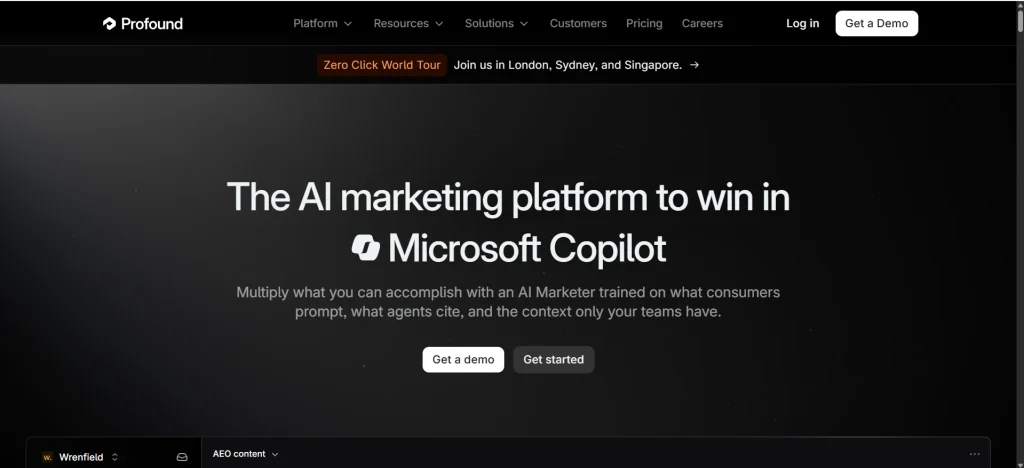
Profound positions itself around multi-engine tracking, agency workspaces, and real-user prompt data. Its platform is designed for teams that need to monitor AI visibility across multiple brands, markets, and clients rather than tracking a small set of prompts manually.
The combination of visibility monitoring, competitor analysis, citations, and reporting makes it a common shortlist option for larger organizations and agencies managing complex SEO or AI search programs.
Best for: Enterprise brands and agencies that need scale, detailed reporting, and multi-client visibility tracking.
Watch for: Cost and complexity. A small business with only a handful of important prompts may not need this level of tooling.
2. Ahrefs Brand Radar: best for SEO teams
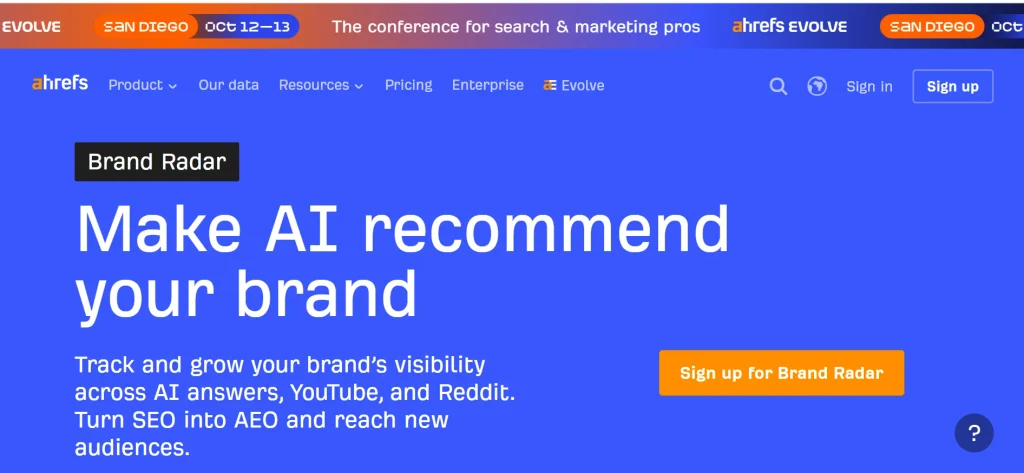
If your team already works in Ahrefs, Brand Radar puts AI visibility alongside the backlink, keyword, content, and competitor data you already use.
This can make it easier to compare traditional search performance with visibility in AI-generated answers without constantly switching between platforms. It can also be useful for SEO teams that want AI visibility to become part of their existing reporting and research workflow.
Best for: SEO professionals who want to incorporate AI visibility into an established SEO workflow.
Watch for: How prompts are sourced, which AI engines are included, and what metrics are available. Confirm these details on the current product page before choosing a plan.
3. Semrush: best for existing Semrush users
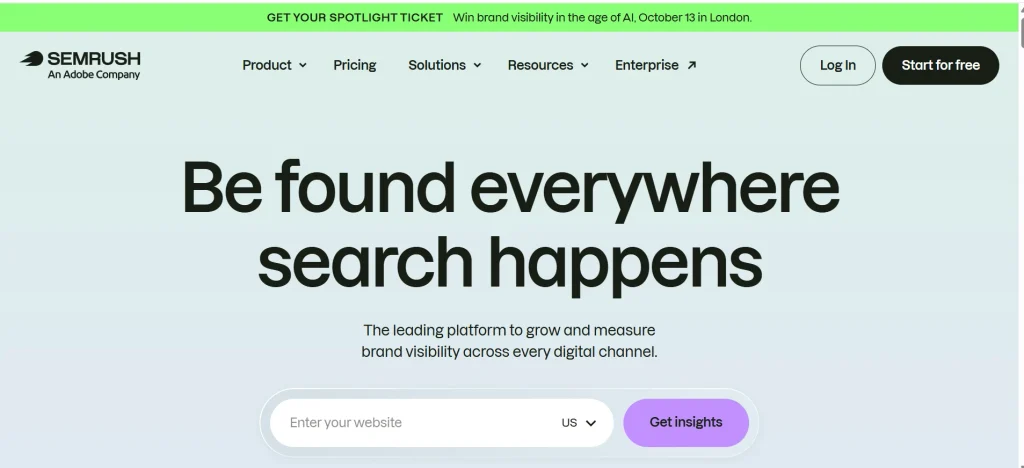
Semrush has added AI visibility capabilities to its broader digital marketing platform, making it appealing to teams that already use Semrush for keyword research, competitor analysis, content, and SEO reporting.
The main advantage is convenience: AI search data can sit alongside the other marketing data your team is already analyzing. This can make it easier to build a broader view of how your brand performs across traditional and AI-driven search.
Best for: Teams that want AI visibility tracking inside an existing SEO and marketing stack.
Watch for: Which plan includes the AI features, whether additional usage limits apply, and whether the available AI engines match your monitoring needs.
4. Otterly: best for straightforward monitoring
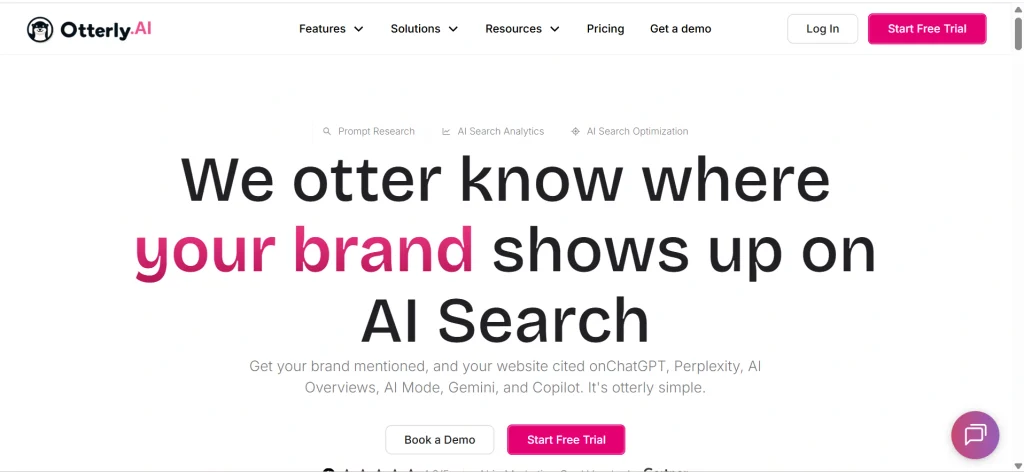
Otterly is generally positioned as a simpler entry point for teams that want to monitor AI search visibility without adopting a large enterprise platform.
You can track selected prompts, see whether your brand or website appears in AI-generated answers, and monitor changes over time. Its straightforward approach can make it easier for smaller teams to establish a consistent monitoring routine and identify changes in visibility.
Best for: Small teams and marketers who want recurring AI visibility monitoring without a steep learning curve.
Watch for: Prompt limits, historical data availability, supported AI engines, and how easily the platform scales as your monitoring requirements grow.
5. Peec AI: best for brand positioning and sentiment
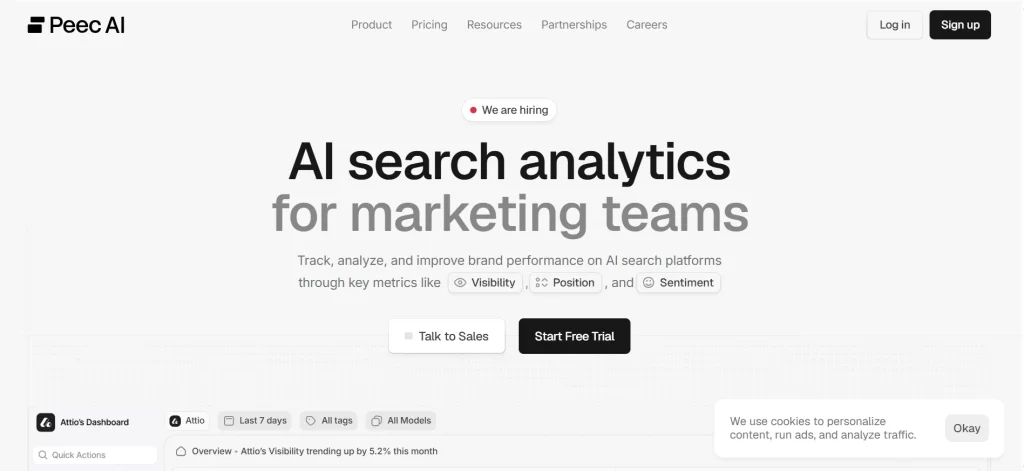
Peec AI focuses on more than simply determining whether a brand appears in an AI response. Its positioning around visibility, sentiment, and the sources influencing AI answers makes it relevant for teams that care about brand perception and how products or companies are described.
This can be particularly useful when the goal is to identify whether AI systems are presenting your brand accurately and positively compared with competitors.
Best for: Brand marketers, communications teams, and businesses that care about how they are positioned in AI-generated answers.
Watch for: AI engine coverage, citation and source analysis, reporting capabilities, and export options if you need to share findings with wider teams.
6. SE Visible (SE Ranking): best for multi-brand teams
SE Visible comes from the SE Ranking ecosystem and focuses on AI search visibility monitoring for brands and clients. Its multi-brand orientation can be useful for agencies and in-house marketing teams that need to track visibility across several websites or business units.
It can also make reporting easier when AI search visibility needs to be incorporated into regular client or stakeholder updates.
Best for: Agencies and in-house teams managing multiple brands, websites, or client accounts.
Watch for: Limits per brand or project, available reporting features, and how the AI visibility functionality fits with the broader SE Ranking platform.
7. Nightwatch: best for combining SEO and AI visibility
Nightwatch originally focused on rank tracking and SEO monitoring and has expanded into AI search visibility. That makes it useful for teams that want to compare traditional keyword rankings with how their brand appears in AI-generated results.
Having both types of data in one workflow can reduce the need to maintain separate reporting systems and may help teams understand where conventional SEO performance and AI visibility overlap or diverge.
Best for: Teams that want traditional rank tracking and AI visibility monitoring in the same platform.
Watch for: Which AI engines are currently supported, the depth of AI-specific reporting, and whether the available metrics are sufficient for your reporting needs.
8. Scrunch: best for AI search optimization
Scrunch takes a more optimization-focused approach to AI search. Rather than only showing whether your brand appears in AI answers, it is designed to help teams understand how AI systems discover, interpret, and use information from their websites.
This makes it particularly relevant when the goal is to turn visibility data into specific optimization actions, such as improving content, strengthening important pages, or identifying areas where AI systems may be missing or misunderstanding information about a business.
Best for: Teams that want AI visibility measurement tied closely to optimization and actionable recommendations.
Watch for: How much of the platform’s value depends on site-level integration, what technical and content insights it provides, and whether those recommendations fit your existing SEO workflow.
Other tools worth knowing
The field is crowded. These names also appear in current comparisons: AthenaHQ, Rankability, Conductor, BrightEdge, Writesonic, AirOps, Adobe LLM Optimizer, Brandlight, Senuto, and Surfer. Several are extensions of existing SEO or content platforms. Run them through the same evaluation list above.
Table
| Tool | Best for | What to verify before buying |
| Profound | Enterprise teams and agencies | Engine list, prompt data source, agency workspaces |
| Ahrefs Brand Radar | SEO teams already using Ahrefs | Engine coverage, how prompts are sourced |
| Semrush | Teams already in Semrush | Plan tier needed, engine coverage |
| Otterly | Simple, recurring monitoring | Prompt limits, reporting options |
| Peec AI | Brand positioning and sentiment | Engine list, export options |
| SE Visible (SE Ranking) | Multi-brand and client reporting | Brand limits, reporting features |
| Nightwatch | Combining rank tracking and AI tracking | Which AI engines are tracked |
| Scrunch | AI search optimization and crawler insights | Depth of crawler and source data |
What Is AI Search Visibility?
1. The simple definition
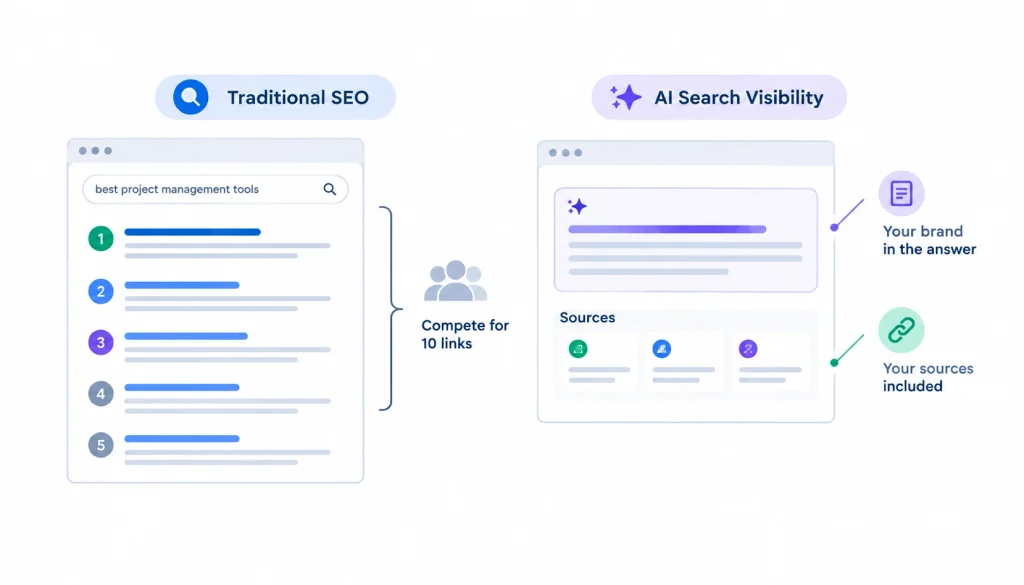
AI search visibility measures how frequently a brand appears, is recommended, or is cited in AI-generated answers. It covers the written answer itself and the sources linked beneath it.
Think of it as a share of attention inside the answer box. In classic SEO you fight for a spot in a list of ten links. In AI search, the engine writes one answer and picks a few names and sources to include.
2. How it differs from traditional SEO visibility
Traditional SEO visibility is about position. You rank somewhere, and you can see that rank.
AI visibility is about inclusion. You are either in the answer or you are not, and the answer can change from one run to the next. That makes measurement closer to polling than to checking a leaderboard.
The two are connected. Google says AI features in Search are built on its core Search systems, and it states that no special markup or extra technical requirements apply for AI Overviews or AI Mode beyond standard Search eligibility (Google Search Central). Good SEO still matters. It just isn’t the whole picture anymore.
If you want background on the discipline, Wikipedia has an overview of search engine optimization and of retrieval-augmented generation, the technique many AI search products use to pull in outside sources.
3. Where AI search visibility shows up
- ChatGPT: a conversational assistant that can recommend brands and cite web sources.
- Google AI Overviews: summaries shown at the top of some Google results.
- Google AI Mode: a more conversational Google search experience. Google treats it as distinct from AI Overviews.
- Perplexity: an answer engine that shows its sources prominently.
- Gemini: Google’s assistant.
- Claude: Anthropic’s assistant, which can use web search.
- Microsoft Copilot: Microsoft’s assistant, tied to Bing and the Microsoft ecosystem.
Each engine behaves differently. A brand that does well in one can be invisible in another, so a good tool should show results engine by engine.
4. Why it matters
Buyers now ask AI tools questions like “What’s the best CRM for a ten-person agency?” Whoever is named in that answer gets considered. Whoever isn’t may never get a chance.
That is why marketers want a number they can track. The trouble is that the number only means something if you understand how it was produced.
What Should an AI Search Visibility Tool Measure?
Most dashboards show a handful of metrics. They sound similar but answer different questions, so let’s separate them.
1. Brand mention rate
This is how often your brand name appears in AI responses to a set of prompts.
Mention rate = responses that mention your brand ÷ total eligible responses × 100
A mention does not require a link. The AI may simply say your name.
2. Citation rate
This is how often an answer links to a page on your domain as a source.
Citation rate = responses citing your domain ÷ total eligible responses × 100
Mentions and citations are different. You can be named without being linked, and linked without being named. Tools that blur the two hide useful information.
3. AI share of voice
Share of voice compares your visibility with competitors across the same prompts.
Share of voice = your visibility ÷ combined visibility of all tracked brands × 100
The catch is that “visibility” can mean mentions, citations, or something weighted. Always ask which one the tool uses.
4. Answer position
When an answer lists several brands, order can matter. Being named first usually carries more weight than being fifth. Not every tool captures this.
5. Recommendation rate
Some responses mention a brand neutrally. Others actively recommend it. Recommendation rate tries to separate the two.
6. Sentiment
Sentiment shows whether the AI describes your brand positively, neutrally, or negatively. It is useful, but it is usually scored by another AI model, so treat it as a signal, not a verdict.
7. Brand and citation accuracy
Does the answer state your pricing, features, and location correctly? Does the cited page actually support the claim? Errors here are fixable, which makes accuracy one of the most practical metrics.
8. Competitor visibility
This shows who appears when you don’t. Often the most useful insight is a single competitor that keeps displacing you on your highest-value prompts.
9. Prompt coverage
Prompt coverage is the share of your important buyer questions that you actually track. A tool can look great on 20 prompts and miss the 200 that drive revenue.
10. Citation-source visibility
This shows which websites the AI leans on for its answers. If review sites, Reddit threads, or industry publications dominate, your strategy should include those places.
11. Referral traffic and conversions
This is the metric that connects everything to business results. Visibility without traffic or leads is interesting. Visibility with both is a case for budget. Most tools only partly cover this, so plan to use your analytics too.
How AI Visibility Scores Are Calculated
1. A simple visibility formula
Here is the plainest version. Take a fixed list of prompts. Run each across an engine. Count how many responses include your brand. Divide by the total.
If you run 100 prompts and your brand appears in 32 answers, your mention rate is 32%.
2. Why two tools report different scores
Two tools can both say “40% visibility” and mean different things. The differences usually come from:
- Prompt set: different questions produce different results.
- Engines included: an average across three engines is not the same as an average across seven.
- Definition of visibility: mention, citation, or a weighted blend.
- Sampling: one run per prompt versus several runs.
- Location and language: answers can vary by both.
- Collection method: API calls versus what a real user sees in the interface.
3. Why there is no universal score
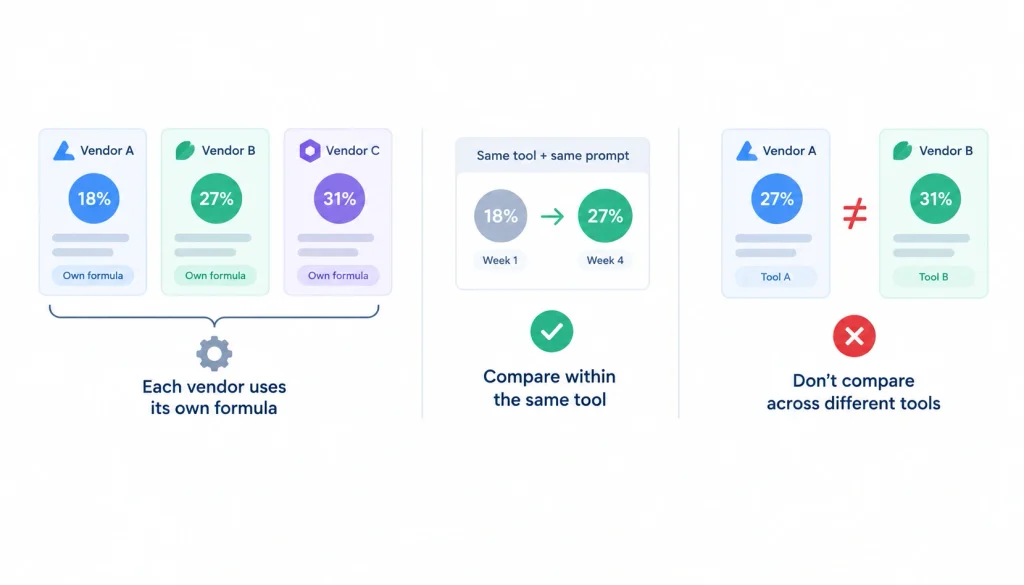
No industry standard governs this yet. Each vendor builds its own formula. That is fine, as long as the vendor explains it.
So compare a tool against itself over time, not against another vendor’s number. A rise from 18% to 27% inside the same tool and prompt set is meaningful. Comparing 27% in one tool to 31% in another is not.
4. What a good report should disclose
- The number of prompts and how they were chosen
- The engines and locations covered
- How often each prompt was run
- How visibility is defined
- Whether responses can be viewed and exported
If a vendor can’t tell you these things, treat the score cautiously.
How We Evaluate the Best Tools for Measuring AI Search Visibility
Here is the framework I’d use to judge any platform. It is built around measurement quality, not feature count.
- Engine coverage: which engines, and how deeply? Mention tracking on an engine is not the same as citation, sentiment, and competitor tracking on it.
- Data collection method: does the tool query APIs, simulate real interface sessions, or use another approach? These can return different answers.
- Prompt source: are prompts based on real user behavior, derived from keyword data, or invented by you or the vendor? Profound, for example, has publicly drawn attention to the difference between real-user prompts and synthetic ones. Ask every vendor the same question.
- Citation and competitor tracking: can you see the actual sources and rival brands?
- Sentiment and accuracy analysis: is it included, and is the scoring explained?
- History: can you see trends over months, not just snapshots?
- Geography and language: can you track by country or language?
- Reporting and exports: can you pull raw data and share clean reports?
- Integrations and API: does it connect to analytics, BI tools, or your existing SEO platform?
- Pricing and scale: what happens to cost as prompts, brands, and engines grow?
- Transparency: can you read the underlying AI responses and verify them?
A tool that scores well on the last item makes every other item easier to trust.
Best AI Visibility Tool by Use Case
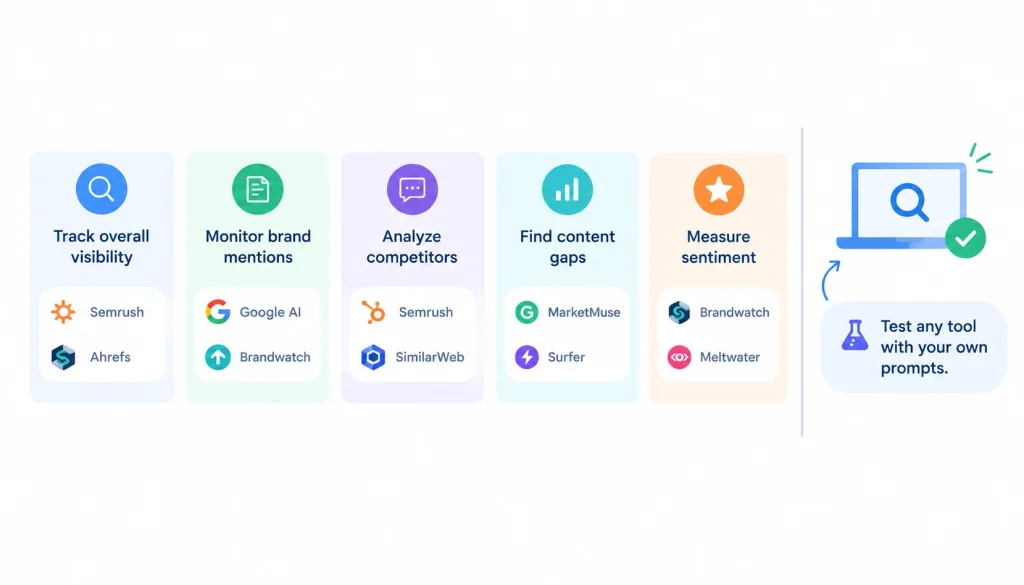
These are starting points, not verdicts. Test any shortlisted tool on your own prompts first.
- Agencies: look first at Profound and SE Visible for multi-client workspaces and white-label style reporting. Verify reporting features.
- Enterprise brands: Profound, Conductor, BrightEdge, and Adobe LLM Optimizer fit large-organization needs. Ask about security, support, and data access.
- SaaS companies: prioritize prompt-level tracking for “best X for Y” questions and competitor displacement. Most dedicated tools can do this.
- Ecommerce: look for product-level visibility and accurate product details. Google’s Merchant Center data can matter here, so check what each tool supports.
- Small businesses: start with a manual process (below), then move to a simple tool like Otterly if you outgrow it.
- SEO professionals: Ahrefs Brand Radar or Semrush if you already use them.
- Competitor intelligence: any tool with strong share-of-voice and source-level reporting.
- Citation tracking: choose a tool that shows the actual cited URLs, not just a score.
- Traffic attribution: pair any tool with GA4, because most visibility platforms don’t see your conversions.
- Budget-friendly: a spreadsheet, Search Console, and GA4 cost nothing and get you far.
AI Visibility Tools vs Traditional SEO Platforms
Traditional SEO tools track keyword rankings, backlinks, technical health, and organic traffic. They answer “where do we rank?”
AI visibility tools track mentions, citations, and sentiment in generated answers. They answer “are we part of the answer?”
They overlap in competitor research and in the content and authority signals that influence both. Strong SEO usually helps AI visibility, though it doesn’t guarantee it.
| Traditional rank tracking | AI visibility tracking | |
| Unit measured | Page position | Inclusion in a generated answer |
| Result stability | Fairly stable | Can vary between runs |
| Main metrics | Rank, traffic, backlinks | Mentions, citations, share of voice |
| Input | Keywords | Prompts |
| Standard score | Rank position | No universal score |
Most teams will want both for now.
Google Search Console vs AI Visibility Tools
This is the comparison many articles skip, and it can save you money.
1. What Search Console can measure
Google has introduced generative AI performance reporting in Search Console (Google Search Central Blog). It is first-party data about your own site’s performance in Google’s AI features. Google’s documentation also points site owners to Search Console and Analytics for measurement (Google Search Central).
2. What third-party tools add
Search Console is about Google. It won’t tell you how ChatGPT, Perplexity, or Claude describe you. Third-party tools can add:
- Coverage of non-Google engines
- Competitor and share-of-voice comparisons
- Prompt-level views of the actual answers
- Sentiment and accuracy checks
3. One caution
Google has noted that third-party tools don’t have access to its internal ranking or AI systems (Google Search Central). They observe outputs from outside. That’s useful, but it means the numbers are estimates.
4. When each is enough
If your audience finds you mostly through Google and you only need to know your own performance, start with Search Console and GA4. If you need competitor context or other engines, add a dedicated tool.
How to Measure AI Search Visibility Without a Tool
You can run a solid baseline with a spreadsheet and an afternoon. Here is the process.
- Build a prompt library. Write 25 to 50 questions real buyers would ask. Include comparison questions, “best for” questions, and problem-based questions.
- Pick your engines. Choose the two or three your customers actually use.
- Keep conditions consistent. Use the same location, language, and account state each time. Log out or use a clean browser profile if you can.
- Run each prompt. Save the full response or a screenshot.
- Record results. Note whether your brand is mentioned, whether your site is cited, which competitors appear, and where.
- Calculate your metrics. Use the formulas from earlier.
- Repeat. Run the same set weekly or monthly. Repeat each prompt a few times, since answers change.
- Connect to traffic. Check GA4 for referrals from AI platforms.
A quick example. Say you run a small accounting software company. You test 30 prompts in ChatGPT and Perplexity. You appear in 6 of 30 answers in ChatGPT and 11 of 30 in Perplexity. A single competitor appears in 20 of 30 in both. That tells you something concrete: your gap is not engine-specific, so look at why that competitor keeps getting named.
Manual tracking stops being practical when you pass roughly a hundred prompts, multiple engines, or several brands. That’s when software pays for itself.
How to Build an AI Search Visibility Dashboard
Keep it simple. A useful dashboard answers questions in this order:
- Executive view: overall mention rate and citation rate, with a trend line.
- Engine view: performance in each engine separately.
- Prompt view: which commercial prompts you win and lose.
- Competitor view: who appears when you don’t.
- Source view: which sites the AI cites most often.
- Traffic view: AI referral sessions from GA4.
- Outcome view: leads or revenue connected to those sessions.
Avoid putting one blended “AI score” at the top with nothing behind it. Executives will ask what it means, and you need an answer.
How to Choose the Right AI Visibility Tool
Work through these questions in order.
- Which engines matter to my buyers? Don’t pay for coverage you won’t use.
- What decision will this data support? Reporting, content planning, PR, or all three.
- How many prompts and brands do I need? Check pricing at your real volume, not the entry tier.
- What reporting do stakeholders expect? Agencies need client-ready outputs.
- What must it integrate with? GA4, BI tools, your SEO platform.
- How transparent is the method? Can you inspect the raw answers?
- What’s my budget over twelve months? Include growth.
Questions to ask every vendor:
- How are prompts chosen, and can I add my own?
- How do you collect responses?
- How many times is each prompt run?
- Can I export raw responses and citations?
- How do you score sentiment?
- What can’t your tool measure?
The last question is revealing. A confident vendor will answer it plainly.
How Accurate Are AI Search Visibility Tools?
Accurate enough to show direction, not precise enough to treat as an absolute ranking.
1. Why answers change
AI responses are generated, not retrieved from a fixed list. The same prompt can yield different wording and different brands on different runs.
2. Other sources of variation
- Sampling: one run per prompt gives a noisy picture.
- Prompt bias: if your prompts only mention your own category terms, you’ll overstate visibility.
- Location and personalization: results may differ by region and by user context.
- Engine differences: each engine uses different sources and methods.
- Synthetic vs real prompts: invented prompts may not reflect how people actually ask.
3. How to validate a vendor
Pick 10 prompts. Run them yourself manually. Compare your results with the tool’s dashboard. They won’t match perfectly, but they should tell a similar story. If the tool says you appear often and you never see yourself, ask why.
Treat any visibility score as a trend indicator. Compare it with itself over time, not with a different tool’s score.
How to Improve AI Search Visibility After Measuring It
Measurement is only useful if it changes what you do. Based on what your data shows:
- Fix factual errors. If AI states wrong details, update your site and the third-party pages that carry the wrong information.
- Strengthen key commercial pages. Make sure product, pricing, and comparison pages are clear and current.
- Fill topic gaps. Look at prompts where you never appear and ask whether you have a good answer on your site.
- Earn third-party mentions. If the source view shows review sites and community discussions dominating, participate where buyers actually talk. White hat link building can also help you earn relevant third-party mentions and strengthen your site’s authority through legitimate outreach and content-based strategies.
- Write citation-worthy content. Original data, clear definitions, and direct answers are easier to reference. A strong content marketing and blog writing strategy can help turn these principles into consistently useful, authoritative content.
- Keep standard technical SEO healthy. Crawlability, indexing, and good structured data still help. If you need help identifying and fixing SEO issues, working with an experienced SEO consultant can provide a more structured approach.
- Re-test the same prompts. Change something, wait, then measure again with the same set.
For a general definition of the emerging discipline, Wikipedia covers generative engine optimization. Treat it as an overview, since the field is moving quickly.
Frequently Asked Questions About
What is AI search visibility?
AI search visibility measures how often a brand is mentioned, recommended, or cited in AI-generated answers across platforms like ChatGPT, Google AI Overviews, Gemini, Perplexity, Claude, and Copilot.
How do you measure AI search visibility?
- Define the buyer prompts you want to track.
- Choose the AI engines to test.
- Run the same prompts under consistent conditions.
- Record mentions, citations, and competitors.
- Calculate mention rate, citation rate, and share of voice.
- Repeat on a schedule.
- Connect results to traffic and conversions.
What is the best tool for measuring AI search visibility?
It depends on your needs. Larger teams and agencies often look at Profound. SEO teams may prefer Ahrefs Brand Radar or Semrush. Smaller teams may start with Otterly or a manual spreadsheet. Test any shortlisted tool on your own prompts.
What is an AI visibility score?
It’s a vendor-defined number summarizing how often your brand appears in AI answers. There’s no universal formula, so only compare scores within the same tool.
What is the difference between a mention and a citation?
A mention means the AI names your brand. A citation means the answer links to one of your pages as a source. You can have one without the other.
What is the AI share of voice?
It compares your visibility against competitors across the same set of prompts, usually as a percentage.
Final Verdict
The best tools for measuring AI search visibility are the ones that show you what they measure, how they collect the data, and why the numbers change. A polished dashboard matters less than a transparent, verifiable methodology.
Choose Profound if enterprise or agency scale is your priority, Ahrefs Brand Radar if you already rely on Ahrefs, and Semrush if you want AI visibility tracking within your existing SEO stack.
Otterly is a good choice for simple, recurring monitoring, while Peec AI is worth considering when brand positioning and sentiment are key priorities. SE Visible can work well for teams reporting across multiple brands or clients, Nightwatch is useful if you want traditional rank tracking and AI tracking together, and Scrunch is a strong option if AI search optimization and crawler insights are important to you.
If you’re unsure where to start, establish a manual baseline using Search Console and GA4, then move to a paid platform when your prompt set becomes difficult to manage in a spreadsheet.
Whichever tool you choose, test it against your own prompts, verify its current features and pricing, and focus on whether the data helps you make better SEO and AI search decisions.