Luxury hotels sell recognition as much as rooms. Guests expect to be known, remembered, and treated as individuals. Yet the same hotels need steady direct booking revenue, and the easiest email tactic, a discount blast, works against the brand.
The better path treats email as an extension of service. Messages are relevant, personal, and timed around the guest’s journey. Exclusivity comes from access and attention, not from price cuts.
This guide covers what luxury hotel email marketing is, why it matters, how to build a strategy, how to segment guests, ten campaign examples, automation, software selection, ROI measurement, best practices, common mistakes, and a 90-day plan.
What Is Luxury Hotel Email Marketing?
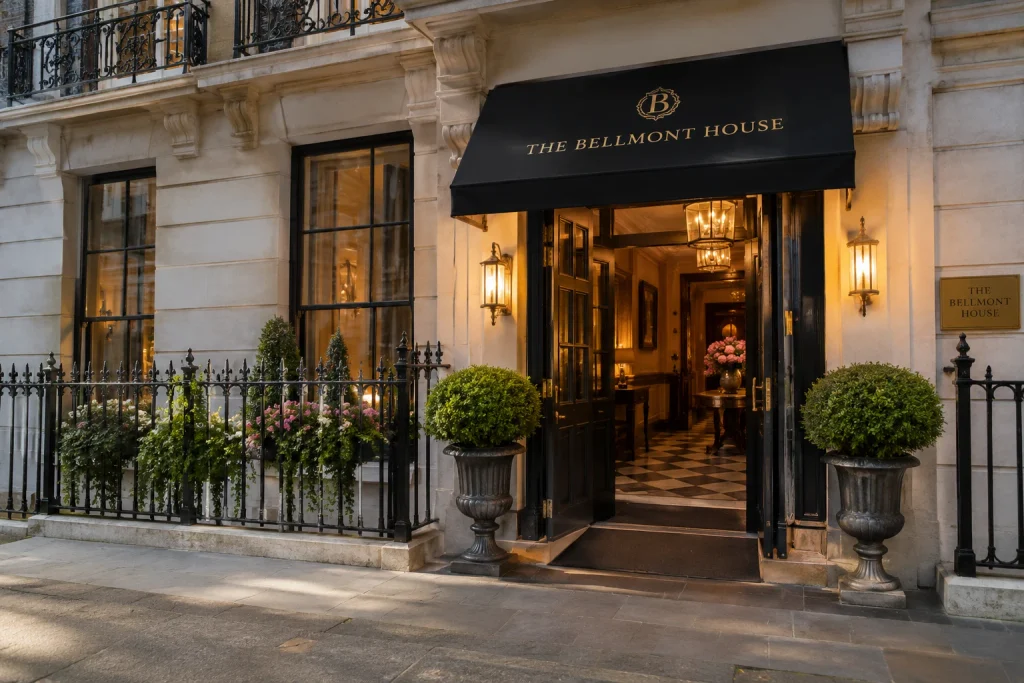
Luxury hotel email marketing is the use of permission-based email to build relationships with prospective and past guests. It prioritizes personalized service, curated experiences, and brand-consistent storytelling over mass promotion. Its goals include direct bookings, repeat stays, ancillary revenue, and loyalty.
How Luxury Hotel Email Marketing Differs From Traditional Hotel Marketing
| Traditional hotel email | Luxury hotel email |
| Mass promotion to a broad list | Guest recognition based on known preferences |
| Discount-led campaigns | Experience-led storytelling |
| Generic automation | Personalized service, with human escalation |
The difference is tone and intent. A traditional email asks, “How do we fill rooms?” A luxury email asks, “What would this guest value next?”
The Role of Email Across the Luxury Guest Journey
Email supports five stages:
- Discovery: welcome and brand storytelling for new subscribers.
- Booking: confirmations and inquiry follow-ups.
- Pre-arrival: preference gathering, transfers, dining, experiences.
- On-property: service messages that complement, not replace, the concierge.
- Retention: thank-you notes, anniversaries, VIP invitations, and win-back messages.
Why Is Email Marketing Important for Luxury Hotels?
Email gives a hotel a direct, owned channel to guests it already knows. It supports booking revenue, relationship building, upselling, loyalty, and consistent brand communication. Unlike third-party channels, the hotel controls the message and the data.
Increase Direct Bookings and Reduce OTA Dependence
Email lets a hotel invite past guests and subscribers to book directly, with benefits that make sense for the property, such as concierge access or curated packages. Direct invitations can reduce reliance on OTAs, though the size of that effect depends on the hotel.
Build Long-Term Relationships With High-Value Guests
Stay history and stated preferences let you write to guests as individuals. A message that references a past anniversary or spa visit signals that the hotel remembers.
Generate Additional Revenue Through Personalized Experiences
Pre-arrival and pre-stay emails can present dining, spa, and experience options matched to guest interests. This can support ancillary revenue without discounting the room.
Strengthen Guest Loyalty and Repeat Stays
Thank-you emails, early access, and anniversary invitations keep the relationship active between stays.
Maintain Consistent, Premium Brand Communication
Email templates, photography, and voice guidelines keep every touchpoint aligned with the brand.
Benefit-to-KPI map
| Benefit | Measurable KPI |
| Direct bookings | Email-attributed direct bookings and revenue |
| Relationship building | Click rate, replies to concierge, unsubscribe rate |
| Ancillary revenue | Spa, dining, and experience revenue per recipient |
| Loyalty and repeat stays | Repeat-stay rate among emailed segments |
| Brand consistency | Complaint rate, qualitative guest feedback |
How to Build a Luxury Hotel Email Marketing Strategy
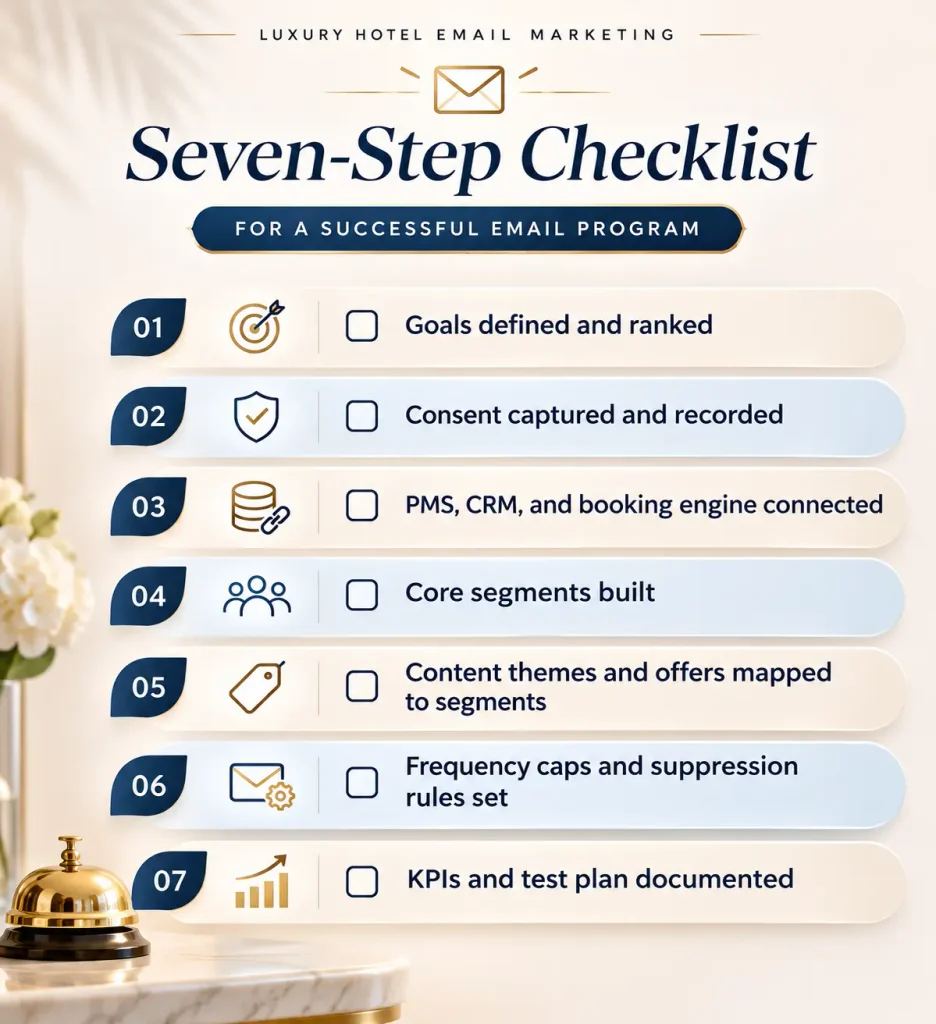
A luxury hotel email strategy has seven steps: set goals, build a permission-based list, connect guest data, segment, create personalized content, set frequency and automation rules, and establish metrics and testing.
Step 1 – Define Your Business and Campaign Goals
Choose a small number of goals: direct bookings, repeat stays, ancillary revenue, or retention. Each campaign should map to one primary goal so you can measure it.
Step 2 – Build a Permission-Based Guest Email List
Collect addresses through website sign-ups, booking journeys, loyalty programs, and explicit opt-ins. Record when and how each guest consented. Check your obligations under rules such as CAN-SPAM and EU data protection law; see the references at the end of this guide.
Step 3 – Connect Guest Data Across Your Systems
Your PMS, CRM, booking engine, and preference records should share data. Without that connection, personalization becomes guesswork.
Step 4 – Segment Your Luxury Hotel Audience
Start with first-time guests, returning guests, VIPs, wellness travelers, families, and corporate travelers. The next section covers this in detail.
Step 5 – Create Personalized Content and Offers
Build content around destination experiences, room preferences, dining, and concierge services. Lead with the experience, not the rate.
Step 6 – Set Campaign Frequency and Automation Rules
Define frequency caps, suppression rules (for example, no promotions to a guest currently in-house or with an open service complaint), and honor stated preferences.
Step 7 – Establish Performance Metrics and Testing
Agree on KPIs before launch and test one variable at a time.
How to Segment Luxury Hotel Guests for More Relevant Emails
Segmentation groups guests by data you already hold so each email feels written for them. The most useful luxury segments combine stay history, travel purpose, and timing.
Segment by Booking History and Guest Lifetime Value
Separate first-time, repeat, and high-value guests. Define “high value” using your own revenue data, not a generic threshold.
Segment by Travel Purpose and Experience Preferences
Leisure, wellness, family, celebration, and corporate travelers want different things. Use stated preferences and past spend where available.
Segment by Location, Seasonality, and Booking Lead Time
Guests from the same market often plan on similar timelines. Use your own booking data to learn when each market books.
Segment VIP Guests Without Over-Automating Personal Service
For VIPs, use email to support a personal relationship, for example drafts reviewed or sent by the guest relations team. Avoid automation that feels impersonal at the top of your guest pyramid.
Use Behavioral Triggers Without Becoming Intrusive
Triggers such as a website visit or abandoned inquiry can prompt a follow-up. Keep messages helpful and infrequent, and avoid language that reveals how closely you tracked behavior.
| Guest segment | Email concept | Primary objective |
| First-time guest | Personal welcome and concierge introduction | Guest experience |
| Returning guest | Invitation based on previous stay | Repeat booking |
| VIP suite guest | Priority access to a curated experience | Retention |
| Wellness traveler | Personalized spa retreat | Ancillary revenue |
| Lapsed guest | Destination-inspired return invitation | Reactivation |
| Previous OTA guest | Benefits of booking directly next time | Direct conversion |
10 Luxury Hotel Email Marketing Campaigns With Examples
The ten campaigns below cover the guest lifecycle.
1. A Personalized Welcome Email
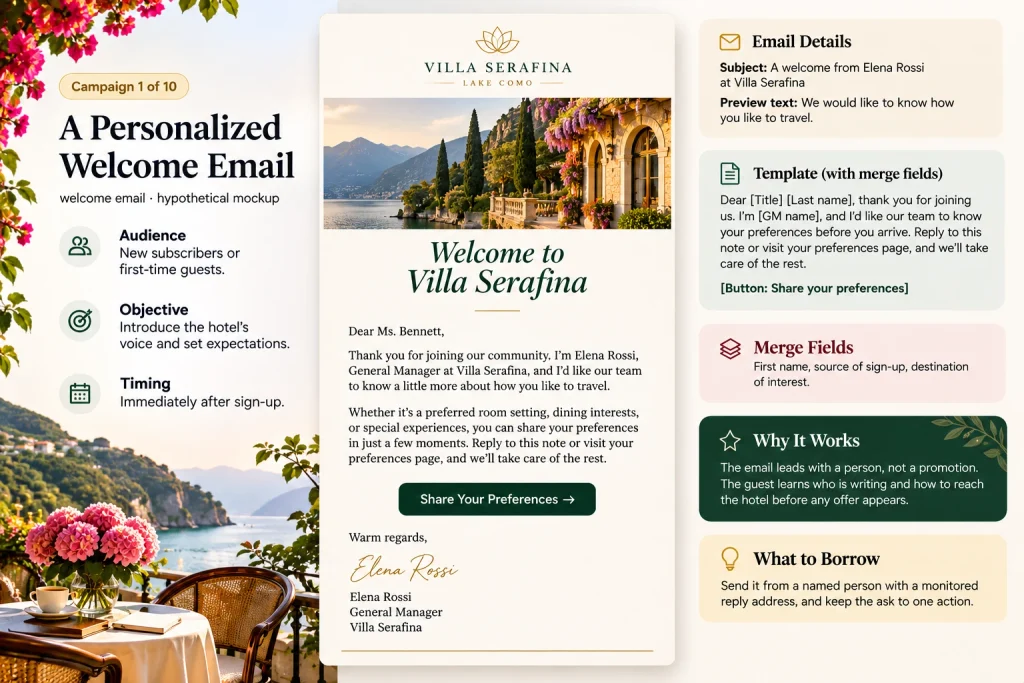
Illustrative luxury hotel welcome email concept. The hotel and campaign are fictional.
Copy This Welcome Email Template
Subject: A welcome from [GM name] at [Hotel]
Preview text: We would like to know how you like to travel.
Dear [Title] [Last name],
Thank you for joining us. I’m [GM name], and I’d like our team to know your preferences before you arrive.
Reply to this note or visit your preferences page, and we’ll take care of the rest.
[Button: Share your preferences]
Personalization fields: Guest name, sign-up source, destination of interest.
2. A Pre-Arrival Concierge Email
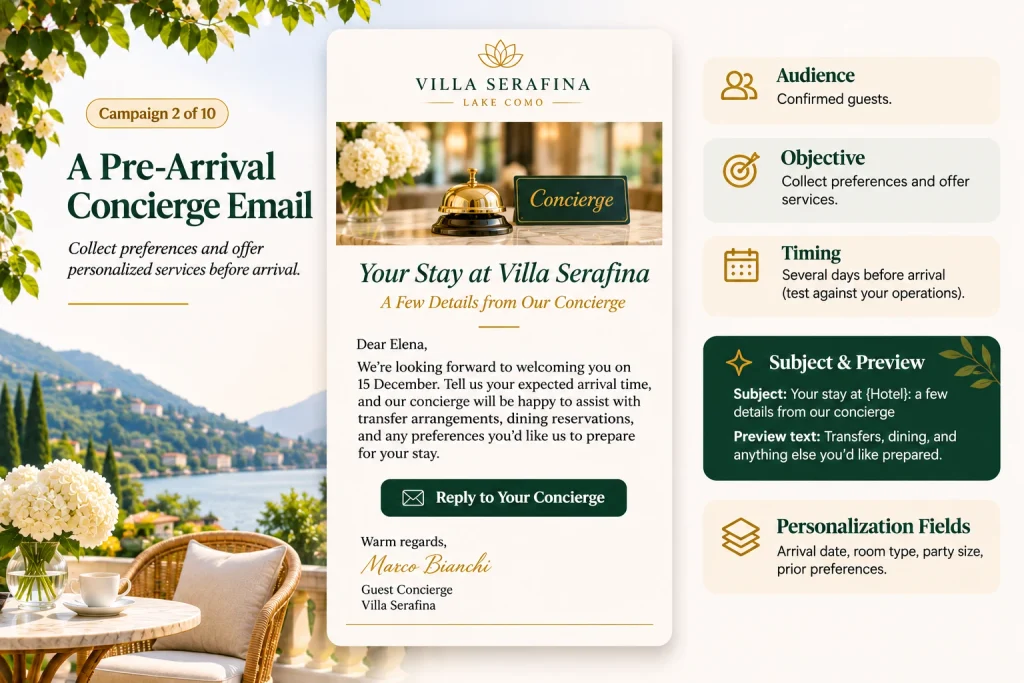
Copy This Pre-Arrival Concierge Email
Subject: Your stay at {Hotel}: a few details from our concierge
Preview text: Transfers, dining, and anything else you’d like prepared.
Dear {First name},
We’re looking forward to welcoming you on {Arrival date}.
To help make your arrival as seamless as possible, please let us know your expected arrival time. Our concierge will be happy to assist with available transfer arrangements.
We would also be delighted to help reserve a table at {Restaurant} or prepare your room according to your preferences.
If there’s anything else we can arrange before your stay, simply reply to this email. Our concierge team will be pleased to assist.
[CTA: Reply to Your Concierge]
Warm regards,
{Concierge name}
Guest Concierge
{Hotel}
Personalization fields: Arrival date, room type, party size, prior preferences, concierge name.
3. An Exclusive Suite Upgrade Invitation
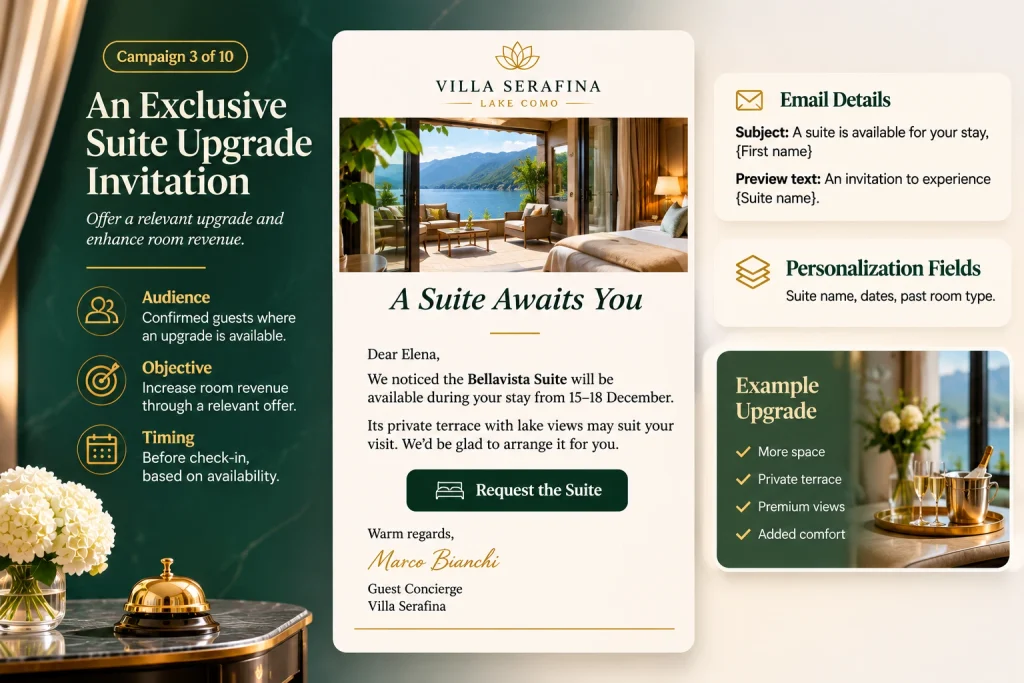
Copy This Suite Upgrade Email Template
Subject: A suite is available for your stay, {First name}
Preview text: An invitation to experience {Suite name}.
Dear {First name},
We are delighted to be welcoming you to {Hotel} from {Arrival date} to {Departure date}.
We would like to invite you to experience {Suite name}, which may be available during your stay.
With its {Suite feature}, this beautiful space offers an opportunity to make your visit even more memorable.
If you would like to explore this upgrade, our team would be pleased to confirm availability, pricing, and arrangements.
[CTA: Request the Suite]
Warm regards,
{Concierge name}
Guest Concierge
{Hotel}
Personalization fields: First name, suite name, arrival and departure dates, suite feature, previous room type.
4. A Private Dining or Spa Experience Email
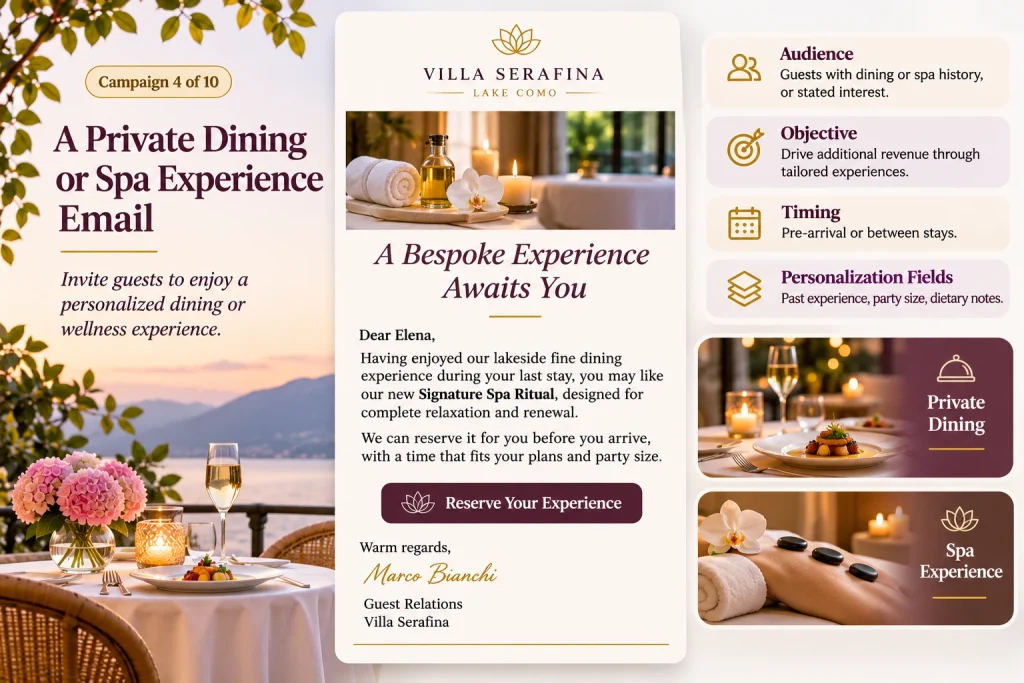
Copy This Private Dining or Spa Email
Subject: An evening prepared for you
Preview text: A private table or treatment, arranged in advance.
Dear {First name},
We look forward to welcoming you to {Hotel}.
Having enjoyed {Past experience} during your previous stay, we thought you might appreciate our new {Experience}.
Whether you wish to enjoy an intimate dining experience or a restorative spa treatment, our team would be delighted to help arrange something special for your visit.
Simply let us know your preferred date, time, and any special requests. We will be pleased to confirm availability and share the arrangements, including pricing.
[CTA: Reserve Your Experience]
Warm regards,
{Concierge name}
Guest Relations
{Hotel}
Personalization fields: First name, past experience, new experience, party size, dietary preferences, concierge name.
5. A Seasonal Luxury Escape Campaign
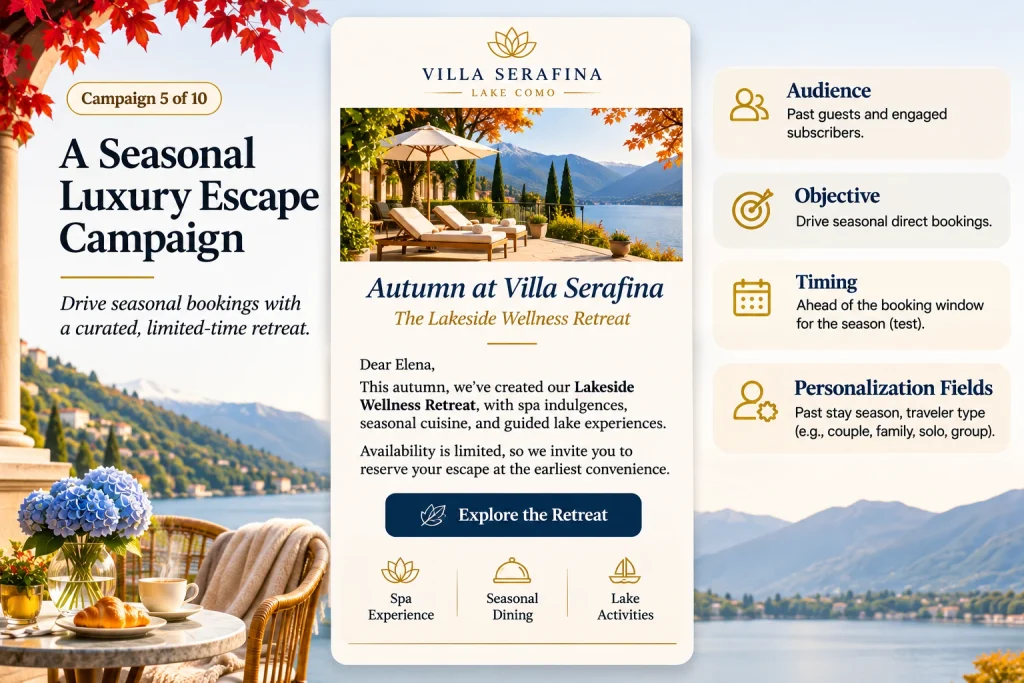
Copy This Seasonal Luxury Escape Email
Subject: {Season} at {Hotel}
Preview text: A retreat designed around the season.
Dear {First name},
As {Season} approaches, we would be delighted to invite you to experience something special at {Hotel}.
We’ve thoughtfully created {Retreat name}, a seasonal escape designed around {Retreat theme}.
Your retreat includes:
- {Inclusion 1}
- {Inclusion 2}
- {Inclusion 3}
We invite you to discover the retreat and explore the available dates. Our team would be pleased to help you plan a memorable stay.
[CTA: Explore the Retreat]
Warm regards,
{Guest Relations name}
Guest Relations Team
{Hotel}
Personalization fields: First name, season, retreat name, retreat theme, package inclusions, past stay season, traveler type.
6. A VIP Loyalty Appreciation Email
- Audience: Top-tier or repeat guests
- Objective: Retention
- Subject line: For our most valued guests
- Preview text: Early access to something we’re planning.
- Sample copy: “{First name}, because you’ve stayed with us {Number} times, we’d like you to be first to hear about {Event}.”
- CTA: Request early access
- Timing: Before general announcement
- Personalization fields: Number of stays, tier, preferred contact
7. A Special Occasion or Anniversary Email
- Audience: Guests who celebrated a milestone at the hotel
- Objective: Repeat booking
- Subject line: One year since {Occasion}
- Preview text: An invitation to return.
- Sample copy: “It’s been a year since you celebrated {Occasion} with us. We’d love to welcome you back.”
- CTA: Plan your return
- Timing: Around the anniversary
- Personalization fields: Occasion, date, prior room
8. A Post-Stay Thank-You and Feedback Email
- Audience: Recent guests
- Objective: Gratitude and feedback
- Subject line: Thank you, {First name}
- Preview text: How was your stay?
- Sample copy: “It was a pleasure hosting you. If you have a moment, tell us what we did well and what we could improve.”
- CTA: Share brief feedback
- Timing: Shortly after check-out
- Personalization fields: Stay dates, room, team members who served them
9. A Past-Guest Re-Engagement Email
- Audience: Lapsed guests
- Objective: Reactivation
- Subject line: Something new at {Hotel}
- Preview text: An invitation to rediscover the property.
- Sample copy: “Since your last stay, we’ve introduced {New feature}. We’d be delighted to show you.”
- CTA: Discover what’s new
- Timing: Based on your typical stay cycle
- Personalization fields: Last stay date, past interests
10. A Direct Booking Benefits Email
- Audience: Guests who previously booked via OTAs (where consent allows)
- Objective: Direct conversion
- Subject line: A more personal way to book your next stay
- Preview text: Benefits reserved for direct guests.
- Sample copy: “When you book with us directly, you can speak with our concierge, and access {Benefit}. We’d love to host you again.”
- CTA: Book direct
- Timing: Between stays
- Personalization fields: Last stay, booking source
How to Write Luxury Hotel Emails That Feel Exclusive, Not Promotional
Exclusive emails read like invitations from a person who knows the guest. They use restrained language, strong imagery, and a single clear action.
Write Elegant, Personalized Subject Lines
Keep them short and specific. Reference the guest, the property, or the experience. Avoid all-caps and aggressive urgency.
Use Storytelling to Sell the Experience
Describe what the guest will feel and do, such as a morning at the spa or a private dinner. Lead with the experience, then the logistics.
Choose Premium Photography and Minimalist Layouts
Use fewer, higher-quality images and generous white space. Add alt text to every image.
Create Clear but Subtle Calls to Action
Use understated, specific wording such as “Request this experience.” Avoid a stack of competing buttons.
Design Mobile-Friendly and Accessible Emails
Use readable type sizes, strong contrast, and a single-column layout. Test on several devices and email clients.
Use AI-Assisted Copy Without Losing the Hotel’s Brand Voice
AI can speed up drafts, but a human should edit against a written voice guide and verify every factual claim about the property.
Before and after (hypothetical)
| Generic promotional | Luxury-focused invitation |
| Subject: BIG SALE! 30% OFF this weekend only!!! | Subject: A weekend at {Hotel}, prepared for you |
| Body: Book now and save on all rooms. Limited time. | Body: Dear {First name}, we’d like to welcome you back for a weekend at the spa, with a private dinner arranged by our chef. |
Which Email Campaigns Should Luxury Hotels Automate?
Luxury hotels should automate repeatable, trigger-based messages such as welcomes, confirmations, pre-arrival notes, thank-yous, and win-backs, while keeping human involvement for VIPs, complaints, and sensitive requests.
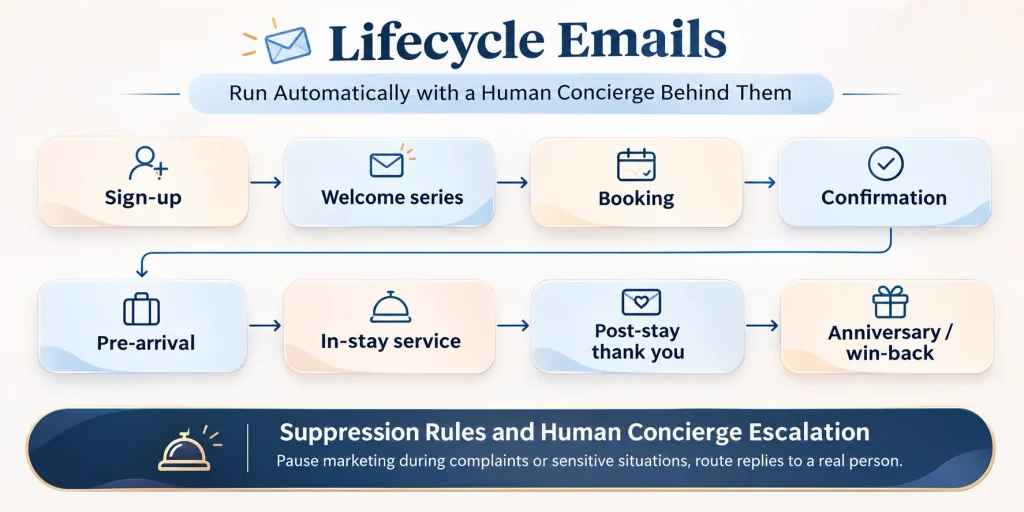
guest lifecycle automation · 8 stages
Messages run automatically from sign-up through win-back, while suppression rules and concierge escalation keep a person in the loop.
Welcome Series for New Subscribers
Introduce the property, its story, and how to share preferences.
Booking Confirmation and Pre-Arrival Communication
Confirm details, name a concierge contact, and ask for preferences.
Personalized Upselling Before Check-In
Offer upgrades and experiences matched to the guest profile.
During-Stay Guest Service Messages
Send brief, useful messages, such as spa availability, and avoid promotions that feel intrusive.
Post-Stay Feedback and Review Requests
Thank the guest and invite short feedback.
Anniversary, Loyalty, and Win-Back Campaigns
Use dates and stay history to prompt a personal invitation.
Booking Abandonment and Inquiry Follow-Ups
Follow up on abandoned booking attempts or inquiries with a helpful, low-pressure message.
Suppression Rules and Human Concierge Escalation
Pause marketing during complaints, in-house stays, or sensitive situations, and route replies to a real person.
| Trigger | Example message | Suggested timing |
| Newsletter sign-up | Welcome to the hotel | Immediately |
| Reservation confirmed | Booking details and concierge contact | Immediately |
| Arrival approaching | Stay preferences and experiences | 5–7 days before |
| Check-out completed | Thank-you and feedback | 1–3 days after |
| Past stay anniversary | Personal return invitation | Around anniversary |
| Extended inactivity | Re-engagement invitation | Based on stay cycle |
Timings are illustrative starting points, not universal performance benchmarks. Test against guest behavior and property operations.
How to Choose the Right Luxury Hotel Email Marketing Software
Choose software based on how well it connects to your PMS and guest data, supports segmentation and consent, and reports revenue, not on brand recognition alone. No single platform is best for every property.
Hotel CRM Versus General Email Marketing Software
Hospitality CRMs are built around guest profiles and stay data. General tools may offer flexible design and lower entry cost but may need integrations to reach hotel data.
Essential Features for Luxury Hotels
- PMS integration
- Unified guest profiles
- Segmentation
- Automation
- Consent management
- Revenue attribution
- Reporting
Hospitality Platforms and General Marketing Tools to Evaluate
The outline names Revinate, Cendyn, Mews-connected solutions, SendSquared, and Mailchimp, among other providers. No verified vendor information was supplied, so this guide does not state what any of them can or cannot do. Verify features, integrations, and pricing directly with each vendor and date your findings.
| Platform | Verified capabilities | Pricing (checked Nov. 16, 2026) |
|---|---|---|
| Revinate | Guest CRM, advanced segmentation, PMS data connection, email campaigns, A/B testing and automated guest marketing workflows. | Custom pricing; request a quote. |
| Cendyn | Unified guest profiles, personalized email campaigns, automated guest journeys, multichannel marketing, analytics and PMS integrations. | Custom quote; no standard public CRM price confirmed. |
| Mews-connected solutions | Marketplace integrations with hospitality CRM and marketing providers, including Revinate and Cendyn. Capabilities depend on the connected solution. | Varies by integration; additional partner fees may apply. Mews Help Center+1 |
| SendSquared | Hospitality CRM, email and SMS campaigns, guest lifecycle communication, PMS integrations, unified messaging and marketing automation. | Custom quote based on property scale and hotel room count. |
| Mailchimp | Email campaigns, audience segmentation, automation flows, templates, A/B testing and campaign reporting, depending on plan. | Free plan available; Essentials from $13/month, Standard from $20/month and Premium from $350/month (USD, published starting prices). |
Questions to Ask Before Selecting a Platform
- Does it integrate with our PMS and booking engine?
- How is pricing structured, and what could raise it?
- What implementation support is included?
- How are security and consent handled?
- Can it scale across properties or markets?
How to Measure Luxury Hotel Email Marketing Performance and ROI
Measure performance with a mix of engagement, deliverability, and revenue metrics. Revenue and incremental bookings tell you more than opens.
Track Engagement Without Relying Only on Open Rates
Monitor click rate, unsubscribe rate, spam complaints, and deliverability. Open rates can be unreliable as a sole indicator.
Measure Direct Bookings and Revenue Per Recipient
Track bookings and revenue attributed to each campaign, and divide revenue by the number of recipients to compare campaigns of different sizes.
Calculate Email Marketing ROI
\text{ROI}=\frac{\text{Attributed Revenue}-\text{Campaign Cost}}{\text{Campaign Cost}}\times 100
This is a simplified, revenue-based calculation. A fuller profitability view should consider contribution margin, incremental bookings, and associated costs.
Hypothetical example: If a campaign cost 2,000 and generated 10,000 in attributed revenue, ROI = (10,000 − 2,000) ÷ 2,000 × 100 = 400%. These figures are invented for illustration only.
Compare Direct Booking Acquisition Costs With OTA Costs
Compare your email cost per direct booking with your actual OTA costs. Use your own commission data.
Use Attribution and Incrementality Testing
Attribution shows which messages preceded a booking. Incrementality testing, such as holding out a control group, shows whether the email caused it.
Run A/B Tests to Improve Performance
Test one variable at a time (subject line, send time, CTA, image), and run each test long enough to reach a meaningful sample.
Email Marketing Best Practices for Luxury Hotels
The core practices are to prioritize relevance, protect the brand, respect consent, maintain deliverability, coordinate channels, and review data regularly.
Prioritize Relevance Over Email Volume
Send fewer, better-targeted messages.
Protect the Premium Brand With Experience-Led Offers
Offer value-added experiences rather than deep discounts.
Respect Consent, Privacy, and Guest Preferences
Honor opt-outs promptly, store consent records, and limit data to what you need. Consult the references at the end of this guide and your legal counsel.
Authenticate Email Domains and Maintain Deliverability
Set up domain authentication (SPF, DKIM, DMARC) and review Google’s sender guidelines.
Coordinate Email With Concierge, SMS, and WhatsApp
Avoid duplicating messages across channels. Let guest preference decide the channel.
Review Guest Data Quality and Campaign Performance Regularly
Clean bounced and duplicate records, and review results on a set schedule.
Common Luxury Hotel Email Marketing Mistakes and How to Fix Them
| Mistake | Fix |
| Sending the same message to every guest | Segment by stay history, purpose, and preferences |
| Overusing discounts and urgency | Lead with experiences and invitations |
| Sending too many emails | Set frequency caps and honor preferences |
| Using poor-quality guest data | Audit, deduplicate, and connect your systems |
| Directing guests to generic booking pages | Link to pages matching the offer, with preselected details where possible |
| Ignoring mobile experience and deliverability | Test on devices and authenticate your domain |
| Measuring success by opens instead of revenue | Track clicks, bookings, and revenue per recipient |
A 90-Day Luxury Hotel Email Marketing Implementation Plan
| Period | Priorities | Deliverable |
| Days 1–30 | Audit data, consent, integrations, and existing campaigns | Segmentation and measurement foundation |
| Days 31–60 | Launch welcome, pre-arrival, and post-stay automations | Core lifecycle journeys |
| Days 61–90 | Introduce VIP campaigns, A/B testing, and revenue reporting | Optimization dashboard and campaign calendar |
Frequently Asked Questions About Luxury Hotel Email Marketing
How often should a luxury hotel send marketing emails?
There is no universal number. Start with a modest cadence, set frequency caps, and adjust based on unsubscribe rates, complaints, and bookings. Transactional and service emails are separate from marketing frequency.
What is the best time to send hotel marketing emails?
It depends on your guests and markets. Test send times against your own click and booking data.
What makes an effective luxury hotel email subject line?
It is short, specific, and personal, and it signals an invitation or experience rather than a sale. Test variations against clicks and bookings.
How can luxury hotels increase direct bookings through email?
Invite past guests and subscribers to book directly, explain the benefits of doing so, link to relevant booking pages, and follow up on abandoned inquiries. Measure direct bookings per campaign.
Can small boutique luxury hotels benefit from email automation?
Yes. Automating welcome, pre-arrival, and post-stay messages can save staff time while keeping communication consistent, provided the tools suit the property’s size and budget.
Can hotels use AI to personalize guest communications?
Yes, as a drafting and personalization aid, with human review for brand voice and accuracy, and with attention to guest data privacy.
Can hotels send promotional emails to guests who booked through OTAs?
It depends on whether you have lawful permission to market to them. Rules vary by jurisdiction and by what the guest agreed to. Check the references at the end of this guide and consult legal counsel.
How long does it take to see results from hotel email marketing?
It varies with list size, data quality, and booking windows. Engagement can show early, while booking results may lag.
Final Thoughts: Make Every Guest Email Feel Like Part of the Luxury Experience
Effective luxury hotel email marketing combines thoughtful personalization, relevant timing, elegant creative, and measurable results. Start with your guest data, launch a small set of essential lifecycle journeys, and optimize based on guest experience and direct booking performance.
External references to consult: