Online gaming has evolved thehakegamer from simple, text-based multiplayer experiments into a global entertainment industry. Better internet connectivity, more capable gaming technology, smartphones, esports and online communities each pushed it forward.
Newzoo forecasts that the global games market will generate $213.9 billion in 2026 from 3.70 billion players, and the International Telecommunication Union (ITU) estimates that about 6 billion people, or 74% of the world’s population, used the internet in 2025.
The change goes beyond how people play. Online gaming has changed how people communicate, compete, create content and join digital communities. This guide traces that evolution from early networked games to cloud gaming, and covers the business models, social effects and challenges that came with it.
Key statistics at a glance
| Metric | Figure | Source |
| Global games market revenue, 2026 forecast | $213.9 billion (+6.1% year on year) | Newzoo |
| Global players, 2026 forecast | 3.70 billion | Newzoo |
| Mobile share of games revenue, 2026 forecast | 57% ($121.1 billion) | Newzoo |
| Internet users worldwide, 2025 | About 6 billion (74% of the population) | ITU |
| Global esports audience, 2025 | 640.8 million | Newzoo data, reported by Quantumrun |
| Americans who play video games weekly, 2026 | 212.3 million (67% of ages 5 to 90) | ESA |
The Early Days of Online Gaming: Where It All Began
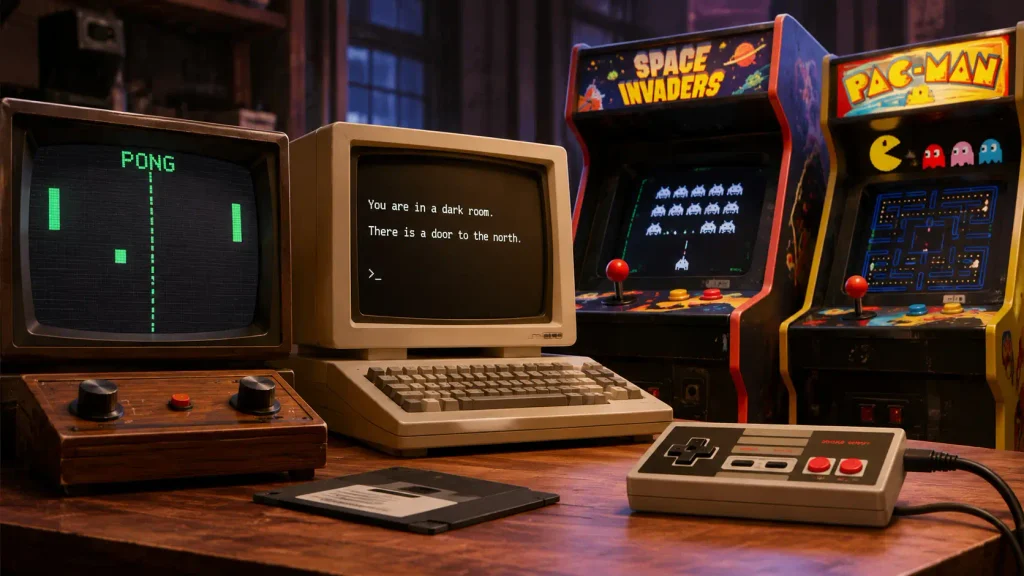
Online gaming began with experiments on shared computers, then passed through text-based worlds, arcades and modem connections before the internet made connected play practical.
The First Computer Games and Early Networked Experiences
Early games ran on mainframe computers and were experimental by nature. Early multiplayer experiments let more than one person take part in the same game. Text-based games known as Multi-User Dungeons (MUDs) let players share a virtual world through written descriptions and typed commands.
They laid the groundwork for the persistent online worlds that came later.
The Role of Arcades and Local Multiplayer Gaming
Arcades taught players to compete. High-score systems turned a single game into a public contest, and local multiplayer and shared-screen play let friends compete in the same room. The limit was obvious: without internet connectivity, you could only play against people who were physically present. Online gaming filled that gap.
How Dial-Up Internet Introduced Online Multiplayer
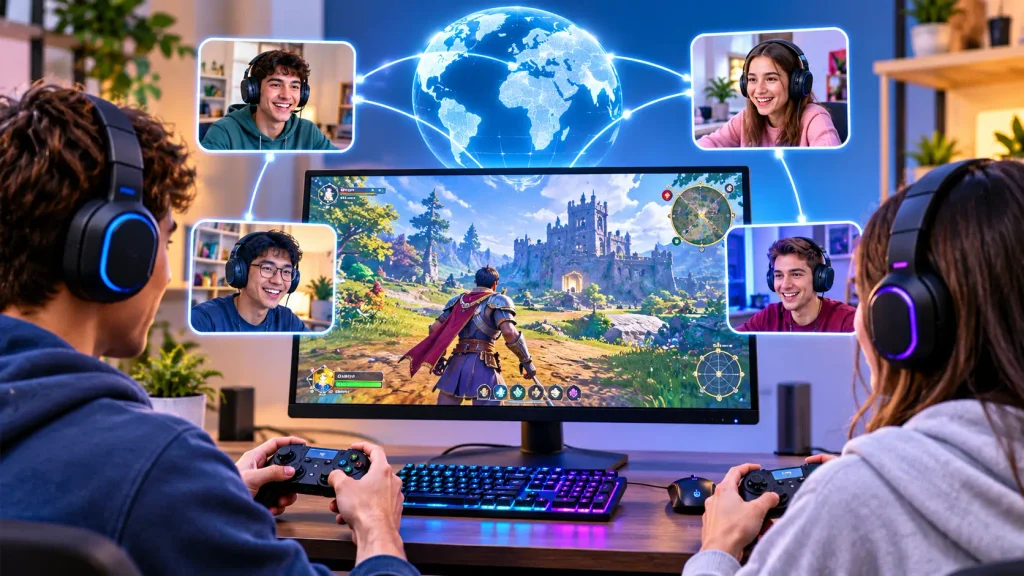
Dial-up internet and modems made the first online matches possible. Early modem-based gaming let players connect with one another, but internet limitations and connection problems made sessions unreliable. Even so, early multiplayer titles and online communities formed around these connections.
A reasonable interpretation is that players accepted the friction because the alternative, playing only with people nearby, was more limiting.
How Internet Technology Transformed Online Gaming
Faster, more stable and more widely available connections made richer multiplayer games possible. The ITU estimates that about 6 billion people used the internet in 2025, up from 5.8 billion in 2024, and that the online population grew by more than 240 million people during 2025.
| Internet technology | Gaming impact |
| Dial-up | Enabled early online connections |
| Broadband | Improved multiplayer connectivity |
| Fiber-optic internet | Higher bandwidth and potentially lower latency |
| Modern wireless networks | Expanded connectivity across devices |
The Transition from Dial-Up to Broadband Internet
Broadband brought faster connections and shorter waits. Multiplayer experiences improved, and developers could build more demanding online games. Wireless broadband now matters as much as fixed lines: the ITU reports 99 mobile broadband subscriptions per 100 inhabitants in 2025, accounting for 89% of all mobile subscriptions, up from under 50% in 2015.
Some of those subscriptions belong to connected devices or to people holding several, so the figure is not the same as the share of people with access.
How Dedicated Game Servers Improved Multiplayer Experiences
Dedicated game servers host the match on central machines rather than on a single player’s device. The outline’s three benefits follow from that design: server-based multiplayer environments, matchmaking and player coordination, and better server stability and performance. The practical implication is that when many players share one match, a stable server matters as much as the game’s design.
The Importance of Speed, Bandwidth, and Low Latency
Latency is the delay between a player’s action and the game’s response, and ping is the usual way to measure it. Bandwidth is how much data a connection can carry. Competitive games reward low latency, and connection stability matters because an unstable connection causes lag even when headline speeds are high.
Connection quality is still uneven. The ITU estimates that 5G subscriptions reached about 3 billion, roughly one-third of mobile broadband subscriptions, and that more than half of the world’s population is covered by 5G.
It also finds that users in high-income countries generate nearly eight times more mobile data than users in low-income countries, and about 2.2 billion people remain offline. A reasonable reading is that uneven network quality shapes who can enjoy demanding online games.
The Rise of Multiplayer Gaming and Global Communities
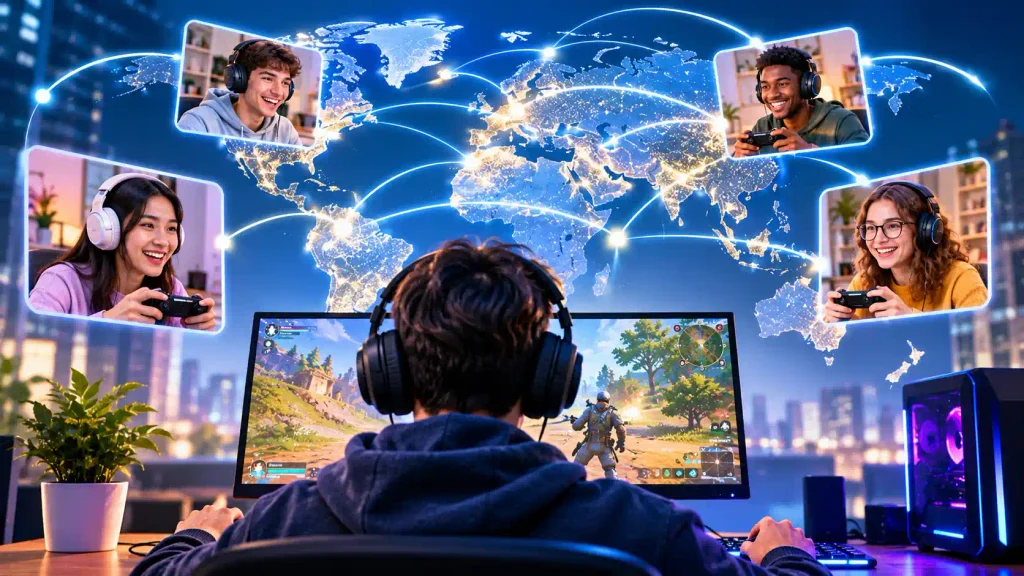
Online play replaced the nearby-friends limit with opponents and teammates anywhere in the world. In the United States, the Entertainment Software Association (ESA) reports that 89% of players aged 8 to 90 have played online and 55% play with others weekly.
The Growth of Massively Multiplayer Online Games (MMORPGs)
MMORPGs are built around persistent virtual worlds, character development and cooperative missions. World of Warcraft is the example most often cited. These games showed that thousands of people could share one world and work toward common goals.
The Evolution of Competitive Online Multiplayer Games
Player-versus-player gaming took the arcade high-score tradition global. First-person shooters and battle royale games put players into large online matches, while ranked matchmaking and leaderboards gave them a way to measure progress against everyone else. This competitive layer later fed directly into esports.
How Cross-Platform Gaming Connected Different Devices
Cross-platform gaming links PC, console and mobile players. Cross-play lets friends on different devices share a match, and cross-progression lets them carry progress between devices. Newzoo’s 2026 forecast counts 3.10 billion mobile players, 977 million PC players and 651 million console players.
Those figures add up to more than the 3.70 billion total, which indicates that many players use more than one platform. Compatibility challenges include differences in hardware, controls and platform ecosystems.
Gaming Communities Beyond the Game
Voice chat and communication tools turned matches into conversations, and platforms such as Discord gave groups a place to stay connected between sessions. The ESA’s 2026 report found that 37% of U.S. players have met a good friend, spouse or significant other through video games. Its 2025 report lists real-life friends (66%) and online-only friends (40%) among the people U.S. players game with.
How Mobile Gaming Made Online Games More Accessible
Smartphones put games in the hands of anyone with a phone. Newzoo forecasts 3.10 billion mobile players in 2026, which is 84% of all players, and $121.1 billion in mobile revenue, or 57% of the global games market.
The Smartphone Revolution in Gaming
Touchscreen controls and portable gameplay made casual gaming possible for broader audiences. Newzoo’s final estimate put mobile revenue at $113.3 billion in 2025, up 10.7%, and it forecasts $121.1 billion in 2026, up 6.8%. Growth is shifting geographically: Newzoo expects Central Southern Asia, Southeast Asia, and the Middle East and Africa to account for 80% of the 117.8 million net new mobile players added in 2026.
The Rise of Free-to-Play Mobile Games
Free-to-play mobile games use free downloads, optional in-app purchases, advertising and other monetization. Newzoo notes that mobile revenue is growing even as downloads fall, because growth increasingly comes from deeper spending per player and from direct-to-consumer channels. Newzoo also forecasts about 1.65 billion paying players in 2026, which is roughly 45% of the 3.70 billion total by simple division.
Mobile Multiplayer and Social Gaming
Smartphones let friends play together from different places, and mobile esports has become a visible part of competitive gaming. Mobile Legends: Bang Bang peaked above 3 million concurrent viewers at the 2025 Esports World Cup, according to Esports Charts. Cross-device communities now connect mobile players with PC and console players.
| Traditional gaming | Mobile gaming |
| Often requires dedicated hardware | Uses smartphones and tablets |
| Frequently involves larger installations | Often supports quick downloads |
| Typically played in dedicated settings | Can be played in different locations |
| Historically more reliant on upfront purchases | Often uses free-to-play models |
The Growth of Esports and Professional Online Gaming
Esports turned online competition into an organized ecosystem of tournaments, teams, streaming platforms, sponsors and audiences. Newzoo data reported by Quantumrun puts the 2025 global esports audience at 640.8 million, made up of 318.1 million enthusiasts and 322.7 million occasional viewers.
Esports Charts reports that live esports viewing reached 3.3 billion hours in 2025 excluding mainland China, up 1.5% on 2024. Stream Hatchet counts 2.7 billion hours; the gap likely reflects different measurement scopes, and neither methodology was reviewed here.
From Casual Competition to Professional Esports
Organized tournaments, professional teams and players, and competitive communities moved gaming from casual contests to a structured scene. The League of Legends World Championship 2025 reached 6.75 million peak viewers, and the LCK 2025 season was the most-watched esports property of the year at about 161.8 million hours, according to Esports Charts figures reported by Outlook Respawn.
How Streaming Platforms Changed Competitive Gaming
Live gameplay broadcasts let audiences watch matches from anywhere, and gaming personalities and influencers add commentary and community around them. Stream Hatchet reports that Twitch (43.6%) and YouTube Gaming (40.5%) together accounted for 84.1% of esports hours watched in 2025.
At the 2025 Esports World Cup, Esports Charts recorded YouTube growing 109.4% to 75.4 million hours, TikTok growing 80.1% to 25.57 million hours, and Twitch edging down 0.6% to 48.54 million hours.
How Online Gaming Created New Career Opportunities
The ecosystem now supports professional players, streamers and content creators, tournament organizers, coaches and commentators. Newzoo’s narrower professional esports model puts 2025 revenue at $1.866 billion, up from $996 million in 2020, as reported by Bitcoin.com News.
The Role of Sponsorships and Gaming Events
Brand partnerships and prize pools fund the scene, and events run both online and offline. The Esports World Cup Foundation reports 3 million on-site visitors for the 2025 event in Riyadh, and an aggregation of Foundation data lists $70.45 million in prize money paid out.
Team Falcons won the 2025 Club Championship and a $7 million prize. For 2026, the tournament was scheduled for Paris with a $75 million prize pool across 25 tournaments.
How Gaming Business Models and Distribution Have Changed
Online gaming changed how games are purchased, distributed and monetized. Newzoo’s 2026 outlook says future growth will depend increasingly on retaining and monetizing existing audiences rather than adding new players.
From Physical Game Copies to Digital Downloads
Games once shipped on cartridges, CDs and DVDs. Digital game stores replaced the trip to a shop with instant downloads and updates.
The Growth of Subscription-Based Gaming
Subscription services give players access to a library of games for a regular fee. Xbox Game Pass is the example named in the outline. The benefits are access and variety, and the limitations include ongoing payments and the fact that library access is not the same as owning a game.
How Free-to-Play Games Changed the Industry
Free-to-play games offer free access and earn money from optional purchases, including cosmetic upgrades, in-game currencies and microtransactions. Newzoo expects microtransactions to regain share as the largest business model in 2026. Premium games remain important too: all of the top 10 PC games by revenue in 2025 were premium titles, according to Newzoo.
Downloadable Content and Live-Service Games
Expansion packs, seasonal content and continuous updates keep players engaged after launch. The model is not guaranteed to work. Newzoo’s data for the first half of 2026 described a mixed picture, with most established live-service and evergreen titles flat or down, as reported by GamesIndustry.biz.
| Business model | How it works | Example |
| Traditional purchase | Pay once to own a game license | Full-price game |
| Subscription | Pay regularly for access | Xbox Game Pass |
| Free-to-play | Play without an upfront purchase | Fortnite |
| Microtransactions | Purchase optional digital items | Skins and cosmetics |
| DLC | Purchase additional game content | Expansion packs |
These models can overlap. A free-to-play game can also offer subscriptions or downloadable content.
Modern Gaming Technologies Changing the Player Experience
Cloud streaming, immersive hardware, artificial intelligence and better graphics are reshaping how online games look, feel and run.
Cloud Gaming and Streaming-Based Gameplay
Cloud gaming runs the game on remote servers and streams the video to the player’s device, so powerful local hardware is not required. NVIDIA GeForce NOW and Xbox Cloud Gaming are examples. The trade-off is that it needs a fast, stable connection, and latency can limit fast-paced play.
Market-size estimates vary widely: Mordor Intelligence sizes the 2026 cloud gaming market at $6.23 billion, Persistence Market Research at $6.8 billion, and Fortune Business Insights at $23.79 billion using a broader definition. Microsoft reportedly logged 1.7 billion cloud gaming hours in fiscal 2025, up 45%, according to figures compiled by VoxBooster from Microsoft’s earnings.
Virtual Reality and Augmented Reality Gaming
VR creates immersive virtual environments, and AR layers digital interactions onto the real world.
Artificial Intelligence in Modern Online Games
AI shows up as smarter non-player characters (NPCs), adaptive difficulty, procedural content generation and AI-assisted game development.
Improved Graphics, Audio, and Game Physics
Realistic environments, ray tracing, spatial audio and more detailed animations and interactions raise immersion.
The Social and Cultural Impact of Online Gaming
The ESA’s 2026 report found that 212.3 million Americans aged 5 to 90 play video games for at least one hour a week, which is 67% of that age group and 3% more than in 2025. The average player is 37.
How Online Gaming Builds Friendships and Communities
Shared interests, cooperative experiences and international communities all create bonds. The ESA reports that 37% of players have met a good friend, spouse or significant other through video games, and that 75% of American parents play weekly, with 81% of those parents also gaming with their children.
Gaming as a Form of Digital Entertainment
Watching gameplay, streaming culture, gaming events and online communities make gaming a spectator activity as well as a participatory one. The esports viewing figures above show the scale of that audience.
How User-Generated Content Changed Gaming
Custom maps, modifications and player-created experiences let players shape the games they play. Minecraft and Roblox are the examples named in the outline.
Gaming Accessibility and Inclusion
Customizable controls and accessibility options help players with disabilities, and communities are becoming more inclusive. The ESA reports that 21% of American adult players have a disability, and it launched an Accessible Games Initiative in March 2025 that tags games with their accessibility features.
Challenges That Have Emerged Alongside Online Gaming
These challenges are real, but they do not make online gaming inherently harmful.
Cybersecurity, Account Theft, and Online Scams
Phishing and fake gaming websites target players’ accounts and payment details. Sensible precautions include unique passwords, two-factor authentication where offered, buying only from official stores and never sharing login codes.
Cheating, Bots, and Unfair Competition
Aimbots and other cheating tools damage fair play. Anti-cheat technologies and fair matchmaking aim to protect the competitive experience.
Toxic Behavior and Online Harassment
In-game abuse affects the experience of many players. Moderation, reporting tools and community management are the main responses.
Microtransactions and Gaming Addiction Concerns
Spending transparency, loot boxes and randomized rewards raise concerns, particularly for younger players. Healthy gaming habits and parental controls help. The ESA’s 2025 report notes that most parents use ESRB ratings and parental controls to manage what their children play.
What Does the Future of Online Gaming Look Like?
The developments below are plausible directions, not forecasts of certain outcomes. Newzoo expects the global player base to reach 3.95 billion in 2028 and 4.07 billion in 2029, while noting that growth will rely more on retaining and monetizing existing players.
More Advanced AI-Powered Gaming Experiences
Dynamic NPC interactions, adaptive environments and personalized gameplay are the likely areas of change.
Faster Connectivity and More Responsive Multiplayer
Continued network improvements and lower latency would support more demanding online experiences. The ITU’s finding that 5G subscriptions already reach about one-third of mobile broadband subscriptions shows the direction of travel.
The Expansion of Cloud and Cross-Platform Gaming
Cloud and cross-platform gaming point toward device-independent access and connected ecosystems. Forecasts diverge: Mordor Intelligence projects $21.62 billion by 2031 (a 28.25% CAGR), while MarketsandMarkets projects $40.20 billion by 2031. Potential barriers to adoption include connection quality and the uneven network access noted earlier.
More Immersive VR and AR Experiences
Improved headsets, interactive virtual environments and mixed-reality experiences are the expected areas of progress.
Final Thoughts on How Online Gaming Has Evolved
Online gaming has traveled from mainframe experiments and text-based worlds to a global ecosystem. Three ideas explain that journey:
- Technology made online gaming more accessible and more sophisticated.
- Connectivity turned gaming into a social and competitive experience.
- New business models and emerging technologies continue to reshape the industry.
Online gaming is still evolving, and future developments are likely to influence how people play, interact and experience digital entertainment.
Frequently Asked Questions About the Evolution of Online Gaming
When did online gaming become popular?
Online gaming became mainstream as internet access spread, but the supplied research contains no dated milestones. Today’s scale is clear: the ESA reports 89% of U.S. players aged 8 to 90 have played online, and Newzoo forecasts 3.70 billion players worldwide in 2026.
What was online gaming like before broadband internet?
Before broadband, online play relied on dial-up and modem-based connections. Internet limitations and connection problems made sessions unreliable, though early multiplayer titles and online communities still formed. Text-based games such as MUDs were among the earliest shared online experiences.
How has the internet changed video games?
Faster, more stable connections made real-time multiplayer, dedicated servers, matchmaking, digital downloads, streaming and cloud gaming possible. The ITU estimates about 6 billion people were online in 2025, which gives online games a far larger potential audience than early dial-up players had.
What technologies have had the biggest impact on online gaming?
Broadband and mobile networks, dedicated servers, smartphones, streaming platforms and cloud gaming have each shaped the industry. The supplied research does not rank them, so any ordering is interpretation. Smartphones stand out by reach: Newzoo counts 3.10 billion mobile players.
Why has mobile gaming become so popular?
Mobile gaming runs on devices people already own, uses touchscreen controls, supports quick downloads and often follows a free-to-play model. Newzoo forecasts that mobile will account for 57% of 2026 games revenue and 84% of all players, making it the largest platform.
How has online gaming changed social interaction?
It lets people play, talk and build communities across distances. The ESA reports that 55% of U.S. players aged 8 and over play with others weekly, and 37% have met a good friend, spouse or significant other through video games.
What is the difference between cloud gaming and traditional gaming?
Traditional gaming runs the game on the player’s own hardware. Cloud gaming runs it on remote servers and streams it to the device, which lowers hardware demands but requires a fast, stable connection. Latency can limit fast-paced competitive play.
How have esports changed the gaming industry?
Esports created organized tournaments, professional careers and large streaming audiences. Newzoo data reported by Quantumrun puts the 2025 esports audience at 640.8 million, and the Esports World Cup announced a $75 million prize pool for 2026. Streaming platforms and sponsors now sit at the center of the ecosystem.
What are the biggest challenges facing online gaming?
The main challenges are account theft and scams, cheating, toxic behavior and harassment, and concerns about microtransactions and gaming addiction. Security habits, moderation, anti-cheat systems and parental controls address them.
What is the future of online gaming?
Likely developments include more advanced AI, faster connectivity, wider cloud and cross-platform access, and more immersive VR and AR. Newzoo expects the player base to reach 4.07 billion by 2029, though these trends are expectations rather than certainties.