Speed and reliability have transformed from “nice to have” to “must have” in the online work environment. If you are scraping data, running automated tools, or monitoring search results in different parts of the world, the workflow can be disturbed in no time due to slow connections and unstable IPs. This is where datacenter proxies come into play.
These high-performance proxies are quick, which also makes them the ideal tool for companies and power users who need fast, scalable access to the web. But the performance of all datacenter proxies is not up to par.
The article below outlines the criteria for good performance, the features a quality provider should offer, and the common pitfalls to avoid when selecting a datacenter proxy solution.
Why DC Proxies

Speed and Scalability Advantages
Datacenter proxies are hosted on high-quality servers located in data centers. They are not connected to the consumer internet, so they provide much lower latency and quicker responses than residential or mobile proxies.
This characteristic makes them fit for high-volume, time-sensitive tasks like web scraping, price monitoring, and large-scale automation.
For businesses that need immediate access to large IP pools, choosing to buy datacenter proxy services is often the fastest way to scale operations without sacrificing performance. One of the best datacenter proxy providers are: ProxyWing, Decodo, IPRoyal
Cost Efficiency for Large-Scale Operations
On a per-IP basis, datacenter proxies are far superior compared to residential proxies. With it, providers can allocate thousands of IPs quickly, thus making them a cost-effective solution for projects that need fast scaling.
In fact, this affordability is a major reason why datacenter proxies are widely used in commercial automation alongside data collection workflows.
Predictable Performance
Likewise, in comparison to residential IPs that require individual users’ connection quality, datacenter proxies provide a much more stable connection, consistent bandwidth, and reliable uptime.
This predictability is also helpful for long-running tasks and production-level systems.
What to Expect From a Datacenter Proxy
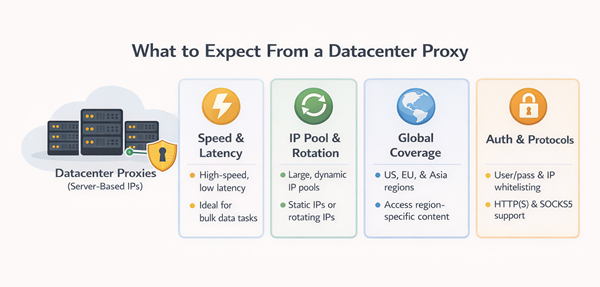
Connection Speed and Latency
Proxies in data centers are primarily designed for speed. These are placed in server environments that are optimized for performance, and usually provide faster response times than IPs that are based on ISPs.
The performance advantage is especially noticeable in applications such as continuous monitoring, large-scale data collection, or accessing multiple endpoints simultaneously.
IP Pool Size and Rotation Options
Flexible IP management is a must-have for a high-quality datacenter proxy service. Generally, users can choose between shared and dedicated IP pools, as well as static or rotating IPs.
Also, the success rate of a proxy is determined by the frequency of its rotation. For instance, too frequent rotation can cause instability, whereas too little can increase the risk of detection.
Location Coverage
While it can differ, most data center proxy providers offer coverage across major regions, which include North America, Europe, and some parts of Asia.
Likewise, geographic diversity also matters when accessing region-specific content, testing localized ads, or performing SEO research across multiple markets.
Authentication and Protocol Support
The conventional methods of authentication are to allow certain IPs and to use username/password as credentials. Reliable providers in the case of protocols support both HTTP(S) and SOCKS5, guaranteeing that there will be compatibility with many different types of tools, browsers, and also custom scripts.
Providers Compared
Performance Metrics to Evaluate
While making a comparison of the datacenter proxy providers, performance should be measured in terms of clear, objective criteria:
- Speed benchmarks for evaluation of latency and response times
- Success rate, particularly for scraping or automation tasks
- Uptime guarantees with 99% or higher are the norm
These factors are helpful in discerning whether a proxy network can manage continuous workloads without interruptions.
Infrastructure Quality
Top providers depend on Tier-1 data centers that have cutting-edge hardware and improved routing. In addition, the origin of the IPs, if they are owned or recycled, is very crucial to know.
Reused IP ranges are more likely to be flagged, which can negatively affect performance.
Support, Transparency, and Testing
Trustworthy providers reveal their infrastructure and constraints without hesitation. Services that provide trial access, money-back guarantees, or user-friendly dashboards for monitoring usage should be your pick.
Quick and efficient technical support is also important when you are trying to fix performance or configuration problems.
Risks of Datacenter IPs
Higher Detection Rates
Datacenter IPs are easier for websites to identify than residential ones. Many large platforms actively monitor and restrict known datacenter ranges, which can lead to blocks or CAPTCHAs during intensive activity.
Shared IP Reputation Issues
When IPs are shared, the behavior of other users matters. Abuse or spam activity can result in blacklisting or throttling, even if your own usage is compliant. This can directly impact speed and success rates.
Not Ideal for All Use Cases
Datacenter proxies are not always suitable for account management, social media automation, or tasks that require human-like behavior. In such cases, users often combine datacenter proxies with residential IPs to balance speed and trustworthiness.
Summary
Data center proxies remain the fastest and most easily scalable proxy solutions. They guarantee outstanding performance, constant uptime, and good value for money, even for massive businesses.
But the success of the operation relies on selecting a good provider, carefully managing IP reputation, and choosing the right proxy type for your particular use case.