“Data becomes powerful only when businesses know where to store it and how to use it.”
Every second, businesses generate huge volumes of data from customer interactions, mobile apps, cloud systems, websites, and smart devices. But raw data alone has little value without the right infrastructure to organize, process, and transform it into meaningful insights.
That’s why modern organizations rely on data warehouses and data lakes. While both are designed to manage large-scale data, they solve different business challenges from structured reporting and analytics to AI, machine learning, and big data processing. In this guide, you’ll discover the key differences, benefits, use cases, and latest trends shaping the data warehouse vs data lake landscape.
What Is a Data Warehouse?
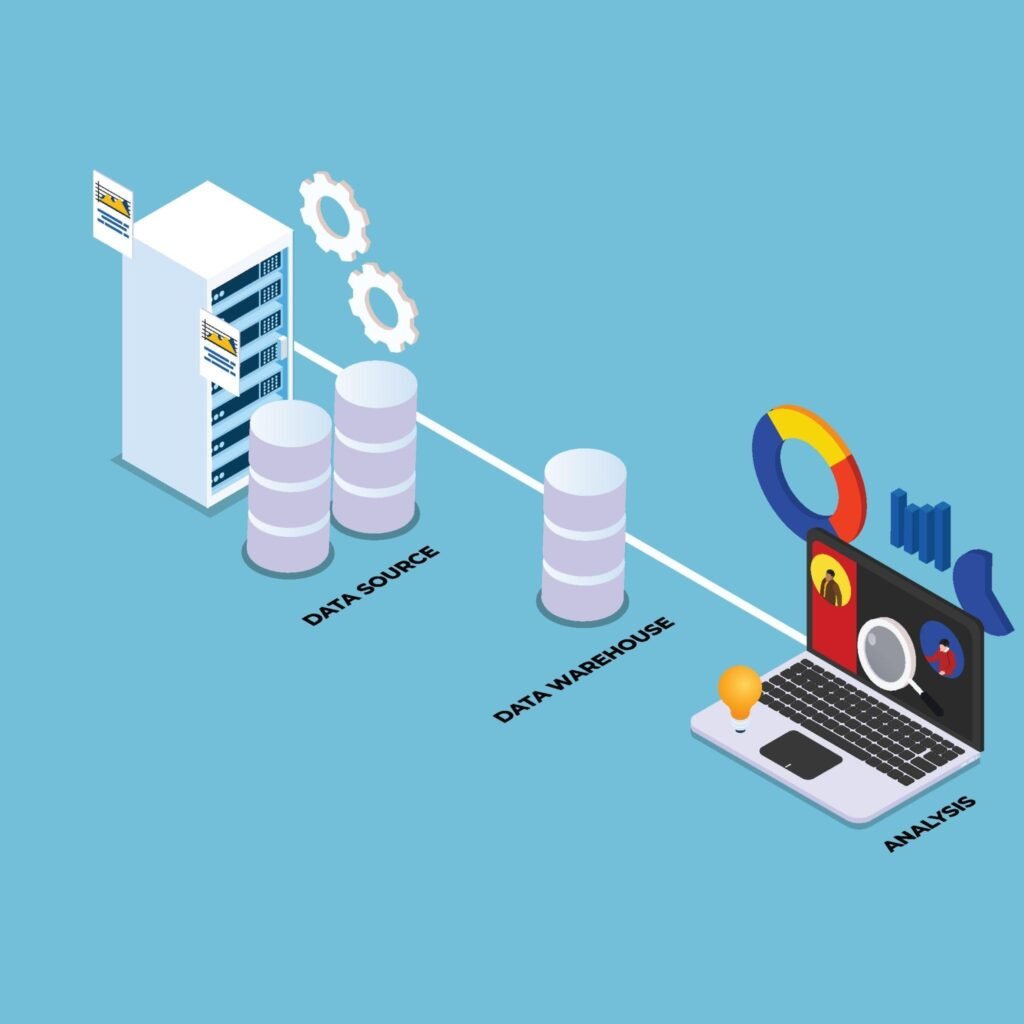
A data warehouse is a centralized storage system designed to collect, organize, and manage structured data from multiple business sources like CRM, ERP, ecommerce, and marketing platforms. The data is cleaned and transformed through an ETL (Extract, Transform, Load) process before storage, ensuring accuracy and consistency for reporting and analytics.
It is mainly used for business intelligence, dashboards, KPI tracking, and strategic decision-making. Modern cloud-based data warehouses also provide high performance, scalability, security, and seamless integration with analytics tools, making them essential for enterprise data management.
Key Features of a Data Warehouse
1. Structured Data Storage
Data warehouses mainly store structured data that follows a predefined schema. This organized approach improves reporting accuracy and consistency.
2. Schema-on-Write Architecture
Before storing the data, the schema is defined in advance. This ensures that all incoming data matches the required structure.
3. Optimized for Analytics
Data warehouses are designed for analytical workloads rather than transactional operations. They support fast SQL queries and complex reporting.
4. Historical Data Analysis
Businesses can store years of historical data for trend analysis and forecasting.
5. Integration with BI Tools
Most data warehouses integrate seamlessly with business intelligence platforms and dashboard tools.
What Is a Data Lake?
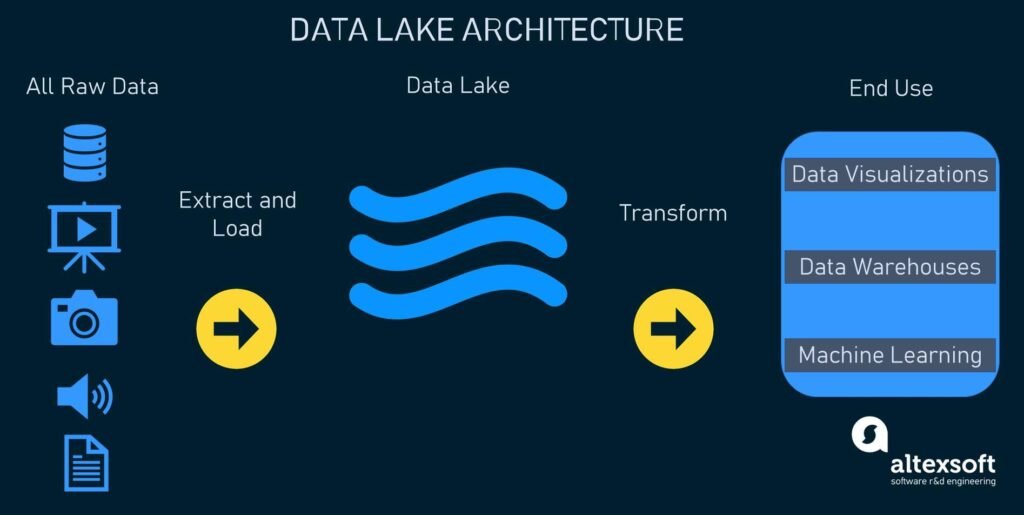
A data lake is a centralized storage system designed to store large volumes of raw data in its original format. Unlike a data warehouse, it can handle structured, semi-structured, and unstructured data from sources like social media, IoT devices, videos, emails, and cloud applications without requiring preprocessing.
Data lakes are highly scalable and cost-effective, making them ideal for big data analytics, machine learning, AI, and real-time data processing. They allow data scientists and engineers to access flexible raw datasets for advanced analysis and experimentation.
Key Features of a Data Lake
1. Supports Multiple Data Types
Data lakes can store structured, semi-structured, and unstructured data.
2. Schema-on-Read Architecture
Data is stored first and structured later during analysis, providing greater flexibility.
3. Highly Scalable Storage
Cloud-based data lakes can handle massive data volumes efficiently.
4. Cost-Effective Infrastructure
Data lakes are often cheaper because they use low-cost object storage systems.
5. Ideal for AI and Big Data Analytics
Machine learning models and advanced analytics tools work efficiently with raw datasets stored in data lakes.
Data Warehouse vs Data Lake: Core Differences
Although both systems store and manage data, they are designed for different purposes. Understanding these differences is important for selecting the right architecture.
| Feature | Data Warehouse | Data Lake |
| Data Type | Structured | Structured, semi-structured, unstructured |
| Storage Format | Processed data | Raw data |
| Schema | Schema-on-write | Schema-on-read |
| Performance | Fast SQL analytics | Flexible large-scale processing |
| Cost | Higher | Lower |
| Main Users | Business analysts | Data scientists and engineers |
| Scalability | Moderate | Highly scalable |
| Processing Style | ETL | ELT |
| Primary Use | Reporting and BI | Big data and AI |
How Data Warehouses Work
A data warehouse follows a structured workflow that ensures data consistency and high-performance analytics. The process usually begins with collecting data from multiple business applications such as sales software, finance systems, marketing tools, and customer databases.
The collected data goes through ETL processes where it is cleaned, standardized, and transformed into a unified format. Once processed, the data is loaded into the warehouse and organized into tables, schemas, and data models.
Users can then access the data through SQL queries, dashboards, and reporting tools. Since the information is optimized for analytics, organizations can generate reports quickly and accurately. This structured approach makes data warehouses ideal for business intelligence and enterprise reporting.
Advantages of a Data Warehouse
Modern businesses rely heavily on data warehouses to improve reporting, analytics, and business intelligence processes. These systems provide structured and reliable data that helps organizations make faster and more informed decisions.
1. Faster Reporting and Analytics
Data warehouses are optimized for analytical queries, enabling businesses to generate reports quickly and efficiently. This improves reporting speed and helps organizations access insights without delays.
2. Improved Data Quality
Data cleaning and transformation ensure accurate and reliable information. High-quality data reduces reporting errors and improves business decision-making.
3. Better Decision-Making
Executives and analysts can access trusted business insights for strategic planning. This helps organizations identify opportunities, reduce risks, and improve overall performance.
4. Enhanced Security
Most enterprise data warehouse platforms offer advanced governance and compliance features. Strong security controls help protect sensitive business and customer data.
5. Consistent Business Intelligence
Structured storage improves KPI tracking and reporting consistency across departments. Businesses can create standardized reports with reliable data sources.
6. Centralized Data Storage
A data warehouse combines data from multiple systems into a single centralized repository, making data management easier. This reduces data silos and improves collaboration across teams.
7. Historical Data Analysis
Organizations can store years of historical information for trend analysis, forecasting, and performance monitoring. Historical insights help businesses improve future planning and strategy.
8. Improved Data Consistency
Standardized schemas and structured formats reduce inconsistencies across business reports. Consistent data improves reporting accuracy and operational efficiency.
9. Better Compliance Management
Data warehouses help organizations maintain regulatory compliance with built-in governance features. This is especially important for industries handling sensitive information.
10. High Query Performance
Optimized indexing and structured storage improve query execution speed. Faster queries enhance analytics performance and user productivity.
11. Integration with BI Tools
Most data warehouses integrate easily with reporting and dashboard tools. This simplifies analytics workflows and improves business intelligence capabilities.
12. Supports Enterprise Analytics
Large organizations can perform advanced analytics on enterprise-scale datasets. Data warehouses help businesses process complex analytical workloads efficiently.
13. Reliable Data Backup and Recovery
Many data warehouse solutions include disaster recovery and backup features. This protects organizations from data loss and system failures.
14. Enhanced Collaboration
Teams across departments can access the same trusted data source for reporting. Shared access improves communication and data-driven collaboration.
15. Scalable Cloud Solutions
Modern cloud-based data warehouses can scale resources according to business needs. This flexibility supports growing data volumes and changing business demands.
Disadvantages of a Data Warehouse
Although data warehouses provide strong analytics capabilities, they also have limitations related to cost, scalability, and flexibility. Organizations must carefully manage these systems to avoid performance and maintenance challenges.
1. Expensive Infrastructure
Traditional data warehouses often require high storage and maintenance costs. Hardware, licensing, and management expenses can increase over time.
2. Limited Flexibility
Handling unstructured data can be challenging. Data warehouses work best with structured and predefined data formats.
3. Slower Data Ingestion
Transforming data before storage increases processing time. This can delay the availability of data for analytics.
4. Complex ETL Processes
Maintaining ETL pipelines requires technical expertise. Complex workflows can increase operational overhead.
5. Difficult Schema Changes
Modifying schemas in a data warehouse can be time-consuming and complex. Frequent structural changes may impact reporting systems.
6. High Maintenance Requirements
Continuous monitoring, optimization, and updates are necessary. Organizations often require dedicated teams for management.
7. Scalability Challenges
Traditional systems may struggle with rapidly growing data volumes. Expanding infrastructure can become expensive and complicated.
8. Longer Implementation Time
Building a data warehouse architecture can take months or even years. Large-scale deployment requires careful planning and integration.
9. Requires Skilled Professionals
Database administrators and data engineers are needed for management. Skilled professionals are essential for maintaining performance and reliability.
10. Less Suitable for AI Workloads
Structured environments may not efficiently support advanced AI applications. Machine learning projects often require more flexible storage systems.
11. High Dependency on Data Modeling
Poor data modeling can negatively impact analytics performance. Effective schema design is critical for accurate reporting.
12. Limited Real-Time Processing
Many traditional warehouses are not optimized for real-time analytics. Businesses may experience delays in accessing live insights.
13. Increased Operational Costs
Licensing, hardware, and maintenance costs can grow significantly over time. Long-term operational expenses may become difficult to manage.
14. Data Silos May Still Exist
Improper integration can lead to disconnected datasets. This can reduce reporting consistency across departments.
15. Performance Bottlenecks
Large analytical workloads may slow system performance if not optimized properly. Regular tuning and optimization are often required.
How Data Lakes Work
A data lake works differently from a traditional warehouse. Instead of transforming data before storage, it stores information in its raw format immediately after collection. This allows businesses to ingest massive amounts of data without worrying about predefined schemas.
When analysts or data scientists need the data, they apply the required schema during the analysis process. This approach is called schema-on-read. It provides greater flexibility because organizations can analyze the same dataset in multiple ways.
Data lakes often use distributed storage and cloud infrastructure to handle large-scale data processing. Technologies like Hadoop and cloud object storage systems are commonly used to build scalable data lake environments.
Advantages of a Data Lake
Data lakes provide flexible and scalable storage environments for handling massive amounts of raw data. They are widely used for big data analytics, artificial intelligence, and machine learning projects.
1. Massive Scalability
Data lakes can store huge amounts of data without performance limitations. This makes them ideal for organizations managing rapidly growing datasets.
2. Supports Unstructured Data
Organizations can store videos, images, logs, and social media data easily. This flexibility supports modern analytics and multimedia applications.
3. Lower Storage Costs
Cloud-based object storage significantly reduces infrastructure costs. Businesses can store large datasets at a lower operational expense.
4. Advanced Analytics Support
Data lakes are ideal for machine learning and predictive analytics projects. Raw data access improves experimentation and advanced model training.
5. Greater Flexibility
Businesses can analyze raw data in multiple ways without predefined structures. This allows teams to explore and process data more freely.
6. Real-Time Data Processing
Data lakes support streaming and real-time analytics for faster insights. Businesses can monitor operations and customer activities instantly.
7. Faster Data Ingestion
Raw data can be stored immediately without extensive transformation processes. This speeds up data collection and reduces processing delays.
8. Supports Multiple Data Sources
Organizations can collect data from IoT devices, applications, websites, APIs, and cloud systems. This creates a unified environment for large-scale analytics.
9. Ideal for Big Data Environments
Data lakes are designed to handle massive datasets generated by modern enterprises. They support scalable analytics and cloud-based processing.
10. Encourages Data Exploration
Data scientists can experiment with raw datasets for advanced analytics projects. This improves innovation and supports AI development.
11. Cloud-Native Architecture
Most modern data lakes are built for cloud scalability and flexibility. Cloud environments improve storage efficiency and performance.
12. Supports AI and Deep Learning
Large raw datasets improve artificial intelligence and machine learning model training. Businesses can build smarter predictive systems using diverse data sources.
13. Flexible Schema Management
Businesses can apply schemas later during analysis instead of before storage. This approach improves flexibility for changing analytics needs.
14. Cost-Effective Long-Term Storage
Organizations can retain large amounts of historical data at a lower cost. This is beneficial for long-term analytics and compliance requirements.
15. Enables Predictive Analytics
Data lakes support advanced forecasting and predictive modeling techniques. Businesses can identify trends and improve future planning
Disadvantages of a Data Lake
Data lakes provide flexibility and scalability, but they also introduce governance, security, and management challenges. Without proper organization, businesses may struggle to maintain data quality and usability.
1. Risk of Becoming a Data Swamp
Without governance, data lakes can become disorganized and difficult to manage. Poor organization reduces analytics efficiency and usability.
2. Security Challenges
Managing permissions and compliance across raw datasets can be complicated. Sensitive data requires strong governance controls.
3. Slower Query Performance
Raw data analysis may take longer compared to optimized warehouses. Additional processing is often needed before analysis.
4. Requires Skilled Professionals
Organizations often need experienced data engineers and scientists. Managing large-scale raw data environments requires technical expertise.
5. Data Quality Issues
Raw data may contain duplicates, errors, or inconsistent formatting. Poor-quality data can affect analytics accuracy.
6. Difficult Data Governance
Managing metadata and ensuring compliance can be challenging. Proper governance strategies are necessary for large data environments.
7. Complex Data Discovery
Finding the right datasets in massive storage environments may be difficult. Poor metadata management can slow analytics workflows.
8. Lack of Structure
Unorganized storage can reduce reporting efficiency. Businesses may struggle to maintain consistency across analytics projects.
9. Increased Processing Complexity
Raw data often requires additional preparation before analysis. Data transformation can increase processing workloads.
10. Higher Security Risks
Large amounts of sensitive raw data increase cybersecurity concerns. Organizations must implement advanced security measures.
11. Metadata Management Challenges
Poor metadata management can make datasets difficult to identify and use. Effective metadata practices improve accessibility and organization.
12. Inconsistent Reporting
Different users may interpret raw datasets differently, causing inconsistencies. Standardization becomes more difficult in flexible environments.
13. Performance Optimization Challenges
Query optimization in data lakes can require advanced tools and expertise. Large datasets may impact processing speed.
14. Tool Compatibility Issues
Some traditional analytics tools may not work efficiently with raw data environments. Additional integration solutions may be required.
15. Governance and Compliance Costs
Organizations may need additional tools and resources for compliance management. Governance frameworks increase operational complexity and costs.
Data Warehouse Use Cases
Data warehouses are widely used by organizations to store structured business data and generate accurate insights for reporting and analytics. They help companies improve decision-making, monitor performance, and analyze historical trends efficiently. Since data warehouses are optimized for fast query processing and business intelligence, they are commonly used across multiple departments and industries.
Business Intelligence Dashboards
Companies use data warehouses to build interactive dashboards that display important business metrics in real time. These dashboards help managers and executives monitor KPIs, track performance, and make faster strategic decisions.
Financial Reporting
Data warehouses simplify financial analysis by storing organized financial records from multiple systems. Businesses use them to generate balance sheets, profit and loss reports, tax reports, and revenue forecasts accurately.
Sales Analytics
Organizations analyze sales performance, customer purchasing behavior, and product trends using data warehouses. This helps businesses identify profitable products, improve marketing strategies, and increase revenue.
Inventory Management
Retailers and ecommerce businesses use data warehouses to track inventory levels, supply chain performance, and stock availability. This improves inventory planning and reduces overstocking or shortages.
Customer Relationship Analysis
Businesses collect customer data from CRM systems to analyze customer behavior, preferences, and engagement. These insights help improve customer experience and retention strategies.
Operational Reporting
Companies use data warehouses for operational reporting to monitor daily business activities, employee performance, workflow efficiency, and overall operational productivity.
Industries such as banking, healthcare, ecommerce, retail, manufacturing, and telecommunications heavily rely on data warehouses for accurate reporting, compliance management, and data-driven decision-making.
Data Lake Analytics
Organizations use data lakes to process and analyze massive datasets collected from multiple sources. This helps businesses identify trends, improve operations, and gain valuable business insights from large-scale data environments.
Machine Learning Projects
Data lakes provide raw datasets that are highly useful for machine learning and AI model training. Data scientists use this information to build predictive models, recommendation systems, and automation solutions.
Real-Time Streaming Analytics
Businesses use data lakes to analyze real-time streaming data from websites, applications, sensors, and online platforms. This helps organizations monitor activities instantly and make faster decisions.
IoT Data Processing
IoT devices generate huge amounts of sensor data continuously. Data lakes store and process this information efficiently for monitoring systems, smart devices, and industrial automation.
Predictive Analytics
Companies use data lakes for predictive analytics to forecast customer behavior, market trends, equipment failures, and business risks using advanced analytics techniques.
Log File Analysis
Technology companies store server logs, application logs, and system logs in data lakes for troubleshooting, cybersecurity monitoring, and performance optimization.
Technology companies, AI startups, healthcare organizations, financial institutions, and research companies frequently rely on data lakes for advanced analytics, machine learning, and large-scale data processing workloads.
Can Businesses Use Both?
Yes. Many modern enterprises combine data warehouses and data lakes together using a hybrid architecture called a data lakehouse. This approach allows businesses to take advantage of the strengths of both systems while reducing their individual limitations.
Organizations can use data warehouses for structured reporting and business intelligence while using data lakes for big data analytics, machine learning, and real-time processing.
A lakehouse combines:
- The scalability and flexibility of a data lake
- The performance and governance of a data warehouse
This modern architecture supports both traditional analytics and AI-driven workloads, making it increasingly popular among cloud-first organizations. Businesses can store raw data in a data lake while simultaneously using structured datasets for reporting and dashboard creation.
This unified approach improves data accessibility, reduces storage silos, and enables organizations to handle large-scale analytics more efficiently. It also allows businesses to combine internal operational data with external company and market data for deeper analytics and better decision-making.
This often includes enriching internal records with external company data, giving teams broader context on markets, competitors, and potential customers.
As companies continue investing in cloud computing and AI technologies, lakehouse architectures are becoming a preferred solution for modern enterprise data management.
Future Trends in Data Management
AI-Driven Analytics
Organizations increasingly use AI tools with data lakes for predictive insights.
Real-Time Data Processing
Businesses demand faster analytics for immediate decision-making.
Cloud-Native Architectures
Cloud-based warehouses and lakes continue replacing on-premise systems.
Data Governance Automation
Automation tools improve compliance, security, and data quality management.
Rise of Lakehouse Platforms
Lakehouse architectures are becoming the future of modern enterprise analytics.
FAQs
1. What is the main difference between a data warehouse and a data lake?
A data warehouse stores structured and processed data optimized for reporting and business intelligence, while a data lake stores raw structured, semi-structured, and unstructured data for big data analytics, AI, and machine learning.
2. Which is better for business analytics: data warehouse or data lake?
A data warehouse is better for traditional business analytics, dashboards, and reporting because it provides clean and structured data with fast query performance. Data lakes are better for advanced analytics and large-scale data exploration.
3. Can a business use both a data warehouse and a data lake together?
Yes. Many organizations use both systems together through a modern architecture called a data lakehouse. This combines the scalability of a data lake with the performance and governance of a data warehouse.
4. Why are data lakes popular for AI and machine learning?
Data lakes can store large volumes of raw data from multiple sources, making them ideal for machine learning, predictive analytics, and AI model training where flexible and diverse datasets are required.
5. Are data warehouses more expensive than data lakes?
Generally, yes. Data warehouses often require higher storage, processing, and maintenance costs because data must be cleaned and transformed before storage, while data lakes use lower-cost scalable storage systems.
6. What industries commonly use data warehouses and data lakes?
Industries such as ecommerce, banking, healthcare, retail, telecommunications, manufacturing, and technology companies use data warehouses for reporting and data lakes for big data analytics, AI, and real-time processing.
Conclusion
Understanding the difference between a data warehouse vs data lake is essential for modern businesses managing large volumes of data. A data warehouse provides structured, reliable, and high-performance analytics for reporting and business intelligence, while a data lake offers flexibility, scalability, and support for big data and machine learning workloads.
Choosing the right solution depends on your business goals, data types, analytics requirements, and technical capabilities. Many organizations now combine both systems to create modern data architectures that support advanced analytics, real-time processing, and AI-driven insights.
As data continues to grow rapidly, businesses that invest in the right data management strategy will gain a significant competitive advantage in the digital economy.