Most companies promote what they offer. Few create the reputation that makes people want to buy from them before a sales call even happens.
That second way is called authority marketing. It’s why some experts are chosen without ever making a pitch while others fight over price for years.
Authority marketing is when a person or a company becomes seen as a trusted expert in an area. This way, people. Trust you before your sales team even starts talking.
It brings together content, public relations, speaking, referrals and connections into one plan with one goal: to be the choice when someone finally needs what you offer.
This guide explains what authority marketing really is, how it is different from thought leadership and personal branding, the seven-pillar system that most people still use and a clear path to building it from the beginning. It also shows how it works with AI search tools, like ChatGPT and Google’s AI Overviews.
What Is Authority Marketing?
Authority marketing definition
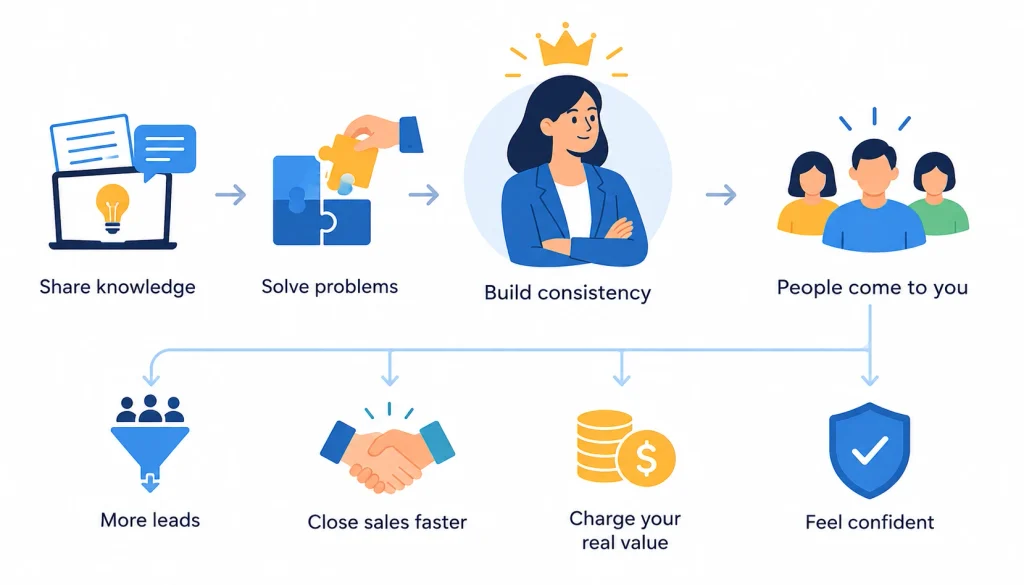
Authority marketing is about intentionally becoming known as the expert people turn to. You build that reputation by sharing knowledge, solving problems and being consistent.Once people see you as someone who knows what they’re doing they start coming to you.
That trust helps you bring in leads close sales more quickly and feel confident charging the real value of your work. It’s not loud ads or just shouting your name. It’s about earning trust step by step before you even ask for anything.
How authority marketing works
The process is easy even though it takes time to do. You choose an area where you really know a lot, you keep sharing helpful information about it and you get trusted people (reporters, radio show hosts, people in your field) to say good things about you in public. Eventually that mix makes you the person people think of when the subject comes up.
Imagine a money expert who spends two years writing every week about changes in tax rules for people who work on their own.
By the year people looking for help with taxes find her posts, hear her on a radio show and see her name in a magazine. She never asked any of them for anything. That is authority marketing working the way it should.
Why expertise alone isn’t enough
There are truly talented people who remain unnoticed. Doing a job doesn’t mean others will know about it. Authority marketing is around because being knowledgeable needs to be shown in public over again before it becomes trust and trust is what really makes someone go from being interested, to wanting to hire you.
Authority vs. visibility vs. credibility
These three get confused constantly, so it helps to separate them:
- Visibility is how many people see you.
- Credibility is whether they believe what you say.
- Authority is what happens when visibility and credibility combine and compound over time.
You can be visible without being credible (a loud opinion with no substance), and you can be credible without being visible (a brilliant expert nobody’s heard of). Authority marketing is the discipline of building both at once.
Why Is Authority Marketing Important?
It builds trust before the sales conversation. By the time a prospect reaches out, they’ve usually already read your content or heard you speak. The trust-building happened before you said a word.
It differentiates you from competitors. In crowded markets, most competitors sound identical. A clear point of view, published consistently, makes you the one people remember.
It reduces dependence on price-based competition. When you’re the recognized expert, prospects stop comparing you on price alone. They’re paying for confidence, not just a deliverable.
It creates long-term brand equity. Unlike a paid ad campaign that stops producing the moment you stop paying, published authority content and earned media keep working for years.
It generates qualified opportunities. People who find you through your own content or a trusted third party tend to arrive further along in their decision, which shortens the sales cycle.
It strengthens your search and digital presence. Search engines and, increasingly, AI answer engines reward sources that show real expertise and get cited elsewhere. Authority marketing and SEO reinforce each other.
Authority Marketing vs. Thought Leadership vs. Personal Branding
These three terms overlap so much that people use them interchangeably, but they’re not the same thing.
| Concept | Primary Focus | Main Audience | Content Focus | Distribution | Business Outcome |
| Authority marketing | Building recognized, trusted expertise as a system | Buyers and decision-makers | Educational, proof-driven content | Owned, earned, and third-party channels | Leads, sales, pricing power |
| Thought leadership | Developing and sharing original ideas or opinions | Peers and industry | Opinion, analysis, forward-looking ideas | Publications, speaking, LinkedIn | Reputation, influence |
| Personal branding | Managing how an individual is perceived | Broad, career-focused | Personal story, values, positioning | Social media, personal site | Career growth, opportunities |
Is thought leadership part of authority marketing?
Yes. Thought leadership is one part of authority marketing. It provides the ideas but authority marketing is the bigger system that turns those ideas into content, media coverage, speaking invitations and leads.
Is personal branding part of authority marketing?
Also yes, in the way. Personal branding manages perception; authority marketing puts that perception to work in commerce. The founder can have a personal brand and still never convert it into business unless it is linked to a clear strategy.
The 7 Pillars of Authority Marketing
This framework, popularized by Adam Witty and Rusty Shelton in their book on the topic, remains the clearest way to organize an authority marketing strategy. Here’s what each pillar actually involves in practice.
1. Personal and corporate branding
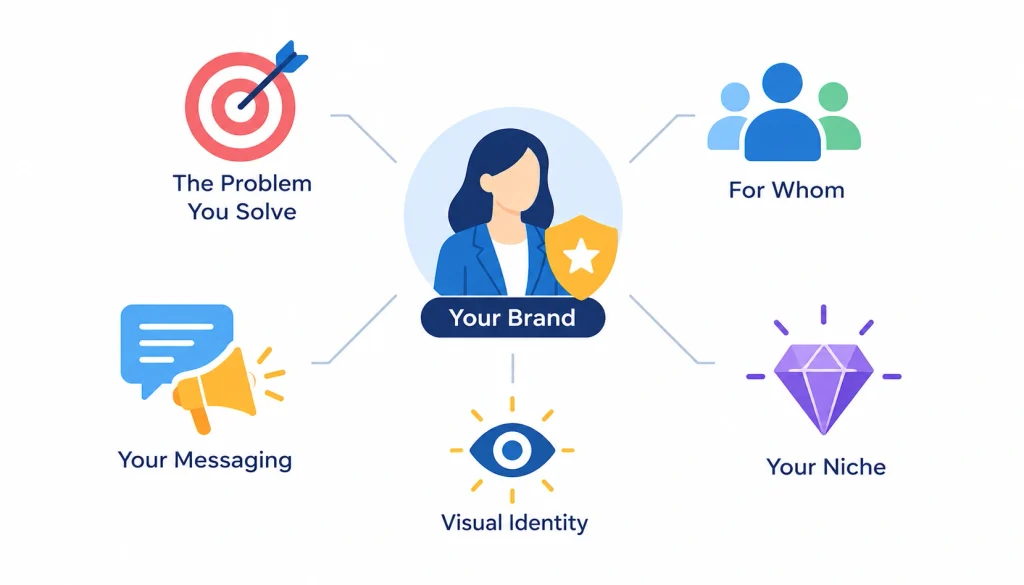
This is your positioning: the specific problem you solve, for whom, and why you’re different. It includes your messaging, your visual identity, and the niche you’ve chosen to own. Without a clear position, the other six pillars have nothing to build on.
2. Content marketing
Articles, guides, videos, podcasts, books, and original research all fall here. This is where your expertise becomes something other people can actually consume, share, and cite.
3. Referral marketing
Word-of-mouth doesn’t happen by accident. This pillar covers deliberately nurturing relationships with past clients, industry peers, and partners so they refer business your way without being asked every time.
4. Lead generation
Assessments, webinars, email opt-ins, and consultation offers turn attention into actual contact information and, eventually, conversations.
5. PR and earned media
Getting quoted by journalists, contributing expert commentary, and appearing in industry publications signals that someone other than you thinks you’re worth listening to. Earned media carries more weight than anything you say about yourself.
6. Speaking
Conferences, podcasts, webinars, and panels put you in front of an audience that already trusts the platform hosting you. Some of the fastest authority-building happens through borrowed audiences like this.
7. Events
Hosting roundtables, workshops, or community meetups (in person or online) builds deeper relationships than one-way content ever will, and it turns an audience into a network.
How to Build an Authority Marketing Strategy From Scratch
Step 1: Choose your authority niche. Pick something specific enough that you can actually own it. “Marketing” is too broad. “Retention marketing for subscription box companies” is ownable.
Step 2: Define your ideal audience. Know exactly who needs to see you as the expert. Authority built for the wrong audience doesn’t convert.
Step 3: Identify your unique expertise. What do you know from direct experience that most people in your field don’t talk about? That’s your edge.
Step 4: Develop a point of view. Generic advice doesn’t build authority. A specific, sometimes contrarian stance does, as long as you can back it up.
Step 5: Create your authority positioning statement. One or two sentences that state who you help, with what problem, and how your approach differs.
Step 6: Build your content pillars. Choose three or four recurring themes you’ll cover repeatedly, so your content builds on itself instead of scattering.
Step 7: Create your flagship content. One deep, well-researched piece (a guide, a report, a book) that becomes the anchor everything else links back to.
Step 8: Build third-party credibility. Pursue podcast guest spots, journalist relationships, and speaking slots. This is the pillar most people skip, and it’s the one that separates real authority from self-published opinion.
Step 9: Create a distribution system. Decide where your content lives and how it gets seen: your own channels, guest platforms, and earned media, working together instead of separately.
Step 10: Turn authority into qualified leads. Add clear calls to action, lead magnets, and consultation offers so recognition converts into pipeline, not just applause.
What Content Builds Authority?
Not all content carries the same weight. Original research and case studies tend to earn more trust and more backlinks than opinion pieces, because they’re harder to produce and harder to dismiss. A useful content marketing mix includes:
- Original research and proprietary data
- In-depth guides that go further than surface-level explainers
- Case studies with real, specific outcomes
- Industry reports and benchmarks
- Data-driven articles
- Books or ebooks
- Podcast appearances and interviews
- Webinars and workshops
- Video content
The goal isn’t to produce all of these at once. It’s to pick two or three formats you can sustain and do them well for a long time.
How Original Research Can Accelerate Authority
Original research is one of the ways to build authority because original research produces something nobody else has: your own data. A small survey of your customers or your industry can become a statistic that gets cited for years.
Here is how the cycle works in practice. You run a survey among 200 customers about a pain point. You publish the findings as a report. That report becomes three or four blog posts, an infographic and a pitch angle for journalists who cover your industry.
Coverage of research earns backlinks and the backlinks reinforce your search visibility, which brings more people to the short report. A year later you refresh the survey and repeat the cycle now with a credible track record, behind original research.
This approach mirrors what research-driven marketing sites have documented: assessment and survey data can be repurposed into infographics, statistics, PR pitches and even books turning an original research effort into months of content and outreach opportunities.
How to Build Authority With SEO
Search engines and authority marketing reward the same behavior: consistent, deep coverage of a specific topic, backed by credible signals. A strong content strategy can also support ethical [White Hat Link Building Services] by creating valuable resources that naturally attract relevant, high-quality backlinks.
Create topical depth. Don’t write one article about your subject; write the most thorough set of articles on it that exists.
Build topic clusters. Group related articles around a central pillar page and link them together, so search engines and readers can see the full picture.
Optimize author profiles. A visible author bio with real credentials tells both readers and search engines that a real, qualified person stands behind the content.
Strengthen internal linking. Connect related pieces so visitors (and crawlers) can trace your expertise across the whole site.
Earn authoritative backlinks. Links from respected industry sites carry far more weight than volume from low-quality sources.
Build branded search demand. When people start searching your name or company directly, that’s a strong signal of recognition search engines pick up on.
Demonstrate first-hand experience. Specific examples, screenshots, and personal results outperform generic advice, both for readers and for Google’s quality guidelines around experience and expertise.
Build entity associations. Consistently connect your name with your specific topic across platforms like LinkedIn, Wikipedia (where relevant), and industry directories, so search engines learn to associate you with that subject.
Authority Marketing in the Age of AI Search
This is where the landscape has shifted since the original authority marketing frameworks were written. Tools like ChatGPT, Google’s AI Overviews, Gemini, and Perplexity now answer questions directly, often without sending a click to any website at all.
1. Why authority matters for AI-generated answers
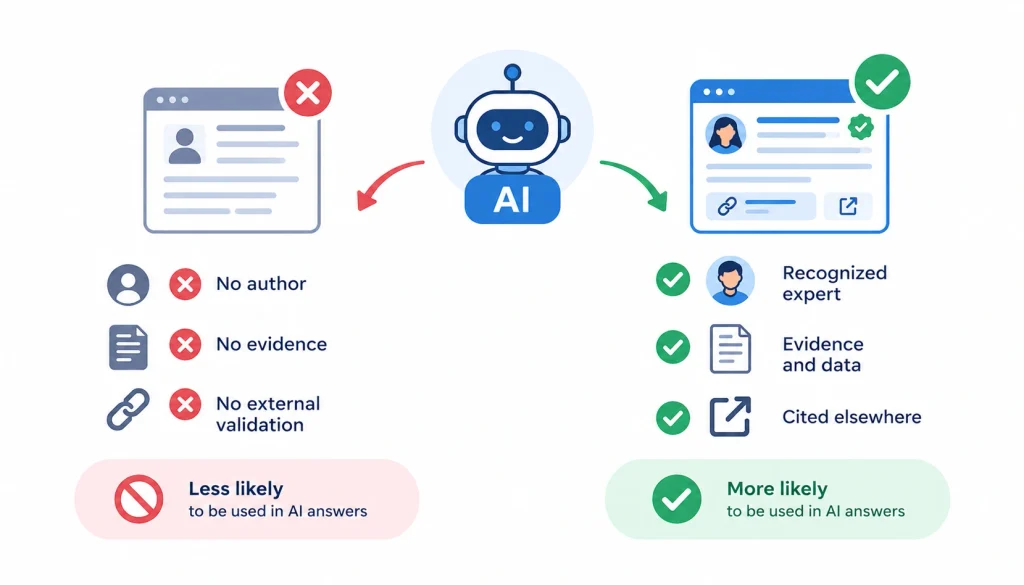
These systems are trained to prefer sources that show clear expertise and get cited elsewhere. A page with no author, no evidence, and no external validation is far less likely to get pulled into an AI-generated answer than one from a recognized, well-cited expert.
2. How AI systems identify credible sources
AI answer engines lean on the same signals search engines already use: consistent topical coverage, backlinks from reputable sites, mentions across multiple platforms, and clear authorship. In other words, the same work that builds authority marketing also builds AI visibility.
3. Building an entity around an expert
Search engines and AI models increasingly think in terms of entities rather than keywords. That means your name, your company, and your area of expertise need to show up consistently and accurately across your website, social profiles, press mentions, and third-party listings. Strong online presence management helps keep these signals consistent and makes it easier for search engines and AI systems to understand and associate your brand with your expertise.
4. Creating content worth citing
AI Overviews tend to pull from content that answers a question clearly and specifically, often within the first few sentences. Writing direct, well-supported answers near the top of a section increases the odds of being quoted or summarized.
5. Original research as an AI-search advantage
Proprietary data is hard for AI models to fabricate or replace, which makes it more likely to get cited by name. If you’re the original source of a statistic, you have a real shot at being the source AI tools point back to.
6. Digital PR and third-party mentions
Every time a reputable outlet mentions your name alongside your expertise, it reinforces the entity signal that both search engines and AI systems rely on.
7. Optimizing for Google AI Overviews
Structure content with clear headers, direct answers early in each section, and supporting data. This is the same structure that wins featured snippets, and it tends to perform well in AI Overviews for the same reasons.
8. Building authority across ChatGPT, Gemini and Perplexity
These tools draw on different data sources and update on different schedules, so consistency matters more than gaming any one platform. The most reliable approach is still the fundamental one: publish accurate, well-sourced content and get cited by others.
Authority Marketing Channels: Where Should You Build Your Presence?
| Channel | Best For | Authority Signal |
| Search visibility | Rankings and citations | |
| B2B thought leadership | Engagement and connections | |
| YouTube | Demonstrating expertise | Video authority |
| Podcasts | Expert positioning | Interviews and mentions |
| Audience ownership | Subscriber growth | |
| PR | Third-party credibility | Media coverage |
| Industry publications | Deep expertise | Editorial validation |
| Events | Relationship building | Speaking and participation |
Most people try to be everywhere at once and end up doing nothing well. Pick two or three channels where your audience already spends time, and go deep before you go wide.
Best Authority Marketing Tools
Content research tools: tools like AnswerThePublic or SparkToro for finding what your audience is actually asking.
SEO tools: Ahrefs, Semrush, or Google Search Console to track rankings, backlinks, and search visibility.
Survey and research tools: Typeform or Google Forms for gathering the original data that fuels research-driven content.
Social media tools: scheduling and analytics tools like Buffer or LinkedIn’s native analytics to track engagement.
PR tools: journalist request platforms (the successors to the old HARO model, such as Qwoted or Featured) for earning press mentions.
Analytics tools: Google Analytics to track how content and campaigns translate into traffic and conversions.
CRM and lead-generation tools: HubSpot or a comparable CRM to track how authority-driven leads move through your pipeline.
How to Measure Authority Marketing
Authority is admittedly harder to measure than a paid ad’s click-through rate, but it’s not immeasurable. Track a mix of recognition and commercial metrics.
| Metric | What It Tells You |
| Branded search volume | How many people are actively searching your name or company |
| Direct traffic | Whether people come straight to your site instead of finding you cold |
| Qualified leads | Whether authority is translating into real business interest |
| Media mentions | Third-party validation of your expertise |
| Backlinks | External sites vouching for your content |
| Speaking invitations | Industry recognition of your expertise |
| Podcast appearances | Reach into new, relevant audiences |
| Referral traffic | How much your network is actively sending business your way |
| Conversion rate | Whether trust is turning into action |
| Sales-cycle length | Whether authority is shortening the time from first contact to close |
How Long Does Authority Marketing Take?
Authority builds in stages, and none of them can be skipped.
0 to 30 days: positioning and foundation. Nail down your niche, your point of view, and your core content pillars.
31 to 60 days: content and distribution. Publish consistently and start pushing that content out through the channels you’ve chosen.
61 to 90 days: PR and relationship building. Start pitching podcasts, journalists, and speaking opportunities using the content you’ve already published as proof of expertise.
3 to 6 months: recognition and momentum. People start recognizing your name without an introduction, and inbound interest starts to pick up.
6 to 12+ months: compounding authority. Backlinks, mentions, and referrals start reinforcing each other, and growth stops depending entirely on new effort.
Authority marketing is a compounding asset, not a short campaign. The people who quit at month two rarely see the payoff that shows up around month six or later.
90-Day Authority Marketing Plan
Days 1 to 30: Build the foundation. Define your niche and positioning statement, audit existing content, set up author profiles and social presence, and outline your flagship content piece.
Days 31 to 60: Publish and distribute. Launch your flagship content, publish at least four to six supporting pieces, and begin outreach to podcasts and relevant publications.
Days 61 to 90: Earn external validation. Follow up on outreach, secure at least two or three guest appearances or mentions, and launch a small piece of original research if resources allow.
A simple weekly checklist helps keep this on track: one piece of content published, one outreach email sent, one relationship touchpoint maintained, and one metric reviewed.
Authority Marketing Examples
For consultants: a narrow specialty, a weekly newsletter, and regular podcast guest appearances often outperform a large marketing budget.
For SaaS companies: founder-led content and original product-usage research tend to build more trust than traditional feature-focused marketing.
For agencies: case studies with specific, verifiable results do more for authority than generic capability decks.
For professional services (law, accounting, advisory): plain-English explainers of complex regulations consistently earn search visibility and referrals.
For CEOs and founders: a clear point of view shared consistently on LinkedIn, backed by real business results, builds personal authority that lifts the whole company.
For small businesses: local media commentary and community involvement can build authority just as effectively as national PR, at a fraction of the cost.
Common Authority Marketing Mistakes
Trying to be an authority on everything. Broad positioning dilutes recognition. Narrow it down.
Creating generic content. If your content could have been written by any competitor, it won’t build authority for you specifically.
Confusing self-promotion with thought leadership. Talking about your own achievements isn’t the same as offering a useful perspective others can learn from.
Ignoring third-party validation. Self-published content alone rarely builds the kind of trust that earned media and speaking slots do.
Publishing without distribution. Great content nobody sees doesn’t build authority. Distribution matters as much as creation.
Chasing vanity metrics. Follower counts feel good but don’t always correlate with leads or revenue.
Buying fake authority signals. Paid “expert” round-ups, fake testimonials, or purchased followers tend to backfire once anyone checks.
Stopping before authority compounds. The biggest mistake is quitting during the slow early months, right before momentum usually builds.
How to Know If Your Authority Marketing Is Working
Use a simple scorecard to check progress: search visibility, branded search growth, media mentions, backlinks, engagement, audience growth, speaking or podcast invitations, qualified leads, and any measurable revenue influence. If most of these are moving in the right direction over a two- to three-quarter window, the strategy is working, even if any single metric looks flat in a given month.
Frequently Asked Questions
What is authority marketing?
It’s the practice of building recognized expertise and trust for a person or company, using content, PR, speaking, and relationships, so that credibility is established before a sales conversation begins.
What are the seven pillars of authority marketing?
Branding, content marketing, referral marketing, lead generation, PR and earned media, speaking, and events.
What is an example of authority marketing?
A consultant who publishes weekly articles on a narrow topic, appears regularly on relevant podcasts, and gets quoted in a trade publication is practicing authority marketing.
Is authority marketing the same as thought leadership?
No. Thought leadership is one input into authority marketing. Authority marketing is the broader system that turns ideas into visibility, credibility, and leads.
How long does authority marketing take?
Early positioning and content can happen within the first 30 to 60 days, but real momentum, mentions, and inbound interest usually take six months or longer to compound.
Conclusion
Don’t simply promote what you sell. Build a reputation that makes people want to buy from you.
Authority marketing isn’t a quick campaign you run before a product launch or a short-term strategy designed to generate a few extra leads. It’s a long-term system built on consistent content, earned credibility, valuable insights, and genuine relationships.
Over time, these efforts compound, making your brand more recognizable, trustworthy, and easier to choose when customers are ready to buy.
The key is to start narrow and focus on a specific audience or area where you can genuinely demonstrate expertise.
Publish useful content consistently, share real experience, answer the questions your audience actually has, and look for opportunities to earn third-party validation through reviews, mentions, interviews, partnerships, and industry recognition.
Most importantly, measure more than traffic and follower counts. Pay attention to branded searches, qualified leads, engagement from the right audience, referrals, mentions, and ultimately, the customers your authority helps you win.
The businesses and individuals who commit to this process are the ones who gradually stop chasing customers and start getting chosen.
When people already trust your expertise before they need your product or service, selling becomes less about convincing and more about being the obvious choice.