If you’ve tried to check your Baidu rankings using the same tools you use for Google, you’ve probably noticed something odd: the numbers don’t match what you see when you actually search from China. That gap is the whole reason a dedicated keyword rank tracking tool for Baidu exists.
Baidu runs on different infrastructure, different ranking signals, and a different regulatory environment than Google. A tracker built for Google Search will often miss this entirely, because it’s pulling data from servers and IP ranges that Baidu treats differently than a real user inside mainland China. This guide walks through how Baidu tracking actually works, what to look for in a tool, and how the main options on the market compare.
A Baidu rank tracker is software that checks where your website shows up in Baidu’s search results for a set of keywords, then logs that position over time. Instead of guessing whether your China SEO work is paying off, you get an actual number: position 4 today, position 2 next week, and so on.
If you’re already using rank tracking software across multiple search engines, adding Baidu-specific tracking gives you a more complete view of your global SEO performance and helps you measure visibility in the Chinese market with greater accuracy.
The useful ones do this from servers located inside China, or at least route requests in a way that mimics a real mainland user. That distinction matters more than most people expect.
Best Keyword Rank Tracking Tools for Baidu
Here’s how the leading Baidu rank tracking tools compare based on their publicly available features, supported search engines, pricing information, and intended use cases as of 2026.
1. GeoRanker
GeoRanker specializes in location-based rank tracking, making it a strong choice for businesses targeting specific cities or regions within China. Since Baidu search results can vary significantly by location, GeoRanker’s geo-specific tracking helps marketers understand how rankings change across different markets. It also offers competitor monitoring, historical ranking data, and customizable reporting, making it suitable for agencies managing multiple clients.
2. Rank Tracker (SEO PowerSuite)
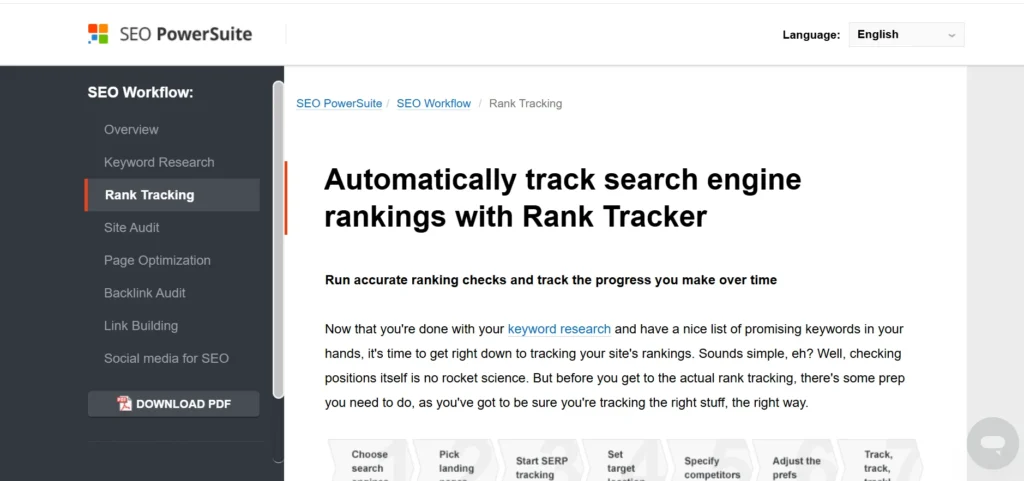
Rank Tracker, part of the SEO PowerSuite suite, supports Baidu along with hundreds of other search engines worldwide. As a desktop application, it gives users complete ownership of their data while offering features like unlimited keyword tracking, keyword discovery, competitor analysis, and scheduled ranking reports. Although it doesn’t provide the same level of cloud collaboration as some SaaS platforms, it’s a cost-effective option for freelancers, consultants, and in-house SEO teams.
3. Dragon Metrics
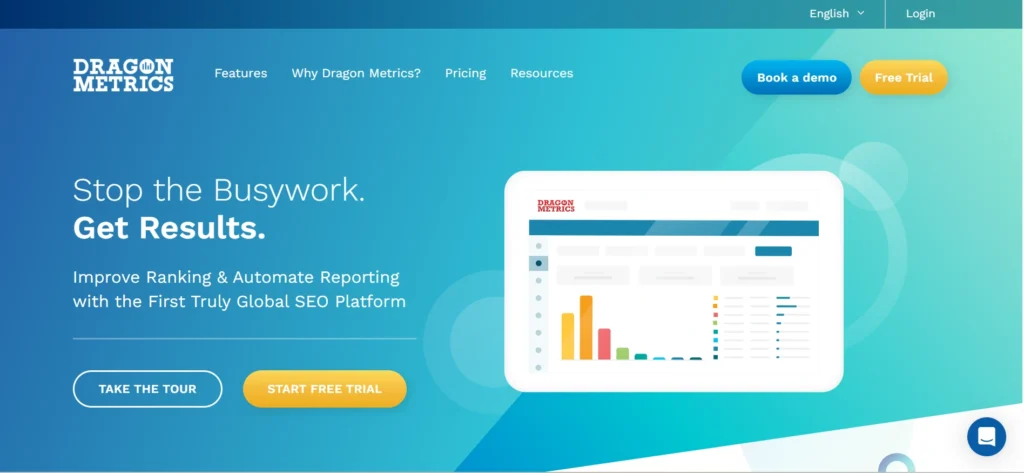
Dragon Metrics is one of the most recognized platforms built specifically for China SEO. In addition to Baidu, it supports search engines like Sogou and Shenma, making it ideal for brands targeting the broader Chinese search ecosystem. The platform combines keyword rank tracking with site audits, backlink monitoring, content optimization, and competitor analysis. Its deep understanding of the Chinese digital landscape makes it a preferred solution for agencies and enterprises focused on China.
4. NoCodeSERPAPI
NoCodeSERPAPI is designed for teams that need direct access to Baidu SERP data through an API instead of relying on a traditional dashboard. Developers and data teams can integrate ranking data into custom dashboards, internal reporting systems, or business intelligence platforms. This flexibility makes it a good option for companies building automated SEO workflows or managing large-scale reporting across multiple websites.
5. SEOpital
SEOpital combines keyword tracking with AI-powered content optimization. Rather than simply reporting keyword positions, it connects ranking data with actionable content recommendations to help improve search visibility. This integrated approach is useful for content marketing teams that want to identify ranking opportunities and optimize pages based on real performance data instead of switching between multiple SEO tools.
6. Energent AI
Energent AI goes beyond traditional rank tracking by using artificial intelligence to analyze ranking fluctuations and identify potential reasons behind changes. Instead of only showing that rankings have increased or decreased, it can surface patterns related to algorithm updates, competitor activity, or content changes. This makes it particularly valuable for SEO teams that want faster insights and less manual analysis.
7. Other Baidu SEO Platforms
Several all-in-one SEO platforms, including SE Ranking and Wincher, also provide varying levels of Baidu support. While their primary focus remains Google, Bing, and other major search engines, they can be useful for businesses managing international SEO campaigns from a single platform. If your organization already uses one of these tools, adding Baidu tracking may be more cost-effective than investing in a separate China-specific solution. However, for businesses whose primary audience is in China, dedicated platforms like Dragon Metrics generally offer more comprehensive Baidu-focused features.
How Baidu Rank Tracking Works
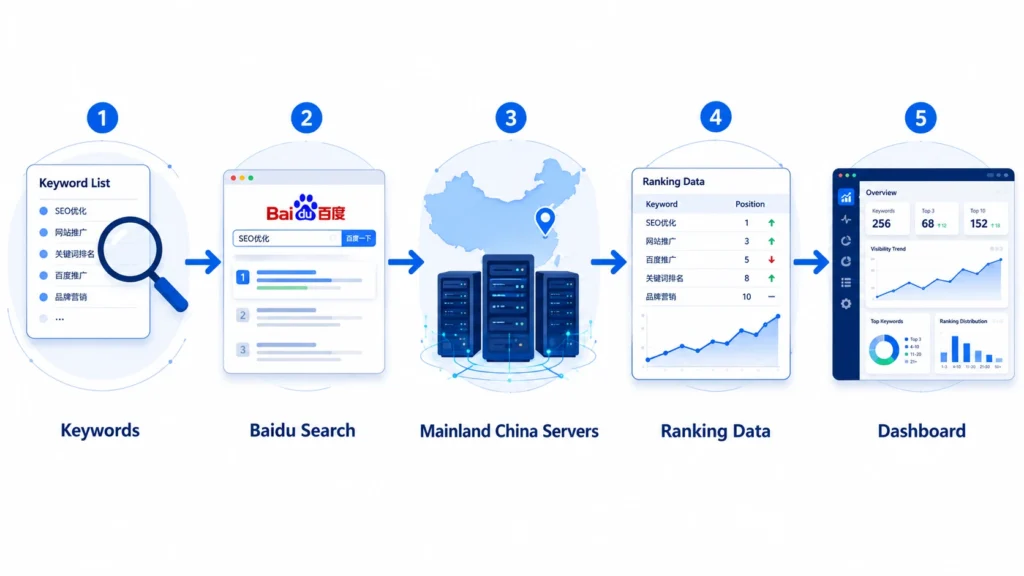
Most tools will send automated searches to Baidu for each keyword that you are tracking. They will then record your website’s URL and its position in the search results. The best tools perform these checks from different cities or provinces and across both desktop and mobile devices, since Baidu rankings can vary by location and device. This level of localized tracking helps you make better SEO decisions, just as fleet maintenance software provides location-based insights and real-time data to improve operational efficiency across multiple vehicles.
This is similar in principle to how Google Search Console reports position data, but the underlying mechanics are different. Baidu weighs site speed, ICP licensing status, and local hosting more heavily than Google does. Baidu’s own webmaster documentation covers these factors in more depth (ziyuan.baidu.com), and China-focused marketers regularly compare notes on this in threads on r/SEO and in LinkedIn groups focused on APAC growth.
Why Google Rank Trackers Don’t Work Well for Baidu
Tools like Ahrefs or Semrush that are focused on Google are made to work with Google’s index and Google’s search results page structure. These tools can sometimes give you an idea of where you rank on Baidu.
The information is often old, checked from the wrong place or missing important local search features like Baidus map pack or knowledge panels on Baidu.
It is similar to trying to check your credit score using a system that is meant for banks in a country. You might get some information. It will not show what is really happening with your credit score. Google tools are like that when you try to use them for Baidu they do not work very well for Baidu.
Why Tracking Baidu Keyword Rankings Matters

If you’re spending budget on China SEO, position data is how you prove it’s working. Without it, you’re optimizing blind.
1. Measure SEO Performance
Ranking changes tell you whether your content, technical fixes, or link-building efforts are moving the needle. A jump from page 3 to page 1 for a commercial keyword is a concrete result you can report to a client or a boss.
2. Monitor Competitors
Watching where competitors rank for the same terms shows you gaps in your own strategy. If a rival suddenly appears in the top 3 for a keyword you own, that’s worth investigating before you lose the traffic.
3. Track Local Search Visibility
Baidu results vary by city and province more than most Western marketers assume. A business ranking well in Shanghai might barely appear in Chengdu, so local tracking matters if you serve specific regions.
4. Improve ROI for China SEO Campaigns
Agencies and in-house teams both need to justify spend. Rank data, tied to actual traffic and conversions, is the clearest way to show that a China SEO campaign earned its budget back.
How to Choose the Best Baidu Rank Tracking Tool
Not every tool on the market is built the same way, and the differences matter more here than they would for a generic Google tracker. Here’s what to check before you commit to one.
1. Accuracy
Ask whether the tool checks from real mainland China IPs or simulates location through a workaround. Accuracy issues are one of the most common complaints in China SEO forums and LinkedIn groups focused on APAC marketing.
2. Update Frequency
Daily updates are the standard for anyone running active campaigns. Weekly checks are fine for slower-moving industries, but they’ll hide short-term volatility that daily tracking would catch.
3. Geo-Specific Tracking
Look for tools that let you set tracking down to the city level, not just “China” as a whole. This is one of the most requested features in Baidu SEO discussions, and one of the most frequently missing.
4. Desktop vs Mobile Rankings
Mobile search behavior on Baidu differs from desktop, sometimes significantly. A tool that only checks desktop rankings is giving you half the picture, since mobile now accounts for the bulk of search traffic in China.
5. Competitor Tracking
You want to add competitor domains alongside your own keywords, so you can see relative movement, not just your own isolated numbers.
6. Historical Ranking Reports
Trend lines over months matter more than a single day’s snapshot. A tool without historical graphs makes it hard to spot seasonal patterns or the long-term effect of a content push.
7. AI Insights
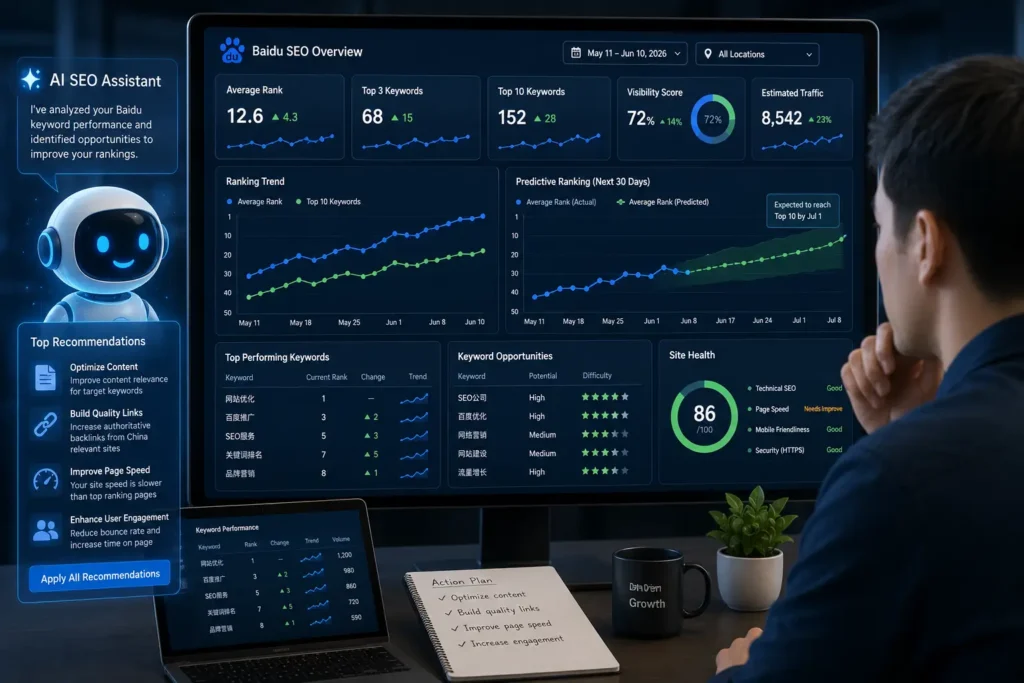
Newer platforms are starting to flag ranking drops automatically and suggest likely causes, instead of leaving you to spot the pattern manually in a spreadsheet.
8. API Access
If you manage multiple client accounts or want to feed ranking data into your own dashboards, API access saves a lot of manual export work.
9. White-Label Reporting
Agencies in particular should check for white-label options, since client-facing reports look more professional without a third-party tool’s branding on them.
Comparison Table of the Top Baidu Rank Tracking Tools
| Tool | Mainland China Data | Mobile Tracking | API Access | AI Insights | Best For |
| GeoRanker | Yes | Yes | Limited | No | Local/city-level tracking |
| Rank Tracker | Yes | Yes | No | No | Desktop-based control |
| Dragon Metrics | Yes | Yes | Yes | Limited | Dedicated China SEO agencies |
| NoCodeSERPAPI | Yes | Yes | Yes | No | Developers building custom dashboards |
| SEOpital | Yes | Yes | Limited | Yes | Content-tracking integration |
| Energent AI | Yes | Yes | Yes | Yes | Automated insights, less manual work |
Pricing varies widely depending on keyword volume and update frequency, so it’s worth requesting a trial or demo directly from each vendor before committing to an annual plan.
How to Set Up Baidu Keyword Tracking
Once you’ve picked a tool, the setup process is fairly consistent across platforms.
1. Add Keywords
Start with your core commercial and informational keywords, ideally the ones you already know matter from Baidu Webmaster Tools or your own analytics.
2. Select Target Locations
Choose the specific cities or provinces relevant to your business, rather than tracking generically for “China.”
3. Track Mobile and Desktop Rankings
Set up both, since the two can diverge more on Baidu than they typically do on Google.
4. Monitor Competitors
Add two or three direct competitors so you have a comparison point beyond your own numbers.
5. Generate Reports
Schedule regular exports or dashboards so stakeholders see progress without you manually pulling data every week.
Advanced Features to Look For
A handful of features separate basic rank checkers from tools built for serious China SEO work.
AI recommendations flag drops early and suggest what might have caused them. Keyword clustering groups related terms so you’re not tracking dozens of near-duplicate keywords separately. SERP feature tracking shows whether you’re appearing in Baidu’s knowledge panels or map results, not just the standard blue links.
Share of Voice measures your overall visibility across a keyword set compared to competitors, which is often a better campaign-level metric than any single keyword’s position. Historical trends and search visibility scores help you spot slow declines before they become a real problem. API integrations let you pull this data into whatever internal system your team already uses. These integrations can also connect with facility management software, allowing organizations to centralize analytics, automate reporting, and streamline operational data across multiple business systems.
Common Mistakes to Avoid When Tracking Baidu Rankings
1. Ignoring Localization
Simplified Chinese content that reads like a direct translation from English tends to underperform, even if the keywords are technically correct. Native-level copy matters for both users and Baidu’s ranking signals.
2. Tracking Only National Rankings
If your business serves specific regions, national-level tracking will hide meaningful local variation. Set up city-level tracking for anywhere you actually operate.
3. Using Google-Only Tools
As covered earlier, Google-first trackers often return inaccurate or incomplete Baidu data. It’s worth the switch to a dedicated tool once China becomes a real part of your SEO strategy.
4. Not Monitoring Mobile Rankings
If you do not track searches on devices you will miss most of the real search behavior in China. This is because people in China use their devices to search the internet more often than they use their desktop computers.
Mobile search volume is usually higher than desktop search volume in China. This means that mobile searches are very important for understanding what people are really searching for in China.
Best Practices for Improving Baidu Rankings
Tracking rankings only helps if you act on what the data shows. A few fundamentals go a long way. Keyword research should account for how Chinese users actually phrase queries, which can differ meaningfully from a direct translation of your English keyword list. Simplified Chinese content written by native speakers, not machine-translated, tends to perform better across the board.
Website speed matters more on Baidu than many international teams expect, partly because of network conditions inside China. Local hosting, ideally with an ICP license, is one of the more well-documented ranking factors discussed in Baidu’s own webmaster guidelines.
Technical SEO basics like clean URL structures and proper sitemap submission still apply, just adapted to Baidu’s own webmaster tools instead of Google Search Console.
Frequently Asked Questions
1. What is the best keyword rank tracking tool for Baidu?
There isn’t a single universal answer, since it depends on your budget and needs. Dragon Metrics suits agencies focused purely on China SEO, while Energent AI fits teams wanting automated insights, and Rank Tracker works well for those who prefer desktop software.
2. Can Google Search Console track Baidu rankings?
No. Google Search Console only reports data for Google’s own search results. Baidu has its own equivalent, Baidu Webmaster Tools, for that purpose.
3. How do I check keyword rankings on Baidu?
You can search manually from a mainland China IP, but for consistent tracking across many keywords, a dedicated Baidu rank tracking tool is far more practical.
4. Which SEO tools support Baidu?
Dragon Metrics, GeoRanker, Rank Tracker, NoCodeSERPAPI, and SEOpital all offer some level of Baidu tracking, with varying degrees of accuracy and depth.
5. Is Baidu SEO different from Google SEO?
Yes, in several ways. Baidu weighs local hosting, ICP licensing, and site speed more heavily, and its algorithm handles Chinese-language content differently than Google handles English or other Latin-script languages.
6. How often should I track Baidu keyword rankings?
Daily tracking is standard for active campaigns. Weekly checks can work for slower-moving industries with less competitive pressure.
7. Can Ahrefs track Baidu rankings?
Ahrefs is built primarily around Google’s index, so its Baidu data, where available, tends to be limited and less reliable than a dedicated Baidu tool.
Conclusion
Choosing the keyword rank tracking tool for Baidu ultimately depends on your business goals, your budget and the technical needs of your company. Some tools are designed for China SEO management while others are focused on being cost-effective offering API access or providing insights powered by artificial intelligence.
The important thing is to pick a tool that gives accurate ranking data from mainland China, offers reliable reports and includes the features your team needs to keep track of performance properly.
As your SEO approach changes over time, regular rank tracking helps you see how far you have come, find chances and react fast when Baidus search results change. With the tool you can make smart choices using real search data, increase your presence in the Chinese market and create a better SEO plan for the future.