Nobody talks about the failed AI projects.
You’ve heard about the companies that managed to ship faster, the startups that built an MVP in weeks, the enterprises that automated their workflows. But what you haven’t heard is about the one company that gave the AI tool to its non-technical team and received the mountain of code that nobody knew how to maintain.
That’s the part worth understanding before your business decides how to approach generative AI in software development.
The technology is real. The productivity gains are real. But generative AI doesn’t reduce your need for skilled developers; it raises the bar for what those developers can accomplish.
The businesses getting results from AI-assisted development aren’t the ones that cut their engineering teams.
They’re the ones that put better tools in the hands of experienced engineers and got significantly more output from the same headcount.
What Generative AI Actually Does in a Development Workflow
The common picture of AI in software development is a tool; you type half a function, and the AI finishes it. That exists, and it helps. But it’s a small slice of what generative AI does inside a real development pipeline.
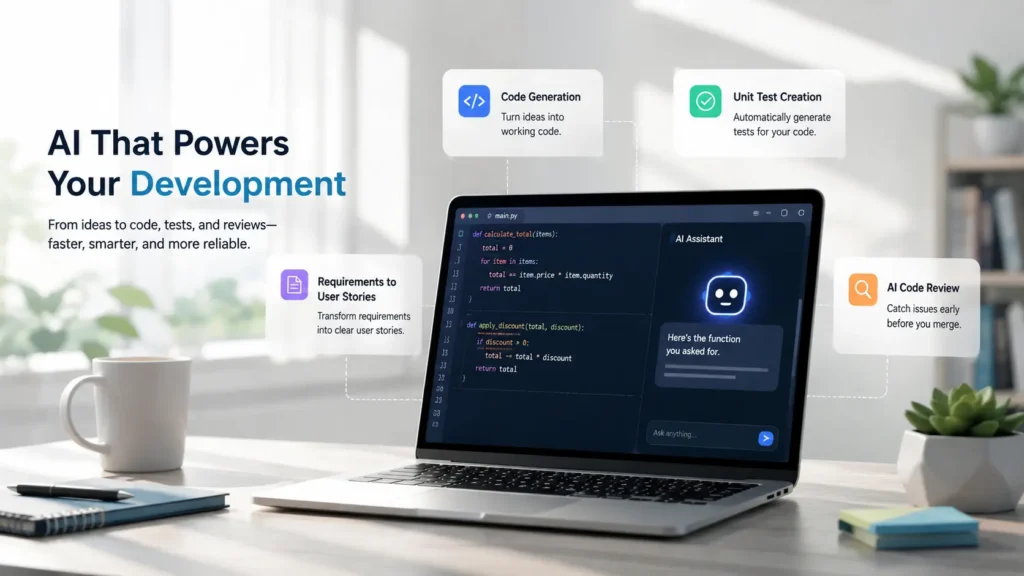
In terms of workflow, the generative AI performs actions that would traditionally have taken up too much of the senior engineers’ time. The AI takes prompts in plain English and creates the code for you. It also generates unit tests for your existing functions. It turns loose product requirements into user stories and APIs. It reviews code before you even open it.
It was always the engineer’s time that was expensive. In the past, part of this time was used for tedious tasks that didn’t require much judgment: document creation, pattern implementation, test case creation, and more. Generative AI takes care of all these tasks.
Now the engineer can use this time to make architectural decisions, handle edge cases, integrate complex components, and tackle difficult tasks.
Also Read: The Role of AI in the Functioning of Modern Applications
That’s not a story about replacing developers. It’s a story about what a good developer can accomplish when the repetitive parts of the job get handled automatically.
AI Code Generation Still Requires Human Judgment
Tools like GitHub Copilot and Amazon CodeWhisperer generate code that is often technically correct. The problem is that “technically correct” and “right for this specific system” are two different things.
A seasoned engineer reviewing AI code reviews it in the same way as a junior developer’s pull request – looking for compatibility with the architecture, handling of edge cases, and not introducing issues that will make future maintenance difficult in six months. Such a process needs genuine engineering knowledge and cannot be performed by any non-engineering person in the team, no matter how impressive the AI-generated code looks.
Businesses that treat AI as a shortcut to skip hiring developers usually discover this the hard way. The code ships. It looks fine. Then it breaks in production in a way that takes a senior engineer three days to diagnose, because nobody with the right experience was there to catch the problem before it went live.
How AI Changes the Testing Side of Development
Testing is where software projects quietly fall apart. Under deadline pressure, test coverage shrinks. Edge cases get skipped. QA cycles get compressed. Then the bug shows up in production, in front of a real user, at the worst possible time.
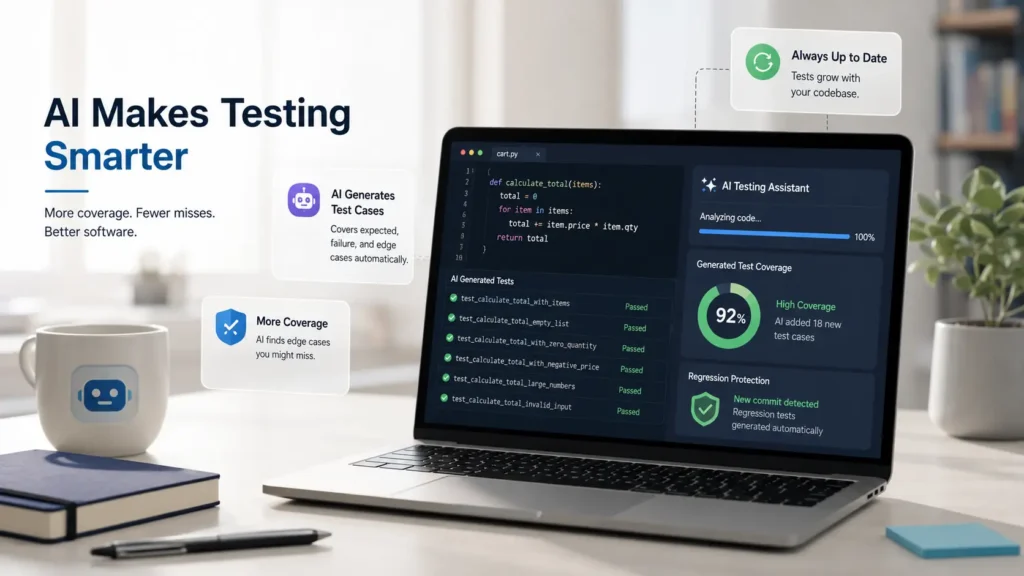
Generative AI addresses this directly. LLMs can analyze existing code and generate test cases that cover expected behavior, failure scenarios, and edge cases that a developer writing tests manually might miss or skip due to time pressure. Some systems automatically generate regression tests when new code is committed, so the test suite grows alongside the product instead of lagging behind it.
But someone still has to review those generated tests, confirm they actually test the right behavior, and catch the cases where the AI produced a test that passes but doesn’t cover what it’s supposed to cover. That someone is a developer who understands the system.
Where Generative AI Fits in Enterprise Software
Enterprise development carries constraints that startup development doesn’t. Legacy systems, compliance requirements, data governance policies, and deep integration complexity make it harder to move fast, regardless of what tools you introduce.
Generative AI helps enterprise teams in specific, practical ways:
- Automated documentation for legacy codebases that were never properly documented, a task engineers hate doing manually, and AI handles efficiently.
- Code migration assistance when moving from older languages or frameworks to modern stacks, where the volume of code to convert would otherwise require months of manual work
- Intelligent internal tooling built faster, custom dashboards, reporting pipelines, and workflow automation that previously took months now get shipped in weeks
None of these applications remove the need for engineers. They remove the ceiling on what a well-staffed engineering team can accomplish in a given timeframe. An enterprise that previously needed twelve months and a large team to modernize a legacy system can potentially do it in six months with the same team using AI-assisted development. That’s a meaningful business outcome, but it still requires the team.
The Businesses That Get This Wrong
Here’s what the failed AI development projects have in common: they treated generative AI as a way to reduce engineering investment rather than amplify it.
They gave access to AI coding tools to people without a technical background to evaluate the output. They cut developer headcount based on the assumption that AI would fill the gap. They shipped AI-generated code without proper review, testing, or architectural oversight.
The output looked like software. It functioned like software. Until it didn’t, and then there was nobody with the right expertise to fix it quickly.
Generative AI is a force multiplier. A force multiplier only works if there’s a force to multiply. Trying to run it without experienced developers is like buying a high-performance engine and putting it in a car with no steering wheel.
What This Means If You’re Building Software Right Now
The businesses getting the most value from generative AI in software development share a common approach: they hired strong developers first, then introduced AI tooling into an already-functional engineering workflow.
The AI made their good developers faster. It didn’t substitute for having good developers in the first place.
If you’re planning a software project, whether it’s a new product, an AI-native application, or a modernization of existing systems, the decision to hire experienced developers isn’t in tension with using AI tools. It’s the prerequisite for using them effectively.
One of the most reputable names in the software development industry is CMARIX. Their expertise lies in integrating generative AI into software, enabling features such as conversational AI, document intelligence, personalized recommendations, workflow automation, and natural language search. Every solution is engineered to deliver measurable business value.
Their AI consulting helps businesses identify where AI fits in different types of businesses, so the build begins with a clear use case rather than a vague brief. The AI accelerates the work. The engineers decide what’s actually worth shipping.