AI filmmaking changes how filmmakers approach character movement
Motion capture has been a key part of filmmaking for decades. It helps translate an actor’s physical performance into a digital character with detailed body movement, timing, and emotion.
With the rise of AI filmmaking, creators can now generate characters, scenes, and performances faster without always relying on traditional production methods.
AI video tools can help filmmakers explore ideas, build visual concepts, and create early versions of scenes before production begins. However, AI does not completely replace motion capture because some performances still depend on real human movement and detailed physical data.
The question is not whether AI will replace mocap, but where each approach works best.
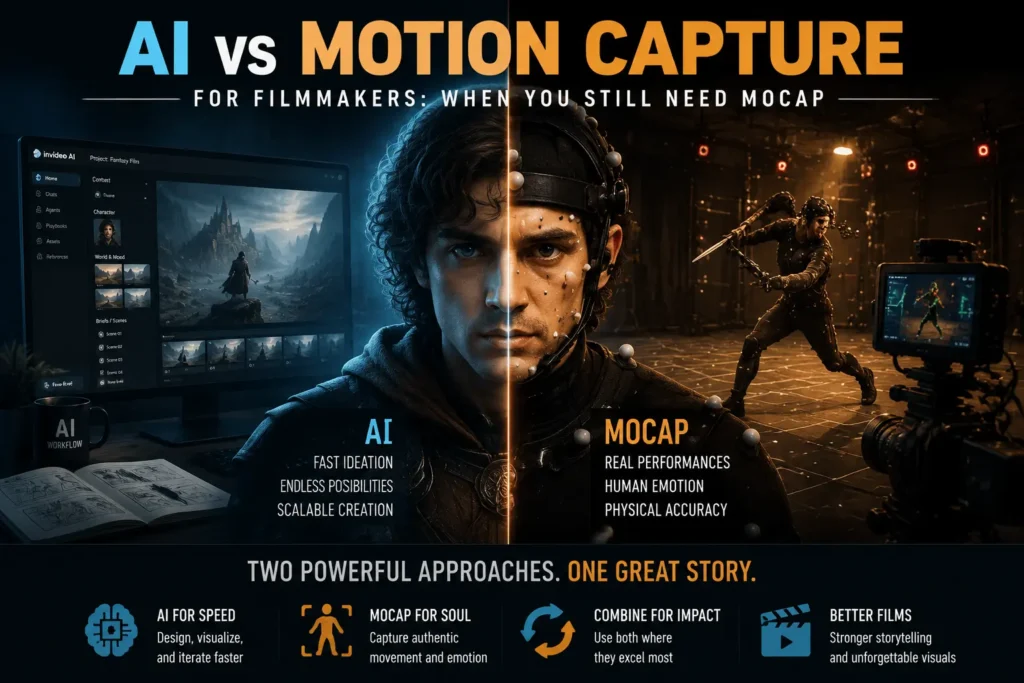
How AI video workflows support modern filmmaking projects
AI tools are changing how filmmakers approach pre-production, experimentation, and content creation. Instead of spending hours building every element manually, creators can use AI to explore different visual directions and refine ideas faster.
For filmmakers working on concept videos, trailers, shorts, and visual experiments, invideo agent can help turn creative ideas into complete video projects by handling elements such as scripts, scenes, visuals, voiceovers, music, and editing through an agentic workflow.
Taking this workflow further, invideo agent two adds deeper project memory, specialized creative agents, and the ability to understand different formats like scripts, documents, and videos. This helps filmmakers maintain consistency across complex projects while streamlining different stages of production.
This approach supports AI filmmaking by helping creators focus more on creative decisions while reducing repetitive production tasks.
However, AI-generated movement has limits. It can create convincing visuals, but it may not always capture the subtle physical details of a trained performer, especially for complex action sequences or emotionally intense scenes.
Where AI-generated movement works well in filmmaking
AI-generated motion can be useful when filmmakers need speed, flexibility, or quick visual exploration.
For example, AI can help create early character tests, concept scenes, or stylized sequences where perfect physical accuracy is not the main goal.
AI filmmaking workflows are especially useful for:
- Testing different character designs before production
- Creating visual prototypes for pitches
- Exploring camera ideas and scene direction
- Producing short-form content with limited resources
These workflows allow creators to experiment quickly before investing in more expensive production processes.
Why motion capture remains important for complex performances
Motion capture records real human movement using sensors, cameras, and specialized software. The process captures details that are difficult for AI systems to reproduce consistently.
Mocap remains valuable when a project requires:
Realistic body mechanics
Human movement contains small details such as weight shifts, balance changes, and natural timing. These details are important for realistic characters, especially in films with detailed animation.
Emotional performances
A character’s movement often communicates emotion before dialogue begins. Motion capture allows performers to bring their own acting choices into digital characters.
Complex action sequences
Stunts, fighting scenes, and athletic movements require accurate body dynamics. Mocap provides filmmakers with reliable movement data that can be refined during production.
How filmmakers can combine AI and motion capture
The strongest workflows may come from combining both technologies instead of choosing one over the other.
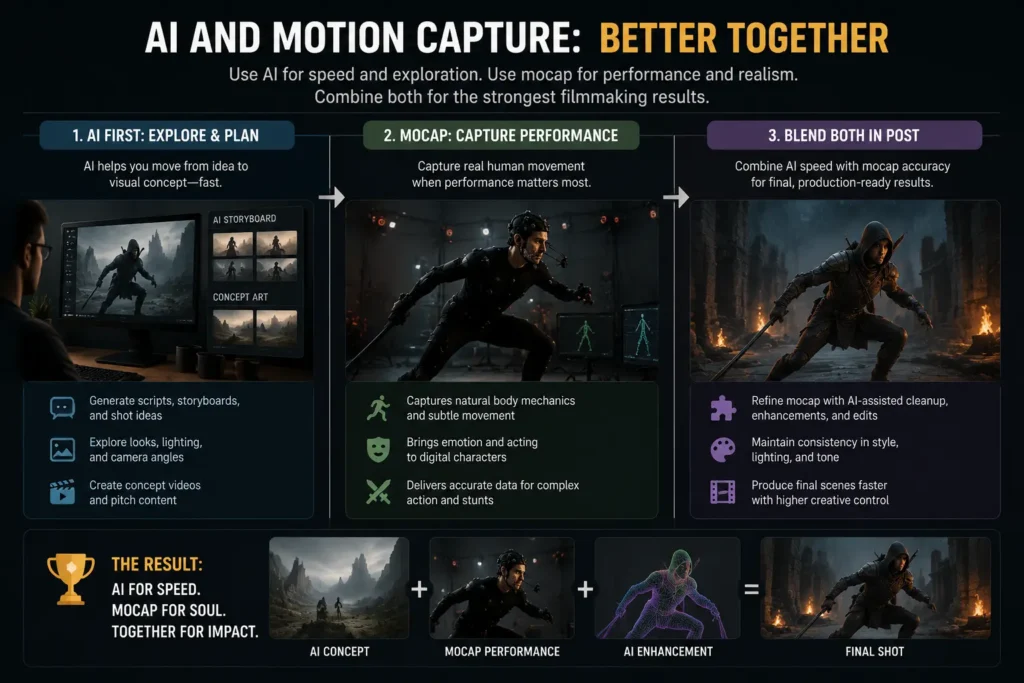
The first step is using AI tools for exploration. Filmmakers can test concepts, create story ideas, and develop visual references before entering production.
The second step is using motion capture when a scene requires detailed performance data. Actors can provide realistic movement that becomes the foundation for digital characters.
The third step is combining both approaches during post-production. AI can help speed up editing, visual adjustments, and content variations while mocap provides authentic movement.
This combination creates a more efficient AI filmmaking process where technology supports human performance rather than replacing it.
How AI filmmaking tools and mocap serve different creative goals
AI and motion capture solve different problems.
AI is useful for speed, experimentation, and creating content variations. It helps filmmakers move quickly from an idea to a visual concept.
Motion capture is useful for accuracy, performance, and realism. It captures the physical qualities that make characters feel believable.
For example, a filmmaker creating a storyboard, pitch video, or early concept trailer may benefit from AI workflows. A filmmaker producing a character-driven feature film with detailed performances may still need mocap.
invideo Agent fits into the first category by helping creators build complete video projects faster while maintaining creative control throughout the process. For AI filmmaking projects focused on rapid development, it can support everything from initial concepts to finished videos.
When filmmakers should choose mocap over AI tools
Motion capture is still the better choice when:
- A character’s performance is central to the story
- Physical realism is a major requirement
- Actors need to contribute detailed expressions and movement
- The production requires precise animation control
AI tools can support these projects, but they are not always a replacement for performance capture.
The future of filmmaking will combine AI creativity and human performance
AI is making filmmaking more accessible by reducing barriers around planning, production, and content creation. At the same time, motion capture continues to provide a level of performance detail that remains difficult to replicate.
The future of AI filmmaking will likely involve both technologies working together. Creators can use AI to develop ideas faster and use mocap when human movement and emotion need to be captured with precision.
Tools like invideo Agent represent this shift by helping filmmakers move from concepts to complete videos more efficiently, while traditional techniques like motion capture continue to play an important role when realism matters most.