Moving an online store to a new platform is one of the few projects that can cut your revenue in a week. The new site can look better, load faster and still lose half its organic traffic if the old URLs, content and tracking don’t carry over.
That is why choosing from the top eCommerce migration agencies for replatforming without traffic loss is a different decision from hiring a general developer. The platform move is the easy part. Protecting your search visibility during the move is where agencies earn their fee.
A migration does not have to lose traffic. Google says rankings can fluctuate for a while after a site move, but a well-planned move with correct redirects keeps most of the visibility you already have. (Google Search Central)
This guide compares seven agencies that often appear in this space, explains how we evaluated them, and shows you how to check any agency’s SEO claims yourself. It also covers costs, timelines, platform quirks and a hiring checklist.
Top eCommerce Migration Agencies in 2026
Choosing an eCommerce migration agency requires more than comparing platform expertise or development costs. You need a partner that understands data migration, technical SEO, integrations, user experience, and the risks associated with moving an established online store.
The following agencies offer different strengths, from enterprise replatforming to custom development and UX-led redesigns. Each profile highlights what the agency may be best suited for, questions to ask before hiring, and potential limitations to consider.
Confirm current services, partnerships, and case studies directly with each company, as these can change over time.
1. Dinarys
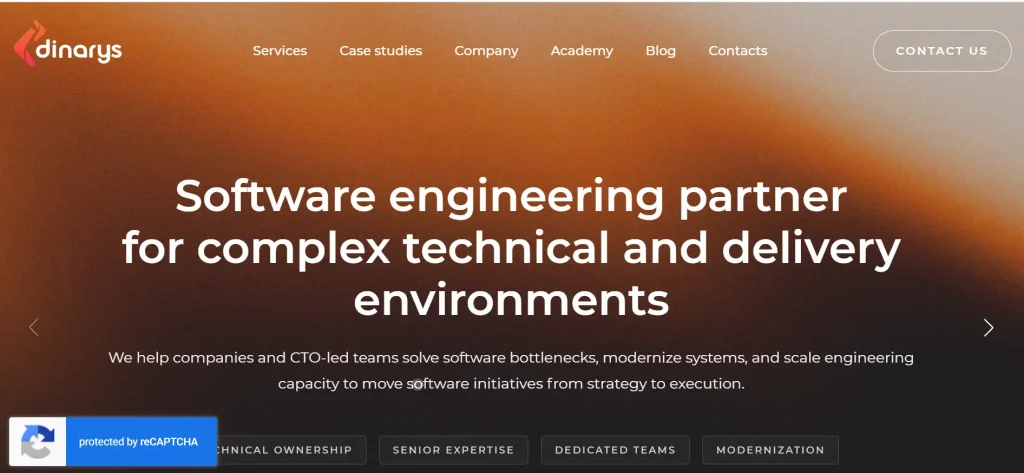
Best for: Businesses looking for an eCommerce-focused migration partner with a structured implementation process.
Dinarys positions itself around eCommerce development and migration, making it worth considering for businesses moving between platforms or modernizing an existing online store.
Its published migration guidance covers important areas such as platform selection, data integrity, third-party integrations, SEO preservation, quality assurance, and post-launch support.
These considerations are particularly important for stores with established organic traffic, extensive product catalogs, and complex checkout workflows.
Before hiring the agency, ask how it translates these principles into a project-specific migration plan and how it measures success after launch.
Ask about: Who will own the URL mapping and redirect strategy, how the team controls changes in the staging environment, and whether it can share organic traffic data from a previous migration involving the same platform combination.
Possible limitation: Businesses planning large, multi-country migrations should confirm the agency’s available team capacity, experience with regional storefronts, and ability to coordinate complex integrations across multiple markets.
2. N-iX

Best for: Complex, engineering-heavy migrations involving enterprise systems, extensive integrations, and large eCommerce operations.
N-iX is a software engineering and consulting company that may be suitable for businesses dealing with complicated technical environments. Its published replatforming guidance addresses migration readiness, data transfer, integrations, SEO preservation, user experience, testing, and post-launch support.
This broader engineering perspective can be valuable when an eCommerce migration involves ERP systems, customer databases, inventory platforms, payment services, or other business-critical applications. For organizations replacing legacy infrastructure, the ability to coordinate backend engineering with storefront development can be an important consideration.
Ask about: Who will be responsible for technical SEO, how SEO requirements will be incorporated into development specifications, and what monitoring process the team uses to identify ranking losses or indexing problems after launch. Request examples of migrations involving comparable technical complexity.
Possible limitation: Smaller businesses with straightforward catalogs and limited integration requirements may not need an enterprise-oriented engagement. Confirm the proposed team structure, project scope, and pricing before committing.
3. Vaimo
Best for: Enterprise eCommerce migrations, international storefronts, and businesses using Adobe Commerce (formerly Magento).
Vaimo is an eCommerce-focused agency with experience in enterprise commerce solutions, including Adobe Commerce.
It may be a suitable option for businesses operating large product catalogs, multiple regional websites, or complex customer journeys. International migrations require particular attention to language variations, regional URLs, currency settings, localized product information, and hreflang implementation.
These elements help search engines understand which pages should appear for users in different countries and languages. When evaluating Vaimo, ask how its technical team coordinates platform development, data migration, and SEO requirements across multiple markets.
Ask about: A comparable multi-country migration, the process used to preserve international organic visibility, and the performance data available to demonstrate the outcome. Also ask how the team validates redirects, localized metadata, canonical tags, and regional URL structures before launch. You can explore its company updates and projects through Vaimo’s LinkedIn page.
Possible limitation: Enterprise-focused services may be more appropriate for businesses with substantial budgets and complex requirements. Smaller stores should compare the proposed scope and cost against their actual migration needs.
4. ELEKS
Best for: Custom eCommerce architectures, enterprise software environments, and migrations involving headless or composable commerce.
ELEKS is a software engineering company that may be worth considering when a migration involves more than transferring products and customer records between platforms.
Businesses replacing legacy systems or building custom commerce experiences often need tailored APIs, backend services, and integrations with existing business applications.
An engineering-led approach can help address these requirements, particularly when standard platform features cannot support the desired functionality.
However, custom development introduces additional SEO considerations, including rendering, URL management, metadata generation, internal linking, and structured data implementation.
Ask about: How technical SEO requirements are documented before development begins, who validates search engine rendering, and whether the team has completed migrations involving similar eCommerce platforms. Request examples showing how it preserved important URLs, implemented redirects, and monitored organic performance after deployment. You can also review recent company updates and projects through its LinkedIn presence.
Possible limitation: General software engineering expertise does not automatically guarantee deep eCommerce SEO experience. Confirm that the proposed team includes specialists who understand migration-related ranking risks and can work alongside developers throughout the project.
5. Codal
Best for: eCommerce brands combining a platform migration with a website redesign or customer experience improvement.
Codal focuses on digital strategy, design, and technology, making it worth evaluating for businesses that want to modernize their storefront while moving to a new commerce platform.
Combining these activities can create opportunities to improve navigation, product discovery, mobile usability, checkout experiences, and conversion rates. Businesses planning a similar redesign alongside their migration can also explore professional eCommerce website development services to improve storefront usability, performance, and the overall customer experience.
However, changing the design, content, information architecture, and URL structure simultaneously can make SEO performance harder to protect and post-launch problems more difficult to diagnose. A structured migration plan should distinguish necessary technical changes from optional redesign improvements.
Ask about: How the agency preserves high-performing landing pages, product descriptions, category structures, internal links, and metadata during a redesign.
Ask whether it maintains a URL-level redirect inventory and compares organic performance before and after launch. You can also explore company updates through Codal’s LinkedIn page.
Possible limitation: If your store has a very large catalog, complex integrations, or demanding enterprise requirements, verify the agency’s experience managing migrations at a comparable scale. Confirm that migration engineering and technical SEO receive sufficient attention alongside design and UX.
6. Innowise

Best for: eCommerce migrations involving complex data structures, custom software, and integrations with existing business systems.
Innowise provides custom software development services that may be relevant to businesses moving from legacy commerce systems or working with highly customized technology stacks.
These projects frequently involve connecting the new platform with enterprise resource planning (ERP) software, customer relationship management (CRM) systems, warehouse management tools, payment providers, and inventory databases.
When a migration requires tailored integrations or custom business functionality, custom software development services can help businesses connect their eCommerce platform with existing systems and operational workflows.
A well-planned migration must ensure that these systems exchange data correctly and that critical processes continue working after launch. Product availability, pricing, order synchronization, and customer information should all be tested before the new storefront goes live.
Ask about: How the agency validates migrated data, tests integrations under realistic conditions, handles failed synchronization, and manages redirect mapping.
Request a detailed testing plan that covers product catalogs, customer accounts, checkout workflows, and post-launch monitoring. You should also clarify which team members are responsible for technical SEO and organic traffic reporting.
Possible limitation: Custom development expertise should not be treated as proof of specialized eCommerce migration or SEO capabilities. Verify the agency’s experience with your target platform and ensure the proposal includes dedicated SEO requirements, redirect validation, and post-launch support.
7. Relevant Software
Best for: Custom eCommerce development projects involving cloud infrastructure, APIs, and tailored business functionality.
Relevant Software develops custom digital products and software solutions, making it an option for businesses that need a tailored approach to replacing an existing commerce system.
This may be useful when a standard platform cannot accommodate specific workflows, integration requirements, or business rules.
For example, a migration may involve connecting multiple services through APIs, modernizing backend infrastructure, or building a storefront around a specialized customer experience. In these situations, the agency should treat SEO requirements as part of the technical architecture rather than as a final optimization task.
Ask about: Previous eCommerce migration projects, experience with your current and target platforms, and the methods used to measure organic search performance before and after launch.
Ask how the team handles redirects, metadata, canonical tags, structured data, and JavaScript rendering where relevant. You should also clarify the duration of post-launch support and who will investigate any unexpected traffic or indexing changes.
Possible limitation: Custom software development experience does not necessarily mean the agency specializes in every eCommerce platform.
Verify its experience with your specific migration path and confirm that the proposed team can manage technical SEO, integration testing, and post-launch monitoring together.
Quick comparison of top eCommerce migration agencies
The table below is a starting shortlist, not a ranking. “Best for” reflects each agency’s public positioning. Before you sign, ask every one of them for proof of SEO results on a migration similar to yours.
| Agency | Best for | Typical platform focus | SEO migration evidence to request | Enterprise fit |
| Dinarys | Ecommerce-focused replatforming with a structured process | Multiple ecommerce platforms | Before/after traffic on past moves | Mid-market to enterprise |
| N-iX | Large, complex migrations with deep engineering needs | Enterprise and custom commerce | Redirect and QA documentation | Strong |
| Vaimo | Enterprise and international commerce, Adobe Commerce | Adobe Commerce (Magento) and related | Multi-country SEO handling | Strong |
| ELEKS | Custom and architecture-heavy projects | Custom and enterprise builds | Technical SEO involvement | Strong |
| Codal | UX-led redesign combined with a move | Design-driven ecommerce builds | SEO plan within redesign scope | Mid-market |
| Innowise | Integration-heavy projects on a custom stack | Custom development | Data and integration case studies | Mid-market to enterprise |
| Relevant Software | Custom ecommerce with cloud and API work | Custom ecommerce | Migration case studies | Mid-market |
Dinarys’ own guide to ecommerce migration companies is a useful reference for how vendors describe themselves. It lists platform expertise, data integrity, integrations, SEO, QA and post-migration support as selection factors. (Dinarys)
How we evaluated the agencies
“Top agencies” lists are subjective, so here is exactly what we looked at and what we ignored.
How we selected agencies
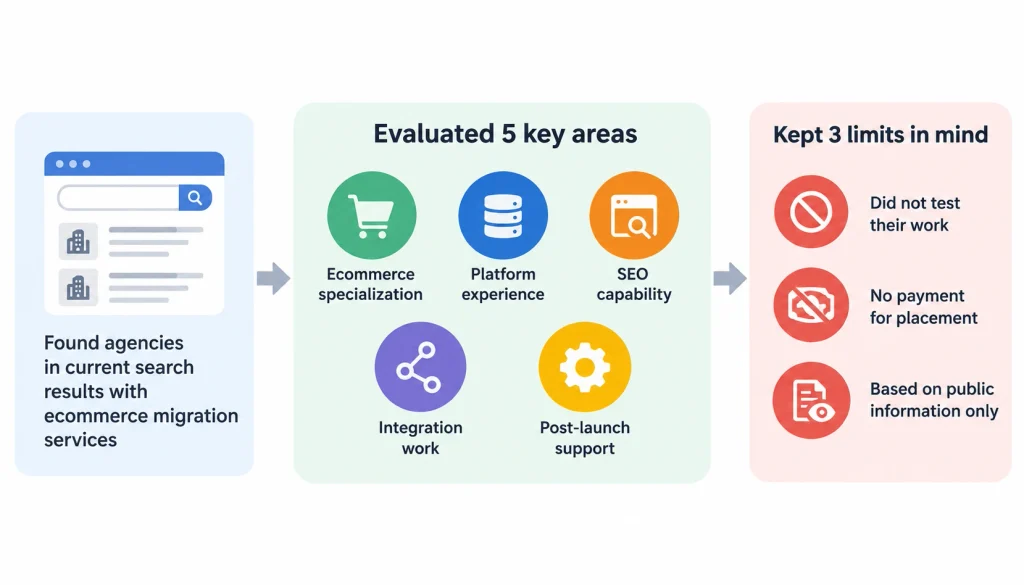
We started with companies that appear in current search results for ecommerce migration and publish migration-related services. Then we looked at five things: ecommerce specialization, platform experience, SEO capability, integration work, and how clearly they describe post-launch support.
We kept three limits in mind. We did not test any agency’s work ourselves. We did not receive payment for placement. And public pages only show what an agency chooses to say, so everything below should be treated as a lead to verify.
How we judged traffic-loss protection
We asked whether an agency’s public material describes a real process for each step that protects organic traffic: a full URL inventory, redirect mapping, metadata and content transfer, staging controls, redirect testing, a launch plan and monitoring after launch. An agency that mentions “SEO-friendly migration” once in a bullet list scores low. One that explains the steps scores higher.
What we did not use
We did not rank by Domain Rating, headcount or the number of services listed. A large engineering team does not tell you whether someone will check your canonical tags on launch day.
We also treated “zero traffic loss” claims with caution. No honest agency can promise that, because rankings depend on factors outside the migration. Look for agencies that talk about reducing risk and show data, not ones that guarantee outcomes.
How to choose an eCommerce migration agency without losing traffic
Use these seven checks. They work for any agency, including ones not listed here.
1. Look for matching migration experience
Ask for projects with the same source and target platforms, similar catalog size and similar market. A Shopify-to-Shopify theme rebuild teaches very little about moving a 200,000-SKU Magento store.
2. Make them explain the SEO process
Ask them to walk through what happens to every old URL. A good answer covers these steps:
- Crawl the old site and collect every URL that gets traffic, links or revenue.
- Map each old URL to a new one and test the redirects.
- Carry over titles, descriptions, headings and body copy.
- Check canonical tags, XML sitemaps and robots.txt.
- Keep structured data, internal links and hreflang intact.
An agency that can’t explain this in plain language probably hasn’t done it often. Beyond the migration itself, businesses can explore technical SEO services to identify crawling issues, improve search visibility, and address technical problems that may affect organic traffic.
3. Check data migration scope
Products and categories are obvious. Also ask about customer accounts, order history, reviews, promotions, inventory and images. Missing reviews, for example, can remove rich-result stars and reduce clicks.
4. Check integration experience
Your store likely talks to an ERP, CRM, PIM, order system, warehouse system, payment gateway, tax and shipping tools. Ask which ones the agency has connected before, and who tests each connection.
5. Review the testing plan
A good plan covers checkout, mobile, speed, integrations and redirects. SEO testing should run on staging, with a crawl before launch, not only after.
6. Ask about cutover and rollback
Launch day needs a clear window, a content freeze, a data sync plan and a defined point at which you roll back. If the agency has no rollback plan, treat that as a warning.
7. Confirm post-launch support
Traffic problems often show up days or weeks after launch. Some agencies describe 30 to 90 days of monitoring after go-live, covering crawl errors, broken links and conversions. (Erpo) Whatever the number, get it in writing.
How to replatform an ecommerce store without losing SEO traffic
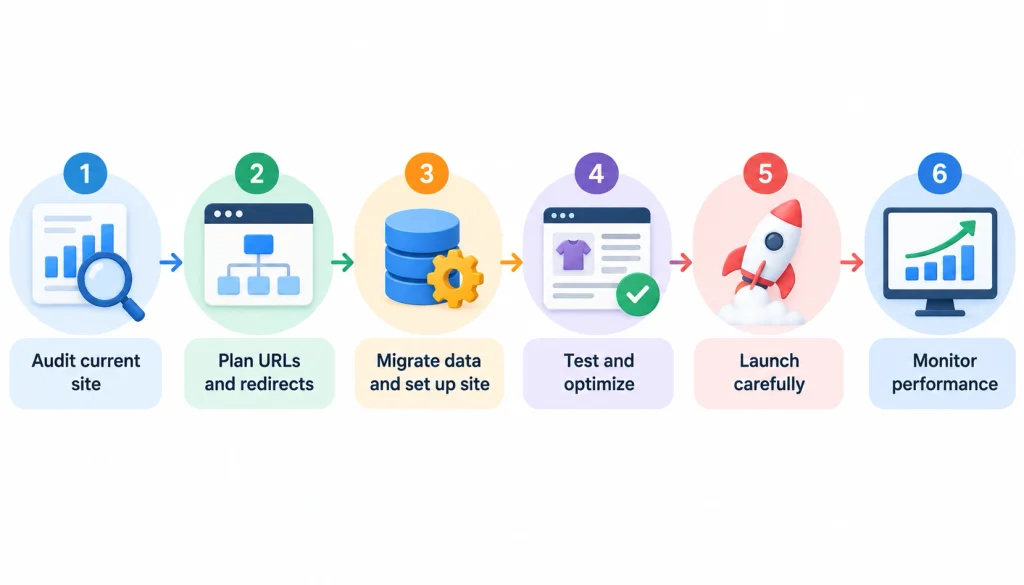
If you want to run this yourself or check an agency’s plan, follow these steps in order. They apply whether you move to Shopify, Adobe Commerce, BigCommerce or something else.
- Set a baseline. Record organic traffic, top landing pages, rankings, indexed pages, backlinks and organic revenue. You can’t prove a loss, or a recovery, without these.
- Crawl the old site. Use a crawler such as Screaming Frog and export every URL, status code, title, canonical and internal link.
- Build the URL map. Pair each old URL with its closest new equivalent. Pull in URLs from Google Search Console, analytics and backlink tools such as Ahrefs or Semrush, since some valuable pages won’t appear in a crawl.
- Keep content and metadata. Titles, descriptions, headings, product copy and category text should move over unless you have a tested reason to change them.
- Set up 301 redirects. A 301 is a permanent redirect that tells search engines the page has moved. (Wikipedia) Point each old URL straight to its final destination, not through a chain.
- Test on staging. Block staging from search engines, then crawl it as if it were live.
- Run a technical SEO check. Review canonicals, noindex tags, XML sitemaps, robots.txt, structured data, pagination and filter pages.
- Launch in a controlled window. Remove staging blocks, turn on redirects, submit the new sitemap and confirm analytics tracking fires.
- Watch the first 48 hours. Check Search Console, server errors, 404s and checkout. Fix problems the same day.
- Monitor for 30 to 90 days. Compare traffic, rankings and revenue to your baseline each week.
Google advises keeping redirects in place for at least a year after a move. (Google Search Central)
What causes organic traffic loss during ecommerce replatforming?
Most losses come from a short list of mistakes. We see the same ones repeatedly.
- Missing or wrong redirects. Old product and category URLs return a 404, or all redirect to the homepage. Both waste the authority those pages earned.
- Changed URL structures. New platforms often impose their own patterns, such as /products/ or /collections/. Each change needs a redirect.
- Lost content. Category descriptions and buying guides get dropped because the new template has no place for them.
- Wrong canonical tags. A bad canonical can tell Google to ignore the page you want ranked.
- Staging indexed, or noindex on live. A staging site left open creates duplicate content. A noindex tag carried over to production removes pages from search.
- Broken internal links. Links in menus, footers and blog posts still point to old URLs.
- Missing structured data. Product, review and breadcrumb markup disappears with the old theme.
- Hreflang errors. International stores can send visitors, and Google, to the wrong country version.
- Tracking gaps. Analytics or conversion tags don’t fire, so you can’t see what is happening.
Search practitioners discuss these in places like bigseo and TechSEO. Real-world threads there are useful for platform-specific surprises, though advice varies in quality, so verify before acting.
Agency vs in-house team vs freelancer
An agency is not always the right call. This table shows where each option fits.
| Factor | Agency | In-house team | Freelancer |
| Cost | Highest | Salary and opportunity cost | Lowest |
| Technical breadth | Wide | Depends on team | Narrow |
| SEO expertise | Varies by agency | Often limited | Varies widely |
| Integrations | Strong on larger teams | Strong on your own systems | Limited |
| Accountability | Contract and team | Internal management | Single person |
| Post-launch support | Usually offered | Built in | Often ad hoc |
A practical middle path for SEO-sensitive stores is to hire a development agency and a separate SEO specialist, then make one person responsible for the redirect map. It adds coordination, but it gives you an independent check on the work.
How much does ecommerce migration cost?
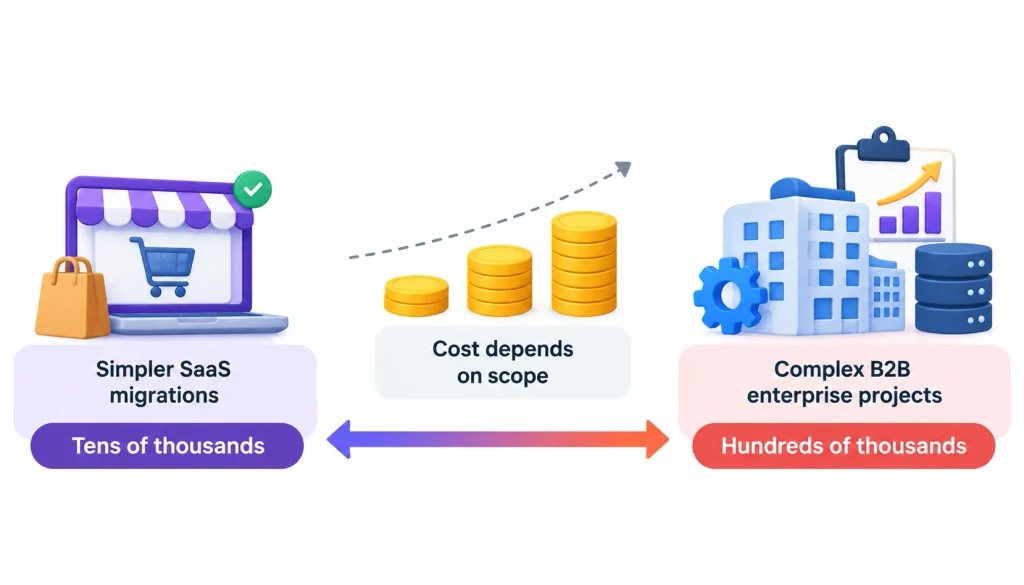
No single price is honest here, because costs depend on scope. N-iX describes ranges that run from tens of thousands for simpler SaaS moves to hundreds of thousands for complex B2B enterprise projects. (NIX United) Treat that as a signal of how wide the spread is, not as a quote.
These factors usually push the price up:
- Number of products and variants
- Custom features and checkout logic
- Integrations with ERP, PIM, CRM and order systems
- Multiple countries, languages and currencies
- Years of order and customer history to move
- Headless or composable architecture
- B2B pricing, accounts and approval flows
- A large, messy URL structure that needs heavy SEO work
Ask each agency to list what the quote includes. SEO work, data migration and post-launch support are the items most often left out.
How long does ecommerce replatforming take?
Small stores with few integrations can move in weeks. Larger projects take months. N-iX gives a broad range of roughly four to nine months depending on complexity. (NIX United)
| Store type | What drives the timeline |
| Small | Limited data, few apps, simple theme |
| Mid-market | Custom features, several integrations, larger catalog |
| Enterprise | Complex architecture, B2B, multiple regions, heavy data |
Be cautious about an agency that quotes a firm date before auditing your site. Flatline Agency makes a similar point and recommends understanding your migration path before committing to a schedule. (Flatline Agency)
Also avoid launching during your peak sales season. A code freeze before Black Friday is cheaper than a recovery effort during it.
Platform-Specific Migration Notes
Every eCommerce platform handles URLs, redirects, structured data, and content rendering differently. During a migration, these differences can affect search engine crawling, indexing, rankings, and organic traffic. Before choosing an agency, ask how it will address the technical requirements of your specific platform and preserve your existing SEO performance.
- Shopify and Shopify Plus: Shopify uses predefined URL structures, including /products/ and /collections/. When migrating from another platform, many existing URLs may need permanent redirects to their new destinations. Your agency should also review product variants, collection filters, canonical tags, and duplicate pages to ensure search engines index the right versions of your products and collections.
- Adobe Commerce (Magento): Magento stores often have complex layered navigation, configurable products, and numerous filter combinations. These features can generate large numbers of URLs, creating duplicate content and crawl-budget challenges. Before migration, identify which filtered pages should be indexed, preserve important category and product URLs where possible, and verify canonical tags, XML sitemaps, and redirect rules.
- WooCommerce: Since WooCommerce runs on WordPress, product pages, blog posts, categories, and SEO plugin settings may all influence organic visibility. Your migration agency should carefully review permalink structures, metadata, schema markup, internal links, and existing SEO plugin configurations. It should also confirm that blog content and supporting resources remain accessible and that redirects are implemented for URLs that change.
- BigCommerce: BigCommerce has its own URL conventions and platform-specific SEO features. Before migrating, review the existing URL structure, redirect requirements, product categories, and pagination behavior. Check that the new theme preserves structured data, canonical tags, metadata, and mobile usability. Testing these elements before launch helps prevent technical SEO issues from affecting product visibility.
- Salesforce Commerce Cloud: Enterprise implementations may involve multiple storefronts, regional domains, and localized product catalogs. Your agency should map existing URLs to the correct destinations and verify international SEO elements, including hreflang tags, canonical URLs, and language-specific content. It should also test how redirects and indexing rules behave across different storefronts to prevent regional pages from competing with one another.
- Shopware: Frequently used by businesses serving European markets, Shopware can involve multiple sales channels, languages, currencies, and regional storefronts. During migration, check multilingual URL structures, language-specific metadata, canonical tags, and hreflang implementation. Your agency should also confirm that each sales channel serves the correct content and that existing rankings for localized product and category pages are protected.
- Headless or Composable Commerce: Headless architectures separate the storefront from the commerce backend, offering greater flexibility but introducing additional technical SEO considerations. If the front end relies heavily on JavaScript, verify that search engines can render product details, category content, metadata, and internal links correctly. Test server-side rendering or static rendering where appropriate, along with canonical tags, structured data, XML sitemaps, and page performance before launch.
Understanding these platform-specific requirements helps you evaluate whether an agency has the technical expertise your migration demands. For additional context, explore Wikipedia’s overview of e-commerce and its introduction to search engine optimization.
Questions to ask an ecommerce migration agency before hiring
Use this list in your calls. The answers tell you more than any sales deck.
- How many migrations like ours have you completed?
- Can you share before-and-after organic traffic from a past project?
- Who owns the redirect map, and who signs it off?
- How do you find URLs that need redirects beyond a basic crawl?
- How do you move titles, descriptions and on-page content?
- How do you protect structured data and hreflang?
- How do you test redirects before launch?
- How do you keep staging out of search results?
- How do you migrate analytics and conversion tracking?
- Which ERP, PIM, CRM and order systems have you connected before?
- What happens if traffic drops after launch?
- What does post-launch support include, and for how long?
- What is the rollback plan?
- What exactly does the quoted price cover?
If you want real-world views from store owners, communities such as r/ecommerce and r/shopify often discuss agency experiences, good and bad. Read them as anecdotes, not proof.
Ecommerce migration RFP checklist
Send this information to every agency so quotes are comparable.
- Current platform and target platform
- Number of SKUs and total URLs
- Countries, languages and currencies
- Systems to integrate
- SEO requirements and current organic traffic baseline
- Data to move (customers, orders, reviews, promotions)
- Analytics and tracking setup
- Deadline and any blackout dates
- Post-launch support expectations
- Budget range
- Success measures, such as organic revenue held within an agreed range
Ecommerce replatforming SEO checklist
Before launch
- Crawl the existing site and export all URLs
- Record rankings, traffic and organic revenue
- Finish and test the redirect map
- Confirm titles, descriptions and content moved over
- Test structured data, canonicals and internal links
Launch day
- Activate redirects
- Remove staging restrictions and noindex tags
- Submit the XML sitemap
- Check robots.txt
- Test checkout and analytics
After launch
- Watch Google Search Console daily for the first week
- Crawl the new site and check for 404s and redirect chains
- Compare rankings, traffic, conversions and revenue to your baseline
- Keep redirects live for at least a year
Frequently Asked Questions
What is ecommerce replatforming?
Ecommerce replatforming means moving an online store from one platform to another. It covers products, customers, orders, content, integrations and SEO assets. The aim is better performance, flexibility or scalability without disrupting sales or search visibility.
What does an ecommerce migration agency do?
It plans and runs the move. That usually includes strategy, platform setup, data migration, URL mapping, redirects, integrations, testing, launch and monitoring afterward.
What is the best ecommerce migration agency?
It depends on your platform, size and risk level. Enterprise and multi-country stores often look at larger firms such as Vaimo or N-iX. Smaller stores may do better with a focused ecommerce specialist. Match the agency to your project and ask for proof.
Can changing ecommerce platforms hurt SEO?
Yes, if URLs, content, redirects or tracking aren’t handled well. Google notes that temporary ranking changes can follow a site move even when it’s done correctly.
How do I migrate an ecommerce site without losing SEO?
Benchmark current performance, map every valuable URL, move content and metadata, set 301 redirects, test on staging, launch in a controlled window and monitor closely for 30 to 90 days.
How long should 301 redirects stay in place?
Google recommends at least one year. Keep them longer if old URLs still get traffic or backlinks.
What happens to backlinks after migration?
Backlinks keep passing value when the old URL redirects with a 301 to the right new page. Redirecting everything to the homepage wastes most of that value.
Final Verdict
Choosing the right eCommerce migration agency depends on your business size, platform requirements, technical complexity, and SEO goals. Vaimo and N-iX are worth considering for enterprise or multi-country migrations, while Vaimo is a strong option for Adobe Commerce projects.
For custom or headless builds, ELEKS and Relevant Software may be suitable, whereas Innowise and N-iX are worth evaluating for complex integrations. Codal may fit projects that combine migration with redesign, while Dinarys is an option for businesses seeking an eCommerce-focused migration process.
Ultimately, the best agency is one that can demonstrate a reliable process for protecting URLs, content, integrations, technical SEO, and revenue throughout the migration. Before making a decision, review its migration case studies, verify its redirect strategy, and ensure post-launch monitoring and support are included in the contract.
Disclosure: Agency descriptions reflect public positioning and are not endorsements. We did not test their work or receive payment for inclusion. Verify all claims directly before hiring.