There’s a reflexive bias in a lot of tech companies toward building everything in-house. It feels more controllable, more aligned with company culture, more “ours.” For core product engineering, that instinct is usually right. But the same reflex often gets applied uniformly to every engineering need a company has, internal tools, one-off integrations, time-boxed projects with a clear scope, and that’s where it starts costing more than it saves.
The honest calculus isn’t “in-house versus outsourced” as a blanket philosophy. It’s a project-by-project question about which structure actually fits the work: is this core, differentiating, long-term product engineering that benefits from deep institutional context, or is it a well-scoped, time-boxed piece of work that would take months to hire for internally but could be handled by an experienced outside team in weeks.
Studios like Shadow Digital exist specifically for that second category, work that’s genuinely well-suited to an external team with deep technical range, rather than a justification to outsource everything indiscriminately.
Getting this distinction right matters more than most engineering leaders give it credit for, because the cost of getting it wrong compounds in both directions: over-outsourcing core product work erodes institutional knowledge and creates dangerous dependency, while over-insourcing peripheral work quietly drains engineering capacity that should be going toward the product itself.
The Real Cost of Building Everything In-House
Hiring an in-house engineer for a well-defined, bounded project carries costs that often get underestimated in the initial calculus. Recruiting timelines for specialized roles frequently stretch three to six months even in a reasonable hiring market.
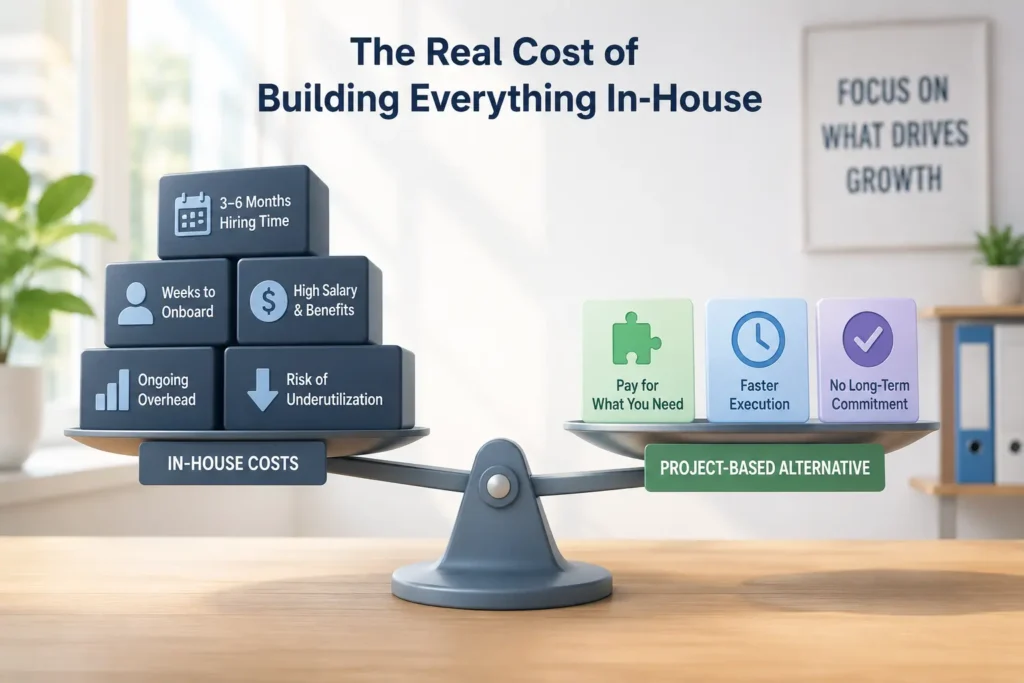
Onboarding takes additional weeks before someone is genuinely productive. And once the specific project that justified the hire is complete, the company either needs to find ongoing work to justify the headcount or faces the harder conversation of letting someone go.
This is a completely reasonable tradeoff for core, ongoing engineering needs, the product itself, the systems the company will maintain and build on for years. It’s a much worse tradeoff for a one-off migration project, a defined integration build, or a time-boxed feature that doesn’t require ongoing maintenance by the same person who built it.
Where Outsourcing Genuinely Wins
A few categories of work consistently make more sense handled by an experienced outside team than built internally from scratch:
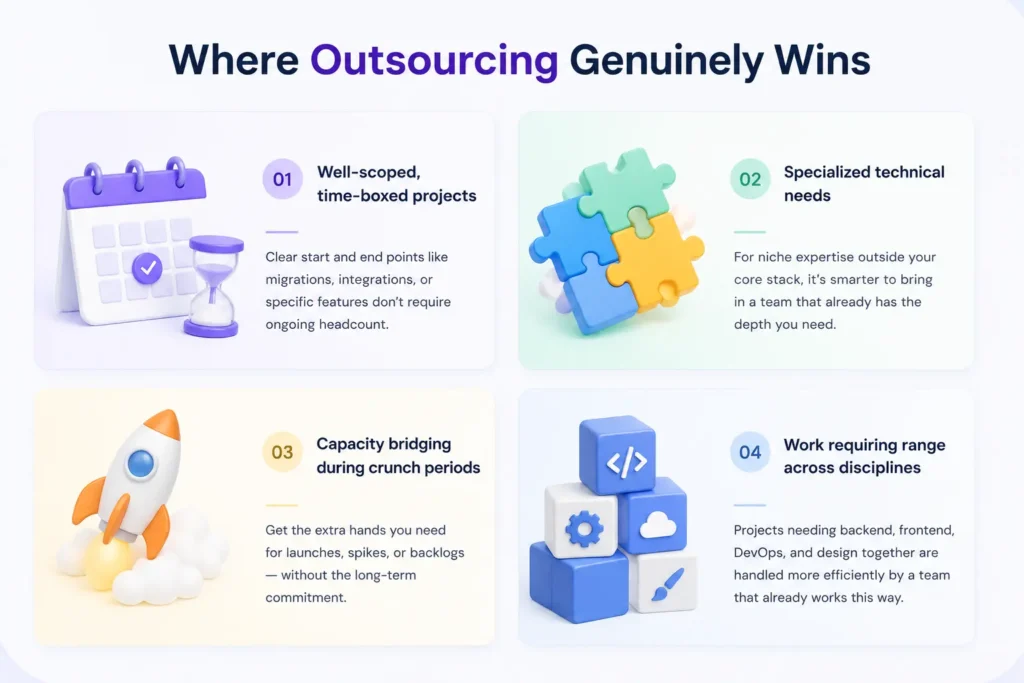
Well-scoped, time-boxed projects with a clear endpoint. A platform migration, a defined integration build, a specific feature with clear requirements, these have natural start and end points that don’t require the ongoing institutional presence a full-time hire implies.
Specialized technical needs outside the core team’s expertise. A product team deep in one stack might need a narrow piece of infrastructure work, a specific integration, or expertise in a technology outside their normal domain. Hiring full-time for a narrow, infrequent need rarely makes sense; bringing in a team that already has that specific depth usually does.
Capacity bridging during crunch periods. Product launches, seasonal demand spikes, or a backlog that’s grown faster than the internal team can reasonably absorb are all situations where temporary additional capacity solves the actual problem without the long-term commitment of new headcount.
Work requiring range across multiple disciplines simultaneously. Some projects genuinely need backend, frontend, DevOps, and design working in close coordination for a defined period. Assembling that full range internally for a single project is often far more expensive than working with a studio that already has that range built into its team structure.
Where In-House Is Almost Always Right
Just as clearly, some categories of work should stay in-house regardless of the short-term cost savings an external team might offer:
Core product engineering that defines competitive differentiation. The systems and features that actually make a product distinctive benefit enormously from deep, accumulated institutional context that’s hard to fully transfer to an outside team, even a very good one.
Anything requiring deep, ongoing understanding of proprietary business logic. Systems tightly coupled to internal processes, data models, and business rules that took years to develop internally are risky to hand to a team without that accumulated context, at least without a long ramp-up period that erodes the cost advantage.
Security-critical infrastructure with long-term ownership needs. Systems that will need continuous internal ownership, security patching, and institutional accountability over years are usually better served by a team that will still be around, and accountable, in three years.
The Framework Worth Applying
A few honest questions clarify which category a given piece of work actually falls into:
- Does this project have a natural endpoint, or is it genuinely ongoing? Ongoing, evolving work benefits from in-house continuity. Bounded, well-scoped work doesn’t need it.
- How much does this require deep institutional context to execute well? Work tightly coupled to proprietary systems and history favors in-house. Work that’s more self-contained doesn’t require that same depth of internal knowledge.
- What’s the actual cost of hiring, onboarding, and eventually managing headcount for work that doesn’t have ongoing demand? This is often understated in initial planning and tends to favor outsourcing more than intuition suggests.
- Does the team need range across multiple disciplines for a limited period, or deep specialization in one area long-term? Multi-discipline, time-boxed needs are often a stronger fit for an external studio built around exactly that range.
What Makes an Outsourcing Relationship Actually Work
Outsourcing done poorly, vague scoping, thin communication, minimal technical oversight, produces exactly the horror stories that make engineering leaders wary of it in the first place.
Outsourcing done well tends to share a few traits: clear, well-documented scope from the start, direct technical communication rather than layers of account management between the internal team and the people actually writing code, and a defined handoff process for anything the internal team will need to maintain going forward.
Studios that treat documentation and knowledge transfer as a core deliverable, not an afterthought, are the ones that make an external engagement feel like an extension of the team rather than a black box.
The Takeaway
The in-house-versus-outsourced decision isn’t a single company-wide policy, it’s a project-level judgment that depends on scope, timeline, and how deeply the work is coupled to institutional knowledge that’s expensive to transfer.
Companies that make this call deliberately, project by project, tend to get more engineering leverage out of both their internal team and their external partners than companies defaulting to one extreme or the other out of habit or discomfort with the alternative.