Picking the wrong ETL tool is an expensive mistake. You migrate your data sources, train your team, build your dashboards on top of it, and eighteen months later you’re doing it all over again because the tool couldn’t scale, didn’t support the connector you needed, or quietly became a cost problem.
This guide breaks down the 25 best ETL tools on the market in 2026, how they compare on the things that actually matter, and how to pick the right one for your team’s size, stack, and budget.
Whether you’re a startup wiring up your first Postgres-to-Snowflake pipeline or an enterprise replacing a legacy Informatica deployment, you’ll find a fit here.
What Are ETL Tools?
ETL tools are software platforms that extract data from source systems, transform it into a usable format, and load it into a destination such as a data warehouse or lake, automating a process that would otherwise require custom-coded scripts and manual maintenance.
What ETL Means
ETL stands for Extract, Transform, Load, the three-step process of moving data from where it’s created to where it’s analyzed.
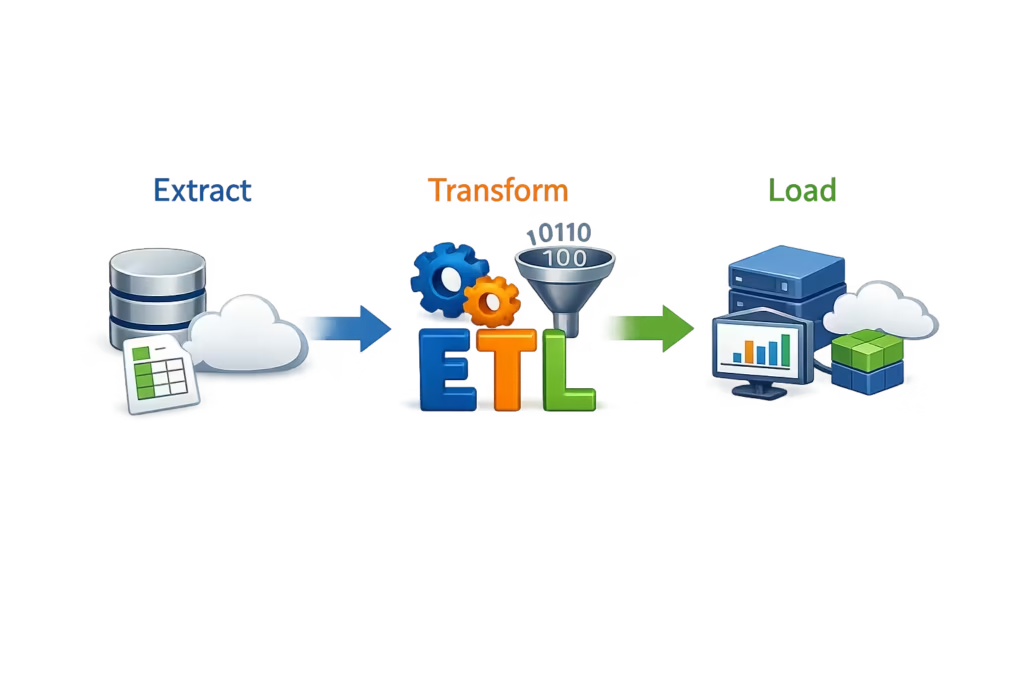
- Extract – pull raw data out of source systems: databases, SaaS apps, APIs, flat files.
- Transform – clean, reshape, deduplicate, and standardize that data so it’s usable.
- Load – write the finished data into a destination, typically a data warehouse or lake.
The term dates back to the 1970s data warehousing era, but the concept has only gotten more important as businesses run on dozens of disconnected SaaS tools that all need to feed a single source of truth.
How ETL Works
A typical ETL job runs on a schedule (hourly, daily) or is triggered by an event.
The tool connects to a source using a pre-built connector, pulls new or changed records, applies transformation logic (renaming fields, joining tables, filtering rows, enforcing types), and writes the result to the destination.
Modern platforms layer monitoring, alerting, and schema-drift handling on top so pipelines don’t silently break when a source API changes.
ETL vs ELT
The order of operations is the whole difference.
| ETL | ELT | |
|---|---|---|
| Transform happens | Before loading, in a staging engine | After loading, inside the warehouse |
| Best suited for | On-prem systems, structured data, strict governance | Cloud warehouses, large/raw data volumes |
| Compute used | Dedicated ETL engine | The warehouse itself (Snowflake, BigQuery, etc.) |
| Common pairing | Informatica, SSIS, DataStage | Fivetran + dbt, Airbyte + dbt |
ELT became dominant once cloud warehouses got cheap and powerful enough to handle transformation themselves — there’s no need to pre-process data in a separate engine when Snowflake or BigQuery can do it faster and closer to where the data lives.
ETL vs Data Pipeline vs Data Integration
These terms get used interchangeably, but they’re not identical.
- ETL/ELT is a specific process, extract, transform, load (or extract, load, transform).
- Data pipeline is a broader term for any automated flow of data between systems, which may or may not include transformation (e.g., a pure replication pipeline).
- Data integration is the broadest term – the overall discipline of connecting systems so data flows and stays consistent across an organization, of which ETL is one method.
Every ETL job is a data pipeline. Not every data pipeline is ETL.
Why ETL Tools Matter in Modern Data Architecture
Businesses today run on 50–200+ SaaS applications on average, and every one of them generates data that matters somewhere else. Without a way to consolidate that data, teams end up making decisions on incomplete or outdated information.
Common Business Use Cases
- Centralizing SaaS data – pulling Salesforce, HubSpot, Stripe, and Zendesk data into one warehouse for a unified customer view.
- Powering BI dashboards – feeding Looker, Tableau, or Power BI with fresh, modeled data.
- Data science and ML – supplying clean, structured training data to models.
- Regulatory reporting – consolidating financial or operational data for compliance.
- Reverse ETL – pushing warehouse insights back into operational tools like a CRM.
Benefits of ETL Automation
- Eliminates manual CSV exports and one-off scripts
- Reduces engineering time spent maintaining brittle custom pipelines
- Standardizes data quality and schema across the business
- Enables near-real-time reporting instead of end-of-month reconciliation
- Scales as data volume and source count grow
Challenges Without ETL Software
- Engineers spend hours per week firefighting broken custom scripts
- Source API changes silently break downstream reports
- Inconsistent data definitions across teams (“revenue” means something different in three different spreadsheets)
- No audit trail for where a number in a dashboard actually came from
- Onboarding a new data source takes weeks instead of hours
How We Evaluated the Best ETL Tools
We compared platforms across eight dimensions that consistently separate a good fit from a costly mistake.
Evaluation Criteria
Ease of Use
How much technical skill is required to build and maintain a working pipeline – no-code, low-code, or full-code.
Connectors
Breadth and depth of pre-built source and destination integrations, and how connectors behave when a source schema changes.
Scalability
Whether the platform holds up at high data volumes and growing source counts without cost or performance cliffs.
Performance
Sync speed, latency, and how close to real-time the platform can get.
Pricing
How the tool bills – per row, per connector, per compute credit, or flat-fee – and how predictable that cost is as usage grows.
Security
Encryption standards, compliance certifications (SOC 2, HIPAA, GDPR-readiness), and role-based access control.
Support
Documentation quality, community size, and availability of live support or dedicated engineers.
AI Features
Whether the platform uses AI for pipeline generation, anomaly detection, schema mapping, or natural-language pipeline building, an increasingly important differentiator in 2026.
Quick Comparison Table of the Best ETL Tools
| Tool | Best For | Deployment | Open Source | Connectors | Real-Time Support | Pricing Model | Free Trial |
|---|---|---|---|---|---|---|---|
| Fivetran | Enterprises wanting zero-maintenance ELT | Cloud | No | 700+ | Yes (CDC) | Consumption (MAR) | Yes |
| Airbyte | Teams wanting open-source flexibility | Cloud/self-hosted | Yes | 600+ | Yes | Free OSS / usage-based Cloud | Yes |
| Informatica | Large enterprises, complex governance | Cloud/hybrid/on-prem | No | 300+ | Yes | Consumption/subscription | Yes |
| Talend | Mid-market to enterprise, data quality focus | Cloud/hybrid | Partial (legacy OSS) | 900+ | Yes | Subscription | Yes |
| AWS Glue | AWS-native shops | Cloud (AWS) | No | AWS ecosystem + JDBC | Yes (streaming) | Pay-per-use compute | AWS free tier |
| Azure Data Factory | Microsoft/Azure shops | Cloud (Azure) | No | 100+ | Yes | Pay-per-pipeline-run | Azure free tier |
| Google Cloud Data Fusion | GCP-native teams | Cloud (GCP) | Built on open-source CDAP | 150+ | Yes | Pay-per-use + instance fee | GCP free tier |
| Matillion | Cloud warehouse-native transformation | Cloud | No | 150+ | Limited | Consumption credits | Yes |
| Hevo | Startups wanting fast no-code setup | Cloud | No | 150+ | Yes | Row/event-based tiers | Yes |
| Stitch | Simple, budget EL for small teams | Cloud | Built on Singer (OSS) | 140+ | No (batch only) | Row-based | Yes |
| Pentaho | On-prem/hybrid enterprise BI+ETL | On-prem/cloud/hybrid | Community edition | 100+ | Limited | Subscription | Community edition free |
| Apache NiFi | Real-time flow-based data routing | Self-hosted/cloud | Yes | Broad via processors | Yes | Free (infra cost only) | N/A |
| Oracle Data Integrator | Oracle-heavy enterprise stacks | On-prem/cloud | No | Oracle ecosystem + JDBC | Yes | License/subscription | Limited trial |
| SSIS | Microsoft SQL Server shops | On-prem/Azure | No | Broad via SQL Server | Limited | Included with SQL Server license | N/A |
| Meltano | Engineering-led open-source ELT | Self-hosted/cloud | Yes | Singer/Airbyte connectors | Limited | Free OSS / hosted tiers | Yes |
| Estuary | Real-time streaming CDC | Cloud/self-hosted | Partial OSS | 150+ | Yes (sub-second) | Usage-based | Yes |
| Nexla | Data-as-a-product, AI-assisted | Cloud | No | 200+ | Yes | Usage/subscription | Demo-based |
| Integrate.io | Operational ETL, flat-fee pricing | Cloud | No | 150+ | Yes (CDC) | Flat monthly fee | Yes |
| Skyvia | Small business no-code sync | Cloud | No | 190+ | Limited | Record-based tiers | Yes |
| Rivery | Mid-market ELT with orchestration | Cloud | No | 200+ | Yes | Consumption credits | Yes |
| Portable | Long-tail/niche connector needs | Cloud | No | 1,300+ (niche-focused) | Limited | Flat monthly fee | Yes |
| Singer | Custom, developer-built pipelines | Self-hosted | Yes | Community taps/targets | Depends on tap | Free (OSS spec) | N/A |
| Apache Hop | Visual, metadata-driven OSS ETL | Self-hosted | Yes | JDBC + plugins | Limited | Free (infra cost only) | N/A |
| IBM watsonx.data integration (formerly DataStage) | Large-scale enterprise/hybrid AI-ready pipelines | On-prem/cloud/hybrid | No | Hundreds via prebuilt connectors | Yes | Consumption/subscription | Trial available |
| Keboola | End-to-end data ops platform | Cloud | Partial | 250+ | Limited | Consumption credits | Yes |
The 25 Best ETL Tools
1. Fivetran
Overview: Fivetran is a fully managed ELT platform built around the idea that connectors should “just work” with zero maintenance. It’s a common default choice for teams that want to stop thinking about pipeline plumbing entirely.
Key Features: Automated schema drift handling, 700+ pre-built connectors, built-in CDC for databases, dbt-native transformation layer.
Pros:
- Extremely low maintenance overhead
- Broad, reliable connector library
- Strong governance and audit logging
Cons:
- Monthly Active Rows (MAR) pricing can spike unpredictably with high-change-rate sources
- Less flexible than open-source tools for custom/niche sources
Best For: Mid-market and enterprise teams that want to trade cost predictability for reliability.
Pricing: Consumption-based on Monthly Active Rows; free tier available for very low volume.
Supported Destinations: Snowflake, BigQuery, Redshift, Databricks, Azure Synapse, and more.
Supported Sources: Salesforce, Postgres, MySQL, Stripe, NetSuite, Workday, and hundreds more.
Our Verdict: The safest “set it and forget it” choice if budget allows — just model your MAR costs before committing.
2. Airbyte
Overview: Airbyte is the open-source alternative to Fivetran, offering a huge and fast-growing connector catalog you can self-host for free or run on Airbyte Cloud.
Key Features: Open-source core, connector development kit (CDK) for building custom connectors, CDC support, dbt integration.
Pros:
- No vendor lock-in; self-hostable
- Very large connector catalog, including long-tail sources
- Active open-source community
Cons:
- Self-hosting requires real DevOps investment
- Connector quality varies since many are community-maintained
Best For: Engineering teams that want control and are comfortable maintaining infrastructure.
Pricing: Free self-hosted; Airbyte Cloud is usage-based.
Supported Destinations: Snowflake, BigQuery, Redshift, Databricks, and dozens more.
Supported Sources: 600+, including many niche SaaS tools not covered by closed-source competitors.
Our Verdict: The best open-source option in 2026 for teams willing to own some operational complexity in exchange for flexibility and cost control.
3. Informatica
Overview: Informatica is a long-standing enterprise data management suite covering ETL, master data management, and data governance in one ecosystem.
Key Features: Enterprise-grade governance, metadata management, AI-assisted mapping (CLAIRE engine), hybrid deployment.
Pros:
- Deep governance and lineage capabilities
- Handles very large, complex enterprise environments
- Broad connector ecosystem across legacy and modern systems
Cons:
- Steep learning curve
- Pricing and licensing complexity require dedicated admin resources
Best For: Large enterprises with strict governance, compliance, and multi-system requirements.
Pricing: Consumption/subscription, typically negotiated per enterprise contract.
Supported Destinations: Nearly all major warehouses, lakes, and on-prem databases.
Supported Sources: 300+, including legacy mainframe and ERP systems.
Our Verdict: Overkill for small teams, but hard to beat for large enterprises with complex governance needs.
4. Talend
Overview: Talend (now under Qlik, following Qlik’s 2023 acquisition) combines ETL with strong data quality and cataloging tools, historically popular for its open-source roots.
Key Features: Data quality profiling, metadata-driven design, broad connector set, data cataloging.
Pros:
- Strong data quality and cleansing capabilities
- Mature, well-documented platform
- Good fit for hybrid on-prem/cloud environments
Cons:
- Open-source edition has been phased down since the Qlik acquisition
- UI feels dated next to newer cloud-native competitors
Best For: Mid-market to enterprise teams prioritizing data quality alongside movement.
Pricing: Subscription-based, tiered by usage and modules.
Supported Destinations: All major cloud warehouses plus on-prem targets.
Supported Sources: 900+ connectors across databases, files, and SaaS apps.
Our Verdict: A solid choice if data quality tooling matters as much as data movement — just confirm current roadmap commitments given the ownership changes.
5. AWS Glue
Overview: AWS Glue is Amazon’s serverless ETL service, tightly integrated with the rest of the AWS ecosystem (S3, Redshift, Athena, Lake Formation).
Key Features: Serverless Spark-based ETL, visual job authoring, built-in data catalog, event-driven triggers.
Pros:
- No infrastructure to manage
- Deep native integration with AWS services
- Scales automatically with workload
Cons:
- Steep learning curve outside the AWS ecosystem
- Cost can be unpredictable under variable workloads
Best For: Teams already committed to AWS as their primary cloud.
Pricing: Pay-per-use, billed by compute time (DPU-hours).
Supported Destinations: S3, Redshift, RDS, and any JDBC-compatible target.
Supported Sources: AWS-native services plus JDBC/ODBC sources.
Our Verdict: The natural choice for AWS-first organizations; less compelling if you’re multi-cloud.
6. Azure Data Factory
Overview: Microsoft’s cloud ETL/orchestration service, deeply integrated with Azure Synapse, Azure SQL, and the broader Microsoft data stack.
Key Features: Visual pipeline designer, mapping data flows, hybrid data gateway for on-prem sources, built-in orchestration.
Pros:
- Excellent for Microsoft-centric organizations
- Strong hybrid connectivity via self-hosted integration runtime
- Good orchestration and scheduling capabilities
Cons:
- Less intuitive for teams outside the Microsoft ecosystem
- Debugging complex data flows can be slow
Best For: Enterprises standardized on Azure and Microsoft SQL Server.
Pricing: Pay-per-pipeline-run and per data flow execution.
Supported Destinations: Azure Synapse, Azure SQL, and external warehouses via connectors.
Supported Sources: 100+, strong on Microsoft and on-prem systems.
Our Verdict: A natural fit if your stack is already Microsoft-heavy; less compelling otherwise.
7. Google Cloud Data Fusion
Overview: Google’s fully managed data integration service, built on the open-source CDAP framework, designed for visual pipeline building on GCP.
Key Features: Visual drag-and-drop pipeline builder, wrangler for data prep, native BigQuery integration.
Pros:
- Strong fit for GCP-native teams
- Visual interface lowers the barrier for non-engineers
- Built on an open-source foundation (CDAP)
Cons:
- Instance-based pricing adds a fixed cost floor even for light usage
- Smaller connector catalog than Fivetran or Airbyte
Best For: Teams standardized on Google Cloud and BigQuery.
Pricing: Pay-per-use plus a per-instance base fee.
Supported Destinations: BigQuery, Cloud SQL, Cloud Storage.
Supported Sources: 150+, GCP-centric with common SaaS connectors.
Our Verdict: Makes the most sense as part of a broader GCP commitment rather than as a standalone pick.
8. Matillion
Overview: Matillion focuses on transformation inside cloud data warehouses, pairing push-down ELT with a visual, warehouse-native design.
Key Features: Push-down ELT execution, visual transformation canvas, native Snowflake/BigQuery/Databricks integration.
Pros:
- Transformation logic runs directly in the warehouse for speed
- Intuitive visual builder for complex transformations
- Strong Snowflake partnership and optimization
Cons:
- Weaker for operational/reverse ETL use cases
- Real-time/CDC support is more limited than dedicated streaming tools
Best For: Teams whose main need is warehouse-native transformation, not just movement.
Pricing: Consumption-based credits.
Supported Destinations: Snowflake, BigQuery, Databricks, Redshift, Azure Synapse.
Supported Sources: 150+ common databases and SaaS apps.
Our Verdict: A strong transformation-first tool for teams already committed to a modern cloud warehouse.
9. Hevo
Overview: Hevo is a no-code ELT platform aimed at getting startups and lean data teams to a working pipeline in minutes.
Key Features: No-code setup, built-in light transformations, automated schema mapping, real-time sync.
Pros:
- Fast time-to-value with minimal engineering involvement
- Includes transformation, unlike pure EL tools
- Transparent, predictable pricing tiers
Cons:
- Smaller connector catalog than the largest platforms
- Less depth for highly complex enterprise transformations
Best For: Startups and small data teams that want ELT plus light transformation without hiring a data engineer first.
Pricing: Tiered by events/rows processed monthly.
Supported Destinations: Snowflake, BigQuery, Redshift, and common warehouses.
Supported Sources: 150+ databases and SaaS apps.
Our Verdict: One of the best starting points for small teams that need more than pure replication but aren’t ready for enterprise tooling.
10. Stitch
Overview: Stitch is a simple, developer-friendly EL (extract-and-load) tool built on the open-source Singer framework. It was acquired by Talend in 2018, which was in turn acquired by Qlik in 2023.
Key Features: Singer-based connector architecture, straightforward setup, row-based replication.
Pros:
- Simple, fast setup for common sources
- Predictable, budget-friendly entry pricing for small volumes
- Built on the open Singer standard, so custom taps are possible
Cons:
- No built-in transformation — you’ll need dbt or manual SQL downstream
- No CDC or true real-time sync (batch-only)
- Connector and feature development has visibly slowed since the Talend-to-Qlik ownership changes, and Qlik is steering new customers toward its broader Talend Cloud platform
Best For: Small teams with stable, common sources (Postgres, MySQL, Salesforce, Stripe) who want a low-frills, low-cost EL layer paired with dbt.
Pricing: Row-based, with entry tiers aimed at small data volumes.
Supported Destinations: Snowflake, BigQuery, Redshift, Databricks, Postgres.
Supported Sources: 140+ via Singer taps.
Our Verdict: Fine for a low-risk, low-volume pipeline today, but evaluate the ownership and roadmap situation carefully before betting a long-term strategy on it, as of 2026 it’s best treated as a stable-but-slow-moving option rather than a growth platform.
11. Pentaho
Overview: Pentaho (owned by Hitachi Vantara) is a long-running ETL and BI suite popular in on-prem and hybrid enterprise environments.
Key Features: Visual job/transformation designer, embedded BI and reporting, community and enterprise editions.
Pros:
- Mature, battle-tested platform with a long enterprise track record
- Strong on-prem and hybrid deployment support
- Community edition available at no cost
Cons:
- Interface feels dated compared to modern cloud-native tools
- Real-time and CDC support is limited relative to newer platforms
Best For: Enterprises with existing on-prem infrastructure and hybrid BI/ETL needs.
Pricing: Subscription for enterprise edition; free community edition.
Supported Destinations: Broad — cloud warehouses plus traditional on-prem databases.
Supported Sources: 100+, strong on relational databases.
Our Verdict: A reasonable legacy-friendly option, though most greenfield projects in 2026 will lean toward cloud-native alternatives.
12. Apache NiFi
Overview: Apache NiFi is an open-source, flow-based data routing and transformation engine built for real-time, high-throughput data movement.
Key Features: Visual flow-based programming, built-in back-pressure and data provenance tracking, extensible processor library.
Pros:
- Excellent for real-time, high-volume streaming use cases
- Fully open-source with no licensing cost
- Strong data lineage and provenance tracking out of the box
Cons:
- Requires real infrastructure and operational expertise to run at scale
- Not as approachable for non-engineers as no-code tools
Best For: Engineering-heavy teams building real-time streaming or IoT data flows.
Pricing: Free (self-hosted infrastructure cost only).
Supported Destinations: Broad, via processors — databases, message queues, cloud storage.
Supported Sources: Broad, via a large processor ecosystem.
Our Verdict: A powerful, free option for real-time flows, but plan for the operational overhead of self-hosting.
13. Oracle Data Integrator (ODI)
Overview: Oracle Data Integrator is a high-performance ELT tool designed to work tightly with Oracle databases and Oracle Cloud infrastructure.
Key Features: E-LT (execute transformations inside the target database) architecture, Oracle-native optimization, knowledge modules for reusable logic.
Pros:
- High performance when paired with Oracle databases
- Mature governance and security features
- Reusable “knowledge module” transformation templates
Cons:
- Best value is realized only inside an Oracle-heavy stack
- Licensing costs and complexity can be significant
Best For: Enterprises with an existing Oracle database and applications footprint.
Pricing: License or subscription, typically enterprise-negotiated.
Supported Destinations: Oracle Database, Oracle Cloud, plus JDBC-compatible targets.
Supported Sources: Broad via JDBC, strongest with Oracle systems.
Our Verdict: The default choice if you’re already deep in the Oracle ecosystem; less compelling elsewhere.
14. SSIS (SQL Server Integration Services)
Overview: SSIS is Microsoft’s on-prem ETL toolkit bundled with SQL Server, widely used in organizations that have run Microsoft data infrastructure for years.
Key Features: Visual package designer, tight SQL Server integration, control flow and data flow tasks.
Pros:
- Included with SQL Server licensing — no extra cost for many shops
- Familiar to a large existing pool of Microsoft-trained engineers
- Reliable for structured, on-prem batch ETL
Cons:
- Not cloud-native; real-time and modern SaaS connectivity are weak
- Aging tooling compared to modern ELT platforms
Best For: Organizations with existing SQL Server infrastructure and mostly on-prem, batch-oriented needs.
Pricing: Included with SQL Server license.
Supported Destinations: SQL Server and other databases via connectors.
Supported Sources: Broad relational database support.
Our Verdict: Still functional for legacy SQL Server shops, but a poor long-term bet for cloud-first or SaaS-heavy data strategies.
15. Meltano
Overview: Meltano is an open-source, code-first ELT framework built around the Singer specification, aimed at data teams that want DataOps-style version control over their pipelines.
Key Features: CLI-driven workflow, Singer/Airbyte connector compatibility, built-in orchestration and version control friendliness.
Pros:
- Full open-source flexibility and no vendor lock-in
- Fits naturally into CI/CD and version-controlled data workflows
- Free to self-host
Cons:
- Requires solid engineering skill to run well
- Smaller community and less polish than Airbyte
Best For: Engineering-led teams who want pipelines defined as code, integrated with existing DevOps practices.
Pricing: Free (open source); hosted options available.
Supported Destinations: Snowflake, BigQuery, Postgres, and more via Singer targets.
Supported Sources: Singer and Airbyte-compatible connector catalog.
Our Verdict: A strong pick for DataOps-minded teams that treat pipelines as software.
16. Estuary
Overview: Estuary Flow is a real-time data integration platform built specifically around sub-second change data capture and streaming use cases.
Key Features: Real-time CDC, exactly-once processing guarantees, unified batch-and-streaming model.
Pros:
- True low-latency, near-real-time sync
- Strong CDC support across popular databases
- Handles both batch and streaming from one platform
Cons:
- Smaller connector catalog than the largest ELT platforms
- Newer platform with a smaller community track record
Best For: Teams whose core requirement is real-time or near-real-time data movement.
Pricing: Usage-based.
Supported Destinations: Snowflake, BigQuery, Postgres, Kafka-compatible systems.
Supported Sources: 150+, with strong database CDC support.
Our Verdict: One of the strongest choices in 2026 specifically for latency-sensitive use cases.
17. Nexla
Overview: Nexla positions itself around “data products” — pre-packaged, reusable data sets — layered with AI-assisted automation for building and monitoring pipelines.
Key Features: Data product abstraction layer, AI-assisted schema detection, monitoring and alerting.
Pros:
- Reusable data product model reduces duplicate pipeline work
- Strong automation and AI-assisted mapping
- Good fit for data-as-a-service internal models
Cons:
- Less well-known, smaller community than major competitors
- Pricing typically requires a sales conversation rather than transparent self-serve tiers
Best For: Organizations standardizing on a “data products” operating model internally.
Pricing: Usage/subscription, generally quote-based.
Supported Destinations: Major cloud warehouses and lakes.
Supported Sources: 200+.
Our Verdict: Worth a look for data platform teams building internal data marketplaces, less so for simple point-to-point needs.
18. Integrate.io
Overview: Integrate.io is an operational ETL platform combining ETL, reverse ETL, and CDC under one flat-fee pricing model, aimed at teams frustrated by unpredictable row-based billing elsewhere.
Key Features: 200+ drag-and-drop transformations, built-in reverse ETL, CDC support, flat-fee all-inclusive pricing.
Pros:
- Predictable flat monthly pricing regardless of volume spikes
- Combines ETL, reverse ETL, and CDC without needing separate tools
- Includes dedicated support in most plans
Cons:
- Smaller connector catalog than Fivetran or Airbyte
- Higher entry price point than lightweight tools like Stitch or Hevo
Best For: Teams that have outgrown EL-only tools and want operational ETL plus reverse ETL in one predictable-cost platform.
Pricing: Flat monthly fee covering ETL, CDC, and reverse ETL.
Supported Destinations: Major cloud warehouses.
Supported Sources: 150+.
Our Verdict: A strong upgrade path for teams that have hit the limits of simple EL tools and want cost predictability.
19. Skyvia
Overview: Skyvia is a no-code cloud data platform aimed at small businesses needing simple integration, backup, and sync between common business apps.
Key Features: No-code workflow builder, data backup, bi-directional sync, SQL-based data access.
Pros:
- Very approachable for non-technical users
- Combines integration, backup, and querying in one tool
- Reasonable pricing for small data volumes
Cons:
- Not designed for high-volume or complex enterprise pipelines
- Limited real-time capabilities
Best For: Small businesses needing simple, no-code sync between common SaaS tools.
Pricing: Record-based tiers.
Supported Destinations: Common cloud warehouses and databases.
Supported Sources: 190+, strong on popular small-business SaaS apps.
Our Verdict: A good fit for lean teams with modest data volumes and no dedicated data engineer.
20. Rivery
Overview: Rivery is a cloud-native ELT platform that bundles data ingestion, transformation, and orchestration together with a credit-based pricing model.
Key Features: Built-in orchestration (“Rivers”), reverse ETL, pre-built transformation logic blocks.
Pros:
- Combines ingestion, transformation, and orchestration in one platform
- Good balance of ease-of-use and technical flexibility
- Includes reverse ETL natively
Cons:
- Credit-based pricing takes time to model accurately
- Mid-sized connector catalog compared to the largest players
Best For: Mid-market teams wanting an all-in-one ELT-plus-orchestration platform.
Pricing: Consumption-based credits.
Supported Destinations: Snowflake, BigQuery, Redshift, Databricks.
Supported Sources: 200+.
Our Verdict: A solid all-in-one option for mid-market teams that don’t want to stitch together separate orchestration tooling.
21. Portable
Overview: Portable specializes in long-tail, niche connectors that larger platforms don’t prioritize, building custom connectors on request at flat pricing.
Key Features: 1,300+ niche connectors, custom connector builds on demand, flat monthly pricing.
Pros:
- Unmatched coverage for obscure or industry-specific data sources
- Predictable flat-fee pricing regardless of volume
- Will build a missing connector for you
Cons:
- Not built for high-throughput, high-scale enterprise pipelines
- Fewer advanced transformation capabilities than full ELT suites
Best For: Teams needing one or two niche source connectors that mainstream tools don’t support.
Pricing: Flat monthly fee.
Supported Destinations: Common cloud warehouses.
Supported Sources: 1,300+, focused on long-tail and industry-specific tools.
Our Verdict: Not a general-purpose ETL replacement, but invaluable when you need that one obscure connector nobody else has.
22. Singer
Overview: Singer is an open-source specification (not a company) that defines a simple JSON-based protocol for building interoperable “taps” (extractors) and “targets” (loaders). It underpins Stitch, Meltano, and parts of Airbyte’s ecosystem.
Key Features: Open JSON-based protocol, large community-built tap/target library, language-agnostic design.
Pros:
- Completely free and vendor-neutral
- Huge community-maintained connector ecosystem
- Composable — mix and match taps and targets
Cons:
- No built-in orchestration, monitoring, or UI — you build that yourself
- Connector quality varies widely since it’s community-maintained
Best For: Engineering teams building fully custom pipelines from open components.
Pricing: Free (open specification).
Supported Destinations: Whatever targets exist in the community catalog.
Supported Sources: Whatever taps exist in the community catalog.
Our Verdict: Less a “tool” than a foundation — best used through a wrapper like Meltano unless you want to build all the orchestration yourself.
23. Apache Hop
Overview: Apache Hop is an open-source, metadata-driven ETL platform that evolved from the Kettle/Pentaho Data Integration codebase, offering a modern visual designer.
Key Features: Visual pipeline and workflow designer, metadata-driven architecture, plugin extensibility.
Pros:
- Fully open-source with an active Apache community
- Visual design approachable for non-programmers
- Flexible plugin architecture
Cons:
- Smaller ecosystem and connector library than commercial competitors
- Requires self-hosting and operational maintenance
Best For: Budget-conscious teams wanting a visual, open-source ETL designer.
Pricing: Free (self-hosted infrastructure cost only).
Supported Destinations: Broad via JDBC and plugins.
Supported Sources: Broad via JDBC and plugins.
Our Verdict: A capable, cost-free option for teams with the engineering capacity to self-host.
24. IBM watsonx.data integration (formerly IBM DataStage)
Overview: IBM’s flagship enterprise integration engine, historically known as DataStage, has been rebranded and modernized as watsonx.data integration, combining ETL/ELT with AI-assisted pipeline building and data observability.
Key Features: Parallel processing engine, no-code/low-code/pro-code authoring, AI assistant for natural-language pipeline building, built-in observability and governance.
Pros:
- Proven, high-performance engine for very large-scale enterprise workloads
- Flexible deployment across on-prem, hybrid, and multicloud
- Strong governance and lineage integration with IBM’s broader data platform
Cons:
- Complex licensing and pricing, typically requiring a sales conversation
- Steep learning curve for smaller teams without dedicated IBM expertise
Best For: Large enterprises with complex, hybrid, or highly regulated data environments already invested in the IBM ecosystem.
Pricing: Consumption-based or self-managed licensing, typically enterprise-negotiated.
Supported Destinations: Broad enterprise warehouse, lake, and lakehouse support.
Supported Sources: Hundreds of prebuilt connectors, including legacy mainframe systems.
Our Verdict: A powerful, modernized option for enterprises that need serious scale and governance — evaluate under its current watsonx.data integration branding rather than the legacy DataStage name.
25. Keboola
Overview: Keboola is an end-to-end data operations platform bundling ingestion, transformation, orchestration, and even ML deployment into a single environment.
Key Features: Modular “component” architecture, built-in orchestration, version control for pipelines, transformation in SQL/Python/R.
Pros:
- Covers the full data lifecycle in one platform, reducing tool sprawl
- Strong for teams wanting DataOps practices without heavy custom engineering
- Flexible transformation language support
Cons:
- Learning curve for teams unfamiliar with its component-based model
- Credit-based pricing requires careful usage modeling
Best For: Data teams wanting one consolidated platform for ingestion, transformation, and orchestration.
Pricing: Consumption-based credits.
Supported Destinations: Snowflake, BigQuery, Redshift, and more.
Supported Sources: 250+.
Our Verdict: A strong consolidation play for teams tired of stitching together five separate tools for one pipeline.
Best ETL Tools by Use Case
Best for Startups
Hevo or Airbyte — fast setup, low starting cost, and enough connector coverage to get moving without a dedicated data engineer on day one.
Best for Small Businesses
Skyvia — no-code simplicity built for teams without in-house technical staff.
Best for Enterprises
Informatica or IBM watsonx.data integration — depth of governance, scale, and hybrid deployment options large organizations need.
Best Open-Source ETL Tool
Airbyte — the broadest connector catalog among self-hostable, community-driven platforms.
Best No-Code ETL Tool
Hevo — the fastest path from zero to a working, no-code pipeline.
Best Cloud-Native ETL Tool
Fivetran — purpose-built for modern cloud warehouses with minimal operational overhead.
Best Real-Time ETL Tool
Estuary — sub-second CDC built into the platform’s core architecture, not bolted on.
Best AI-Powered ETL Tool
IBM watsonx.data integration — natural-language pipeline building and AI-driven observability baked into the platform.
Best ETL Tool for Snowflake
Matillion — push-down ELT execution optimized specifically for Snowflake’s compute model.
Best ETL Tool for Databricks
Fivetran or Airbyte — both have mature, well-supported Databricks destination connectors.
Best ETL Tool for BigQuery
Google Cloud Data Fusion – native, first-party integration for teams already on GCP.
Best ETL Tool for Redshift
Matillion or Integrate.io – strong push-down transformation support tailored to Redshift.
ETL Tool Comparison by Feature
| Tool | CDC | Reverse ETL | AI Features | Data Quality | Governance |
|---|---|---|---|---|---|
| Fivetran | Yes | Limited | Moderate | Basic | Strong |
| Airbyte | Yes | No | Moderate | Basic | Basic |
| Informatica | Yes | No | Strong | Strong | Strong |
| Talend | Yes | No | Moderate | Strong | Strong |
| Integrate.io | Yes | Yes | Basic | Moderate | Moderate |
| Estuary | Yes (sub-second) | No | Basic | Basic | Basic |
| IBM watsonx.data integration | Yes | No | Strong | Strong | Strong |
| Rivery | Yes | Yes | Moderate | Moderate | Moderate |
| Stitch | No | No | None | None | Basic |
Open Source vs Commercial ETL Tools
Open-source tools like Airbyte, Meltano, Apache NiFi, and Apache Hop cost nothing in licensing but require real engineering investment to deploy, monitor, and maintain. Commercial tools like Fivetran, Informatica, and Integrate.io cost money but hand off that operational burden to the vendor.
Choose open source when:
- You have engineering capacity to self-host and maintain infrastructure
- Vendor lock-in is a strategic concern
- Your source needs are niche enough that community connectors matter
Choose commercial when:
- Your team’s time is better spent on analysis than pipeline maintenance
- You need guaranteed uptime, support SLAs, and compliance certifications
- Predictable vendor accountability matters more than cost savings
Neither option is inherently better — it’s a build-versus-buy tradeoff that depends on your team’s engineering capacity and risk tolerance.
Python vs ETL Tools
Some teams ask whether they even need an ETL platform, given that Python (with libraries like pandas, SQLAlchemy, and Airflow) can build custom pipelines from scratch.
Python-based custom pipelines make sense when:
- Your transformation logic is highly specific and doesn’t map to standard connectors
- You have strong engineering resources and want full control
- You’re processing data at a scale or in a shape no off-the-shelf tool handles well
ETL tools make sense when:
- You need dozens of standard SaaS/database connectors without building each one
- Time-to-value matters more than full customization
- You want monitoring, alerting, and schema-drift handling out of the box instead of building it yourself
In practice, most mature data teams use both: an ETL/ELT platform for the 80% of standard connections, and custom Python (often orchestrated with Airflow or Dagster) for the specialized 20%.
How to Choose the Right ETL Tool
Questions to Ask
- What sources and destinations do we need to connect today – and in 18 months?
- Do we need real-time/CDC, or is daily batch sync enough?
- Who will build and maintain pipelines – engineers, analysts, or both?
- What’s our tolerance for usage-based pricing volatility versus a flat fee?
- What compliance certifications (SOC 2, HIPAA, GDPR) do we require?
- Do we need reverse ETL, or just one-way ingestion?
Decision Checklist
- [ ] Confirm the tool supports every source and destination you need today
- [ ] Model pricing against your actual (not estimated) data volume and change rate
- [ ] Check SOC 2 / compliance certifications against your industry’s requirements
- [ ] Test the free trial with a real, messy source not a demo dataset
- [ ] Confirm support responsiveness before, not after, signing a contract
- [ ] Evaluate the vendor’s roadmap and financial stability, not just current features
Decision Matrix
| If you need… | Consider |
|---|---|
| Zero-maintenance, broad connectors | Fivetran |
| Open-source control | Airbyte or Meltano |
| Flat, predictable pricing | Integrate.io or Portable |
| Enterprise governance at scale | Informatica or IBM watsonx.data integration |
| Sub-second real-time sync | Estuary |
| No-code simplicity | Hevo or Skyvia |
Common ETL Mistakes to Avoid
- Choosing on price alone without modeling actual data volume and change rate against the pricing structure
- Skipping a real-world trial and relying only on vendor demos with clean sample data
- Ignoring schema drift – not planning for what happens when a source changes its structure
- Underestimating governance needs until a compliance audit forces a rushed migration
- Building everything custom when an off-the-shelf connector would save months of engineering time
- Treating ETL as “set and forget” – pipelines still need monitoring, testing, and ownership
Modern ETL Architecture
Traditional ETL
Transformation happens in a dedicated engine before data ever reaches the warehouse – common in on-prem systems like SSIS and legacy Informatica deployments.
Modern ELT
Raw data lands in the warehouse first, and transformation happens inside it using SQL or tools like dbt — the dominant pattern for cloud-native stacks in 2026.
Lakehouse Architecture
Combines the flexibility of a data lake (cheap, raw storage for structured and unstructured data) with the performance and governance of a warehouse – platforms like Databricks and IBM watsonx.data lead this space.
Streaming ETL
Processes data continuously as events occur rather than on a batch schedule, using tools like Apache NiFi or Estuary – essential for use cases like fraud detection or live operational dashboards.
Reverse ETL
Takes clean, modeled data from the warehouse and pushes it back into operational tools (CRM, marketing platforms) so business teams work with the same trusted numbers as analytics – supported natively by Rivery, Integrate.io, and others.
ETL Best Practices
Data Validation
Build automated checks for row counts, null rates, and value ranges at every pipeline stage – catching bad data before it reaches a dashboard is far cheaper than fixing it after.
Monitoring
Set up alerting for failed syncs, schema changes, and unusual latency so issues surface within minutes, not when someone notices a broken report.
Schema Management
Version-control schema changes and test them in staging before they hit production pipelines, especially for sources prone to frequent API changes.
Data Security
Encrypt data in transit and at rest, apply role-based access control, and avoid granting broader source permissions than a pipeline actually needs.
Performance Optimization
Use incremental syncs instead of full reloads wherever possible, and push transformation compute down into the warehouse rather than a slower intermediate engine.
Future Trends in ETL Tools
AI-Assisted Data Pipelines
Natural-language pipeline building – describing what you want in plain English and having the platform generate the pipeline — is moving from novelty to standard feature, as seen in IBM’s watsonx.data integration and Nexla.
Data Observability
Platforms increasingly bundle anomaly detection and lineage tracking directly into the pipeline layer instead of requiring a separate observability tool.
Metadata Automation
Automatic schema detection, classification, and documentation are reducing the manual cataloging work data teams used to do by hand.
Serverless ETL
More platforms are moving to fully serverless execution models (like AWS Glue and Google Cloud Data Fusion) so teams stop managing underlying compute entirely.
Real-Time Data Integration
The gap between batch and streaming is closing – expect more “batch and streaming from one platform” architectures like Estuary’s, rather than maintaining two separate systems.
Frequently Asked Questions
What is the difference between ETL and ELT? ETL transforms data before loading it into the destination, while ELT loads raw data first and transforms it inside the destination – typically a cloud warehouse. ELT has become the more common pattern since cloud warehouses can handle transformation compute efficiently.
Is Airbyte really free? The self-hosted, open-source version of Airbyte is free to use, though you’ll pay for the infrastructure it runs on and the engineering time to maintain it. Airbyte Cloud, the managed version, is usage-based.
What is CDC in ETL tools? Change Data Capture (CDC) is a method of detecting and syncing only the rows that changed in a source system, rather than re-processing the entire dataset – it’s essential for near-real-time pipelines.
What is reverse ETL? Reverse ETL pushes clean, modeled data from a warehouse back into operational tools like a CRM or marketing platform, so business teams work from the same numbers as the analytics team.
Do I need an ETL tool if I already use Python? Not necessarily for every source – but most teams use an ETL tool for standard connectors and reserve custom Python for highly specific transformation logic a tool can’t handle out of the box.
What is the best free ETL tool? Airbyte (self-hosted), Apache NiFi, Apache Hop, and Meltano are all genuinely free, open-source options, though each requires engineering effort to deploy and maintain.
How much do ETL tools typically cost? Pricing varies widely – from free open-source options, to entry-level cloud tools starting around $100–$300/month, up to enterprise contracts in the tens of thousands of dollars annually, depending on data volume and features.
What is Fivetran’s Monthly Active Rows pricing? Fivetran bills based on the number of unique rows that changed and were synced in a given month (MAR), rather than total data volume – meaning high-change-rate sources can cost more than static ones.
Is Stitch still a good choice in 2026? Stitch remains operational under Qlik and works well for simple, stable sources at low volume, but its development pace has slowed since the Talend and Qlik acquisitions, so it’s worth confirming the current roadmap before a long-term commitment.
What replaced IBM DataStage? IBM DataStage’s capabilities now live inside watsonx.data integration, which adds AI-assisted, natural-language pipeline building and expanded observability on top of the original DataStage engine.
What is the Singer specification? Singer is an open, JSON-based protocol for building interoperable data extractors (“taps”) and loaders (“targets”). It underpins tools like Stitch and Meltano.
Which ETL tool is best for a small startup? Hevo and Airbyte are both strong starting points – fast setup, reasonable entry pricing, and enough connector coverage to support early-stage growth.
What’s the difference between a data pipeline and an ETL tool? A data pipeline is any automated flow of data between systems; ETL is one specific method (extract, transform, load) for building that pipeline. Not all data pipelines involve transformation.
Can ETL tools handle unstructured data? Some modern platforms, particularly enterprise ones like IBM watsonx.data integration, are adding support for unstructured data (documents, text) alongside traditional structured sources, though most ETL tools remain strongest with structured data.
What is a data lakehouse, and does it change how I should think about ETL? A lakehouse combines data lake storage flexibility with data warehouse-style performance and governance. It doesn’t eliminate the need for ETL/ELT — it changes where transformed data ultimately lands.
How do I estimate ETL tool costs before signing a contract? Model your actual monthly data volume, row change rate, and connector count against each vendor’s specific pricing formula – a free trial run against real (not sample) data is the most reliable way to validate estimates.
What security certifications should I look for in an ETL tool? At minimum, look for SOC 2 Type II compliance; depending on your industry, you may also need HIPAA compliance, GDPR-readiness, or specific data residency guarantees.
Is real-time ETL necessary for most businesses? No – most reporting and analytics use cases are well served by hourly or daily batch syncs. Real-time/CDC is worth the added complexity mainly for operational, fraud-detection, or live-dashboard use cases.
Final Recommendations
There’s no single “best” ETL tool, only the best fit for your team’s size, technical capacity, and budget. If you want zero-maintenance reliability and can absorb consumption-based pricing, Fivetran remains a strong default.
If control and cost predictability matter more, Airbyte or a Singer-based stack gives you that without vendor lock-in.
Enterprises with complex governance needs are still best served by Informatica or IBM’s watsonx.data integration, while startups and lean teams will move faster with no-code options like Hevo or Skyvia.
The right move is to shortlist two or three candidates that fit your actual source list and volume, run a real trial against messy production data, not a clean demo, and model pricing against your genuine growth trajectory before signing anything.
Get that decision right, and your ETL tool becomes invisible infrastructure that just works. Get it wrong, and you’ll be reading a guide like this one again in a year.