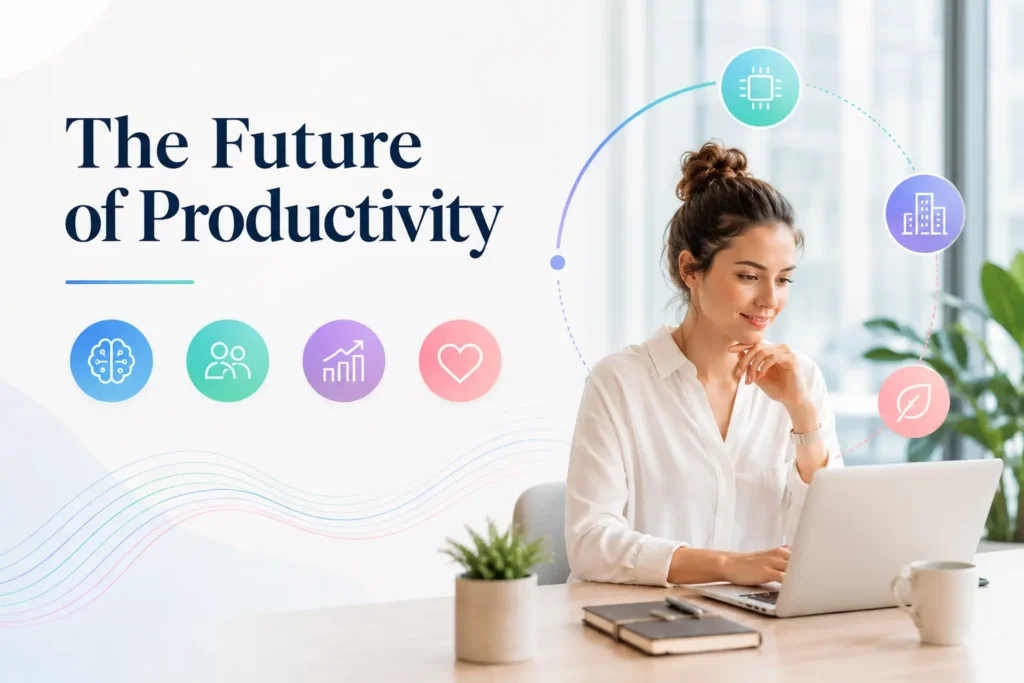
The New Frontier of Productivity
Walk into almost any leadership meeting right now and you’ll hear the same question: how do we get more done without burning people out? That question sits at the center of the biggest productivity trends 2026 is bringing to workplaces everywhere.
This isn’t the old productivity conversation about squeezing more hours out of the day. It’s a deeper shift in how work gets designed, who, or what, does it, and how organizations measure whether it’s actually working.
AI agents are taking on real tasks. Leaders are rethinking what “performance” even means. And employees are pushing back on burnout culture in ways that are reshaping company strategy.
This guide breaks down the 15 biggest productivity trends of 2026, the forces driving them, and what leaders in HR, operations, finance, and the C-suite need to do to keep up.
Why Productivity Is Being Redefined in 2026
What are productivity trends in 2026? Productivity trends in 2026 describe the shift from measuring hours worked to measuring outcomes delivered, powered by agentic AI, hybrid work maturity, and a growing focus on employee wellbeing. Organizations are redesigning workflows around human-AI collaboration rather than simply adding more tools or hours.
From “Working Harder” to Working Smarter
For decades, productivity meant efficiency: do the same task faster, automate the repetitive parts, squeeze more output from the same headcount. That model is running out of road.
The shift now is toward sustainable performance — output that holds up over months and years, not just a strong quarter followed by a wave of resignations. Companies are learning that a team running at 110% capacity every week isn’t productive; it’s borrowing performance from the future.
The Productivity Paradox
Here’s the uncomfortable truth many executives are facing: organizations are investing more in productivity tools than ever, yet complexity keeps growing. Teams juggle more apps, more meetings, and more data than five years ago, and it’s not making them faster.
More technology doesn’t automatically mean better outcomes. A sales team with six disconnected AI tools isn’t more productive than one with two tools that actually talk to each other. The gap between technology spend and real output gains is what analysts call the productivity paradox, and closing it is the real work of 2026.
Key Takeaways
- AI becomes a genuine collaborator, not just a tool that answers prompts
- Work shifts from being measured by hours to being measured by outcomes
- Leadership style evolves toward adaptability and human-centered decision-making
- Employee wellbeing becomes a formal business strategy, not a side initiative
The Forces Driving Productivity Trends in 2026
Several forces are converging to reshape how organizations think about output and performance.
Agentic AI and Autonomous Work
Unlike earlier AI tools that simply respond to prompts, agentic AI can plan multi-step tasks, use other software, and complete work with limited supervision. This is the single biggest driver of change in how work gets distributed between humans and machines.
Economic Uncertainty and Efficiency Pressures
Budget scrutiny hasn’t gone away. Leaders are under pressure to grow output without growing headcount at the same rate, which pushes automation and AI adoption higher up the priority list.
Hybrid Work Maturity
Hybrid work is no longer a pandemic-era experiment, it’s an operating model organizations have had years to refine. The focus has moved from “where do people work” to “how do we make distributed collaboration actually effective.”
Skills Shortages
Persistent gaps in technical and AI-related skills mean companies can’t simply hire their way out of capacity problems. That’s accelerating investment in automation and internal upskilling.
Employee Expectations and Wellbeing
Workers increasingly expect flexibility, purpose, and mental health support as baseline conditions, not perks. Organizations that ignore this see it show up in turnover and disengagement.
Digital Workplace Evolution
The tools employees use daily — chat, project management, knowledge bases — are consolidating and becoming more AI-native, changing how information flows through an organization.
The 15 Biggest Productivity Trends in 2026
1. Agentic AI Becomes a Digital Coworker
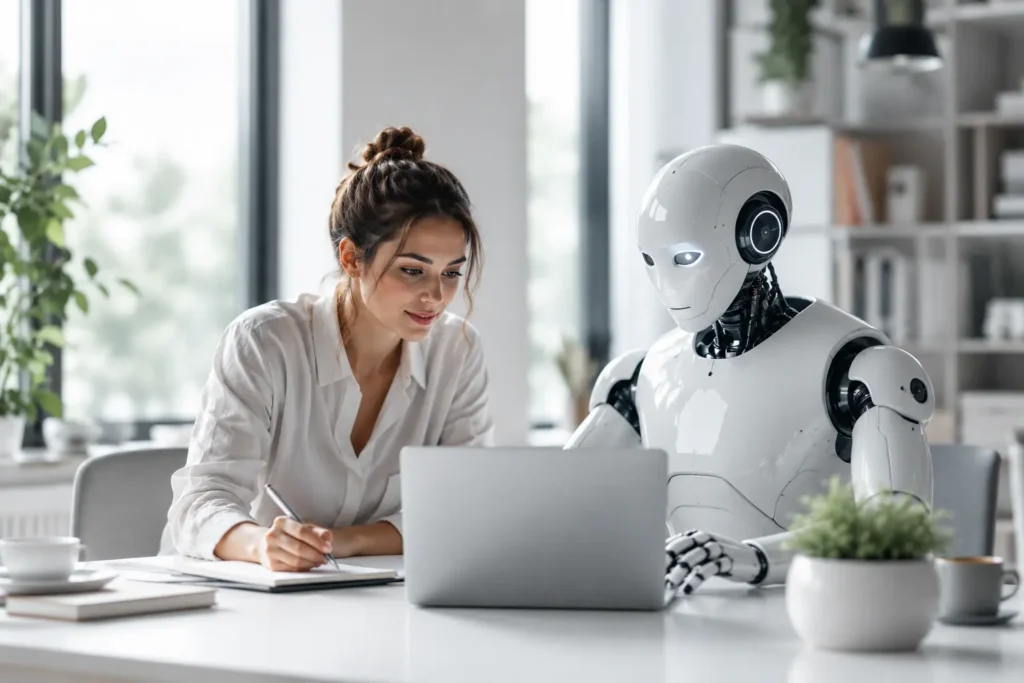
Agentic AI systems can now execute multi-step workflows: pulling data, drafting reports, scheduling follow-ups, and flagging exceptions for human review. The distinction matters because it changes the working relationship, AI is less a search engine and more a junior team member.
AI agents vs. AI assistants: An assistant responds to a single request; an agent pursues a goal across multiple steps and tools with minimal prompting. See the comparison table later in this guide for a full breakdown.
Human-agent collaboration works best when humans set goals and guardrails, and agents handle execution and monitoring. A finance team, for example, might have an agent reconcile transactions daily and only escalate anomalies above a set threshold.
Practical business example: A mid-size logistics company deployed an agent to monitor shipment delays and automatically rebook affected orders. Dispatch staff went from manually tracking exceptions to reviewing a daily summary — cutting resolution time by more than half.
2. Productivity Shifts from Hours to Outcomes
Time-based measures like hours logged or tickets closed are giving way to outcome-based measures: revenue influenced, customer issues resolved, project milestones hit.
Measuring business impact instead of activity means asking “did this move the needle” rather than “how busy was the team.” New performance metrics increasingly tie individual and team contributions directly to business results, which is fairer to remote and async workers who can’t be judged by visible “busyness.”
3. Asynchronous Work Becomes the Default
Real-time meetings are being replaced by documented, async-first workflows wherever possible.
- Fewer meetings: Status updates move to written formats teams can read on their own time
- Documentation-first culture: Decisions and context get written down so no one has to be in the room to stay informed
- Global collaboration: Distributed teams across time zones can contribute without waiting for overlapping hours
4. Deep Work Becomes a Competitive Advantage
Uninterrupted focus time is now treated as a scarce resource worth protecting deliberately.
Organizations are blocking “no-meeting” windows, reducing context switching by limiting the number of active tools per role, and auditing recurring meetings for actual necessity. Teams that protect focus time consistently outperform those constantly pulled into low-value syncs.
5. Human-AI Teams Outperform Individual Contributors
The highest-performing teams in 2026 pair people with AI tools rather than treating AI as a replacement.
This requires workflow redesign, rebuilding processes around what AI does well (data processing, drafting, pattern detection) and what humans do well (judgment, relationship-building, ambiguous problem-solving). Task allocation becomes explicit: which steps go to AI, which stay human. AI increasingly supports decision-making by surfacing options and risks, while final calls remain with people.
6. AI Governance Moves to the Executive Agenda
As AI use spreads, so does risk — and boards are paying attention.
Shadow AI (employees using unapproved AI tools with company data) is a growing compliance concern. Formal governance frameworks now address compliance with data regulations, responsible AI practices around bias and transparency, and security controls over what data AI tools can access.
7. The Rise of the Chief Productivity Officer
Some organizations are creating dedicated leadership roles focused solely on productivity strategy, sitting between operations, HR, and technology.
This role exists because productivity initiatives were historically scattered — HR owned engagement, IT owned tools, operations owned process — with no one owning the whole picture. A Chief Productivity Officer provides cross-functional coordination, ensuring AI rollouts, workflow redesign, and wellbeing programs work together instead of competing for budget.
8. Skills Replace Traditional Job Roles
Rigid job titles are giving way to skills-based organizational models.
- Skills-based organizations assign work based on verified capabilities, not job titles
- Internal mobility increases as employees move fluidly between projects that match their skills
- Continuous learning becomes an expectation baked into every role, not an annual training event
9. Quiet Thriving Replaces Quiet Quitting
Where “quiet quitting” described disengagement, “quiet thriving” describes employees actively reshaping their roles to find more meaning and energy in their work.
This trend is tied to employee engagement strategies that emphasize purpose-driven work and psychological safety — environments where people feel safe raising concerns or trying new approaches without fear of punishment.
10. Wellbeing Becomes a Productivity Strategy
Burnout is now treated as a business risk, not just an HR issue.
Burnout prevention programs increasingly use workload data to flag at-risk teams before turnover spikes. Mental health support has expanded from optional benefits to embedded parts of workplace culture. Leaders frame sustainable performance as the real goal — steady output over years, not unsustainable sprints.
11. Knowledge Management Is Reinvented by AI
Finding information inside a company has historically been slow and frustrating. AI is changing that.
Enterprise search tools now use natural language to pull answers from scattered documents, chats, and databases. This builds stronger organizational memory, institutional knowledge that doesn’t disappear when someone leaves. AI-powered documentation tools and AI enabled board portals auto-generate summaries and meeting notes, reducing the manual burden of keeping records up to date.
12. Workflow Automation Expands Beyond Repetitive Tasks
Automation used to mean simple, rule-based tasks. Now it handles more judgment-based work too.
Intelligent automation combines AI decision-making with traditional automation to handle exceptions, not just routine cases. Cross-platform workflows connect previously siloed tools, so a single trigger can update a CRM, notify a team, and generate a report. No-code automation platforms let non-technical staff build these workflows themselves, reducing dependence on IT.
13. Real-Time Productivity Analytics Drive Decisions
Leaders are moving away from monthly or quarterly reviews toward continuous visibility into how work is progressing.
The same measurement gap shows up in physical space, where workplace trends research distinguishes active occupancy from space that’s merely claimed, a distinction badge data and booking logs both miss.
Live dashboards show project and team status as it changes. AI insights flag bottlenecks or at-risk deadlines before they become crises. Predictive analytics forecast likely delays or resource shortages based on historical patterns, giving managers time to act early rather than react late.
14. Industry-Specific Productivity Transformation
Productivity gains look different depending on the industry:
- Manufacturing: AI-driven predictive maintenance reduces unplanned downtime
- Healthcare: Administrative automation frees clinical staff from paperwork, giving more time for patient care
- Finance: AI agents handle reconciliation and fraud detection, speeding up close cycles
- Retail: Demand forecasting and inventory automation reduce stockouts and overstock
- Professional services: AI-assisted research and drafting cut time spent on lower-value client deliverables
15. Reflective Leadership Defines High-Performing Organizations
The best-performing organizations in 2026 are led by people who pause to evaluate before reacting.
Adaptability matters more than having a fixed five-year plan, given how quickly tools and market conditions change. Decision quality improves when leaders build in time to weigh AI-generated recommendations rather than accepting them automatically. This is fundamentally human-centered leadership — using AI to inform judgment, not replace it.
Productivity Trends by Business Function
Each department experiences these shifts differently:
- HR: Skills-based hiring, AI-assisted screening, and burnout-risk monitoring reshape talent management
- Marketing: AI agents draft campaign variants and analyze performance in real time, freeing teams for strategy
- Sales: AI handles lead scoring and follow-up sequencing, letting reps focus on relationship-building
- Customer Support: AI agents resolve routine tickets autonomously, escalating complex cases to human agents
- Finance: Automated reconciliation and anomaly detection speed up reporting cycles
- Engineering: AI-assisted code review and testing reduce time spent on repetitive quality checks
- Operations: Real-time dashboards and predictive analytics improve resource planning
- Executive Leadership: Outcome-based reporting replaces activity-based updates, sharpening strategic decisions
AI Assistants vs. AI Agents: What’s the Difference?
Definitions
An AI assistant responds to individual requests — answering a question, drafting a message, summarizing a document — one interaction at a time. An AI agent pursues a defined goal across multiple steps, using tools and making decisions along the way with minimal ongoing prompting.
Key Differences
| Feature | AI Assistant | AI Agent |
|---|---|---|
| Scope of task | Single request/response | Multi-step goal completion |
| Autonomy | Requires prompting per step | Operates with minimal supervision |
| Tool use | Limited or none | Can use multiple tools/systems |
| Example use | Drafting an email | Managing an entire outreach campaign end-to-end |
| Oversight needed | Light | Requires governance and monitoring |
Business Use Cases
Assistants work well for drafting content, answering employee questions, and summarizing documents. Agents work well for end-to-end processes like order fulfillment monitoring, recruitment pipeline management, or financial reconciliation.
Which Will Deliver More Value in 2026?
Most organizations will see the biggest returns from agents applied to well-defined, repeatable processes — not from replacing every assistant use case. The realistic path is layering agents on top of existing assistant tools, not ripping out one for the other.
Productivity Tools Powering 2026 Workplaces
| Category | Strengths | Ideal Use Case | AI Capabilities |
|---|---|---|---|
| AI Productivity Platforms | Broad task automation, integrates with existing apps | Cross-functional teams needing general AI support | Drafting, summarization, agentic task execution |
| Project Management Tools | Visual tracking, deadline management | Teams managing multi-step projects | Predictive timelines, automated status updates |
| Collaboration Platforms | Real-time and async communication | Distributed and hybrid teams | Meeting summarization, smart notifications |
| Knowledge Management Systems | Centralized, searchable organizational knowledge | Teams needing fast access to internal information | Natural language search, auto-tagging |
| Automation Platforms | Connects disparate tools and triggers workflows | Repetitive cross-app processes | No-code workflow builders, conditional logic |
| Meeting Intelligence Tools | Captures and structures meeting content | Teams reducing meeting overhead | Transcription, action item extraction |
Productivity Metrics Every Organization Should Track
What KPIs should organizations measure? Organizations should track a mix of outcome-based KPIs, AI-specific productivity metrics, employee experience indicators, and operational efficiency measures to get a complete view of performance — not just activity levels.
| Metric Category | Example Metrics |
|---|---|
| Outcome-Based KPIs | Revenue per employee, project completion rate, customer outcomes achieved |
| AI Productivity Metrics | Task automation rate, AI-assisted output volume, agent error/escalation rate |
| Employee Experience Metrics | Engagement scores, burnout risk indicators, voluntary turnover |
| Operational Efficiency Metrics | Cycle time, cost per output unit, process bottleneck frequency |
Executive Dashboard Example
A well-designed executive dashboard combines these categories into a single view: outcome trends alongside wellbeing indicators, so leaders can see if productivity gains are coming at the cost of employee health.
Challenges That Could Slow Productivity Growth
- AI Fatigue: Employees overwhelmed by constant tool changes and AI-generated content to review
- Shadow AI: Unapproved tools creating data security and compliance blind spots
- Information Overload: Too many dashboards, notifications, and data sources diluting focus
- Meeting Creep: Old meeting habits resurfacing despite async-first intentions
- Digital Burnout: Constant connectivity eroding the boundaries needed for recovery
- Resistance to Change: Employees and managers hesitant to adopt new workflows or trust AI recommendations
How Organizations Can Prepare for Productivity Trends in 2026
- Audit current workflows to identify where time and effort are actually going, not where leaders assume they’re going
- Identify high-impact AI opportunities by targeting repetitive, well-documented processes first
- Build human-AI collaboration models that clearly define which tasks go to AI and which stay human
- Upskill employees with practical, role-specific AI training rather than generic courses
- Establish AI governance covering data security, compliance, and responsible use before scaling adoption
- Measure and optimize continuously using outcome-based KPIs rather than one-time pilot metrics
Real-World Examples of Productivity Transformation
| Organization Type | Challenge | Solution | Results | Key Lesson |
|---|---|---|---|---|
| Enterprise Organization | Slow cross-department reporting cycles | Deployed AI agents for data consolidation and reporting | Reporting cycle cut by roughly half | Automation works best on well-defined, repeatable processes |
| Mid-Market Business | High employee turnover linked to burnout | Introduced wellbeing metrics into performance dashboards | Reduced voluntary turnover within a year | Wellbeing and output metrics must be tracked together |
| Startup | Limited headcount to handle customer support volume | Implemented an AI agent to resolve routine tickets | Freed founders to focus on product and sales | Early AI investment can substitute for premature hiring |
| Remote-First Company | Meeting overload across time zones | Shifted to async-first documentation culture | Fewer meetings, faster global collaboration | Written-first culture scales better across time zones than live meetings |
Expert Predictions: What Comes After 2026?
Agentic Organizations
Some analysts predict entire departments will eventually run on networks of coordinated AI agents overseen by small human teams focused on strategy and exceptions.
Autonomous Business Processes
End-to-end processes, from order intake to fulfillment, may run with minimal human intervention except at key decision points.
AI-Native Companies
New companies built from day one around AI-first workflows may operate with leaner teams than traditional organizational structures required.
Workforce Evolution Through 2030
Expect continued growth in skills-based hiring, more fluid team structures, and an expanding set of roles focused on managing and governing AI systems rather than performing the tasks AI now handles.
Frequently Asked Questions
What are productivity trends in 2026? They center on outcome-based work measurement, agentic AI collaboration, hybrid work maturity, and employee wellbeing as a formal business strategy.
How is AI changing workplace productivity? AI is shifting from answering individual requests to executing multi-step tasks autonomously, freeing employees to focus on judgment-based and relationship-driven work.
What is an AI agent? An AI agent is a system that pursues a defined goal across multiple steps, using tools and making decisions with minimal human prompting, unlike a single-response AI assistant.
What is the difference between AI assistants and AI agents? Assistants handle one request at a time; agents manage ongoing, multi-step processes with greater autonomy and tool use.
How can businesses improve productivity in 2026? By auditing workflows, targeting high-impact AI use cases, building clear human-AI task allocation, upskilling employees, and establishing AI governance.
Which productivity tools are best for AI-powered work? The best fit depends on the use case — AI productivity platforms for general tasks, automation platforms for cross-app workflows, and meeting intelligence tools for reducing meeting overhead.
What KPIs should organizations measure? A mix of outcome-based KPIs, AI-specific performance metrics, employee experience indicators, and operational efficiency measures.
How will hybrid work evolve? Hybrid work is maturing into an async-first model focused on documentation and outcomes rather than physical location or meeting attendance.
What industries will benefit most from AI-driven productivity? Manufacturing, healthcare, finance, retail, and professional services are seeing some of the clearest early gains from AI-driven automation.
What skills will be most valuable in the future of work? Skills in AI collaboration, adaptability, judgment-based decision-making, and continuous learning are becoming more valuable than static technical credentials alone.
Conclusion
The productivity trends 2026 has brought aren’t about working longer or adding more tools — they’re about rethinking how work gets designed, measured, and sustained. Agentic AI is becoming a genuine collaborator, outcomes are replacing hours as the measure that matters, and employee wellbeing has moved from a side conversation to a core business strategy.
The organizations pulling ahead are the ones treating these shifts as connected, not separate initiatives. AI governance, workflow redesign, skills development, and wellbeing programs all reinforce each other when built together — and undermine each other when built in isolation.
Start where the data points you: audit your workflows, find the highest-impact AI opportunities, and build the human-AI collaboration models that fit your teams. The organizations that get this right in 2026 won’t just be more productive — they’ll be better places to work, which is ultimately what sustainable productivity has always required.