Every company that runs on data eventually hits the same wall: information is scattered across a dozen systems, in a dozen formats, and nobody can get a straight answer out of it.
An ETL pipeline is the engineering answer to that problem. It’s the machinery that pulls data from wherever it lives, cleans it up, and delivers it somewhere useful, usually a data warehouse, so people can actually query it.
This guide walks through how ETL pipelines work, how they’re architected, what tools teams use to build them, and the practices that separate a pipeline that runs quietly for years from one that breaks every other week.
Whether you’re building your first pipeline or auditing an existing one, you’ll find a practical reference here.
What Is an ETL Pipeline?
ETL pipeline definition
An ETL pipeline is an automated process that extracts data from one or more source systems, transforms it into a clean and consistent format, and loads it into a target system such as a data warehouse or data lake. ETL stands for Extract, Transform, Load, the three stages every pipeline performs, in that order.
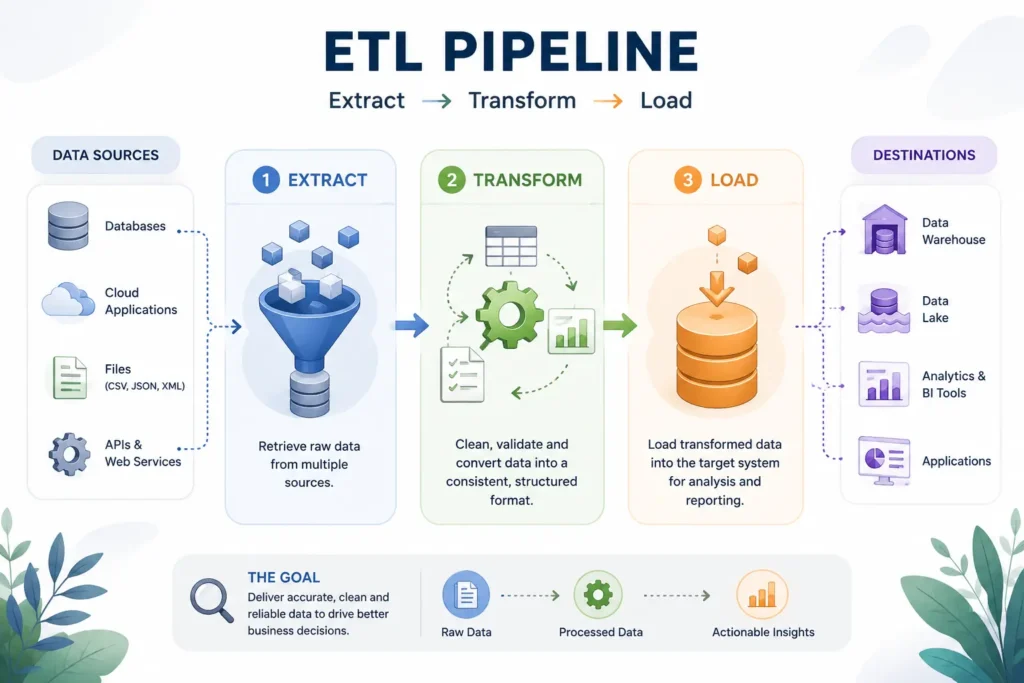
Think of it as a supply chain for data. Raw material (source data) gets collected, processed into a usable product (clean, structured data), and delivered to a warehouse (the target database) where it’s ready to be used.
Why ETL pipelines matter
Without an ETL pipeline, analysts and applications would need to query dozens of live source systems directly — slow, risky, and inconsistent. ETL pipelines solve several real problems at once:
- Consistency – data from different systems is normalized into one schema
- Performance – analytical queries run against a warehouse built for reporting, not against production databases
- Reliability – automated, scheduled runs replace manual spreadsheet exports
- Historical tracking – pipelines can preserve snapshots of data over time for trend analysis
A retail chain, for example, might pull sales data from point-of-sale systems in 500 stores. Without an ETL pipeline, someone would need to manually reconcile 500 spreadsheets every night. With one, that reconciliation happens automatically before anyone gets to their desk.
ETL pipeline in modern data engineering
ETL used to mean nightly batch jobs written in stored procedures. Modern data engineering has broadened the concept considerably. Today’s ETL pipelines often run in the cloud, process data continuously rather than once a day, and sit alongside a close cousin: ELT (Extract, Load, Transform), where raw data is loaded first and transformed inside the warehouse using tools like dbt.
Both approaches are still called “ETL” colloquially, and most data teams use a mix of both depending on the source and use case. We’ll compare them directly later in this article.
How an ETL Pipeline Works
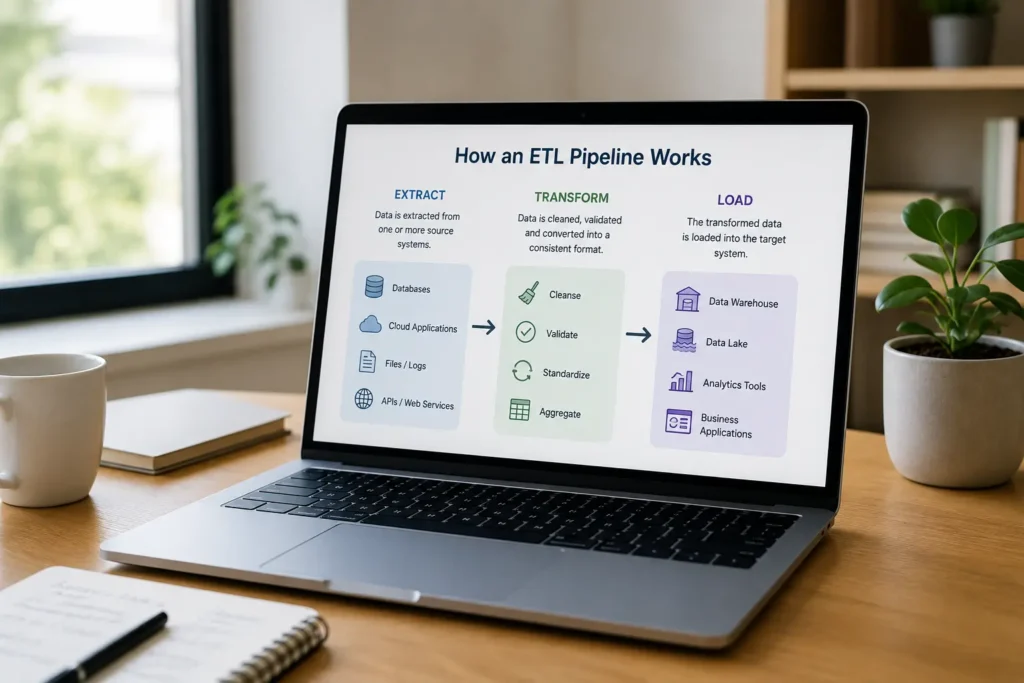
At a high level, every ETL pipeline performs three sequential operations. Each one solves a different problem, and skipping any of them usually causes downstream data quality issues.
Extract
Extraction is the process of pulling raw data out of source systems – databases, APIs, flat files, SaaS platforms, or streaming systems. The extraction method depends on the source: a full extract pulls the entire dataset every run, while an incremental extract pulls only records that changed since the last run.
Incremental extraction is generally preferred at scale because it reduces load on source systems and speeds up pipeline runs. A finance team extracting millions of daily transactions, for instance, would extract only new transactions rather than re-pulling years of history every night.
Transform
Transformation is where raw data becomes usable data. This stage handles:
- Cleaning (removing duplicates, fixing nulls, correcting formats)
- Standardizing (converting units, date formats, currencies)
- Enriching (joining with reference data, calculating new fields)
- Aggregating (rolling up transaction-level data into daily summaries)
This is typically the most complex and compute-intensive stage of the pipeline, and it’s where most of the “business logic” of a pipeline lives.
Load
Loading writes the transformed data into the target system – a data warehouse, data mart, or data lake. Loads can be full (overwrite everything) or incremental (append or merge only new/changed records). Most production pipelines use incremental loading once the initial historical load is complete, since it’s faster and less disruptive to downstream users querying the warehouse during the load window.
ETL Pipeline Architecture
A well-designed ETL pipeline architecture is made up of distinct layers, each with a specific job. Understanding these layers makes it much easier to diagnose problems and plan for scale.
Data sources
These are the systems data originates from: relational databases, SaaS applications (like Salesforce or Shopify), flat files (CSV, JSON, XML), APIs, and streaming platforms like Kafka. A typical enterprise pipeline pulls from a mix of all of these.
Data ingestion
The ingestion layer handles the actual mechanics of pulling data from sources — connecting, authenticating, and retrieving records. This layer often includes connectors or adapters built specifically for each source type.
Transformation engine
This is the compute layer that applies business logic to raw data. It could be a distributed processing engine like Apache Spark, a SQL-based transformation tool like dbt, or custom scripts running on a scheduler.
Data validation
Validation checks that transformed data meets quality expectations before it’s loaded — checking for nulls in required fields, duplicate records, referential integrity, and value ranges. Pipelines that skip this layer tend to load bad data into production dashboards, which erodes trust fast.
Workflow orchestration
Orchestration tools coordinate the order, timing, and dependencies of pipeline tasks. If the “transform” step depends on three extraction jobs finishing first, the orchestrator enforces that sequence and retries failed steps automatically. Apache Airflow is the most widely used tool in this layer.
Target systems
This is where processed data lands — typically a cloud data warehouse (Snowflake, BigQuery, Redshift) or a data lake (S3, Azure Data Lake). Some pipelines also load into operational data stores or data marts built for a specific team.
Monitoring and logging
This layer tracks pipeline health: run duration, row counts, failure rates, and error logs. Without it, teams find out about broken pipelines when a business user complains that a dashboard looks wrong — which is always too late.
ETL Pipeline Components
Architecture describes the layers; components are the actual building blocks within those layers.
Source systems
The databases, APIs, and files that hold the raw data. Examples include a MySQL production database, a Salesforce CRM, and a folder of vendor-supplied CSV files.
Connectors
Pre-built or custom integrations that know how to talk to a specific source system’s API or protocol. Most modern ETL tools ship with a library of hundreds of pre-built connectors, which is often the single biggest time-saver when choosing a tool.
Transformation logic
The actual code or configuration — SQL queries, Python scripts, or a visual mapping tool — that defines how raw fields become clean, business-ready fields.
Scheduler
The component that triggers pipeline runs, whether on a fixed schedule (every night at 2 a.m.) or in response to an event (a new file landing in a folder).
Metadata repository
A catalog that tracks what data exists, where it came from, its schema, and how it has changed. Metadata repositories are the foundation of data lineage and impact analysis.
Monitoring tools
Dashboards and alerting systems — like Datadog, Grafana, or a tool’s built-in monitoring — that surface pipeline health in real time.
ETL Pipeline Process Step by Step
Building and running an ETL pipeline follows a repeatable sequence. Here’s what that looks like in practice.
- Planning — Define the business requirement, identify source systems, and design the target schema before writing any code. Skipping this step is the single most common cause of pipelines that need to be rebuilt within a year.
- Extraction — Connect to source systems and pull the required data, using full or incremental extraction depending on volume and source capability.
- Cleansing — Remove duplicates, handle missing values, and correct obvious data errors before deeper transformation begins.
- Transformation — Apply business logic: standardize formats, join datasets, calculate derived fields, and aggregate where needed.
- Validation — Run automated checks to confirm the transformed data meets quality and schema expectations.
- Loading — Write the validated data into the target system, using full or incremental load strategies.
- Monitoring — Track each run for failures, performance issues, and data anomalies.
- Maintenance — Update the pipeline as source systems change, schemas evolve, or business logic needs adjustment.
Planning and maintenance are the two steps teams most often shortchange — and the two that determine whether a pipeline survives long-term.
ETL Pipeline Example
Seeing ETL applied to real scenarios makes the abstract stages concrete.
Retail example
A retail chain extracts point-of-sale transactions from 500 store systems each night. The transform stage standardizes currency and time zones, deduplicates transactions caused by system retries, and calculates daily revenue per store. The load stage writes results into a Snowflake warehouse that powers an executive sales dashboard by 6 a.m.
Healthcare example
A hospital network extracts patient visit records from its electronic health record (EHR) system and lab results from a separate lab information system. Transformation matches patient records across both systems using a master patient index, while validation checks ensure no records are loaded without required fields like visit date and provider ID. The pipeline must also mask certain fields to remain HIPAA-compliant before the data reaches analysts.
Finance example
An investment firm extracts trade data from multiple exchanges via API throughout the trading day. Because this data feeds risk models used intraday, the pipeline runs in near-real-time rather than as a nightly batch. Transformation reconciles trade timestamps across exchanges with different time formats, and the loaded data supports both compliance reporting and real-time risk dashboards.
Types of ETL Pipelines
Not all ETL pipelines run the same way. The right type depends on how quickly data needs to be available.
Batch ETL
Processes data in scheduled chunks — hourly, nightly, or weekly. This is still the most common type because it’s simpler to build and sufficient for most reporting use cases.
Real-time ETL
Processes data continuously as it arrives, typically with latency measured in seconds. Used when decisions depend on current data, like fraud detection or live inventory tracking.
Streaming ETL
A specific form of real-time ETL built on streaming platforms like Apache Kafka or Amazon Kinesis, processing unbounded data streams event-by-event rather than in micro-batches.
Incremental ETL
Extracts and processes only new or changed records since the last run, rather than reprocessing the full dataset. Most production batch pipelines use incremental logic once the initial historical load is complete.
Cloud-native ETL
Built using managed cloud services — AWS Glue, Azure Data Factory, Google Cloud Dataflow — that handle infrastructure scaling automatically, reducing the operational burden on data teams.
ETL Pipeline vs ELT
| Aspect | ETL | ELT |
|---|---|---|
| Order of operations | Transform before loading | Load before transforming |
| Where transformation happens | Separate processing engine | Inside the target warehouse |
| Best for | Complex transformations, smaller data volumes, compliance-sensitive masking before load | Large data volumes, modern cloud warehouses with strong compute |
| Typical tools | Informatica, Talend, SSIS | Fivetran + dbt, Airbyte + dbt |
| Flexibility | Raw data isn’t preserved after transformation | Raw data is retained, enabling re-transformation later |
Neither approach is universally “better” — ELT has grown popular because cloud warehouses now have enough compute power to transform data efficiently in place, but ETL remains preferred when data must be cleaned or masked before it ever touches the target system, such as with sensitive healthcare or financial records.
ETL Pipeline vs Data Pipeline
| Aspect | ETL Pipeline | Data Pipeline |
|---|---|---|
| Scope | A specific type of data pipeline focused on extract-transform-load | A broader term for any automated movement of data between systems |
| Transformation required | Yes, always | Not necessarily — some data pipelines just move data without transforming it |
| Example | Nightly load into a data warehouse | Streaming raw sensor data into a data lake with no transformation |
Every ETL pipeline is a data pipeline, but not every data pipeline is an ETL pipeline. This distinction matters when scoping a project — “build a data pipeline” is a much broader ask than “build an ETL pipeline.”
ETL Pipeline vs Data Integration
| Aspect | ETL Pipeline | Data Integration |
|---|---|---|
| Definition | A technical process for moving and transforming data | A broader discipline covering how systems and data sources are connected across an organization |
| Includes | Extraction, transformation, loading | ETL, APIs, data virtualization, master data management, and governance |
| Relationship | One tool within data integration | The overarching strategy that ETL pipelines help execute |
Data integration is the strategic umbrella; ETL pipelines are one of the primary tools used to achieve it.
ETL Pipeline Use Cases
Business Intelligence
ETL pipelines feed the dashboards and reports that executives and analysts rely on daily, consolidating data from sales, marketing, and operations into one queryable source.
Data Warehousing
ETL is the mechanism that actually populates a data warehouse — without it, a warehouse is just an empty, well-designed database.
Machine Learning
ML models need clean, consistently formatted training data. ETL pipelines prepare and refresh feature data so models stay accurate as new data arrives.
Customer Analytics
Pipelines combine data from CRM systems, support tickets, and product usage logs to build a unified view of customer behavior.
Financial Reporting
Regulatory and investor reporting requires reconciled, auditable data — ETL pipelines standardize figures across business units before they reach a finance team’s reporting tools.
Marketing Analytics
Marketing teams use ETL to blend ad spend data from multiple platforms (Google Ads, Meta, LinkedIn) with conversion data to measure ROI accurately.
Healthcare Analytics
Hospital systems use ETL to combine EHR, billing, and lab data for population health analysis and regulatory reporting, typically with strict compliance controls built into the pipeline.
ETL Pipeline Benefits
- Time savings — eliminates manual data collection and reconciliation
- Improved data quality — validation and cleansing catch errors before they reach reports
- Single source of truth — consolidates fragmented data into one consistent view
- Better decision-making — leaders work from timely, accurate data instead of guesswork
- Scalability — automated pipelines handle growing data volumes far better than manual processes
- Historical analysis — pipelines preserve data over time, enabling trend and cohort analysis
ETL Pipeline Challenges
Data quality
Source systems are messy — duplicate records, inconsistent formats, and missing values are the norm, not the exception. Pipelines need dedicated validation logic to catch these issues rather than assuming clean input.
Scalability
A pipeline built for gigabytes of data can buckle under terabytes. Teams need to plan for data growth from the start, choosing tools and architectures that scale horizontally.
Performance
Poorly optimized transformations can turn a 30-minute pipeline run into a multi-hour one, delaying downstream reports and eating into overnight processing windows.
Security
Pipelines often move sensitive data — customer PII, financial records, health information — across systems, which means every hop needs to be secured, not just the final destination.
Compliance
Regulations like GDPR and HIPAA impose specific requirements on how personal data is processed and stored, and pipelines handling regulated data must be designed with those rules in mind from day one, not retrofitted later.
ETL Pipeline Best Practices
Automation
Manual pipeline triggers and manual error recovery don’t scale. Fully automated scheduling and retry logic should be the default, not an enhancement added later.
Incremental loading
Loading only new or changed data dramatically reduces run time and resource usage compared to full reloads, especially as source tables grow.
Error handling
Pipelines should fail gracefully — catching errors, logging context, and retrying transient failures automatically rather than silently dropping records or crashing without explanation.
Logging
Detailed logs of every run — row counts, duration, errors — make troubleshooting dramatically faster when something goes wrong at 3 a.m.
Monitoring
Active monitoring with alerting (not just logs someone has to go looking for) ensures failures are caught within minutes, not discovered days later by an unhappy stakeholder.
Documentation
Every pipeline should have documentation covering its sources, transformation logic, schedule, and owner. Undocumented pipelines become “the thing nobody wants to touch” within a year.
Testing
Pipelines should be tested like any other software — with unit tests, integration tests, and validation checks run before code reaches production.
ETL Pipeline Optimization Techniques
Parallel processing
Running independent extraction or transformation tasks concurrently rather than sequentially cuts total run time significantly, especially with distributed engines like Spark.
Partitioning
Splitting large datasets into smaller partitions (by date, region, or another key) allows pipelines to process and query data more efficiently, and enables reprocessing a single partition instead of an entire table.
Compression
Compressing data in transit and at rest reduces storage costs and speeds up network transfer between pipeline stages.
Pushdown optimization
Rather than pulling raw data into a separate compute engine, pushdown optimization executes transformation logic directly inside the source or target database, reducing data movement.
Resource optimization
Right-sizing compute resources — scaling up during large batch windows and scaling down afterward — controls cloud costs without sacrificing performance.
ETL Pipeline Security Best Practices
Encryption
Data should be encrypted both in transit (using TLS) and at rest, at every stage of the pipeline — not just in the final warehouse.
Authentication
Every connection between pipeline components and source or target systems should use strong, individually scoped credentials rather than shared service accounts.
Access control
Role-based access control ensures only authorized users and systems can view or modify pipeline configurations and the data flowing through them.
Compliance
Pipelines handling regulated data need built-in controls — audit logs, data residency enforcement, and retention policies — that map directly to applicable regulations like GDPR or HIPAA.
Data masking
Sensitive fields (like social security numbers or patient identifiers) should be masked or tokenized before reaching analysts who don’t need to see raw values.
ETL Pipeline Monitoring and Observability
Metrics
Key metrics include run duration, row counts processed, error rates, and resource utilization — tracked over time to spot degrading performance before it becomes a failure.
Logging
Structured, centralized logs make it possible to trace a single record’s journey through the pipeline when debugging a data quality issue.
Alerts
Automated alerts — sent to Slack, email, or a paging system — notify the team the moment a pipeline fails or a key metric crosses a threshold.
SLAs
Service-level agreements define how quickly data must be available (e.g., “sales data refreshed by 6 a.m. daily”), giving the team clear targets and stakeholders clear expectations.
Data lineage
Lineage tracking shows exactly where each field in a report originated and what transformations it passed through — essential for both debugging and compliance audits.
ETL Pipeline Testing
Unit testing
Tests individual transformation functions in isolation — for example, confirming a currency conversion function produces the correct output for a range of inputs.
Integration testing
Verifies that the pipeline’s stages work correctly together, from extraction through to loading, using realistic sample data.
Regression testing
Confirms that new changes to pipeline logic don’t break existing functionality — critical when multiple engineers are modifying the same pipeline over time.
Data validation testing
Checks that the actual output data meets defined quality rules: no unexpected nulls, correct row counts, and values within expected ranges.
Modern Cloud ETL Pipelines
AWS
AWS Glue provides a managed, serverless ETL service with built-in data cataloging, while services like AWS Database Migration Service handle ongoing replication into the AWS ecosystem.
Azure
Azure Data Factory is Microsoft’s managed orchestration and ETL service, commonly paired with Azure Synapse Analytics for warehousing and transformation.
Google Cloud
Google Cloud Dataflow (built on Apache Beam) handles both batch and streaming ETL, typically feeding into BigQuery for analysis.
Lakehouse ETL
Lakehouse architectures — popularized by platforms like Databricks — combine the flexibility of a data lake with the structure and performance of a warehouse, letting teams run ETL directly against open table formats like Delta Lake.
Medallion architecture
A common lakehouse pattern that organizes data into three layers: Bronze (raw, unprocessed), Silver (cleaned and validated), and Gold (business-ready, aggregated). Data moves through these layers via ETL processes at each stage.
Popular ETL Tools
Open-source ETL tools
Apache Airflow (orchestration), Apache NiFi, and Singer are widely used open-source options, offering flexibility and no licensing cost at the price of more hands-on maintenance.
Enterprise ETL tools
Informatica PowerCenter, Talend, and IBM DataStage are established enterprise platforms offering robust governance features and vendor support, typically suited to large organizations with complex compliance needs.
Cloud ETL platforms
Fivetran, Stitch, and Airbyte specialize in managed, connector-driven ELT, while cloud-native services like AWS Glue, Azure Data Factory, and Google Cloud Dataflow integrate tightly with their respective cloud ecosystems.
How to Choose the Right ETL Tool
Business size
Smaller teams often benefit from managed cloud tools that reduce operational overhead, while large enterprises may need the governance and customization enterprise platforms provide.
Budget
Open-source tools have no license fee but require engineering time to maintain; commercial tools trade licensing cost for faster implementation and vendor support.
Scalability
Choose a tool whose architecture matches your data growth trajectory — a tool that handles gigabytes comfortably may not handle terabytes without significant rework.
Integration support
A tool’s value is closely tied to its library of pre-built connectors for your specific source systems — check this before evaluating anything else.
Ease of use
Consider the skill level of the team maintaining the pipeline. Visual, low-code tools lower the barrier for smaller teams, while code-first tools offer more flexibility for experienced engineers.
ETL Pipeline Implementation Checklist
- [ ] Define business requirements and success metrics before design begins
- [ ] Identify and document all source systems and their data formats
- [ ] Design the target schema and data model
- [ ] Choose extraction method (full vs. incremental) per source
- [ ] Define transformation and validation rules
- [ ] Select an orchestration and scheduling approach
- [ ] Implement error handling and retry logic
- [ ] Set up logging, monitoring, and alerting
- [ ] Apply security controls: encryption, access control, masking
- [ ] Write unit, integration, and data validation tests
- [ ] Document the pipeline’s sources, logic, schedule, and owner
- [ ] Define SLAs with downstream stakeholders
Common ETL Mistakes to Avoid
- Skipping the planning phase – jumping straight into code without mapping requirements leads to rebuilds
- Ignoring data quality at the source – assuming source data is clean, then being surprised when it isn’t
- No incremental loading strategy – full reloads that grow unsustainably slow as data volume increases
- Poor error handling – pipelines that fail silently or crash without useful logs
- Underestimating scale – building for today’s data volume with no plan for growth
- Skipping documentation – leaving the next engineer (or future you) with no idea how the pipeline works
- No monitoring or alerting – finding out about failures from an angry stakeholder instead of an automated alert
Frequently Asked Questions
What is an ETL pipeline in simple terms? An ETL pipeline is an automated process that collects data from different sources, cleans and organizes it, and loads it into a central system like a data warehouse so it can be analyzed.
What are the three stages of an ETL pipeline? The three stages are Extract (pulling data from sources), Transform (cleaning and reshaping it), and Load (writing it into the target system).
Is ETL the same as a data pipeline? No. ETL is one specific type of data pipeline that always includes transformation. A data pipeline is a broader term that can include processes with no transformation at all.
What’s the difference between ETL and ELT? ETL transforms data before loading it into the target system, while ELT loads raw data first and transforms it afterward inside the warehouse. ELT has become more common with powerful cloud warehouses.
What programming languages are used to build ETL pipelines? Python and SQL are the most common, though Java and Scala are also used, particularly with distributed processing engines like Apache Spark.
How long does it take to build an ETL pipeline? A simple pipeline with one or two sources can take days to build; enterprise-scale pipelines with dozens of sources and complex validation rules can take months.
What is the best ETL tool for small businesses? Managed cloud tools like Fivetran or Stitch are popular for small businesses since they require minimal engineering overhead and offer many pre-built connectors.
Can ETL pipelines run in real time? Yes. Real-time and streaming ETL pipelines, built on platforms like Apache Kafka, process data continuously rather than on a fixed schedule.
What is data validation in an ETL pipeline? Data validation is the process of checking transformed data against quality rules — such as required fields, value ranges, and duplicate checks, before it’s loaded into the target system.
What is the medallion architecture in ETL? The medallion architecture organizes data into Bronze (raw), Silver (cleaned), and Gold (business-ready) layers, with ETL processes refining data as it moves through each layer.
How do you monitor an ETL pipeline? By tracking metrics like run duration and row counts, maintaining structured logs, setting up automated alerts for failures, and defining SLAs for data freshness.
What industries rely most heavily on ETL pipelines? Retail, finance, and healthcare are among the heaviest users, given their need to consolidate large volumes of transactional and regulatory data for reporting and analytics.
What is data lineage in ETL? Data lineage is a record of where each piece of data originated and what transformations it went through on its way to a report or dashboard — used for debugging and compliance.
Do ETL pipelines need to be tested? Yes. Like any software, ETL pipelines should have unit tests for transformation logic, integration tests for end-to-end flow, and data validation tests for output quality.
Final Thoughts
An ETL pipeline is ultimately about trust, making sure the numbers on a dashboard, the data feeding a machine learning model, or the figures in a compliance report are accurate and timely.
Getting there requires more than connecting a source to a warehouse: it takes deliberate architecture, validation, monitoring, and security built in from the start.
The teams that get the most value from their ETL pipelines are the ones that treat them as production software, not one-off scripts, with testing, documentation, and monitoring as standard practice, not afterthoughts.
Whether you’re processing nightly retail transactions or streaming financial trades in real time, the same core discipline applies: extract carefully, transform deliberately, and load reliably.