If someone searched your business name right now, what would they find? A polished website and glowing reviews, or a thin Google Business Profile, mismatched contact details, and silence on social media?
That gap is exactly what online presence management is built to close. It’s not one tactic. It’s the ongoing discipline of shaping how your brand looks and behaves everywhere people encounter it online, search results, maps, review sites, social platforms, and now AI chatbots.
This guide walks through what online presence management actually involves, why it matters more in 2026 than it did five years ago, and exactly how to audit, build, and maintain a presence that earns trust and drives business. Whether you run a local service business, manage a personal brand, or oversee marketing for a multi-location company, you’ll find a practical framework here you can start using today.
What Is Online Presence Management?
Simple Definition
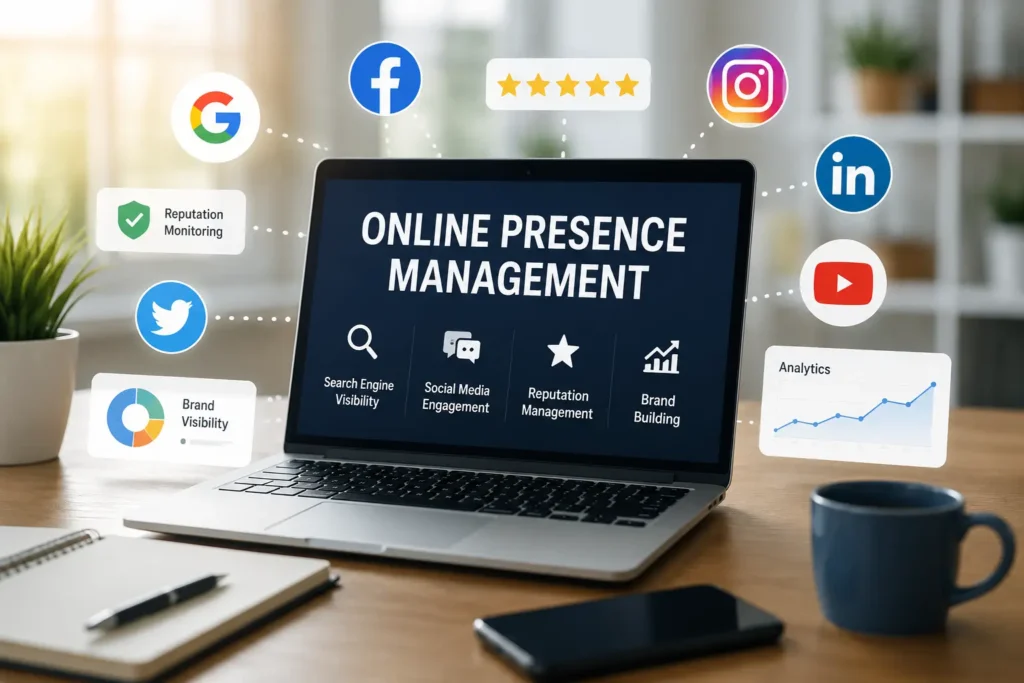
Online presence management (OPM) is the ongoing process of building, monitoring, and optimizing every place your brand appears online, your website, search results, business listings, social profiles, reviews, and content, so that people consistently find accurate, trustworthy, and favorable information about you.
Think of it as digital storefront maintenance. A physical store owner sweeps the sidewalk, updates the window display, and greets customers. OPM is the same idea, applied to search engines, maps, review sites, and social feeds.
How It Differs From Online Reputation Management
People often use “online presence management” and “online reputation management” (ORM) interchangeably, but they’re not the same thing.
| Aspect | Online Presence Management | Online Reputation Management |
|---|---|---|
| Primary goal | Build and grow visibility everywhere | Protect and repair brand perception |
| Scope | Website, SEO, listings, social, content, PR, reviews | Mostly reviews, mentions, and sentiment |
| Approach | Proactive, ongoing growth strategy | Often reactive, triggered by a problem |
| Timing | Continuous, long-term | Can be short-term (crisis response) |
| Success metric | Visibility, traffic, leads, share of voice | Sentiment score, review rating, mention tone |
In short: reputation management is a component of presence management, not a replacement for it. You can have a spotless reputation and still be invisible if nobody can find you. OPM covers both problems at once.
Why Every Business Needs It
Buyers no longer trust a single source. Before contacting a business, most people check the website, skim reviews, glance at social media, and increasingly ask an AI assistant for a recommendation. If any one of those touchpoints is missing, outdated, or inconsistent, you lose credibility — and often the sale.
A dental practice with a strong website but no Google Business Profile activity will lose “near me” searches to a competitor with fewer five-star reviews but a fully optimized profile. Presence isn’t optional anymore; it’s the baseline cost of competing.
Why Online Presence Management Matters
Visibility
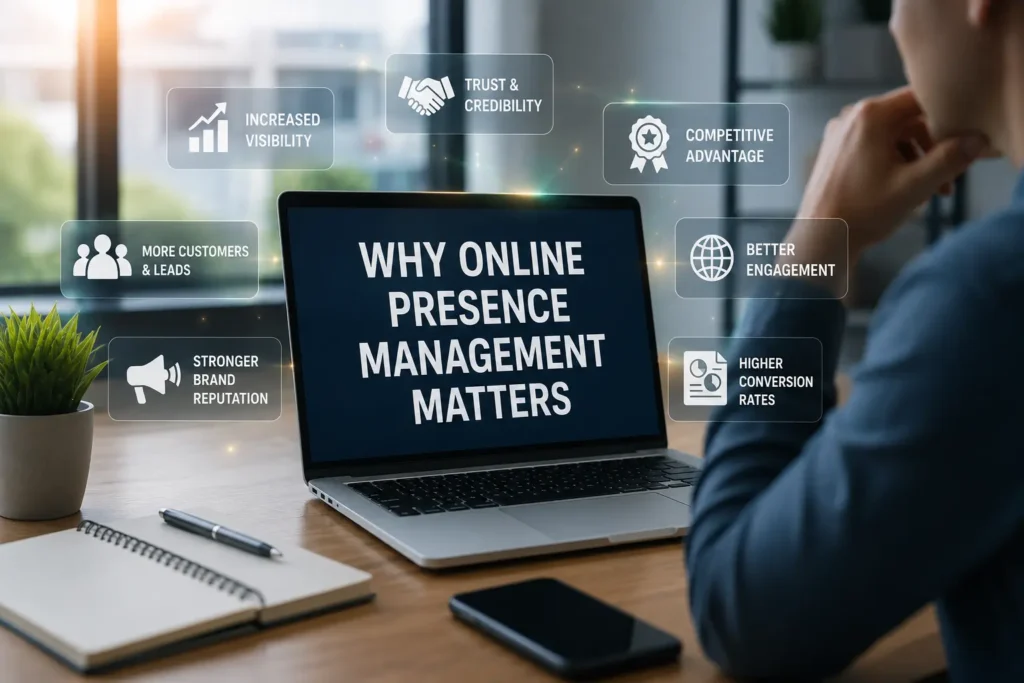
If you’re not visible where people search, you don’t exist to them — no matter how good your product is. Strong OPM means showing up in organic search results, map packs, review platforms, and increasingly, AI-generated answers.
Trust
Consistency builds trust. When your business name, address, hours, and messaging match everywhere, people believe what they read. When listings conflict or reviews go unanswered, doubt creeps in before a single conversation happens.
Lead Generation
A well-managed presence turns passive visibility into active leads. An optimized Google Business Profile generates calls and direction requests. A ranking blog post captures search traffic. A responsive review profile converts researchers into bookings.
Customer Retention
OPM isn’t just for acquisition. Email newsletters, active social channels, and helpful content keep existing customers engaged, which reduces churn and increases repeat business — often at a fraction of the cost of acquiring someone new.
Competitive Advantage
Most small and mid-sized businesses manage their online presence inconsistently — a burst of effort, then months of neglect. A business that treats OPM as an ongoing system, rather than a one-time project, pulls ahead simply by showing up reliably.
The Core Components of Online Presence Management
A complete online presence is made up of several interconnected pieces. Neglecting any one of them creates a weak link the rest of your strategy can’t fully compensate for.
| Component | What It Covers | Primary Benefit |
|---|---|---|
| Website | Homepage, service pages, blog, UX | Owned hub for conversions |
| Search Engine Visibility | Organic rankings, technical SEO | Discoverability |
| Google Business Profile | Local listing, posts, Q&A | Local visibility and trust |
| Business Listings | Directories, citations | Consistency and local SEO |
| Social Media | Platform profiles and content | Engagement and reach |
| Online Reviews | Ratings and responses | Social proof |
| Content Marketing | Blogs, guides, resources | Authority and organic traffic |
| Digital PR | Press coverage, backlinks | Authority and referral traffic |
| Email Marketing | Newsletters, nurture sequences | Retention and direct reach |
| Brand Mentions | Unlinked references to your brand | Awareness and entity signals |
| Videos and Podcasts | Multimedia content | Reach on video/audio platforms |
Website
Your website is the only online asset you fully control. Everything else — social platforms, listing sites, review sites — operates on rules set by someone else. A fast, mobile-friendly, clearly structured website is the foundation everything else points back to.
Search Engine Visibility
This covers how well your website ranks in Google and other search engines for terms your audience actually searches. It includes technical SEO (site speed, crawlability, mobile usability) and on-page SEO (titles, headings, content quality).
Google Business Profile
For any business with a physical location or service area, your Google Business Profile (formerly Google My Business) is often the single highest-impact asset in local search. It controls what shows up in the map pack and local knowledge panel.
Business Listings
Also called citations, these are mentions of your business name, address, and phone number (NAP) across directories like Yelp, Apple Maps, Bing Places, and industry-specific sites. Consistency across listings directly affects local ranking.
Social Media
Social profiles serve two purposes: engagement with your existing audience and a visible presence when people search your brand name. Even businesses that don’t rely on social for leads need active profiles for credibility.
Online Reviews
Reviews are the modern word-of-mouth. Volume, rating, recency, and how you respond all factor into both consumer trust and local search rankings.
Content Marketing
Blog posts, guides, case studies, and resources answer the questions your audience is searching for. Good content marketing compounds — a well-optimized article can generate traffic for years.
Digital PR
Earning coverage from journalists, industry publications, and bloggers builds authority and generates backlinks, which strengthen SEO and expand reach beyond your existing audience.
Email Marketing
Owned, permission-based communication with people who already know you. It’s the most reliable way to stay top-of-mind without depending on an algorithm.
Brand Mentions
Not every mention of your brand includes a link — but search engines and AI systems increasingly treat unlinked mentions as trust signals, especially when they come from credible sources.
Videos and Podcasts
Video and audio content extend your presence into platforms like YouTube, Spotify, and Apple Podcasts — and increasingly show up directly in search results and AI-generated answers.
Online Presence Management Framework
Trying to manage all eleven components at once is overwhelming. A simple six-stage framework keeps the work sustainable.
- Audit – Understand where you currently stand across every channel.
- Optimize – Fix what’s broken, inconsistent, or underperforming.
- Create – Produce the content and assets needed to fill gaps.
- Promote – Get that content and presence in front of the right audience.
- Monitor – Track mentions, reviews, rankings, and metrics continuously.
- Improve – Use what you learn to refine the next cycle.
This isn’t a one-time project — it’s a loop. Most businesses that succeed at OPM run this cycle quarterly, with monitoring happening continuously in the background.
Audit
Before changing anything, document the current state: rankings, listing accuracy, review scores, social activity, and content gaps. You can’t improve what you haven’t measured.
Optimize
Fix the fastest, highest-impact issues first — broken listings, missing profile fields, slow page speed, outdated content. Optimization is about maximizing what you already have before creating more.
Create
Once the foundation is solid, fill genuine gaps: a missing service page, an FAQ addressing common objections, a case study proving results.
Promote
Content that nobody sees doesn’t help. Promotion includes sharing on social, outreach for backlinks, email distribution, and paid amplification where it makes sense.
Monitor
Set up ongoing tracking for rankings, reviews, mentions, and traffic so you catch problems (and opportunities) early instead of months later.
Improve
Use audit data and performance metrics to refine your approach each cycle — double down on what’s working, cut what isn’t.
How to Audit Your Online Presence
A proper audit covers nine areas. Skipping any one of them leaves a blind spot.
Search Visibility
Search your target keywords and see where you actually rank. Check both desktop and mobile results, since they can differ.
Brand SERP
Search your own business name. This “brand SERP”, the first page of results for your name, is often the first thing a prospective customer sees. Check what’s ranking: your website, social profiles, reviews, or something you don’t control.
Business Listings
Audit your NAP consistency across major directories (Google, Bing, Apple Maps, Yelp, Facebook) and industry-specific listing sites. Look for duplicate or outdated listings.
Review Platforms
Check your rating and review volume on Google, Yelp, Facebook, and any industry-specific review site. Note how many reviews are unanswered.
Website Health
Run a technical check: page speed, mobile usability, broken links, and crawl errors. A slow or broken website undermines every other effort.
Social Profiles
Confirm your social profiles are claimed, complete, and consistent — same logo, bio, and contact details across platforms. Note which ones are inactive or abandoned.
Content Inventory
List existing content and identify what’s outdated, thin, or missing compared to what your audience is actually searching for.
Entity Signals
Check whether search engines correctly understand who you are — does your business have a Knowledge Panel? Is your schema markup present and accurate? (More on this in the Entity SEO section below.)
AI Search Visibility
Ask ChatGPT, Gemini, and Perplexity questions a prospective customer might ask, and see whether — and how — your business shows up. This is a newer but increasingly important audit step.
Step-by-Step Guide to Improving Your Online Presence
Once your audit is complete, work through improvements in this order. Fixing the foundation before promoting it prevents wasted effort.
- Optimize your website. Improve page speed, mobile experience, and clear calls to action. A visitor who can’t quickly find what they need will leave, no matter how they arrived.
- Improve SEO. Target keywords your audience actually searches, fix technical issues, and ensure each page has a clear purpose.
- Create helpful content. Publish content that directly answers real customer questions rather than generic industry filler.
- Build backlinks. Earn links from credible, relevant sites through guest content, partnerships, and digital PR — this remains one of the strongest ranking factors.
- Manage reviews. Actively request reviews from happy customers and respond to every review, positive or negative.
- Optimize Google Business Profile. Complete every field, add photos regularly, and post updates.
- Strengthen social media. Focus effort on the one or two platforms your audience actually uses rather than spreading thin across all of them.
- Earn brand mentions. Pursue partnerships, interviews, and community involvement that get your brand named in credible places.
- Use digital PR. Pitch relevant journalists and publications with genuinely newsworthy angles, not generic press releases.
- Maintain consistent business information. Set a single source of truth for your NAP details and update every listing whenever anything changes.
Example: A local home-services company followed this exact sequence over six months — fixing site speed first, then claiming and completing 40+ directory listings, then launching a review-request workflow. Call volume from Google Business Profile increased noticeably within the first quarter, before any new content was even published — proof that fixing the foundation often pays off faster than creating something new.
Cautionary example: A competitor in the same market skipped straight to running paid social ads without fixing an outdated Google Business Profile listing (wrong phone number). The ads drove clicks, but the mismatched contact information sent a portion of that traffic to a dead end — a reminder that promotion without a solid foundation wastes budget.
Online Presence Management for Local Businesses
Local businesses have a distinct set of priorities within OPM, centered on being found by people searching nearby.
Local SEO
Local SEO is the practice of optimizing your online presence to rank in geographically relevant searches — “plumber near me” or “dentist in [city].” It combines Google Business Profile optimization, on-site local signals, and citation building.
Citation Management
A citation is any online mention of your business name, address, and phone number, whether or not it links back to your site. Accurate, consistent citations across dozens of directories reinforce your legitimacy to search engines.
NAP Consistency
NAP stands for Name, Address, Phone number. Even small discrepancies — “St.” vs. “Street,” an old suite number — can confuse search engines about whether listings refer to the same business, diluting your local ranking signals.
Local Reviews
Reviews on Google carry particular weight for local rankings, but industry-specific platforms (like Healthgrades for medical practices or Houzz for contractors) also influence both rankings and buyer trust within that niche.
Google Maps Rankings
Ranking in the map pack depends on relevance, distance, and prominence — the last of which is shaped directly by reviews, citations, and overall online presence strength. A complete, active Google Business Profile is the single biggest lever most local businesses can pull.
Online Presence Management for Personal Brands
Individuals building a name — not just a company — need a slightly different approach, though the same core principles apply.
Founders
A founder’s personal brand often outperforms the company brand in building trust, especially in B2B. Consistent presence on LinkedIn, thought-leadership content, and speaking opportunities all reinforce the company’s credibility by association.
Consultants
For consultants, the personal brand often is the business. A strong LinkedIn presence, published case studies, and visible expertise directly influence whether a prospect books a call.
Creators
Creators depend on platform-native presence — consistent posting, community engagement, and a recognizable niche. Diversifying across at least one owned channel (an email list or website) protects against algorithm or platform changes.
Freelancers
Freelancers benefit most from a focused portfolio site, active reviews on freelance platforms, and consistent visibility in the specific niche they serve, rather than trying to maintain a presence everywhere at once.
Online Presence Management for Multi-Location Businesses
Managing presence across multiple locations multiplies the complexity — and the risk of inconsistency.
Location Pages
Each location should have its own dedicated website page with unique, locally relevant content, not a duplicated template with only the address swapped out.
Listings
Every location needs its own accurate, individually managed set of business listings and its own Google Business Profile — never a single shared listing for multiple addresses.
Review Management
With multiple locations, review monitoring needs to happen at the location level. A strong average across the brand can hide one underperforming location quietly losing customers.
Example: A multi-location dental group centralized review monitoring under one dashboard but assigned response duties to each office manager individually. This kept responses fast and location-specific while still giving leadership visibility across the whole brand — a balance that’s easy to get wrong in either direction (too centralized loses local voice; too decentralized loses oversight).
The Role of Entity SEO
Knowledge Graph
Google’s Knowledge Graph is a database of entities — people, places, organizations — and the relationships between them. When Google fully understands your business as a distinct entity, you’re more likely to earn a Knowledge Panel and be referenced accurately in search results and AI answers.
Schema Markup
Schema markup is structured code added to your website that explicitly tells search engines what your content means — this is a business, this is a review, this is an address — rather than leaving them to infer it.
Brand Entities
Being recognized as a distinct “entity” — separate from similarly named businesses — depends on consistent naming, structured data, and a web of accurate references across the internet.
Organization Schema
Organization schema tells search engines core facts about your business: name, logo, address, contact details, and social profiles. It’s typically added to your homepage.
Person Schema
Person schema does the same for individuals — useful for personal brands, founders, and authors who want search engines to correctly associate them with their work.
Why Entity SEO Matters
Entity SEO matters more now than it did a few years ago because AI search tools rely heavily on structured, verifiable entity data to decide who to cite. A business that’s clearly defined as an entity is easier for both traditional search engines and AI systems to trust and recommend.
Managing Your Presence in AI Search
Google AI Overviews
AI Overviews summarize answers directly in Google’s search results, often pulling from a handful of sources it considers most authoritative and well-structured. Content that clearly answers a specific question — with definitions, lists, and direct language — is more likely to be pulled into these summaries.
ChatGPT
When ChatGPT answers questions with browsing enabled, it tends to favor sources with clear, well-organized information and strong external credibility signals, similar to traditional SEO factors but with more weight on directness and clarity.
Gemini
Google’s Gemini draws on many of the same signals as traditional Google Search, including your entity strength and structured data, since it’s built on overlapping infrastructure.
Perplexity
Perplexity functions like a research assistant, citing multiple sources per answer. Being one of several cited sources on a topic is a realistic, achievable goal — rather than expecting to be the sole answer.
How AI Chooses Sources
Across these platforms, a few consistent patterns hold:
- Clear, direct answers near the top of the content perform better than answers buried in long introductions.
- Structured data (schema markup) helps AI systems understand and trust your content faster.
- Sites with strong existing authority and consistent entity signals are cited more often than newer or inconsistent ones.
- Original data, quotes, or examples make content more citable than generic summaries of information already published elsewhere.
Essential Online Presence Management Tools
| Category | What It’s For | Examples of Tool Types |
|---|---|---|
| SEO Tools | Keyword research, rank tracking, technical audits | All-in-one SEO platforms |
| Analytics Tools | Traffic, behavior, conversion tracking | Web analytics platforms |
| Listing Management Tools | Bulk citation updates and monitoring | Listing/citation management platforms |
| Review Management Tools | Review requests, monitoring, responses | Reputation management platforms |
| Social Media Management Tools | Scheduling, publishing, engagement tracking | Social media schedulers |
| Monitoring Tools | Brand mention and sentiment tracking | Media/brand monitoring platforms |
SEO Tools
Used for keyword research, competitor analysis, and tracking how your rankings change over time. Essential for prioritizing which content and technical fixes matter most.
Analytics Tools
Track how visitors actually behave on your website — where they come from, what they click, and whether they convert. Without this, you’re optimizing blind.
Listing Management Tools
Let you update your business information across dozens of directories from a single dashboard, instead of manually editing each one.
Review Management Tools
Automate review requests after a purchase or appointment, and centralize monitoring so nothing slips through unanswered.
Social Media Management Tools
Allow scheduling posts in advance across platforms and tracking engagement in one place, saving significant time compared to manual posting.
Monitoring Tools
Alert you when your brand is mentioned online, even without a direct link — useful for catching both PR opportunities and reputation issues early.
Key Metrics to Measure Success
A quick answer: the most important metrics to track for online presence management are organic traffic, brand search volume, review rating and volume, keyword rankings, local rankings, share of voice, referral traffic, and conversions. Together, they show whether your presence is growing and whether that growth is translating into business results.
Organic Traffic
The number of visitors arriving from unpaid search results — a direct signal of how well your SEO and content efforts are working.
Brand Searches
The volume of people searching your business name directly. Rising brand search volume is a strong signal that your broader presence efforts (PR, word of mouth, social) are working, even before it shows up in sales.
Review Rating
Your average star rating across platforms — a critical trust signal that influences both consumer decisions and local rankings.
Review Volume
The total number of reviews you’ve collected. Volume matters alongside rating; a 4.8 rating with 300 reviews carries more weight than the same rating with only 5.
Keyword Rankings
Where your website ranks for target search terms. Track movement over time rather than fixating on any single snapshot.
Local Rankings
Where you appear in the map pack for local searches — a distinct metric from general keyword rankings, and critical for any business with a physical or service-area presence.
Share of Voice
How much of the conversation and visibility around your industry or topic belongs to you versus your competitors — a useful way to benchmark presence, not just isolated metrics.
Referral Traffic
Visitors arriving from other websites, directories, or social platforms — a good indicator of how well your broader presence (listings, PR, social) is driving people back to your site.
Conversions
Ultimately, the metric that matters most: how many visitors take the action you want, whether that’s a form submission, a call, or a purchase. Every other metric should ladder up to this one.
Common Mistakes to Avoid
- Ignoring reviews: Unanswered reviews — especially negative ones — signal neglect to both customers and search engines.
- Inconsistent listings: Mismatched NAP details across directories quietly undermine local search rankings.
- Outdated content: Old blog posts with outdated information erode trust and can actively hurt rankings.
- Poor website experience: Slow load times and confusing navigation waste every other effort that drives traffic to the site.
- Neglecting technical SEO: Crawl errors and broken pages prevent search engines from properly indexing content you’ve worked hard to create.
- Ignoring AI search: Treating AI Overviews and chatbot visibility as optional means missing an increasingly common discovery path for new customers.
Online Presence Management Checklist
Daily Tasks
- Respond to new reviews and comments.
- Monitor for new brand mentions.
- Check social media notifications and messages.
Weekly Tasks
- Publish or schedule social content.
- Review website analytics for anomalies.
- Check keyword ranking movement on priority terms.
Monthly Tasks
- Audit business listings for accuracy.
- Publish new content or update an existing page.
- Review Google Business Profile insights and add new photos.
- Send an email newsletter update.
Quarterly Tasks
- Run a full presence audit across all channels.
- Review and refresh outdated content.
- Evaluate backlink and digital PR progress.
- Reassess AI search visibility.
Frequently Asked Questions
What is online presence management? Online presence management is the ongoing process of building, monitoring, and optimizing everywhere your brand appears online — including your website, search rankings, business listings, social media, and reviews.
Is online presence management the same as SEO? No. SEO is one component of online presence management, focused specifically on search engine rankings. OPM also includes reviews, social media, listings, and reputation.
How much does online presence management cost? Costs vary widely depending on whether it’s handled in-house or by an agency, and how many channels are actively managed — ranging from a modest monthly tool budget for a solo business owner to a significant ongoing investment for a multi-location brand.
How long does it take to improve an online presence? Foundational fixes like listing accuracy and website issues can show results within weeks, while organic search rankings and reputation typically take three to six months of consistent effort to shift meaningfully.
Do small businesses need online presence management? Yes. Small businesses often depend more heavily on local search and reviews than larger competitors with existing brand recognition, making OPM especially high-impact.
What’s the difference between a citation and a backlink? A citation is a mention of your business name, address, and phone number, often without a link. A backlink is a hyperlink from another site to yours, which typically carries more direct SEO weight.
How often should I update my Google Business Profile? At minimum, monthly — adding new photos, checking information accuracy, and posting updates. Businesses that update more frequently tend to see stronger engagement from the profile.
Can one bad review hurt my business? A single review rarely causes lasting damage on its own, but an unanswered pattern of negative reviews compounds over time and can meaningfully affect both consumer trust and local rankings.
What is entity SEO in simple terms? Entity SEO is the practice of helping search engines clearly understand who you are as a distinct, verifiable “thing” — a business or person — rather than just a collection of keywords.
How do I show up in ChatGPT or AI search results? Focus on clear, well-structured content that directly answers specific questions, backed by strong existing search authority and accurate structured data — AI tools tend to favor the same fundamentals as traditional SEO, applied more strictly.
Should I be on every social media platform? No. It’s more effective to maintain a strong, consistent presence on the one or two platforms your specific audience actually uses than to spread effort thin across all of them.
What tools do I need to get started with online presence management? At a minimum: an SEO tool for rankings and keywords, an analytics tool for traffic, and a review management process — even a simple spreadsheet — to make sure nothing goes unanswered.
How do I fix inconsistent business listings? Start by identifying your single source of truth for your business name, address, and phone number, then systematically update every directory and listing to match it exactly.
What’s the biggest mistake businesses make with online presence? Treating it as a one-time project instead of an ongoing system — investing heavily for a month, then neglecting it for the rest of the year.
Final Thoughts
Online presence management isn’t about chasing every new platform or tactic. It’s about consistency — making sure that everywhere a potential customer looks, they find accurate, trustworthy, and current information about who you are and what you offer.
The businesses that win aren’t necessarily the ones with the biggest budgets. They’re the ones that treat their online presence as an ongoing system: audit regularly, fix what’s broken, create what’s missing, and monitor continuously — rather than sprinting hard once and going quiet for the rest of the year.
Start with the audit. Fix your foundation. Then build outward, one component at a time, and let consistency do the rest.