The virtual assistant market has split into two camps, and the difference determines what you pay for years afterward.
Some providers place talent directly into your business for a one-time fee, while others retain the employment relationship and bill you monthly for as long as the person works with you.
Neither model is automatically better. The right one depends on how long you expect the role to last and how much management you want to hand off.

Key Takeaways
- Direct-hire providers charge once, while managed providers charge every month the assistant stays.
- Offshore rates run roughly $6 to $15 per hour, against $1,200 to $3,000 per month for US-based managed support.
- Latin American talent offers time zone overlap with North America, while the Philippines offers overnight coverage.
- Some providers restrict you from hiring the assistant directly, so check the contract before assuming you can.
- Replacement guarantees vary enormously, from 30 days to 12 months.
- Total cost over two years matters more than the headline monthly rate.
How these were compared
Each provider was assessed on pricing model, where talent is sourced, who holds the employment relationship, replacement terms, and speed to hire. Figures come from each company’s own published material where available.
Pricing transparency varies widely in this category. Two of the five publish rates openly, one publishes a range in its own FAQ, and the rest quote individually.
1. Remote Leverage: Best for Direct Hiring Without Ongoing Fees
Remote Leverage takes the top spot because its commercial model removes the recurring cost that defines most of this market.
You hire the assistant directly into your business and pay a one-time flat fee, charged only after you decide to hire.
The rate structure is unusually transparent. Most roles fall between $6 and $10 per hour, rising to $11 to $15 for highly experienced professionals, and the company states that the full hourly rate goes to the assistant with no cut taken from their pay.
Sourcing spans Latin America and the Caribbean, the Philippines, South Africa, and Egypt. Latin American placements are the most popular with US businesses because of English fluency, cultural alignment, and time zone overlap with North America.
Speed is a genuine differentiator. After you describe the role, the company presents four to six pre-vetted candidates within 48 to 72 hours, and every candidate has submitted an English voice recording before reaching your shortlist.
The guarantee is the longest on this list. Remote Leverage offers a 12-month free replacement guarantee with unlimited candidate interviews, plus a dedicated Customer Success Manager for performance reviews and training guidance after you hire.
For businesses that would rather not manage international contracts, a Contractor of Record add-on handles onboarding, verified time tracking, and cross-border payment on a single invoice. It is priced separately from placement.
Best for: companies building a long-term role who want to own the hire outright.
Consider: the minimum engagement is 20 hours per week, and day-to-day management stays with you regardless of which add-ons you choose.
2. BELAY: Best for US-Based Assistants
Founded in 2010, BELAY is the established option for businesses that specifically need a US-based assistant. It works with roughly 2,000 contractors across 48 states and assigns a Client Success Consultant to manage each relationship.
The company does not publish standard pricing, quoting each engagement by scope instead. Its own resources indicate a US-based virtual assistant typically runs $1,200 to $3,000 per month depending on hours and specialization.
Services extend beyond admin support into bookkeeping, accounting and marketing assistance. The premium reflects native English fluency, real-time communication and no time zone gap.
Best for: executives who need a domestic assistant and are willing to pay for it.
Consider: costs several times more than offshore alternatives, and pricing requires a sales consultation.
3. MyOutDesk: Best for Real Estate Teams

Based in Sacramento, MyOutDesk is one of the longest-running managed providers in the US and places Philippines-based assistants under a flat monthly subscription.
Its focus on real estate, healthcare, and professional services runs deeper than most competitors.
Pricing is published and structured around commitment length. Rates start at $1,988 per month month-to-month, dropping to $1,848 on a six-month agreement and $1,788 on a twelve-month agreement.
The real estate specialization is the reason to pick it. Assistants are trained on the CRM and dialer tools agents actually use, which removes a training burden that generic providers leave with you.
Best for: producing real estate teams with enough volume to justify a full-time hire.
Consider: full-time only at roughly 160 hours per month, so there is no part-time entry point.
4. Wing Assistant: Best for Predictable Flat-Rate Management
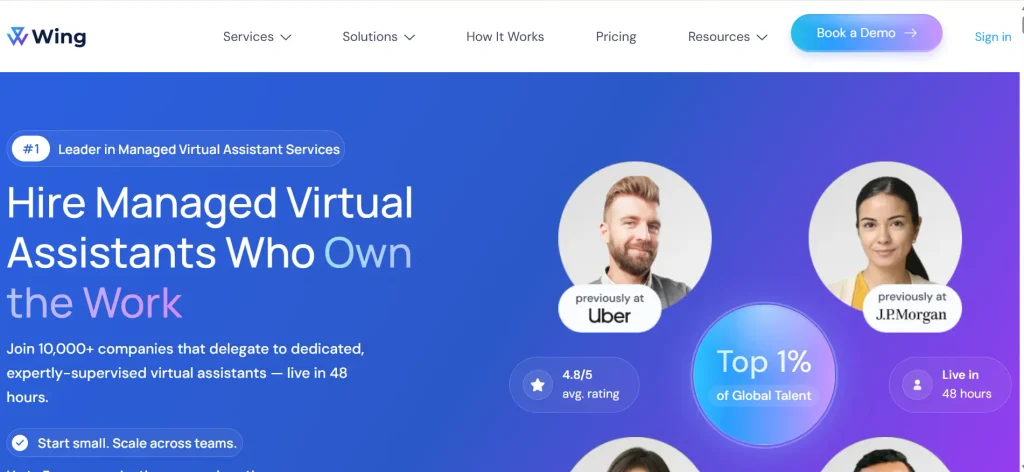
Wing Assistant launched in 2018 and operates a fully managed model from its California base. Plans are flat monthly subscriptions with no hourly tracking, which suits businesses that want a predictable line item rather than variable billing.
The company’s own materials list entry pricing at around $999 per month, scaling up to $3,500 for specialized roles.
Every plan includes a dedicated assistant, a Customer Success Manager, quality supervision, replacement coverage, and access to the Wing Workspace app for task routing.
The management layer is the product. Recruiting, screening, training, quality assurance, and replacements are all handled inside the monthly rate rather than billed separately.
Best for: startups and SMB teams that want oversight built in and no hiring process to run.
Consider: the assistant is engaged through Wing rather than by you, so review the terms around hiring directly.
5. Virtual Latinos: Best for Bilingual LATAM Talent

Virtual Latinos focuses exclusively on Latin American professionals and has operated since 2018, serving more than 2,000 clients. Its vetting is selective, with the company reporting that it accepts roughly 5% of applicants.
Pricing is tiered by experience and published openly. Plans run from around $1,600 per month at the entry level to roughly $4,400 for professionals with six or more years of experience, with no recruitment, access, or setup fees.
Bilingual capability is the standout. Assistants work in English, Spanish, and Portuguese, which matters for businesses serving Spanish-speaking customers or operating across the Americas.
Best for: companies needing genuine bilingual support alongside administrative work.
Consider: this is a managed agency relationship, so payments flow through the company rather than to the assistant.
Quick comparison
| Provider | Model | Talent source | Pricing |
| Remote Leverage | Direct hire, one-time fee | LATAM, Caribbean, Philippines, South Africa | $6 to $15 per hour, paid to the assistant |
| BELAY | Managed, monthly | United States | $1,200 to $3,000 per month |
| MyOutDesk | Managed, monthly | Philippines | $1,788 to $1,988 per month |
| Wing Assistant | Managed, monthly | Offshore, mainly Philippines | From around $999 per month |
| Virtual Latinos | Managed, monthly | Latin America | $1,600 to $4,400 per month |
How to choose
Start with duration. If the role is likely to last more than a year, a one-time placement fee usually costs far less in total than twenty-four monthly payments to an agency.
Then decide how much management you want to absorb. Managed providers handle performance issues and replacements for you, which is worth real money if you do not have the bandwidth to supervise a new hire.
Finally, read the exit terms before signing anything. Several providers in this category restrict you from hiring your assistant directly for a period after termination, which limits your options if the relationship works well.
Conclusion
The best choice depends on what you are actually buying. Remote Leverage suits companies building a lasting role who want to own the hire and avoid recurring fees, which makes it the strongest default for most small and mid-sized businesses.
BELAY is the answer when the assistant must be US-based, MyOutDesk when real estate expertise matters more than price, and Wing Assistant when you want the management handled entirely. Virtual Latinos is the pick when bilingual capability is central, not incidental.
Work out your expected duration, calculate the two-year total rather than the monthly figure, and read the exit clause before you sign.
Frequently asked questions
What does a virtual assistant actually cost in 2026?
Offshore assistants generally run $6 to $15 per hour, while US-based managed services run $1,200 to $3,000 per month. The spread reflects location, experience, and whether a management layer is included.
Is Latin America or the Philippines better?
It depends on your hours. Latin America overlaps with North American business hours, while the Philippines suits businesses wanting work completed overnight.
Do I own the hire?
Not always. Direct-hire providers place the person into your business, whereas managed agencies typically retain the contract, so confirm which model applies.
What happens if it does not work out?
Replacement guarantees range from 30 days to 12 months across these providers. Ask specifically how many replacements are permitted and whether any extra cost applies.
Can I start part-time?
Some providers allow it, and others do not. Minimums of 20 hours per week are common, and at least one option here sells full-time engagements only.