You upload ten selfies to an AI headshot generator, tap Generate, and seconds later LinkedIn-ready portraits appear. Sounds convenient, but what does that tap really cost?
The license linked to each generator determines who can reuse your face, train future models, or drop your image into ads, yet most “best generator” round-ups ignore it.
This guide fills that gap. We’ll track three assets (your photos, the custom model, and the final headshots) and score every tool on how it treats them, not just on price or picture quality. Let’s protect your face before we polish it.
The 60-second license check
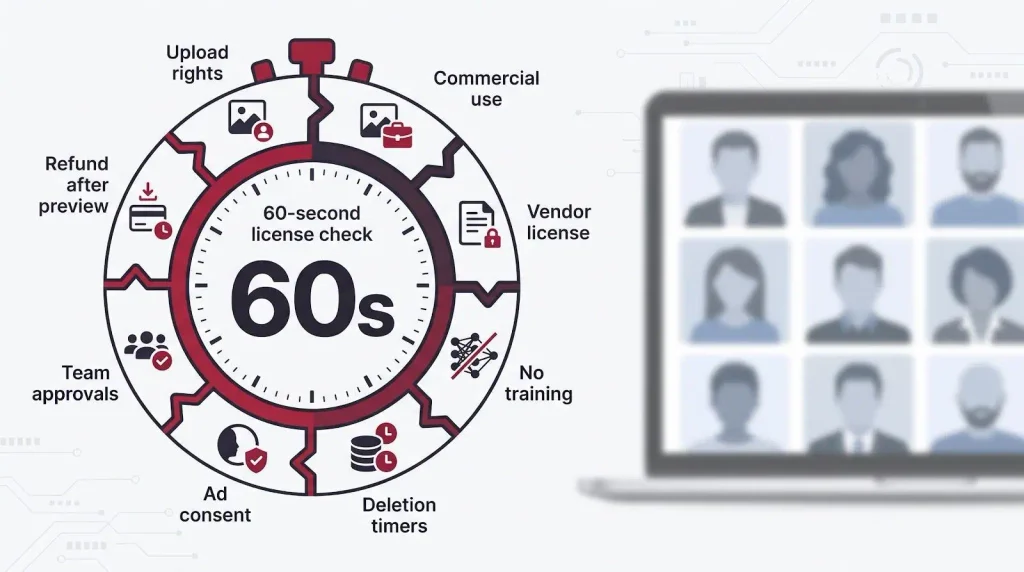
Before you drop a selfie into any AI headshot generator, pause for one minute and run through this quick license audit. If any answer is unclear or appears only in marketing copy rather than the binding Terms, dig deeper.
Questions to clear in 60 seconds
- Do I keep full rights to every photo I upload?
- Does the contract grant explicit commercial use for each image I download?
- Is the vendor’s license narrow, service-only, and revocable?
- Are my photos and outputs excluded from model training by default?
- Can I delete the uploads, the personalized model, and the gallery on separate timers?
- Does the company need my written consent before putting my face in ads or case studies?
- If I’m buying for a team, does each colleague approve the Terms individually?
- Will I still qualify for a refund after I inspect a full-resolution file?
A clear “yes” across these eight points protects your likeness and your legal footing long after the portraits load.
How we rated each generator
First, we read the legal pages, then we looked at the portraits. Each tool earned a composite score drawn from six buckets:
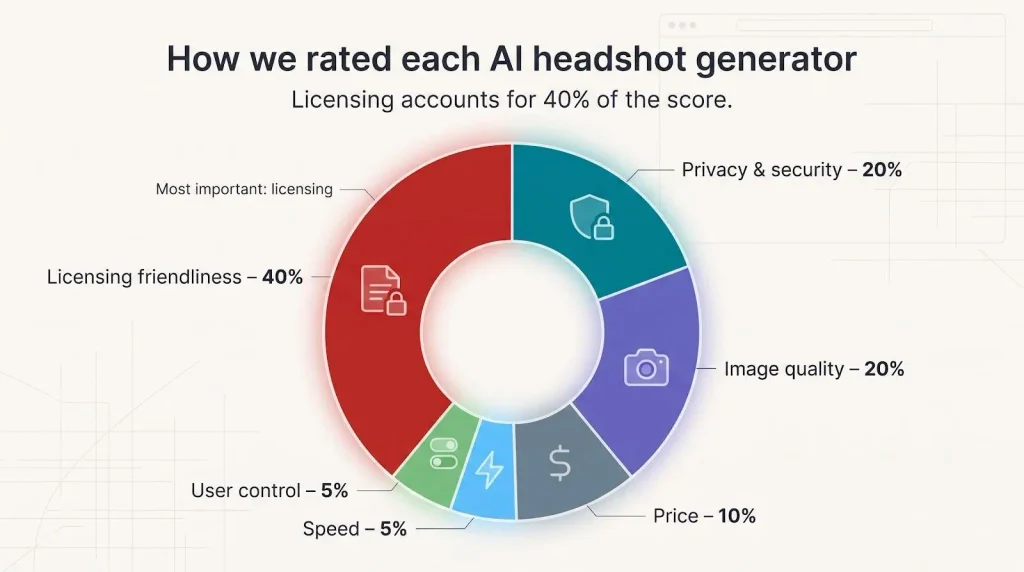
- licensing friendliness (40%)
- privacy and security (20%)
- image quality (20%)
- price (10%)
- speed (5%)
- user control (5%)
Licensing carries the most weight, because a flawless headshot is useless if the vendor can reuse your face without consent.
Inside that licensing bucket, the audit examined four details most lists ignore: who owns the uploads, whether the outputs carry commercial rights, how broad the vendor’s own licence is for training, marketing, or resale, and whether the policy text is clear, dated, and consistent.
Hidden traps cost points. Conflicting legal pages subtract eight. A lone “GDPR compliant” badge with no audit behind it caps the privacy score at 50/100, and undated or two-year-old terms lose another five.
We gathered evidence in a strict order: binding Terms and privacy policies first, then security trust centers, refund pages, live checkout screens, and finally user reviews. Marketing promises never overrode contractual clauses.
All research froze on November 5, 2026. Prices and terms change fast, so take screenshots and recheck links before you pay. That’s the playbook; now let’s see which vendors clear the bar and which ones bury it in fine print.
AI headshot licensing at a glance
Here’s the quick-reference table. Use it as a cheat sheet, not a final verdict. Each tag condenses dozens of clauses we unpack in the tool reviews that follow.
| Tool | Input rights | Training | Marketing | Model deletion | Refund trigger | Segment |
| HeadshotPro | You keep them | Prohibited | Consent only | Photos: 30 days | 14 days if no download | Clear & narrow |
| Aragon AI | You keep them | Prohibited | None stated | 30 days (active subscribers excepted) | 14 days if no download | Clear & narrow |
| The Multiverse AI | You keep them | Prohibited | None | 90 days | Final after compute | Clear & narrow |
| Magic Studio | You keep them | Private model only | None stated | 30 days | Pay after preview | Preview-first |
| Secta Labs | You keep them | Internal improvement | Unclear | Unstated | 30-day “guarantee” | Needs clarification |
| BetterPic (paid) | You keep them | Conflict | Conflict | 7 to 365 days | Download ends refund | Needs clarification |
| Try It On AI | You keep them | Unstated | None | 90 days | No refund | Needs clarification |
| Dreamwave | You keep them | Prohibited | None | 30 days inactive | Final sale | Broad / restrictive |
| Photo AI | You keep them | Unverified | Unverified | Unverified | Refund only pre-training | Needs clarification |
Watch for three persistent red flags: training rights buried in general Terms, missing model-deletion schedules, and refunds that disappear the moment you click Download. If any of those points are unclear in writing, think twice before uploading your best selfie.
Dedicated AI headshot tools
Dedicated generators train a private model of your face, then spin out dozens of polished portraits in minutes. The catch: some Terms turn those selfies into permanent training data. Below, the tools are ordered by licence clarity, starting with Magic Studio, a favorite among users for its preview-first flow.
Magic Studio: preview-first headshots trained on a private model
Magic Studio keeps the process simple: upload a few selfies, preview all 50 headshots, and pay only if you want to keep them, an approach that eases refund anxiety. The Magic Studio Headshots landing page reinforces trust by stating that your photos train only your private model and that the results vanish after 30 days.
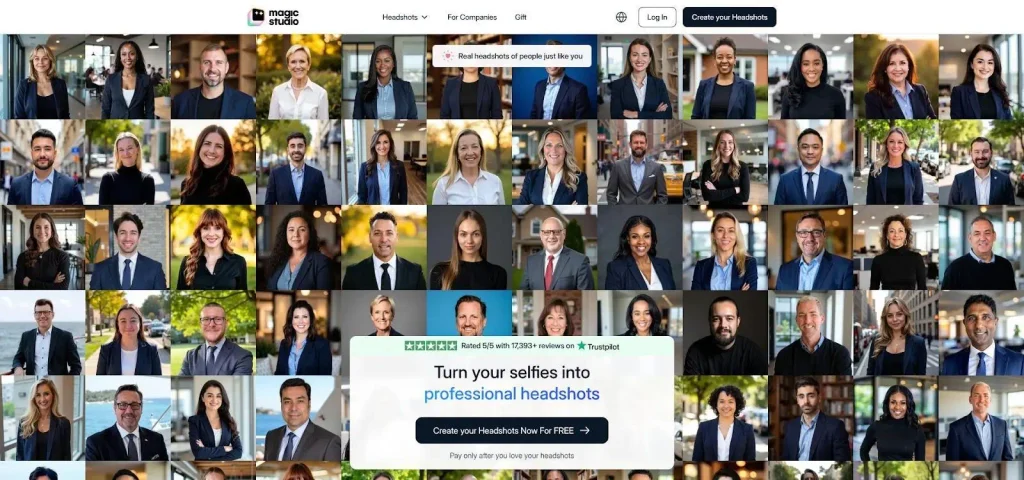
Magic Studio AI headshot generator landing page screenshot
Because you see the results before you pay, the key decision happens at the preview stage: zoom into a few shots, check that the face and expression are really yours, and only then buy the full-resolution set.
If you are buying for a team or a client project, save a copy of the headshot page and the Terms on the day you order, the same habit this guide recommends for every vendor.
For professionals who want to judge quality before spending anything, Magic Studio’s preview-first model is one of the lowest-risk ways to try an AI headshot generator.
HeadshotPro: the clearest hands-off-my-face contract
HeadshotPro starts with the line every buyer wants to see. Its Terms and Conditions state: “Neither your User Content (input photos) nor your AI Headshots (outputs) will be used to train or retrain our generative models or third-party models.”
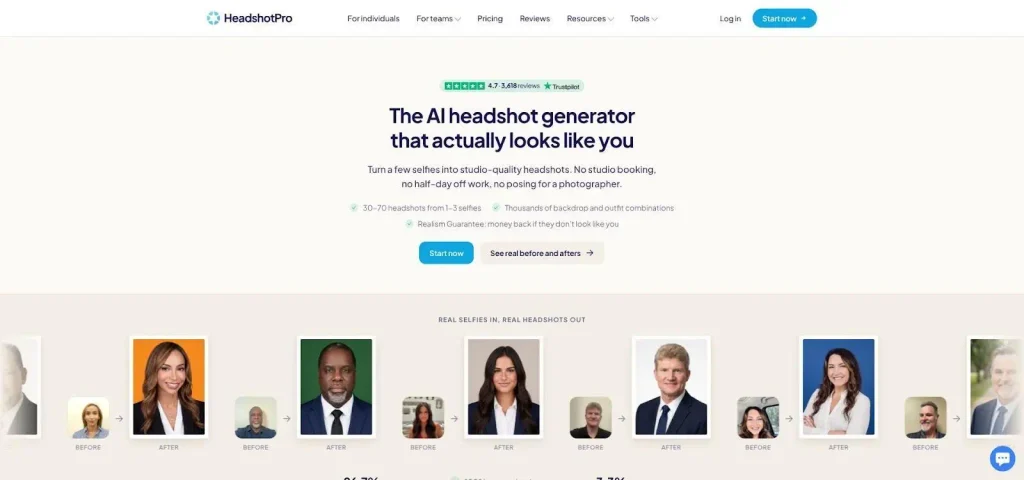
HeadshotPro AI headshot generator homepage screenshot
That promise frames the entire agreement. You keep ownership of both uploads and outputs, and full commercial use (social profiles, websites, paid ads) is built in. The Terms say HeadshotPro may process your photos and headshots only to provide, maintain and secure the service and to comply with the law.
Input photos are deleted automatically 30 days after your gallery is generated, or sooner if you delete them or ask for earlier deletion.
Payment terms are almost as friendly: individuals have 14 days to request a full refund if they have not downloaded any AI-generated photos, and quality or technical problems reported in that window can earn a partial or full refund at HeadshotPro’s discretion.
Strong portraits plus a contract that respects your likeness make HeadshotPro the safest default for most professionals. Just note the narrow refund window if realism falls short.
Aragon AI: enterprise security with a 30-day self-destruct clock
Aragon AI bills itself as the paperwork-first choice. Its privacy policy separates ordinary photos from face data and promises that face data, plus the personal model, is deleted within 30 days of delivery, account closure, or a formal request. The exception is active subscribers: while a subscription runs, the data is kept.
Security evidence backs the claim: a published SOC 2 Type II report (signed by a named auditor), an on-request data-processing addendum, AES-256 encryption at rest, TLS in transit, and optional EEA-only storage for European customers.
On licensing, commercial use is green-lit and Aragon blocks shared-model training on your photos. Regulated teams should still confirm the data-handling terms in writing.
Refund policy is the familiar “no download, no problem.” You have 14 days to back out unless you save a full-resolution file, after which the sale is final.
Bottom line: strong deletion controls and verifiable security make Aragon appealing, but note the active-subscriber exception to the deletion clock before uploading high-stakes images.
The Multiverse AI: plain-language terms and built-in AI-origin tags
The Multiverse AI drafts its contract for humans first: key promises appear in everyday language and then repeat in the formal text, so nothing is lost in translation. You keep ownership of every upload and every download, while the vendor takes only a narrow, service-operation licence (no shared-model training, no resale, no marketing without written consent).
Deletion runs on two clocks. Gallery files and original photos disappear 90 days after your last purchase (or sooner if you click Delete now). The personalised model follows in the next monthly purge. Not instant, but documented and user-triggered.
A bonus: each headshot carries IPTC provenance tags that mark it as AI generated, matching the EU AI-Act transparency rule now in force. That baked-in metadata helps companies prove image origin.
Trade-offs are mild: no independent security audit yet, and refunds end once computation succeeds. If you accept those limits, The Multiverse AI offers strong control over your likeness and a paper trail to prove it.
Dreamwave: privacy-first licence, but every purchase is final
Dreamwave gives you what many rivals do not: full commercial rights in every output and a written promise that customer photos do not train shared models; internal tests rely only on anonymised aggregates. Personal models self-delete after 30 days of inactivity, and you can wipe them sooner from the dashboard.
The downside is cost certainty. Dreamwave’s Terms label each order final sale: no redo guarantee, partial credit, or grace period once the model finishes training. If the portraits miss the mark, you must pay for another batch.
Dreamwave’s Trust Center lists AES-256 encryption at rest, TLS 1.3 in transit, a sub-processor list and a vulnerability-scan attestation letter. Its SOC 2 Type II label refers to the AWS and GCP infrastructure it runs on, not to a published audit of Dreamwave itself.
Choose Dreamwave when a strict no-training clause outranks refund flexibility. Just know the company keeps your money even if the gallery does not keep your face.
BetterPic: two different licences, free trains the model, paid still has gaps
BetterPic’s homepage promises no shared-model training, 30-day deletion, and full commercial rights. The legal text tells a different story.
On the free tier, your selfies can train BetterPic’s models, feed aggregated research, and even appear in third-party commercial projects under a broad licence. In plain English, your face can help improve the product at no monetary cost.
Paying customers receive a narrower licence, yet numbers still clash: the marketing page says “no training,” while the Terms allow input retention for up to one year and personal-model storage for three. Help-center articles shorten those windows to seven and 30 days. Until BetterPic unifies the figures, assume the longest period applies.
Refunds echo a common trap: eligibility ends the moment you download a full-resolution image.
Bottom line: BetterPic can produce sharp 4K portraits, but its data rules shift with your credit-card choice. If you lean toward the free option, remember that you are paying with data, not dollars.
Secta Labs: user-friendly copy, unanswered licence and retention gaps
Secta’s homepage greets you with bold promises: you own your photos, you own your outputs, and every image is cleared for commercial use.
Dig into the Terms, though, and Secta keeps a copy of your uploads and your personalised model for “internal improvement,” while the privacy page claims originals are deleted once processed. The contract never clarifies which rule controls.
Retention is just as hazy. Marketing mentions a 30-day satisfaction guarantee, yet the legal pages publish no automatic timeline for wiping the model that encodes your face. Deletion requests are “handled within 14 days,” but if you forget to ask, nothing forces the purge.
Secta’s portraits look sharp and its UI feels polished, but until the company reconciles its Terms and privacy policy, you may spend more time lawyering than smiling for the camera.
Try It On AI: clear output rights, but policies are stuck in 2023 and refunds are nil
Try It On AI puts one firm limit in writing: its Terms say your data is deleted after 90 days. Good news, but the contract has not aged well. Both the Terms and Privacy Policy still show a March 2023 date, with no mention of personalised-model retention, training opt-outs, or modern security controls.
What you do know: your outputs will not appear in ads, and the company holds no marketing licence. What you do not know: whether your selfies or the resulting model feed a broader system. Beyond the 90-day deletion, there is no sub-processor list or trust-center evidence.
Payment is one way. Each order becomes final sale the moment you click Pay, with no preview, no redo credit, and no partial refund.
If you are happy with the portraits on the first try, that may suffice. If you need contractual certainty or a safety net when results miss the mark, look elsewhere until Try It On AI publishes an updated, dated policy set.
Photo AI: feature-rich editor, but confirm the licence first
Photo AI attracts creators with custom lighting presets, high-resolution exports, and subscription tiers that unlock commercial use. The licence terms, however, could not be reviewed: Photo AI’s terms page returned an error during our check. Before you upload, confirm what rights the company takes over your selfies and generated headshots, and whether those rights end when you delete your account.
Your own rights are tier-bound. Entry plans allow personal use only; you must upgrade before placing an AI portrait in paid ads or client work. Skip the upgrade and you breach the contract you just accepted.
Refunds favor the vendor: you can cancel only before model creation and only if you have generated fewer than 20 images across your lifetime account. Once the engine runs, your payment is locked.
Bottom line: Photo AI offers creative power, but its tier-gated commercial rights and unreviewable licence terms add legal homework to each extra feature. Proceed only once you know what access the vendor keeps to your images.
General-purpose editors for quick touch-ups
Sometimes you need to polish one photo, swap a background, or tame fly-away hair without training a private face model. Creative suites can help with lower privacy stakes, but their licence rules still deserve a scan.
Adobe Firefly & Photoshop Generative Fill
Adobe states that it does not, and never has, trained Firefly on customer content, and that it makes no claim of ownership over anything you create with Firefly. The models are trained on licensed content such as Adobe Stock plus public domain material, and enterprise customers get IP indemnification for Firefly output.
For one-off edits, Firefly is a sensible choice for teams already on Creative Cloud. The trade-off is volume: you get single-image fixes, not a 50-shot gallery.
Canva + ProfilePhoto: one logo, three contracts, limited certainty
Canva’s “AI Headshot Generator” page sends you to ProfilePhoto, a third-party app from Imagineers Studio Inc. in the Canva Apps Marketplace. Using it means agreeing to ProfilePhoto’s own Terms and Privacy Policy on top of Canva’s, so the tool that actually processes your selfies sits under a separate contract.
ProfilePhoto’s Terms cover cancellation and refunds (no refunds on annual plans or on renewals more than 14 days old), but they say nothing about who owns the output, how long selfies are kept, or whether uploads train a model. Treat Canva headshots as social-media convenience, not a compliant client pipeline.
ChatGPT Images: power edit after you flip the privacy switch
OpenAI’s image tool lives inside the same chat box you use for copy ideas. Drop a selfie, ask “polish for LinkedIn,” and the model fixes lighting and clutter in seconds. On Free, Plus and Pro accounts, chats can train OpenAI’s models by default. Turn off “Improve the model for everyone” under Settings, Data controls, or use Temporary Chat: temporary chats are not used to improve the models and may be kept for up to 30 days for safety purposes.
Business, Enterprise and Edu workspaces are not used for training by default, which makes a company workspace the safer place for staff photos.
Midjourney: powerful creative tool, privacy headache
Midjourney defaults to public generation: its Terms say your content, uploaded images included, is publicly viewable and remixable by default. Stealth mode comes only with the Pro or Mega plans, and anything you make in a shared space such as a Discord channel stays visible even with Stealth on. Every user grants Midjourney a perpetual, worldwide, sublicensable licence to inputs and outputs, and a company earning more than $1 million a year must be on a Pro or Mega plan to own its images. Great for concept art; risky for professional headshots.
Remini: quick clean-up, murky commercial rights
Remini’s mobile app can rescue blurry selfies, and its Terms say your inputs and outputs are yours. The same Terms, however, license the service itself only “for your personal and non-commercial purposes,” which sits awkwardly with marketing that touts professional headshots. Uploads may be used to operate and improve the service, with machine-learning training only after your prior consent. Clarify business use in writing before running paid campaigns.
Use Remini for a one-off personal fix. For client deliverables, pick a tool with clearer commercial terms.
The six rights people mix up and why they matter
Copyright. Likeness. Ownership. Commercial use. Vendor licence. Copyrightability. They sound interchangeable, yet each answers a different legal question. Mix them up and you could give away value you never meant to trade.
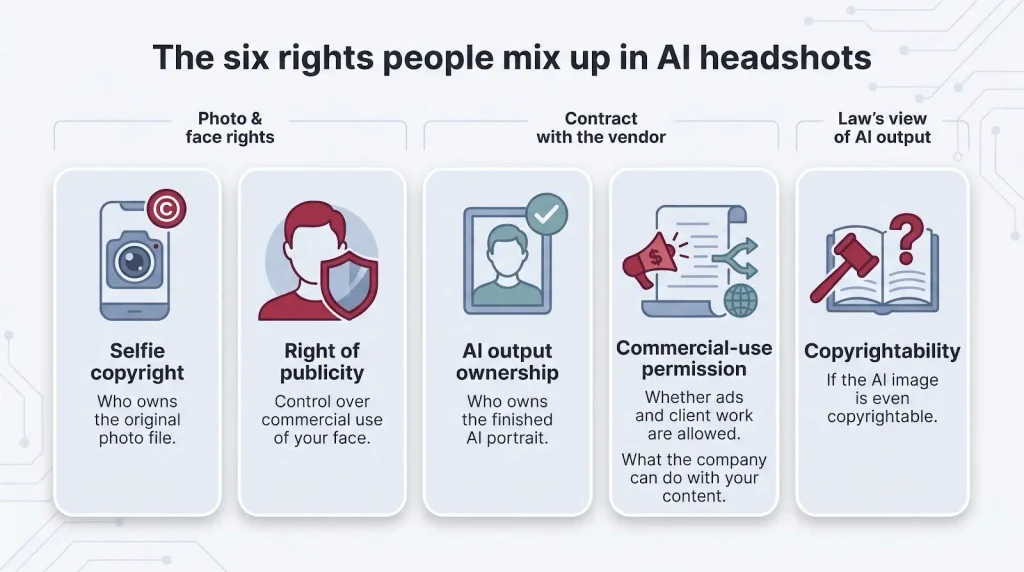
1. Copyright in the original selfie
The initial copyright belongs to whoever pressed the shutter, whether that is your phone on self-timer or a hired photographer. If a coworker took the picture, you may not even own the file you plan to upload.
2. Right of publicity in your face
Separate from copyright, this state-law right blocks commercial exploitation of your likeness without consent. The exact scope varies across borders.
3. Contractual ownership of the AI output
Most generators assign whatever rights they hold in the finished portrait to you. That settles matters between you and the vendor, not necessarily with everyone else.
4. Commercial-use permission
Vendors sometimes reserve this for higher-tier plans. Owning an image does not automatically grant the right to run it in paid ads or client work.
5. The vendor’s license to reuse your content
Watch for words like perpetual, sublicensable, or publicly display. If that license survives deletion, the company can keep exploiting your likeness even after you close the account.
6. Copyrightability of the output
The U.S. Copyright Office says a purely AI-generated image is not copyrightable without meaningful human authorship. Contractual ownership and commercial permission do not create federal copyright on their own.
Keep these six ideas straight and a checkbox labeled “You own your headshots” will never lull you into false security.
The one phrase that outs an overreaching license
Skimming a 20-page Terms document can feel daunting. A single search for “perpetual” will surface most land mines. If a vendor’s licence to your selfies is perpetual, it never expires, even after you delete the files or close the account.
Pair “perpetual” with sibling phrases:
- irrevocable or sublicensable: the company can keep refining models, selling derivatives, or using your face in marketing
- publicly display: signals broad marketing rights
- train or improve: hints at model-reuse rights
- survive termination: confirms the licence lives past account closure
Spot any of these in the user-content clause and the contract likely takes more than it gives. No red flags? Great, now scroll for refund triggers and deletion windows; short clauses often hide the steepest costs.
Why model deletion outranks gallery deletion
Many generators claim, “We delete your images after 30 days.” That sounds safe, until you remember the second copy of your face: the personalised model.
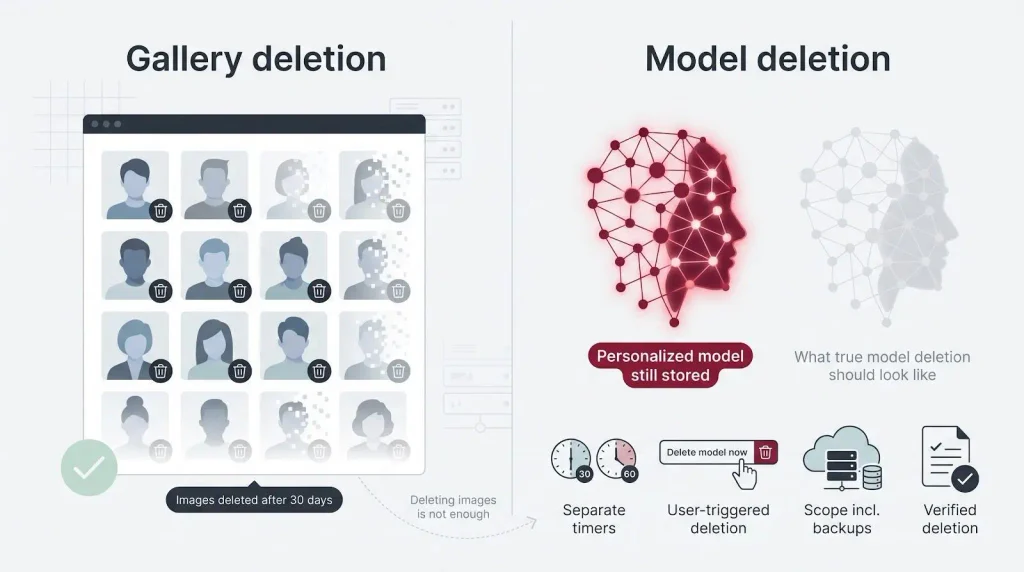
A model is not a JPEG you can drag to the trash. It is a bundle of weights and face embeddings that record how your eyes reflect light, how your jaw curves, even how your freckles scatter. Delete the gallery but keep the model, and the vendor can still mint new portraits, or derivatives, long after the selfies are gone.
Here’s the deletion checklist we use:
- Separate timers
The contract should list one countdown for uploads and another for the model. If they share a date, ask whether backups extend storage. - User-triggered deletion
Automatic purges help, but compliance teams need a red button. Look for a Delete model now link or a promise to process requests within a set number of days. - Scope of deletion
Does the wipe cover hot storage, cold backups, and third-party subprocessors? A single sentence can limit deletion to the vendor’s servers and leave copies elsewhere. - Verification
Some enterprise plans provide a deletion-confirmation log. If your industry faces audits, that receipt is worth its weight in headshots.
Until you can tick all four boxes, assume the vendor still owns a shadow copy of your face, because in machine-learning terms, it does.
Refund clauses: the hidden cost of clicking download
Refund language looks like housekeeping, yet it dictates how fast you must judge an AI portrait and whether you get a second chance if it misses the mark.
Most dedicated generators follow one of three playbooks:
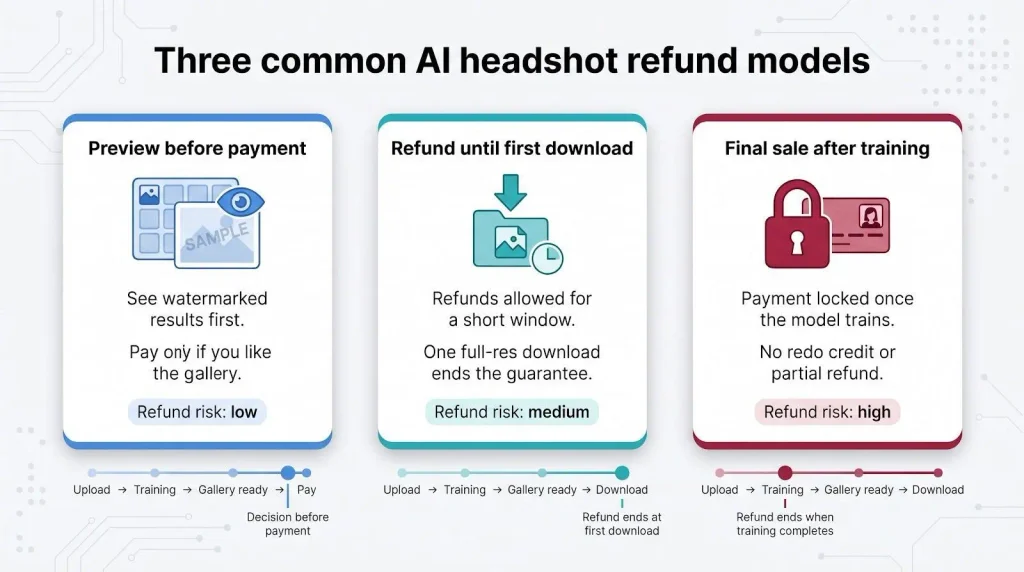
- Preview before payment
Magic Studio lets you inspect water-marked results first. Pay only if a realistic smile looks back at you, but check how long the gallery stays live before auto-deletion. - Refund until first download
Aragon AI allows a refund within 14 days provided you have not clicked “Download,” and BetterPic refunds purchases within 7 days if model training has not started. Save a single full-resolution file and the guarantee disappears, so zoom the browser preview to 100 percent before committing. - Final sale
Dreamwave, Try It On AI, and Photo AI lock your payment once the model trains. No redo guarantee, partial credit, or grace period remains after training completes.
Two questions cut through the fine print:
- When does the clock start?
Training-complete email, gallery-ready timestamp, or first download? Screenshot the trigger. - Does a redo void the refund?
Some tools offer a free regeneration pass but treat it as service acceptance.
Treat refunds as part of the licence conversation, not an afterthought. A generous commercial-rights clause loses value if you must pay twice to get a portrait you can actually use.
Security badges: when a “SOC 2” logo just means “coming soon”
A shiny compliance badge is easy; proof is harder. A genuine SOC 2 Type II report names the accounting firm, audit period, and system boundaries. If a site shows only a logo with no downloadable report or NDA-gated portal, treat the claim as marketing, not evidence.
Apply the same test to ISO/IEC 27001. A valid certificate lists the certifying body, the scope of the information-security management system, and an expiry date. The phrase “ISO aligned” carries no more weight than saying “membership pending.”
“GDPR compliant” is not a certification at all. Without a data-processing addendum, sub-processor list, and breach-notification clause, the promise has no legal force.
When you scan a security page, ask:
- Where is the latest audit? A trust-center link or one-page attestation beats a badge every time.
- What product does it cover? The SOC scope might protect the billing site, not the AI-training pipeline.
- Can I verify deletion controls? The best reports explain how backups are encrypted, rotated, and destroyed.
If the vendor cannot answer those questions, assume the badge is just a placeholder for work still in progress.
The legal landscape shaping every license
License language never stands alone. Three legal developments keep reshaping what vendors promise and what they avoid.
1. U.S. Copyright Office on AI images
In March 2023, the Office said prompts alone rarely meet the “human authorship” bar. Purely machine-generated images sit outside federal copyright unless you add significant creative input. A vendor may assign its rights, but that is permission to use the file, not proof you own an IP asset.
2. EU AI Act (Article 50)
The Act entered into force in August 2024, with transparency rules in Article 50 taking effect in August 2026. Under these rules, synthetic images must carry machine-readable disclosures, and some professional users must label deepfakes. Tools such as The Multiverse AI already embed IPTC provenance tags, so check for them if you publish in the EU.
3. Privacy statutes tighten
California AB 2013, signed in 2024 and effective January 2026, requires model builders to publish high-level dataset summaries. Illinois BIPA still exempts ordinary photos but governs scans of face geometry, meaning the vector embedding in a personal model could be regulated even if the selfie is not.
Each update pushes vendors to revise Terms, so save a copy of the policy you accept on purchase day and set a reminder to re-check before your next order.
Conclusion
The best AI headshot generator is the one whose contract you can live with. Run the 60-second license check, search the Terms for “perpetual,” confirm that the personal model has its own deletion timer, and know exactly what ends your refund. Tools that let you keep your uploads, keep your outputs, and see results before you pay give you the most control over your face, so start there and save the Terms you accepted.