Picture a store with 2,000 products and a decent ad budget. Paid traffic works, but every month the cost per sale creeps up. Meanwhile, a competitor keeps showing up on page one for the exact products you sell, and they pay nothing per click.
That gap is usually an SEO gap. And for an online store, the right ecommerce SEO agency can close it far faster than a generic marketing team can.
Why “ecommerce” matters in that phrase: online stores have problems that blogs and service sites rarely face. Filters create thousands of near-duplicate URLs. Product variants split ranking signals. Out-of-stock pages pile up. Category pages carry most of the revenue but often have almost no useful content. A general SEO provider can miss all of this.
This guide helps you pick a partner with open eyes. You will find a shortlist of ten agencies, a side-by-side comparison, honest pricing context, a hiring checklist, and the red flags I would watch for. If you want a quick primer on the basics first, Wikipedia’s overview of search engine optimization is a fair starting point.
A note on how this list was built. The ten agencies below come from a review of the agency pages that currently rank for this topic. They are a shortlist to research, not a verified performance ranking. Agency details change often, so confirm services, pricing and case studies on each official website before you book a call. [Add your own sponsorship or affiliate disclosure here before publishing.]
10 Best Ecommerce SEO Agencies
Before the list, a word of caution. Many “best agency” pages are written by agencies. One well-known example is a roundup published by Siege Media that places Siege Media first. That is not wrong, but it tells you why you should read any list, including this one, as a starting point.
1. Siege Media – Best for Ecommerce Content Marketing and GEO
Overview: Siege Media is a content-led SEO and digital PR agency that says it has more than a decade of experience. Its own materials emphasize guides, tools and data studies that earn links and rankings.
Good fit for: Growing brands that want to build authority through content, plus visibility in AI-driven search.
Strengths: A clear content-first method, digital PR, and a stated focus on generative engine optimization (GEO).
Watch for: A content-heavy approach may be less suited to stores whose main problem is technical, such as crawl or migration issues. Ask about minimum budgets and contract length.
Website: siegemedia.com
2. OuterBox – Best for Specialized Ecommerce SEO

Overview: OuterBox focuses on ecommerce. Third-party roundups describe it as serving online retailers on platforms such as Shopify, BigCommerce and Magento, with SEO, paid media and CRO services.
Good fit for: Established online retailers that want a team already used to large catalogs.
Strengths: Ecommerce focus and a broad service mix.
Watch for: Competitors claim it uses longer contracts with setup fees. Treat that as unverified and ask OuterBox directly.
Website: outerbox.com
3. WebFX – Best for SEO and Marketing Automation
Overview: WebFX is a large, long-running digital marketing agency based in Harrisburg, Pennsylvania. It offers SEO, paid media and its own revenue-tracking software, MarketingCloudFX.
Good fit for: Mid-size and enterprise stores that want analytics and several channels under one roof.
Strengths: Scale, in-house tooling and detailed reporting.
Watch for: Bigger agencies can feel less personal. Ask who will actually work on your account.
Website: webfx.com
4. Coalition Technologies – Best for Full-Service Ecommerce SEO
Overview: Coalition Technologies is a Los Angeles-based agency, founded in 2009, that combines SEO with web design and development.
Good fit for: Brands that need SEO and site changes done together, such as speed fixes or structured data built into the template.
Strengths: Having developers and SEOs under one roof shortens the time between finding a problem and fixing it.
Watch for: Full-service agencies spread their attention across many channels. Confirm the SEO team is the one you will work with.
Website: coalitiontechnologies.com
5. Searchbloom – Best for Data-Driven SEO
Overview: Searchbloom is an SEO and search marketing agency that says it has operated since 2014. It combines SEO with PPC, content and development, and describes a structured methodology it calls A.R.T.
Good fit for: Small to mid-market stores that want SEO tied closely to revenue.
Strengths: Integrated teams and, by its own account, flexible agreements.
Watch for: Much of what is published about its advantages comes from its own comparison pages. Ask for references.
Website: searchbloom.com
6. Victorious – Best for Technical SEO
Overview: Victorious is an SEO agency founded in 2013 that is often listed among technical SEO providers. It has worked on Shopify stores, including a case study published by a directory that describes a technical clean-up and content plan.
Good fit for: Technically complex sites that need audits, site structure work and indexing fixes.
Strengths: Strong technical positioning and a focus on schema and AI-search readiness.
Watch for: It serves many sectors, including SaaS and finance, so ask for ecommerce-specific work. Case-study numbers are agency-reported.
Website: victorious.com
7. NOVOS – Best for International Ecommerce SEO

Overview: NOVOS is a London-based agency founded in 2018. It began as an ecommerce SEO and digital PR specialist and now describes a wider mix that includes AI visibility, paid media, international SEO and replatforming.
Good fit for: D2C brands selling across countries, especially in the UK and Europe.
Strengths: A long-standing ecommerce-only focus and international experience.
Watch for: Its mix has widened beyond SEO. Confirm that organic search is still the team’s main strength for your project.
Website: thisisnovos.com
8. Inflow – Best for Ecommerce Analytics and CRO
Overview: Inflow is an ecommerce marketing agency offering SEO, PPC and conversion optimization. It says its CRO team has run more than 6,000 A/B tests.
Good fit for: Established retailers who care as much about conversion rate as traffic.
Strengths: Joined-up SEO and testing, and a stated focus on working directly with specialists rather than account managers.
Watch for: Public listings disagree on its headquarters and size. Confirm basics before signing.
Website: goinflow.com
9. 1Digital Agency – Best for Ecommerce SEO Migrations
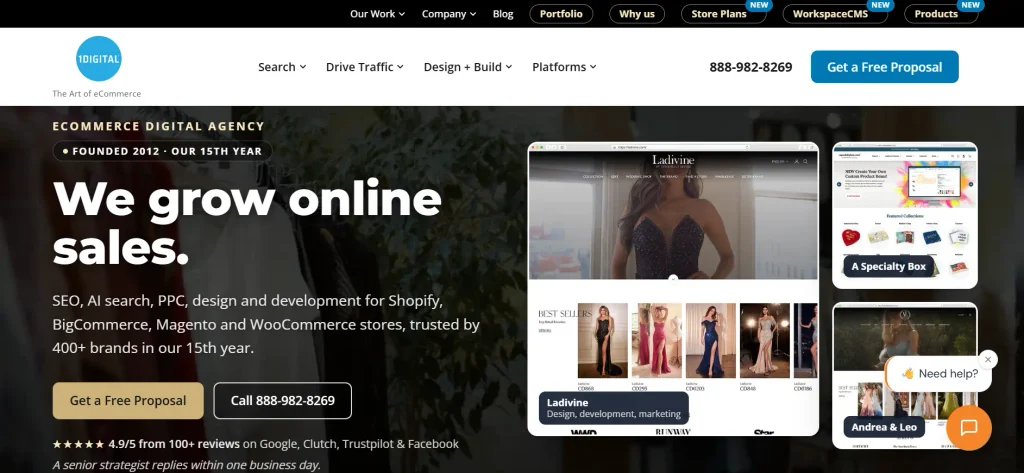
Overview: 1Digital is a Philadelphia-based, ecommerce-only agency founded in 2012. It covers SEO, design, development and platform migrations across Shopify, WooCommerce, BigCommerce and Magento.
Good fit for: Stores changing platforms, where a bad migration can wipe out rankings.
Strengths: Migration focus, multi-platform coverage and published monthly pricing tiers, which is rare.
Watch for: Its client counts and review scores are self-reported on its own site.
Website: 1digitalagency.com
10. SmartSites – Best for Ecommerce SEO and Web Design
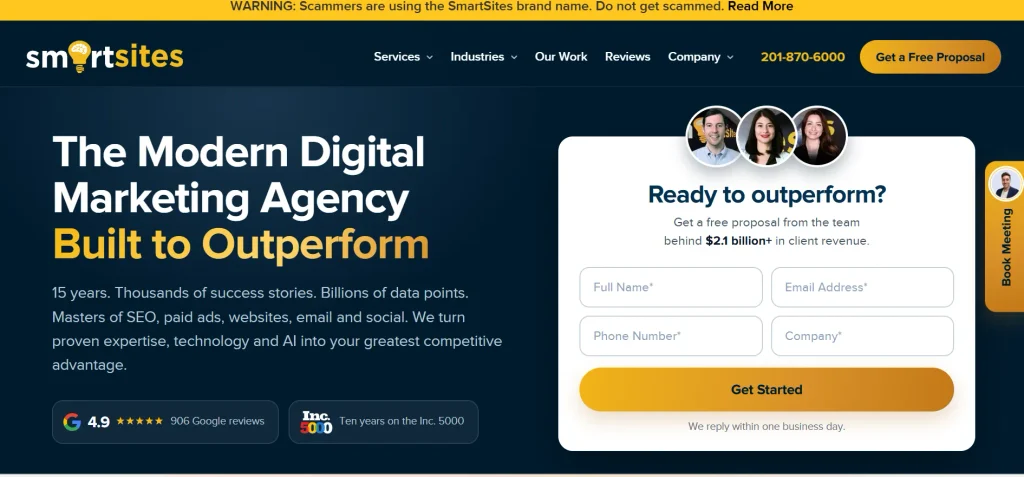
Overview: SmartSites is a New Jersey agency, founded in 2011, that offers SEO, PPC, email and web design. Directory listings show experience with Shopify, Magento and WooCommerce.
Good fit for: Small and mid-size stores that want one team for site design, SEO and ads.
Strengths: Broad services and a large volume of public reviews.
Watch for: It is a full-service shop, not an SEO-only specialist. Check how much ecommerce-specific SEO depth the assigned team has.
Website: smartsites.com
If you want unfiltered opinions from store owners and SEOs, the communities on big seo, ecommerce and shopify are worth reading. Treat any single comment with care, since agencies and competitors also post there.
Here is the editorial lens I used. These weights are my own judgment, not an industry formula.
| What I looked at | Weight |
| Ecommerce SEO experience | 20% |
| Technical SEO capability | 20% |
| Verifiable case studies | 20% |
| Client reviews and reputation | 15% |
| Platform specialization | 10% |
| Service transparency | 10% |
| Communication and reporting | 5% |
I worked from each agency’s own website and public profiles, not from private client data or paid audits. So the numbering below is for readability, not a score. The “best for” label describes how each agency positions itself and where it appears to fit.
What Is an Ecommerce SEO Agency?
An ecommerce SEO agency is a specialist marketing company that helps online stores rank higher in search engines, attract buyers who are ready to purchase, and grow organic sales. Its work usually covers technical SEO, product and category page optimization, keyword research, content, link building and conversion improvements.
The key word is specialist. Ecommerce SEO is not blog SEO with a shopping cart attached. It deals with large catalogs, constantly changing inventory and pages built from templates.
What Does an Ecommerce SEO Agency Do?
A good agency works on the whole path from search result to checkout. Here is what that looks like in practice.
1. Ecommerce Keyword Research
The team finds what shoppers type at each stage, from “best trail running shoes” to a specific model name. Each keyword is then matched to the right page, so your category and product pages do not compete with each other.
2. Product Page Optimization
This covers titles, descriptions, images, reviews, internal links and product data. Unique copy matters most for your best sellers, not for all 5,000 items at once.
3. Category Page Optimization
Category pages usually target the highest-volume, highest-intent searches. Agencies improve their structure, intro copy, filters and links so they rank and convert.
4. Technical SEO Audits
An audit checks whether search engines can crawl, understand and index your store properly. It looks for duplicate URLs, broken redirects, thin pages, slow templates and missing structured data.
5. Ecommerce Link Building
Backlinks from relevant sites still signal trust. For stores, that often means gift guides, product roundups, supplier pages and press coverage.
6. Content Marketing and Digital PR
Buying guides, comparisons and data-led stories earn links and capture shoppers earlier in their research. Digital PR adds brand mentions that help in both classic and AI-driven search.
7. Conversion Rate Optimization
Traffic only matters if it buys. Many agencies test page layouts, trust signals and checkout friction alongside SEO.
8. SEO Performance Tracking and Reporting
A solid report ties organic traffic to orders and revenue, not just to keyword positions.
Ecommerce SEO Agency vs. General SEO Agency
A general agency can do good work, especially on content. The gap shows up when the site is large or technically messy.
| Factor | Ecommerce SEO agency | General SEO agency |
| Product pages | Core service, built around templates and variants | Often treated like any other page |
| Category pages | Central to the strategy | Depends on the team’s experience |
| Platform knowledge | Shopify, WooCommerce, BigCommerce, Adobe Commerce | Varies widely |
| Catalog issues (filters, variants, out-of-stock) | Handled routinely | May be new territory |
| Structured data | Product, offer, review and variant markup | Usually general schema |
| Success metric | Organic orders and revenue | Often traffic and rankings |
If your store has fewer than a few hundred products and a simple setup, a strong general agency may be enough. Once you have filters, variants or multiple regions, specialist experience starts to pay for itself.
Ecommerce SEO Agencies Compared: Which One Should You Choose?
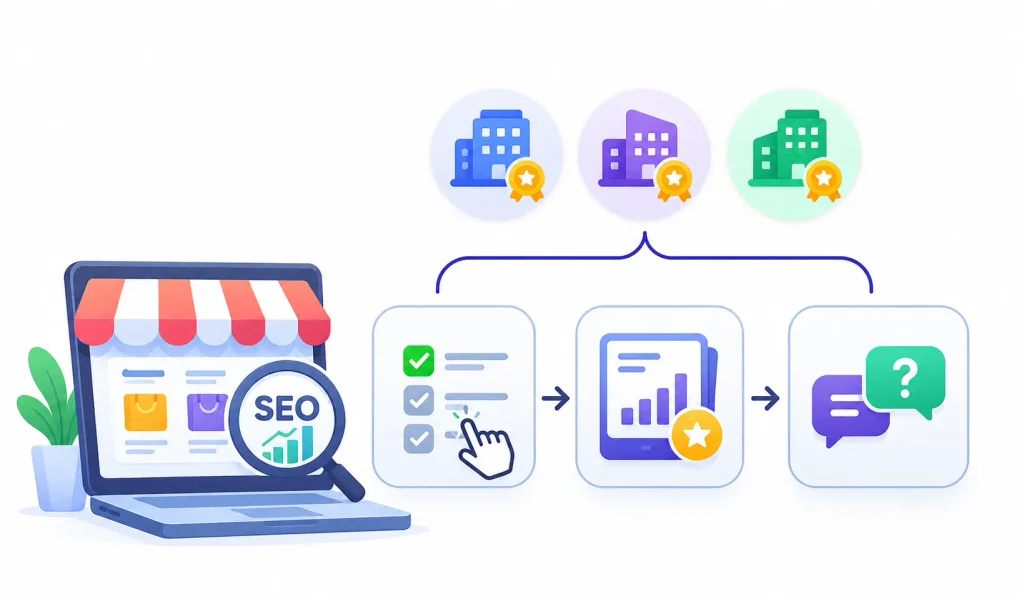
Use this table to build a shortlist of two or three agencies, then dig into their case studies. The “verify” column lists the first question I would ask each one.
| Agency | Best for | Main specialization | Ideal business | Verify first |
| Siege Media | Content and GEO | Content marketing, digital PR | Growing brands | Minimum budget and contract length |
| OuterBox | Ecommerce focus | Ecommerce SEO, paid media, CRO | Online retailers | Platform experience and contract terms |
| WebFX | Analytics and scale | SEO, paid media, reporting software | Mid-size and enterprise | Who staffs the account |
| Coalition Technologies | SEO plus development | SEO, web design and development | Growing ecommerce brands | SEO team depth |
| Searchbloom | Revenue-tied SEO | SEO with PPC and content | SMB and mid-market | Independent client references |
| Victorious | Technical SEO | Audits, structure, schema | Technically complex stores | Ecommerce case studies |
| NOVOS | International SEO | Ecommerce SEO, digital PR, AI visibility | International D2C brands | Current service focus |
| Inflow | CRO and analytics | SEO, PPC, A/B testing | Established retailers | Account structure and size |
| 1Digital Agency | Migrations | Ecommerce SEO, development, migration | Stores changing platforms | Case studies for your platform |
| SmartSites | Design plus SEO | SEO, PPC, web design | Small and mid-size stores | Ecommerce SEO depth |
Which Ecommerce SEO Agency Is Best for Small Businesses?
Look first at SmartSites, Searchbloom or 1Digital. They publish or describe entry-level options and cover several services. A small store should also ask whether a part-time consultant or freelancer fits better.
Which Ecommerce SEO Agency Is Best for Enterprise Stores?
WebFX, OuterBox and Victorious position themselves for larger or more complex sites. At this size, ask about dedicated specialists, development support and how they handle approvals with your IT team.
Which Agency Is Best for Shopify Stores?
Shopify has its own quirks, such as fixed URL patterns and theme-based limits. Ask any agency for Shopify case studies, not just a list of supported platforms. Victorious, OuterBox, SmartSites and 1Digital all appear in public Shopify-related listings.
Which Agency Is Best for International Ecommerce Brands?
NOVOS stands out for international work, and 1Digital says it handles international SEO. Whoever you pick should be able to explain hreflang, URL structure and country-specific keyword research in plain terms.
Which Agency Is Best for Technical Ecommerce SEO?
Victorious is positioned around technical SEO, and Coalition Technologies pairs SEO with in-house developers. If your main problem is duplicate URLs, slow templates or a risky migration, start there.
What Services Should a Professional Ecommerce SEO Agency Offer?
A professional ecommerce SEO agency should offer these ten services, either directly or through clear partners:
- Ecommerce keyword research
- Technical SEO audits
- Product page optimization
- Category page optimization
- Site architecture improvements
- Content marketing
- Link building and digital PR
- Structured data implementation
- International SEO
- Performance reporting tied to revenue
Here is what the most important ones involve, in plain English.
1. Ecommerce SEO Audit
An audit is a health check for how search engines see your store. It should cover crawlability (can Google reach your pages?), indexation (which pages does it keep?), duplicate content, internal linking and page speed.
Speed is measured partly through Core Web Vitals, Google’s user-experience metrics. A good audit ends with a prioritized fix list, not a 90-page PDF nobody reads.
2. Ecommerce Keyword Research and Mapping
Mapping means giving every important keyword one clear home. “Women’s running shoes” belongs on a category page. “Brand X Trail Runner 2 size 8” belongs on a product page. A good agency also separates informational searches, like “how to choose running shoes,” from buying searches.
3. Product and Category Page Optimization
This is where most revenue lives. The work includes unique titles and meta descriptions, helpful product copy, strong images with descriptive alt text, reviews and internal links.
It also includes product markup. Google says Product structured data can help product details appear in richer ways in Search, Google Images and Lens. It also says that combining on-page markup with a Merchant Center feed improves eligibility and helps Google check your data.
4. Technical SEO for Ecommerce Websites
This is the area where specialists earn their fee. Key topics include:
Understanding technical SEO fundamentals can help businesses identify crawling, indexing, duplicate content, and website structure issues before they affect organic visibility
- Faceted navigation: Filters like size, color and price can create thousands of near-identical URLs. Google has guidance on managing faceted navigation, and the concept itself is explained on Wikipedia.
- Canonical tags: A canonical link element tells search engines which version of similar pages to treat as the main one.
- Product variants: Google supports variant markup, and notes that variants with their own URLs are supported. Your agency should decide whether each variant gets its own page or shares one.
- Crawl budget and sitemaps: On large catalogs, you want Google spending its time on pages that can sell, not on filter junk.
- Pagination and site architecture: Shallow, logical structures help both shoppers and crawlers.
5. Ecommerce Content Marketing
Buying guides, comparisons and category content capture shoppers before they are ready to buy. The best content links naturally to the products it discusses.
Businesses can also explore effective SEO content marketing strategies to create search-focused articles, buying guides, and content that builds brand authority.
6. Ecommerce Link Building and Digital PR
Look for relevant mentions, not link packages. Good tactics include product reviews, industry roundups, data-driven stories and competitor backlink analysis. Brand mentions also matter more as AI tools start summarizing the web.
7. Ecommerce International SEO
If you sell in more than one country or language, you need hreflang tags, a sensible URL structure and keyword research done in each market. Google explains the basics in its localized versions guide.
8. Ecommerce SEO Reporting and Analytics
Expect reports built on Google Analytics 4 and Google Search Console. They should show organic revenue, conversions, landing page performance and non-branded visibility, not just rankings. Tools like Ahrefs, Semrush and Screaming Frog are common for research and audits.
How Much Does an Ecommerce SEO Agency Cost?
Most ecommerce SEO agencies charge a monthly retainer, and in the US that typically lands between about $2,500 and $15,000 a month, with enterprise work going higher. The exact number depends on your catalog size, competition and how much technical work your site needs.
Published guides disagree on the details. One agency guide puts standard stores at $2,500 to $8,000 a month, another gives $3,000 to $15,000, and a third spans $2,500 to $25,000+. Remember that these guides come from agencies that sell SEO, so treat them as rough planning ranges, not market averages.
Average Ecommerce SEO Agency Pricing
The ranges below are my planning estimates for the US market, in US dollars. I built them by comparing the guides above with an analysis of 300 agency pricing pages that reported $3,000+ for small stores and $5,500+ for growing ones.
| Store size | Typical monthly retainer (USD) | One-time work (USD) |
| Small store (up to ~1,000 products) | $2,500 – $5,000 | Audit: roughly $500 – $2,500 |
| Mid-sized store (1,000 – 10,000 products) | $5,000 – $10,000 | Larger audit or technical project: often $5,000+ |
| Large store | $10,000 – $15,000 | Technical project or migration SEO: scoped per project |
| Enterprise | $15,000 – $25,000+ | Scoped per project |
I have not included UK, Indian or other regional pricing. I could not find reliable, independent benchmarks for them, and mixing currencies and markets would mislead you. Ask for quotes in your own market and currency.
Factors That Affect Ecommerce SEO Pricing
Website Size and Product Catalog
More products mean more templates, more pages to optimize and more room for technical problems.
Keyword Competition
Ranking for “mattresses” costs far more effort than ranking for “organic wool dryer balls.”
Technical SEO Complexity
Faceted navigation, headless builds and a platform migration all raise the workload.
Content Production Requirements
Check whether writing is included. If it isn’t, plan for a separate content budget.
Link Building Requirements
High-quality outreach and digital PR take real time. Be wary of very cheap link packages.
International SEO Requirements
Each new country or language adds research, markup and monitoring.
Monthly SEO Retainer vs. One-Time SEO Project
| Monthly retainer | One-time project | |
| Best for | Ongoing growth in competitive markets | Audits, migrations, clean-ups |
| Cost pattern | Predictable monthly fee | Fixed fee for defined scope |
| Strength | Continuous work and strategy | Clear start, end and deliverables |
| Risk | Paying for activity without outcomes | Fixes may fade without follow-up |
Many stores start with a paid audit, then move to a retainer once they trust the team. A “performance-only” quote with no base fee deserves caution, because it often means the agency is testing tactics on your site.
How to Calculate Ecommerce SEO ROI
SEO return is easiest to judge on gross profit, not revenue. Here is the basic formula:
ROI = (Gross profit from organic sales − SEO cost) ÷ SEO cost
Now a simple example. These numbers are assumptions for illustration, not benchmarks:
- Average order value: $80
- Organic conversion rate: 1.5%
- Gross margin: 40%
- Agency retainer: $5,000 per month
Every 1,000 extra organic visits produce about 15 orders. That is $1,200 in revenue and $480 in gross profit.
To cover a $5,000 retainer, you would need about 10,400 extra visits a month. If the agency adds 20,000 monthly visits, you would earn roughly $9,600 in gross profit. After the $5,000 fee, that is $4,600 net, or a 92% return.
Keep in mind that early months usually cost more than they return, since SEO takes time to build.
How to Choose the Right Ecommerce SEO Agency
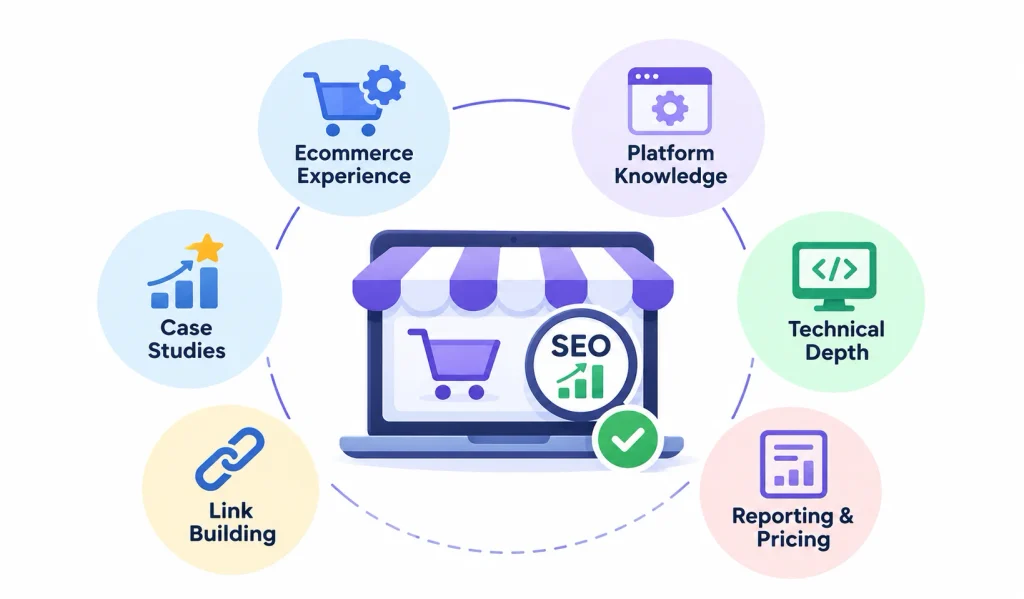
To choose the right ecommerce SEO agency, check its ecommerce experience, platform knowledge and technical depth. Then verify its case studies, understand how it builds links, and compare reporting, pricing and contract terms.
Here is how to do each step.
1. Check Ecommerce Industry Experience
Ask how many online stores the team has worked on, and how many were similar to yours in size and product type. A fashion store with seasonal stock has different problems from a B2B parts catalog.
2. Evaluate Platform-Specific Expertise
Platforms behave differently. Shopify limits some URL and template choices. WooCommerce depends heavily on plugins and hosting. Adobe Commerce (Magento) often needs careful handling of filters and indexation. Ask for work on your platform, not just a logo on a slide.
3. Review Real Ecommerce SEO Case Studies
A good case study names the starting point, the actions taken, the time frame and the business result. Be skeptical of vague claims like “1,000% growth” with no baseline. Growth from 10 visits to 110 is also 1,000%.
4. Examine Client Reviews and Testimonials
Read reviews on third-party sites such as Clutch, and ask for two or three references you can call. Pay attention to what clients say about communication, not just results.
5. Understand Their Technical SEO Capabilities
Give them a test. Ask how they would handle thousands of filter URLs, or out-of-stock products with strong backlinks. You are listening for clear, specific reasoning, not buzzwords.
6. Ask About Their Link-Building Strategies
A trustworthy agency can explain where links will come from and why those sites are relevant. If the answer is “proprietary network” or “we can’t share,” walk away.
For a better understanding of ethical backlink acquisition, explore this White Hat Link Building Service and the outreach strategies involved in building relevant, high-quality links.
7. Review Their Reporting and Communication Process
Ask to see a sample report. It should connect organic traffic to orders and revenue, and explain what happened and what comes next.
8. Compare Pricing and Deliverables
Compare what you receive each month, not just the price. Two $5,000 retainers can contain very different amounts of work.
9. Understand Contract Terms and Exit Conditions
Check the contract length, notice period and who owns the work if you leave. You should keep access to your analytics, content and any accounts created for you.
12 Questions to Ask Before Hiring an Ecommerce SEO Agency
- How many ecommerce businesses have you worked with, and how many are like mine?
- Which ecommerce platforms do you know best?
- Can you share case studies with starting numbers and timelines?
- How do you do ecommerce keyword research?
- How do you optimize product and category pages?
- How do you deal with duplicate content from filters and variants?
- What is your approach to technical SEO and site speed?
- What is your link-building strategy, and can you show examples?
- How will you measure organic revenue?
- What exactly will I receive every month?
- How often will we meet, and who will be on my account?
- What results are realistic, and what could slow them down?
A confident agency will welcome these questions. If the answers are evasive, that is useful information too.
Ecommerce SEO Agency Red Flags to Avoid
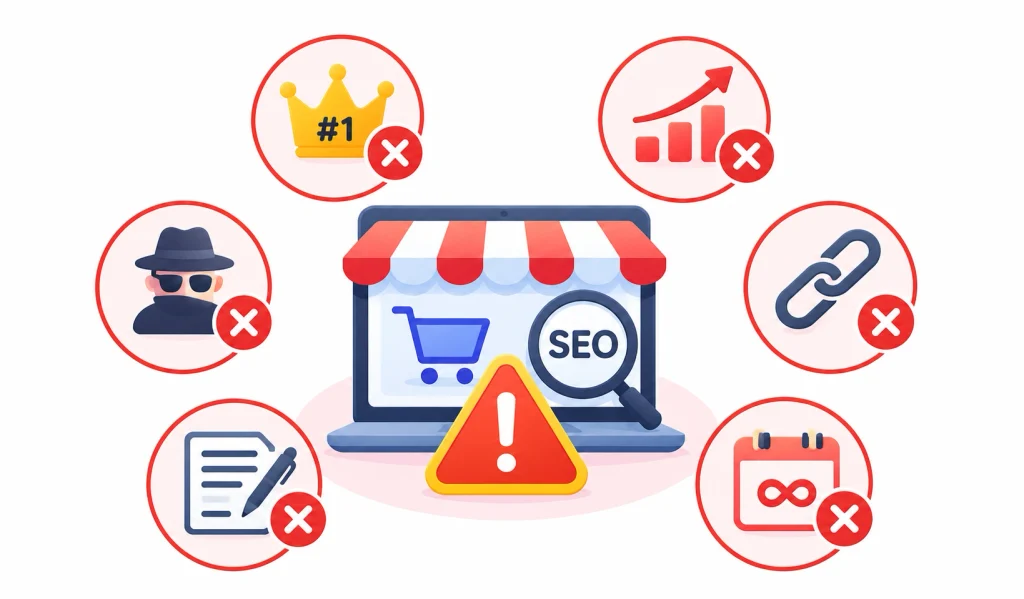
Nobody can control Google, so any pitch that sounds too certain should make you pause. These are the warning signs I would take seriously.
Guaranteed First-Page Rankings
Google’s rankings depend on factors no agency controls. A guarantee usually means a narrow, easy keyword or a promise that will be quietly missed.
Unnatural or Spammy Backlinks
Cheap link bundles can put your store at risk. Ask where links will be placed and judge those sites as a shopper would.
No Ecommerce-Specific Case Studies
If every example is a law firm or a software company, they may be learning on your store.
Generic SEO Packages
A fixed checklist sold to every client ignores your catalog, platform and competitors. Good proposals are shaped around your audit.
No Transparent Reporting
If you can’t see your own analytics and Search Console data, you can’t judge their work. Insist on access from day one.
Unrealistic Traffic and Revenue Promises
Be careful with promises such as “double your revenue in 90 days.” Honest agencies talk in ranges and conditions.
Lack of Platform-Specific Knowledge
If they can’t explain how your platform handles URLs, filters and variants, expect slow progress.
Ecommerce SEO Agency vs. In-House SEO Team vs. Freelancer
There is no single right answer. The best choice depends on your budget, speed and how technical your store is.
| Factor | Agency | In-house team | Freelancer |
| Cost | Monthly retainer | Salaries, tools and benefits | Often lower, hourly or monthly |
| Expertise | A team of specialists | Deep knowledge of your brand | One person’s strengths |
| Scalability | Easy to scale up or down | Slow to hire | Limited by one person’s time |
| Accountability | Contract and reporting | Direct management | Depends on the individual |
| Technical skills | Usually broad | Depends on hires | Varies widely |
| Project management | Included | You manage it | Often you manage it |
| Long-term support | Contract-based | Strongest | Risk if they become unavailable |
How Long Does Ecommerce SEO Take to Show Results?
Ecommerce SEO usually takes several months to show clear results, and the timeline depends on competition, your site’s technical health, your domain’s authority and how fast fixes get implemented. Nobody can promise a specific ranking date. What you can expect is a sequence of work like this.
First 30 Days: Audit and Strategy
The agency audits your site, reviews analytics, researches keywords and agrees priorities with you. You should leave this phase with a clear roadmap.
Days 31–60: Technical and On-Page Optimization
Fixes begin: indexation problems, redirects, site speed, titles, structured data and key category pages. Delays often come from your own developers’ queue, so plan for that.
Days 61–90: Content and Authority Building
Buying guides, category content and outreach start to ramp up. You may see early movement in impressions and long-tail rankings.
Beyond 90 Days: Performance Monitoring and Scaling
The team tracks organic revenue, expands what works and returns to the technical checklist as the catalog changes. SEO is ongoing work, not a one-time job.
How Ecommerce SEO Is Changing With AI Search in 2026
Shoppers now start product research in more places than a Google results page. They also use AI summaries and chat assistants. That doesn’t replace SEO, but it adds new ways for your products to be found.
1. Google AI Overviews and Ecommerce Search
Google’s documentation on AI features in Search says that sound SEO fundamentals apply to these experiences. Check the current version, since this guidance changes. Pages need to be crawlable, indexable and genuinely useful.
2. Generative Engine Optimization for Online Stores
Generative engine optimization (GEO) means making your brand and products easy for AI tools to understand and cite. Several agencies on this list now sell GEO services. Ask what they measure, because the field is young and results are harder to prove than rankings.
3. Improving Product Visibility in AI Search
The basics help most: clear product names, accurate specs, honest reviews, helpful comparison content and consistent information across your site and feeds.
4. Structured Data and Product Information
Clean product data helps both search engines and shopping systems. Use Product structured data on pages that sell a single product, and keep it consistent with your Google Merchant Center feed.
5. Brand Mentions and Digital Authority
Being named on trusted sites, in reviews and in industry roundups builds recognition. Digital PR supports this directly.
6. Traditional SEO vs. Generative Engine Optimization
| Traditional SEO | GEO | |
| Goal | Rank pages in search results | Be cited or recommended in AI answers |
| Core work | Technical health, content, links | Clear facts, brand mentions, structured data |
| How to measure | Rankings, clicks, revenue | Mentions and citations, which are harder to track |
| Maturity | Established methods | Still evolving |
How to Measure the Performance of Your Ecommerce SEO Agency
Rankings and traffic alone don’t prove an agency is working. A store can gain visitors who never buy. Track business outcomes first.
Organic Traffic Growth
Watch non-branded traffic in particular. Branded searches mostly reflect people who already know you.
Organic Revenue and Transactions
This is the most important number. Set up ecommerce tracking in Google Analytics 4 so organic orders and revenue are visible.
Product and Category Page Rankings
Track your top revenue-driving pages, not every keyword.
Organic Conversion Rate
If traffic grows but conversion falls, the agency may be attracting the wrong visitors, or your pages may need work.
Backlink Quality and Referring Domains
Count relevant, trusted sites linking to you, not just the total.
Indexation and Technical Health
Check Google Search Console for indexed pages, errors and speed issues.
Return on SEO Investment
Use the ROI formula from the pricing section, and review it quarterly rather than monthly, since SEO results build over time.
Frequently Asked Questions About Ecommerce SEO Agencies
What Is the Best Ecommerce SEO Agency?
There is no single best agency. The best fit depends on your platform, catalog size, budget and main problem, such as technical issues, content or migration. Use the comparison table above to shortlist two or three, then check their case studies.
What Does an Ecommerce SEO Agency Do?
It improves your store’s visibility in search through technical fixes, keyword research, product and category page work, content, link building and reporting on organic sales.
How Much Does an Ecommerce SEO Agency Cost?
In the US, retainers commonly run from about $2,500 to $15,000 a month, and more for enterprise stores. See the pricing section for context and limits of these ranges.
Is Hiring an Ecommerce SEO Agency Worth It?
It can be, if your organic gross profit is likely to exceed the fee. Run the ROI example with your own order value, conversion rate and margin before you decide.
How Long Does Ecommerce SEO Take?
Expect several months before clear results. The first 90 days are mostly audit, fixes and groundwork.
Should I Hire an Ecommerce SEO Agency or a Freelancer?
Choose an agency if you need a team with several skills. Choose a freelancer for smaller stores or focused projects. See the comparison table earlier in this guide.
Final Thoughts
Choosing an ecommerce SEO agency is a business decision, not just a marketing one. Look for people who understand product catalogs, your platform and the technical traps that online stores fall into.
Insist on transparent reporting, and judge the work by organic revenue and profit, not by rankings alone. Be cautious about big promises, and verify every claim with case studies and references.
If you are not ready to commit, start small. Ask two or three shortlisted agencies for an ecommerce SEO audit or consultation, compare what they find, and pick the team that explains your problems most clearly.