Yes – Google reviews do help SEO, especially when it comes to local search rankings, trust signals, click-through rate (CTR), and conversions. Reviews play a key role in how Google evaluates a business’s popularity, relevance, and credibility in a specific location or industry.
When users search for nearby services or products, businesses with more positive and recent reviews are more likely to appear in the Google Local Pack and Google Maps results. This increased visibility not only improves rankings but also drives more clicks, calls, and visits.
From a user behavior perspective, reviews strongly influence decision-making. Research shows that over 90% of consumers read online reviews before visiting a business, making them one of the most powerful trust signals in digital marketing. In fact, multiple local SEO studies consistently highlight review signals, such as review quantity, rating score, and review freshness, as some of the top ranking factors for local search performance.
In simple terms, Google reviews act as a combination of social proof, keyword relevance, and engagement signal, helping both search engines and potential customers understand whether your business is reliable and worth choosing.
What Are Google Reviews?
Google Reviews are public feedback and ratings that customers leave about a business on its Google Business Profile. These reviews help other users understand the quality of products, services, and overall customer experience before making a decision.
When someone interacts with a business, such as visiting a store, booking a service, or making a purchase, they can rate their experience and share detailed comments. This user-generated content becomes an important trust signal for both potential customers and search engines.
Where Google Reviews Appear
Google reviews are visible across multiple Google platforms, which increases their impact on visibility and SEO performance.
1. Google Maps
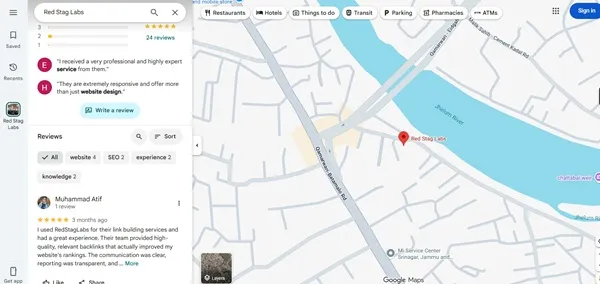
- Reviews appear directly on the business listing in Google Maps.
- Users can see star ratings, written feedback, photos, and owner responses.
- Strong reviews can improve visibility when users search for nearby services.
2. Google Local Pack (Local 3-Pack)
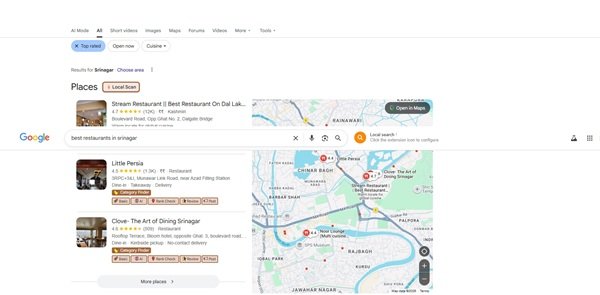
- This is the section that appears at the top of search results for local queries like “best dentist near me.”
- Businesses displayed here show their average star rating and review count, which can influence clicks and rankings.
3. Knowledge Panel (Business Profile Panel)
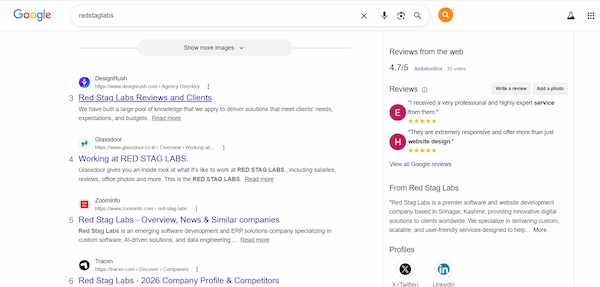
- When users search for a specific business name, reviews appear on the right side of desktop search results or at the top on mobile.
- This panel includes ratings, highlighted reviews, FAQs, photos, and contact details.
Because reviews appear in high-visibility areas of search results, they play a major role in user trust, engagement, and conversion decisions.
Difference Between Star Rating and Review Content
Although both are part of Google reviews, star ratings and written review content serve different purposes in SEO and user decision-making.
| Element | What It Means | SEO / User Impact |
|---|---|---|
| Star Rating | A score from 1 to 5 given by customers | Improves click-through rate and builds instant trust |
| Review Content | Written feedback describing the experience | Helps Google understand relevance and keywords related to the business |
For example, a restaurant with many reviews mentioning phrases like “best vegetarian food in Delhi” sends strong relevance signals to Google. This can help the business rank better for related local searches.
In short, star ratings influence perception and clicks, while review content improves contextual understanding and keyword relevance, making both essential for SEO success.
How Google Reviews Help SEO
Google reviews play a strong role in improving local SEO performance. They help search engines understand how popular, active, and trustworthy a business is in a specific location. When users search for services nearby, businesses with better review signals often get higher visibility in local search results and maps listings.
Improve Local Search Rankings
Google uses several review-based signals to decide which businesses should appear higher in local results. These signals are connected to what Google calls “prominence.” Prominence refers to how well-known, reputable, and relevant a business is both online and offline.
Below are the main review factors that influence local rankings.
Review Quantity
The total number of reviews a business has is an important popularity signal.
- A higher number of reviews indicates that many customers have interacted with the business.
- Businesses with more reviews are often seen as more established and trustworthy.
- When two businesses offer similar services, the one with more genuine reviews may rank higher in local search.
For example, a plumbing service with 250 reviews is likely to appear more prominent than one with only 15 reviews, assuming other factors are similar.
Review Velocity
Review velocity refers to how frequently a business receives new reviews.
- Consistent reviews show that the business is active and serving customers regularly.
- Sudden spikes followed by long gaps may look unnatural or indicate low ongoing engagement.
- A steady flow of new feedback helps maintain ranking stability over time.
This signal helps Google understand that the business is currently relevant and operational.
Review Diversity
Review diversity means receiving feedback from different users across different times and experiences.
- Reviews from unique customer accounts add credibility.
- A mix of detailed and short reviews reflects real customer interaction.
- Diversity also includes varied mentions of services, products, or locations.
When many different people talk about different aspects of a business, Google gains a clearer picture of what the business actually offers.
Review Freshness
Recent reviews are important because they reflect the current quality of a business.
- Fresh reviews signal that customers are still engaging with the business.
- Older reviews alone may not represent present service standards.
- Businesses that regularly collect new feedback often maintain stronger local rankings.
Freshness also influences user trust – people prefer businesses with recent positive experiences.
How Google Uses the Prominence Signal
Google’s local ranking system is largely based on three core factors:
- Relevance – How well the business matches the search query
- Distance – How close the business is to the user
- Prominence – How well-known and reputable the business is
Reviews directly impact the prominence factor.
A business with:
- Many positive reviews
- Ongoing review activity
- Strong average rating
- Detailed keyword-rich feedback
is more likely to be considered prominent. This can lead to better placement in local search results, map listings, and the Local Pack.
In simple terms, reviews act as real-world proof that a business is trusted by customers. The stronger these signals are, the higher the chances of improved local SEO visibility.
Increase Click-Through Rate (CTR)
Google reviews do not only influence rankings, they also play a major role in improving click-through rate (CTR) from search results. When users see strong ratings and positive feedback directly in search listings, they are more likely to click on that business instead of competitors.
Higher CTR sends positive engagement signals to Google, which can indirectly support better SEO performance over time.
Star Ratings Increase Visibility
Star ratings make a business listing stand out visually in search results and on maps.
- Listings with ratings like 4.5★ or higher attract more attention than listings with no ratings.
- The review count displayed next to the rating adds credibility.
- Users scanning results quickly tend to click on listings with visible stars first.
This visual differentiation helps businesses capture more clicks even if they are not in the first organic position.
Social Proof Impact
Reviews act as social proof, which strongly influences user decisions.
- People trust the opinions of other customers before choosing a service.
- A large number of positive reviews reduces hesitation and builds confidence.
- Businesses with strong reputation signals often get more website visits, calls, and direction requests.
When users feel confident about a business from reviews alone, they are more likely to engage immediately.
Better SERP Engagement
Good reviews improve overall engagement metrics in search results.
- Higher CTR means more users are selecting your listing.
- Positive engagement can lead to more time spent on your website or profile.
- Increased interactions such as calls, bookings, and map navigation further strengthen performance signals.
Over time, consistent user engagement supported by strong review ratings can contribute to improved local search visibility and business growth.
H3: Build Trust and Authority Trust signals for users Brand reputation Conversion impact
Build Trust and Authority
Google reviews play an important role in building trust and authority for a business online. Before choosing a service or making a purchase, most users want proof that the business is reliable. Reviews provide real experiences from customers, which helps reduce uncertainty and increases confidence.
Stronger trust signals not only influence user decisions but also support better engagement and long-term SEO performance.
Trust Signals for Users
Reviews act as visible trust indicators in search results and business listings.
- A high average rating shows consistent customer satisfaction.
- Detailed positive feedback reassures new users about service quality.
- Owner responses to reviews demonstrate accountability and professionalism.
When users see authentic reviews from multiple customers, they are more likely to believe that the business delivers what it promises.
Brand Reputation
Google reviews directly shape how people perceive a brand online.
- Businesses with many positive reviews are often seen as more credible and established.
- Negative reviews that are handled properly can still strengthen brand image by showing transparency.
- Consistent review activity keeps the brand visible and relevant in local searches.
Over time, a strong review profile helps build long-term reputation equity, making it easier for customers to recognize and choose the business.
Conversion Impact
Trust built through reviews has a direct effect on conversions.
- Users are more likely to call, visit, or make a purchase from businesses with strong ratings.
- Positive reviews reduce comparison time and speed up decision-making.
- Higher trust levels can lead to better lead quality and repeat customers.
In simple terms, reviews help move users from search → click → action, making them a powerful factor not only for SEO visibility but also for real business growth.
Help Google Understand Your Business Keywords
Google reviews also contribute to SEO by helping search engines better understand what your business is known for. When customers write reviews in their own words, they naturally mention products, services, locations, and experiences. This creates valuable keyword signals without any direct optimization effort.
These natural language mentions improve how Google connects your business listing with relevant search queries.
Reviews Contain Natural Keywords
Customers usually describe their experience using real search terms.
- They may mention specific services, product names, or problems solved.
- Reviews often include location-based phrases and descriptive words.
- These organic mentions help Google identify the main topics associated with your business.
For example, users might write phrases like “quick laptop repair,” “affordable digital marketing service,” or “friendly staff near city center.” Such language strengthens keyword relevance.
Long-Tail Keyword Discovery
Reviews are a powerful source of long-tail keywords, which are more specific and easier to rank for.
- Customers tend to write detailed feedback that includes niche search phrases.
- These phrases may match exactly what future users type into Google.
- Businesses can even use review insights to plan content and landing pages.
Long-tail queries often bring high-intent traffic, which can improve both rankings and conversions.
Contextual Relevance
Review content helps Google understand the context and specialization of a business.
- Frequent mentions of certain services signal expertise in that area.
- Google can associate the business with related queries and categories.
- This improves the chances of appearing for relevant local searches.
Example:
If multiple restaurant reviews mention “best biryani in Srinagar,” Google may start associating that restaurant with searches related to biryani, local food, or dining in Srinagar. This contextual relevance can improve visibility for targeted location-based keywords.
Improve Google Maps Visibility
Google reviews play a major role in improving how prominently a business appears on Google Maps results. When users search for nearby services, Google prioritizes businesses that show strong engagement signals — and reviews are one of the most visible indicators of that engagement.
Better visibility on maps can lead to more direction requests, calls, website visits, and walk-in customers, making reviews an important driver of local growth.
Ranking in Local 3 Pack
The Local 3 Pack is the section that displays the top three business listings for location-based searches like “salon near me” or “best restaurant in Srinagar.”
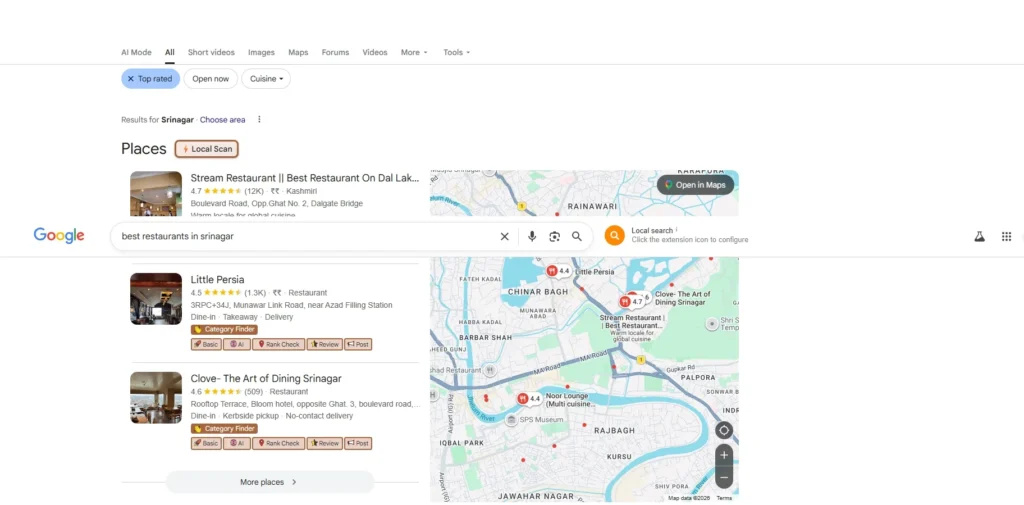
- Businesses with higher ratings and more reviews often have a stronger chance of appearing in this section.
- Review signals such as quantity, freshness, and average rating influence local ranking algorithms.
- Listings in the Local Pack receive significantly higher visibility compared to standard organic results.
Since this section appears at the top of search results, improving review strength can directly increase the likelihood of being featured.
Competitive Advantage
Reviews can give a business a clear advantage over competitors in the same area.
- When multiple businesses offer similar services, users usually choose the one with better ratings and more feedback.
- A well-maintained review profile can help smaller or newer businesses compete with established brands.
- Consistent review growth helps maintain visibility even in highly competitive local markets.
In crowded niches like restaurants, clinics, or repair services, reviews often become the deciding factor for both rankings and customer choice.
Real Example – Case Study
A local café in a competitive urban area focused on improving its review strategy over a three-month period.
Before the campaign:
- Total reviews: 38
- Average rating: 4.1
- Maps visibility: Appeared mostly below top 10 results
- Monthly direction requests: Low
Actions taken:
- Asked customers for feedback after each visit
- Shared direct review links through email and messaging
- Responded to every review within 24 hours
- Encouraged detailed feedback about menu items and service
After three months:
- Total reviews increased to 120+
- Average rating improved to 4.6
- Business started appearing in the Local 3 Pack for key searches
- Direction requests and walk-ins increased noticeably
This example shows how a focused review strategy can improve Google Maps visibility, user trust, and real business performance within a relatively short time.
Do Google Reviews Directly Affect Organic Rankings?
A common question in SEO is whether Google reviews directly improve organic (website) rankings. The short answer is, not in a direct, traditional ranking-factor way, but they can influence organic performance indirectly through multiple signals.
Understanding the difference between direct and indirect impact helps businesses set realistic expectations and build the right strategy.
Direct vs Indirect Ranking Factor
Google has clearly indicated that local search rankings are based on relevance, distance, and prominence. Reviews fall mainly under the prominence category, which is highly important for local pack and maps rankings.
However, for standard organic website rankings (the blue links), reviews are generally considered an indirect influence rather than a core ranking factor like backlinks or content quality.
This means:
- Reviews can improve local listing visibility, which increases exposure.
- Increased exposure can lead to more website clicks and brand searches.
- These user interactions can contribute to stronger organic performance over time.
In simple terms, reviews may not directly push a webpage higher in organic search results, but they can create conditions that support ranking growth.
Reviews Impact Behavioral Signals
Google reviews can significantly influence user behavior, and behavioral signals are closely monitored by search engines.
- Higher ratings can improve click-through rate (CTR) from search results.
- Positive reputation can increase time spent on website pages.
- More trust can lead to repeat visits and branded searches.
When users consistently choose a business with strong reviews, this engagement can signal to Google that the business is relevant and valuable to searchers.
Correlation vs Causation
Many SEO studies show a strong correlation between businesses with high review counts and better search rankings. However, correlation does not always mean direct causation.
For example:
- Successful businesses often deliver better service.
- Better service leads to more positive reviews.
- More reviews lead to higher visibility and more clicks.
As a result, it can appear that reviews alone cause ranking improvements, while in reality they are part of a broader ecosystem of trust, engagement, and brand strength.
Expert Opinions and Google Statements
Google has publicly acknowledged that review count and review score influence local search ranking. Guidance from Google Business Profile resources and local SEO documentation consistently highlights reviews as an important prominence signal.
Local SEO experts and industry studies also emphasize that review signals, including review frequency, diversity, and sentiment, are among the most influential factors in local search visibility.
Overall, while Google reviews may not function as a direct organic ranking signal in the same way as backlinks or technical SEO, they remain a critical indirect driver of traffic, trust, and local search performance.
Google Review Ranking Factors (Explained)
Google uses multiple review-related signals to understand how relevant, trustworthy, and active a business is. These factors mainly influence local SEO rankings, visibility in maps, and user engagement from search results.
Below is a clear breakdown of the most important Google review ranking factors and how they impact SEO performance.
| Factor | Impact on SEO | Why It Matters |
|---|---|---|
| Number of Reviews | High | A larger volume of reviews signals business popularity and real customer interaction. Businesses with more reviews often appear more prominent in local search results. |
| Rating Score | High | Higher average ratings build instant trust and improve click-through rate (CTR), leading to more engagement from search users. |
| Review Freshness | Medium | Recent reviews show that the business is active and currently serving customers, which can help maintain or improve local rankings. |
| Review Keywords | Medium | Natural mentions of services, products, and locations in review text help Google understand business relevance for specific search queries. |
| Owner Replies | Medium | Responding to reviews shows engagement and customer care, which can strengthen user trust and encourage further interaction with the listing. |
In practice, businesses that maintain a balanced review profile, strong quantity, good ratings, steady review flow, and active responses, are more likely to perform better in local search visibility and attract more customer actions.
How Many Google Reviews Do You Need to Rank?
There is no fixed number of Google reviews that guarantees higher rankings. The number required to perform well in local search depends on several factors, especially the level of competition in your niche and location.
Instead of aiming for a universal target, businesses should focus on building a consistent and competitive review profile over time.
No Fixed Number
Google does not set a specific review count threshold for ranking.
- Some businesses rank in the Local Pack with 20–30 strong reviews in low-competition areas.
- In competitive cities or industries, businesses may need hundreds of reviews to stay visible.
- Quality, freshness, and rating score often matter as much as quantity.
This means rankings are influenced by relative strength, not just absolute numbers.
Depends on Niche Competition
Different industries have different review expectations.
- Restaurants, salons, and hotels usually have high review volumes.
- B2B services or specialized providers may rank with fewer but more detailed reviews.
- Urban markets typically require more reviews than small towns.
For example, a café in a busy metro area may need 300+ reviews to compete, while a local repair shop in a smaller region may rank with under 50.
Benchmark Method
A practical way to set a review goal is by analyzing competitors.
Simple benchmarking process:
- Search your main target keywords on Google.
- Check the businesses appearing in the Local 3 Pack and top Maps results.
- Note their:
- Total review count
- Average rating
- Review freshness
- Set a target to match or exceed the top-performing competitors.
This approach ensures your review strategy is based on real market standards, helping you stay competitive and improve local SEO visibility steadily.
How to Get More Google Reviews (Step-by-Step)
Getting more Google reviews requires a simple, consistent process rather than random requests. Businesses that actively encourage feedback at the right time usually build a stronger review profile, which supports local SEO visibility, trust, and conversions.
Follow these practical steps to increase review volume naturally.
1. Optimize Google Business Profile
Before asking for reviews, make sure your business profile is fully optimized.
- Add correct business name, address, phone number, and website.
- Upload real photos of your products, services, or location.
- Select accurate business categories and service areas.
- Keep working hours and updates current.
A complete profile increases user confidence and makes customers more willing to leave feedback.
2. Create a Direct Review Link
Make the review process as easy as possible.
- Generate a direct review link from your Google Business Profile dashboard.
- Share this link with customers through messages, email, or social media.
- Shorten the link for better usability if needed.
Reducing friction in the review process significantly improves response rates.
3. Ask at the Right Moment
Timing plays a major role in getting positive reviews.
- Request feedback immediately after a successful purchase or service experience.
- Ask when customers express satisfaction or appreciation.
- Avoid asking during unresolved issues or complaints.
When the experience is fresh, customers are more likely to respond and write detailed feedback.
4. Use Email or WhatsApp Automation
Automated follow-ups help maintain a steady flow of reviews.
- Send a polite review request within 24–48 hours of service completion.
- Include the direct review link and a short message of appreciation.
- Keep the request simple and friendly.
Consistent automation ensures review velocity without manual effort every time.
5. Add Review Call-to-Action (CTA) on Website
Encourage reviews from website visitors as well.
- Place a “Leave Us a Review” button on contact or thank-you pages.
- Add review reminders in order confirmation or service completion pages.
- Highlight existing positive reviews to build motivation.
This approach converts satisfied website users into active reviewers.
6. Train Staff to Request Reviews
Frontline staff often have the best opportunity to ask for feedback.
- Train employees to politely request reviews after delivering good service.
- Provide them with simple scripts or QR codes linked to the review page.
- Encourage natural conversations rather than forced requests.
Human interaction can significantly improve review participation.
7. Offer Great Service First
The most effective review strategy starts with delivering a strong customer experience.
- Quality service naturally leads to positive feedback.
- Happy customers are more willing to share detailed and authentic reviews.
- Consistent service standards help maintain high rating scores.
In the long run, businesses that focus on customer satisfaction find it much easier to build a powerful review profile that supports both SEO performance and business growth.
H2: How to Respond to Google Reviews for SEO Positive review response template Negative review response strategy Why responses increase engagement signals
How to Respond to Google Reviews for SEO
Responding to Google reviews is not just good customer service, it also supports local SEO performance and user engagement. Active responses show both customers and search engines that a business is attentive, trustworthy, and continuously interacting with its audience.
Consistent review replies can improve profile activity signals, trust levels, and conversion potential.
Positive Review Response Template
When replying to positive reviews, the goal is to show appreciation, reinforce brand value, and naturally mention services or location.
Simple template:
Thank you, [Customer Name], for your kind feedback. We’re happy to know you had a great experience with our [service/product]. Your support means a lot to our team. We look forward to serving you again soon.
Best practices:
- Personalize the response with the reviewer’s name if available.
- Mention the service or product naturally to strengthen relevance signals.
- Keep the tone friendly and professional.
- Encourage future visits or interaction.
Negative Review Response Strategy
Negative reviews should be handled calmly and constructively. A thoughtful response can actually improve brand trust.
Recommended approach:
- Acknowledge the issue – show that you understand the concern.
- Apologize politely – even if the problem was situational.
- Offer a solution or next step – invite the customer to connect offline.
- Stay professional – avoid defensive language or arguments.
Example response:
We’re sorry to hear about your experience. This is not the standard we aim to provide. Please contact us at [phone/email] so we can understand the issue and make things right.
Handling criticism in a positive way shows future customers that the business is responsible and responsive.
Why Responses Increase Engagement Signals
Replying to reviews contributes to stronger engagement and activity signals on your business listing.
- Regular responses show that the business profile is actively managed.
- More interaction can encourage other customers to leave feedback.
- Users may spend more time reading responses and exploring the listing.
- Higher engagement can support better visibility in local search results.
In addition, thoughtful responses improve conversion potential, as many users check how businesses handle feedback before making a decision. Consistent review management therefore becomes an important part of both SEO strategy and reputation building.
H2: Can Fake Reviews Harm SEO? Google spam detection Review filtering Suspension risks
Can Fake Reviews Harm SEO?
Yes – fake or spam reviews can harm SEO performance and business credibility. While some businesses try to increase ratings quickly using artificial reviews, this approach can lead to serious risks, including ranking drops, review removal, or even profile suspension.
Google continuously improves its systems to detect unnatural review activity and maintain trust in local search results.
Google Spam Detection
Google uses automated systems and manual checks to identify suspicious review patterns.
- Sudden spikes in review volume from new or inactive accounts may trigger scrutiny.
- Repetitive wording, unnatural language, or keyword-stuffed reviews can look manipulative.
- Reviews from unrelated locations or devices may raise authenticity concerns.
If Google detects manipulation attempts, it may reduce the visibility of the business listing or ignore those reviews in ranking calculations.
Review Filtering
Google regularly filters reviews it considers low-quality or fake.
- Filtered reviews may not be visible publicly but still exist in the backend system.
- This can create a sudden drop in total review count or average rating.
- Businesses relying on artificial reviews may lose the ranking advantage they expected.
Consistent filtering can also affect user trust if customers notice missing or inconsistent feedback.
Suspension Risks
In serious cases, policy violations related to fake reviews can lead to Google Business Profile restrictions or suspension.
- The business listing may stop appearing in local search or maps.
- New reviews may be disabled temporarily.
- Reinstating a suspended profile can take time and requires proof of compliance.
Beyond SEO impact, fake reviews can damage long-term reputation and customer confidence. A safer and more sustainable strategy is to focus on earning genuine feedback through quality service and ethical review practices.
Why Google Reviews Matter More Than Other Reviews
Not all review platforms have the same influence on SEO visibility. While feedback on multiple platforms helps build overall brand trust, Google reviews have the strongest direct impact on local search performance because they are integrated into Google’s own search ecosystem.
This means users can see ratings, feedback, and business details without leaving search results, which increases both visibility and engagement potential.
Comparison of Major Review Platforms
| Platform | SEO Impact | Visibility |
|---|---|---|
| Very High | Appears directly in search results, Local Pack, and Google Maps listings | |
| Medium | Influences social proof and user decisions but limited direct search ranking impact | |
| Yelp | Medium | Strong visibility in certain niches and regions, especially for restaurants and services |
| Trustpilot | Low (SEO) | Builds brand credibility and trust but less influence on local search rankings |
Why Google Reviews Stand Out
- They are displayed directly on search engine results pages (SERPs) and map listings.
- They influence local ranking signals such as prominence and engagement.
- They improve click-through rate (CTR) due to visible star ratings.
- They support real-time decision-making, as users can compare businesses instantly.
Other platforms still matter for reputation management and customer research, but from a pure local SEO perspective, Google reviews typically deliver the most measurable impact on visibility and conversions.
Advanced Strategies to Use Reviews for SEO
Beyond collecting reviews, businesses can use them strategically to strengthen content relevance, engagement signals, and organic visibility. Reviews contain real customer language, which can be turned into powerful SEO assets when used correctly.
Below are advanced ways to leverage reviews for better search performance.
Use Reviews as Content Ideas
Customer reviews often reveal common questions, problems, and expectations.
- Identify frequently mentioned services or features.
- Turn positive feedback into blog topics or FAQs.
- Create location-based or service-specific content inspired by review phrases.
For example, if many users mention “fast laptop repair,” you can create content focused on quick repair services or troubleshooting guides.
This approach helps target long-tail keywords and user intent more effectively.
Add Reviews Schema Markup
Structured data markup helps search engines understand review content better.
- Implement review or aggregate rating schema on relevant pages.
- This can improve the chances of showing rich snippets like star ratings in organic results.
- Better visibility can increase click-through rates and user trust.
Proper schema usage also supports clearer indexing of customer feedback signals.
Embed Reviews on Landing Pages
Displaying reviews directly on service or product pages can improve both SEO engagement and conversion rates.
- Reviews add fresh content and natural keywords to landing pages.
- They increase time spent on page by providing social proof.
- Real testimonials can reduce bounce rate and encourage action.
Embedding reviews near call-to-action sections often improves lead generation performance.
Create Testimonial Pages
A dedicated testimonial or review page can act as a trust-focused SEO asset.
- Compile detailed customer success stories and experiences.
- Organize reviews by service type, industry, or location.
- Optimize these pages for reputation-related keywords.
Such pages can rank for branded and comparison searches, helping capture high-intent traffic.
Build Topical Relevance
Reviews can strengthen a business’s topical authority in a specific niche or service area.
- Frequent mentions of certain services signal specialization.
- Consistent keyword themes across reviews reinforce relevance signals.
- Combining review insights with targeted content creation builds stronger search positioning.
Over time, this strategy helps search engines associate the business with specific solutions, locations, and customer needs, leading to improved organic and local SEO performance.
Common Mistakes Businesses Make
While Google reviews can significantly support SEO and reputation growth, many businesses make avoidable mistakes that reduce their effectiveness. A poor review strategy can lead to ranking instability, trust issues, or even policy violations.
Understanding these common errors helps build a more natural and sustainable review profile.
Asking All Reviews at Once
Requesting a large number of reviews within a short period can look unnatural.
- Sudden spikes in review activity may trigger spam detection or filtering.
- After the spike, review velocity may drop, which can weaken consistency signals.
- A steady and ongoing review flow is usually more beneficial for local SEO.
Businesses should aim for consistent review generation rather than one-time campaigns.
Ignoring Negative Reviews
Many businesses avoid responding to criticism, which can harm both reputation and engagement.
- Unanswered complaints may reduce user trust.
- Potential customers often read negative feedback before making decisions.
- Constructive responses can demonstrate professionalism and accountability.
Handling negative reviews properly can actually improve brand perception.
Keyword-Stuffed Review Requests
Some businesses try to guide customers to include specific keywords in reviews.
- Overly scripted or unnatural review content may be filtered.
- Customers may feel pressured, reducing authenticity.
- Google values genuine feedback written in the customer’s own words.
Encourage honest experiences instead of trying to control review language.
Buying Reviews
Purchasing fake or incentivized reviews is one of the most risky practices.
- Artificial reviews can be detected and removed.
- Policy violations may lead to listing restrictions or suspension.
- Long-term credibility can be damaged if users suspect manipulation.
A safer approach is to focus on earning real reviews through strong service and consistent follow-ups, which supports both SEO performance and customer trust over time.
H2: Google Reviews vs Backlinks, Which Matters More? Different roles Local vs global SEO Ideal balanced strategy
Google Reviews vs Backlinks – Which Matters More?
Both Google reviews and backlinks are important for SEO, but they serve different purposes and influence different parts of search performance. Understanding their roles helps businesses build a strategy that improves both local visibility and overall organic rankings.
Different Roles
Google reviews mainly influence local search signals, while backlinks are one of the strongest factors for traditional organic rankings.
- Reviews help search engines understand business popularity, trust, and customer satisfaction.
- Backlinks act as authority signals, showing that other websites trust and reference your content.
- Reviews impact map visibility, click behavior, and conversions.
- Backlinks improve domain strength, keyword rankings, and organic traffic potential.
In simple terms, reviews build reputation signals, while backlinks build authority signals.
Local vs Global SEO
The importance of reviews or backlinks depends on the type of SEO you are targeting.
Local SEO focus:
- Reviews play a bigger role in appearing in Google Maps and Local Pack results.
- Businesses like restaurants, clinics, salons, or local agencies benefit more from strong review profiles.
Global or content-driven SEO focus:
- Backlinks are more critical for ranking blog posts, service pages, and informational content.
- Websites targeting national or international audiences need consistent link-building efforts.
Most businesses require both because local visibility often leads to brand searches and organic website visits.
Ideal Balanced Strategy
The best approach is not choosing one over the other but building a balanced SEO strategy.
- Maintain a steady flow of genuine Google reviews to strengthen local presence.
- Invest in quality backlinks from relevant and trusted websites.
- Combine review insights with content creation and on-page optimization.
- Focus on user experience so both reviews and backlinks grow naturally.
When reviews improve trust and engagement, and backlinks strengthen authority and rankings, the combined effect can lead to sustainable SEO growth and better business outcomes.
Future of Reviews in SEO (AI + SGE Impact)
The role of reviews in SEO is evolving as search engines increasingly use AI-powered systems and generative search experiences (SGE) to understand user intent and deliver faster answers. Reviews are becoming more than just ratings – they are turning into structured insights that influence visibility, trust, and discovery.
Businesses that adapt to these changes can gain a long-term advantage in both local and organic search performance.
AI Summarised Reviews
Search engines are now using AI to summarise large volumes of reviews into key highlights.
- Users may see quick summaries such as “customers mention fast service and friendly staff.”
- This reduces the need to read multiple individual reviews.
- Businesses with consistent positive feedback themes may benefit from stronger visibility.
AI-generated summaries can shape first impressions, making review quality and consistency more important than ever.
Voice Search Relevance
Reviews are also influencing how businesses appear in voice search results.
- Voice assistants often rely on highly rated and well-reviewed businesses when giving recommendations.
- Natural language in reviews matches conversational voice queries.
- Location-based phrases in feedback can improve discoverability for “near me” searches.
As voice search adoption grows, maintaining strong review signals can help businesses become preferred recommendations in spoken search results.
Review Sentiment Analysis
Modern search systems analyse the sentiment and context of review content, not just star ratings.
- Positive sentiment around specific services can strengthen topical relevance.
- Repeated negative feedback about certain issues may reduce user trust signals.
- Balanced and authentic feedback helps search engines understand real customer experiences.
Sentiment analysis allows search engines to evaluate overall reputation trends, which may influence visibility and ranking stability over time.
In the future, reviews will likely play an even larger role in SEO as AI continues to interpret customer language, intent, and satisfaction signals more deeply. Businesses that focus on genuine customer experience and consistent feedback will be better positioned for upcoming search changes.
FAQs (People Also Ask Optimization)
1. Do reviews help Google ranking?
Yes, reviews help improve local search rankings, especially in Google Maps and the Local Pack. Factors like review quantity, rating score, freshness, and engagement can influence how prominently a business appears for location-based searches. While reviews may not directly boost traditional organic rankings, they can increase visibility, clicks, and trust, which indirectly supports SEO performance.
2. How long does it take for reviews to affect SEO?
The impact of reviews on SEO is usually gradual rather than instant.
- Small improvements in visibility can happen within a few weeks if review activity increases consistently.
- Strong ranking improvements may take 1–3 months or more, depending on competition and review growth pace.
- Ongoing review collection is important for maintaining long-term results.
3. Does replying to reviews help SEO?
Yes, responding to reviews can support SEO indirectly.
- Active responses show that the business listing is well-managed.
- Engagement may encourage more customers to leave feedback.
- Replies can naturally include service or location mentions, improving contextual relevance.
Consistent interaction also builds trust, which can improve click-through rate and conversions.
4. Do 5-star ratings matter?
High ratings can significantly influence user perception and click behavior.
- Listings with strong average ratings usually attract more clicks.
- Better ratings can increase customer confidence and reduce comparison time.
- However, a natural mix of feedback is normal — businesses should focus on overall service quality rather than chasing perfect scores.
5. Can bad reviews lower rankings?
A few negative reviews typically do not harm rankings if the overall rating and review profile remain strong.
- Consistent poor feedback over time may affect trust and engagement.
- Low ratings can reduce click-through rate and conversions.
- Responding professionally to criticism can help maintain reputation and visibility.
6. Are Google reviews more important than website SEO?
Both are important but serve different purposes.
- Reviews mainly influence local search visibility and trust signals.
- Website SEO focuses on content quality, technical optimization, and backlinks for broader rankings.
A balanced approach combining strong review management with solid website SEO usually delivers the best results.
7. How to remove fake reviews?
Businesses can report suspicious or policy-violating reviews through their Google Business Profile.
- Flag the review and provide a clear reason for removal.
- If needed, contact support with supporting evidence.
- Removal is not guaranteed, but genuine violations may be filtered or deleted.
Maintaining consistent authentic reviews helps minimize the impact of occasional fake feedback.
8. How many reviews are enough?
There is no universal number of reviews required to rank.
- The ideal target depends on industry competition and location.
- Businesses should compare review counts of competitors in top map positions.
- The goal is to match or exceed local benchmarks while maintaining strong ratings and fresh feedback.
A steady flow of genuine reviews is usually more effective than focusing on a specific number.
Conclusion Reviews are one of the strongest local SEO signals They impact ranking, trust, CTR, and conversions Consistent review strategy = long-term ranking growth
Conclusion
Google reviews have become one of the strongest signals in local SEO, influencing how businesses appear in map listings, local search results, and customer decision journeys. They help search engines understand business popularity and relevance while also shaping how users perceive trust and credibility.
A strong review profile can improve search visibility, click-through rate (CTR), brand reputation, and real conversions such as calls, visits, and purchases. Businesses that actively manage reviews, by collecting feedback consistently, responding professionally, and maintaining high service standards, often see better long-term performance in competitive local markets.
In the long run, a consistent and natural review strategy is not just about gaining more stars. It is about building trust, improving engagement signals, and creating sustainable ranking growth that supports both SEO success and business expansion.