Google processes roughly five trillion searches every single year. The search landscape evolves constantly, and your agency must evolve with it. Over 92 percent of marketers actively invest in search engine optimization, making competition fiercer than ever.
To win, agencies need more than just great strategies. You need a streamlined way to measure, analyze, and report on those strategies.
When you manage dozens of clients, isolated data creates a massive bottleneck. You need a system that brings everything together into one clear view. Building a comprehensive SEO Dashboard is the ultimate solution to scaling your agency operations.
This guide will show you how to connect every piece of your campaign data from technical audits to final client reports using platforms like DAXRM.
1. Why SEO Reporting Breaks at Agency Scale
Growing an agency is exciting, but scaling your operations reveals hidden fractures in your workflow. For many marketing teams, client reporting is the first system to break. When you only have a few clients, manually pulling data from different platforms is manageable. However, as your roster grows, this manual approach turns into absolute spreadsheet chaos.
Account managers waste hours jumping between multiple data sources. They pull traffic numbers from one platform, keyword positions from another, and conversion metrics from a completely different tool. This data fragmentation leads to glaring errors and massive inefficiencies.
Furthermore, client expectations are shifting rapidly. Industry discussions show that traditional reporting cycles are simply too slow for modern search changes. Clients expect real time insights, not just a static monthly PDF.
While 31 percent of marketing teams now automate their reporting workflows, agencies relying on manual data entry risk falling behind their competitors.
2. The Foundation: Automated SEO Audits
Great reporting starts with accurate data collection. The foundation of any successful optimization campaign is a technically sound website. This is where a robust SEO Audit Tool becomes absolutely vital to your daily operations.
Manual site crawls take too much time and often miss critical errors. You need continuous site health monitoring to catch problems before they impact organic visibility. An automated audit system crawls your clients websites regularly, identifying broken links, slow loading pages, and missing metadata automatically.
More importantly, these technical insights must feed directly into your reporting infrastructure. When your auditing platform integrates seamlessly with your main dashboard, you eliminate the gap between discovering a problem and showing the client how you fixed it. DAXRM excels at turning complex technical audits into clear, actionable metrics that clients can easily understand.
3. Rank Tracking as the Core SEO Performance Metric
Visibility remains the ultimate goal of any search campaign. However, tracking that visibility has become incredibly complex. Around 60 percent of searches now end without a single click, and AI Overviews appear in roughly 30 percent of Google queries. You need precise tracking to prove your value in this zero click environment.
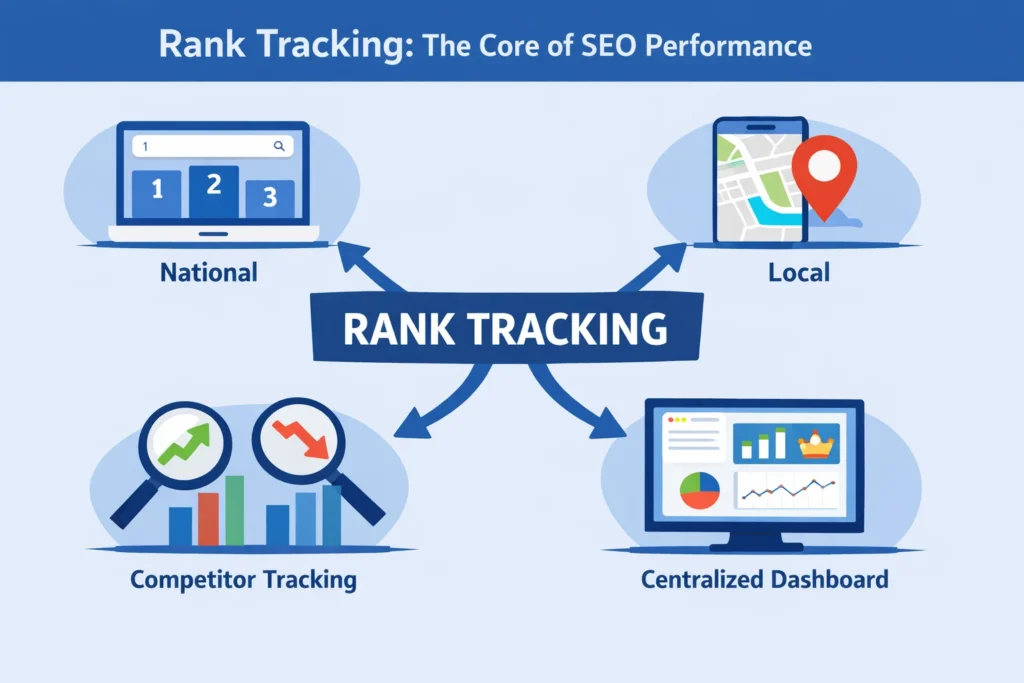
A standard Rank Tracker is essential for monitoring broad, national rankings. But national data alone paints an incomplete picture for businesses that serve specific geographic areas. You must incorporate a dedicated Local Rank Tracker to measure performance in specific cities and neighborhoods. Local search dictates foot traffic, and clients need to see exactly how they perform in the local map pack.
Additionally, competitor tracking is mandatory. Your clients do not just want to know where they stand; they want to know who they are beating. Bringing national, local, and competitor ranking data into one centralized location helps your team adapt strategies quickly and decisively.
4. Turning Data into Insight with SEO Dashboards
Raw data is useless without proper context. Your team might collect thousands of data points every week, but unless you can visualize that information, you cannot make strategic decisions. This is exactly why a centralized SEO Dashboard is non negotiable for scaling agencies.
A proper dashboard provides unified metrics. It takes the fragmented data from your audit tools, analytics platforms, and rank trackers and displays it on a single screen. This unified view allows your account managers to spot performance trends instantly. They can see if a drop in traffic correlates with a specific technical error or a shift in local rankings.
Furthermore, a comprehensive dashboard grants total campaign visibility to your agency leadership. Directors can assess the health of every client account at a glance, ensuring that no campaign falls through the cracks. Using an intelligent platform like DAXRM gives your entire team the clarity they need to drive measurable results.
5. Creating Professional SEO Reports Clients Understand
Your clients likely do not understand complex technical jargon. They want to know if their investment is generating a positive return. Translating your hard work into professional reports is crucial for client retention.
An integrated SEO Reporting Tool allows you to create beautiful, white label reports that highlight your agency branding. Instead of sending confusing spreadsheets, you can present visual dashboards that highlight key performance indicators clearly. Graphs and charts make it easy for business owners to see their traffic growth and ranking improvements over time.
Automated reporting takes this a step further. By scheduling reports to generate and send automatically, you save your staff countless administrative hours. You deliver consistent, high quality updates without the typical end of month stress.
6. Why Client Portals Are Replacing Static Reports
The modern client demands transparency. Sending an email once a month with a PDF attachment is no longer sufficient. Today, leading agencies are shifting toward interactive platforms to keep their clients informed and engaged.
Implementing an SEO Client Portal completely revolutionizes your communication strategy. A secure portal gives your clients 24/7 access to their live campaign performance. They can log in whenever they want to check their latest traffic numbers, view completed tasks, or review ranking improvements.
This level of transparency builds immense trust. It also drastically reduces reporting overhead. When clients can find answers to their own questions by looking at their portal, they send fewer emails and require fewer status meetings. Your team can spend less time explaining past performance and more time executing future strategies.
7. Connecting SEO Data With Advertising Channels
Organic search does not exist in a vacuum. Most businesses run a variety of marketing campaigns simultaneously. To provide true value, your agency must show how organic search fits into the broader marketing ecosystem.
A truly scalable dashboard requires deep integrations with other major platforms. You must connect organic performance data with paid advertising channels like Google Ads, Meta Ads, and Microsoft Ads. This cross channel visibility allows you to compare acquisition costs and identify the most profitable marketing avenues.
Additionally, integrating direct sources like Search Console and Google Business Profile is critical. Pulling in accurate impression data, click through rates, and local engagement metrics ensures your reports reflect absolute reality. DAXRM makes bringing these disparate data sources together simple and effective.
8. Advanced Reporting with Looker Studio
For enterprise clients or highly complex campaigns, you may need to push your reporting capabilities even further. Advanced data visualization is where top tier agencies separate themselves from the competition.
Integrating your dashboard data with Looker Studio opens up endless possibilities for customization. You can build automated dashboards tailored to exact executive level reporting requirements. Looker Studio allows you to blend multiple data sources into highly specific visual narratives.
Building multi client reporting systems through advanced visualizations proves your agency is a sophisticated data partner. By leveraging an ecosystem like DAXRM, you build an infrastructure that handles everything from the initial technical crawl to the final executive presentation. Embracing this level of consolidation is the only way to scale your agency efficiently and profitably in the modern search landscape.