Search technology has changed a lot in the last few years. Earlier, search engines mainly worked by matching exact keywords. If your content had the same words as the query, it had a good chance of ranking. But today, users search in a more natural way. They ask full questions, use voice search, and expect accurate answers, not just matching pages. This shift has pushed search systems to become smarter and more context-aware.
The move from keyword-based search to intent-based search is at the center of this change. Instead of focusing only on words, modern systems try to understand what the user actually means. For example, when someone searches “best way to visualize sales data,” they are not looking for the keyword itself. They want practical solutions, tools, or chart types. This is where semantic understanding becomes important. Search engines now analyze context, relationships between words, and user behavior to deliver better results.
At the same time, newer technologies like vector search are becoming more common. These systems go a step further by converting content into numerical representations and finding similarities between them. This allows search engines and AI systems to match meaning even when the exact words are different. Together, semantic search and vector search are shaping how modern search systems work, especially in AI-driven platforms and large-scale data environments.
In this guide, you will learn the clear difference between semantic search and vector search, how each approach works, where they are used, and how they fit into modern search systems. By the end, you will have a practical understanding of when to use each and why both are important in today’s search landscape.
What is Semantic Search?
Simple Definition
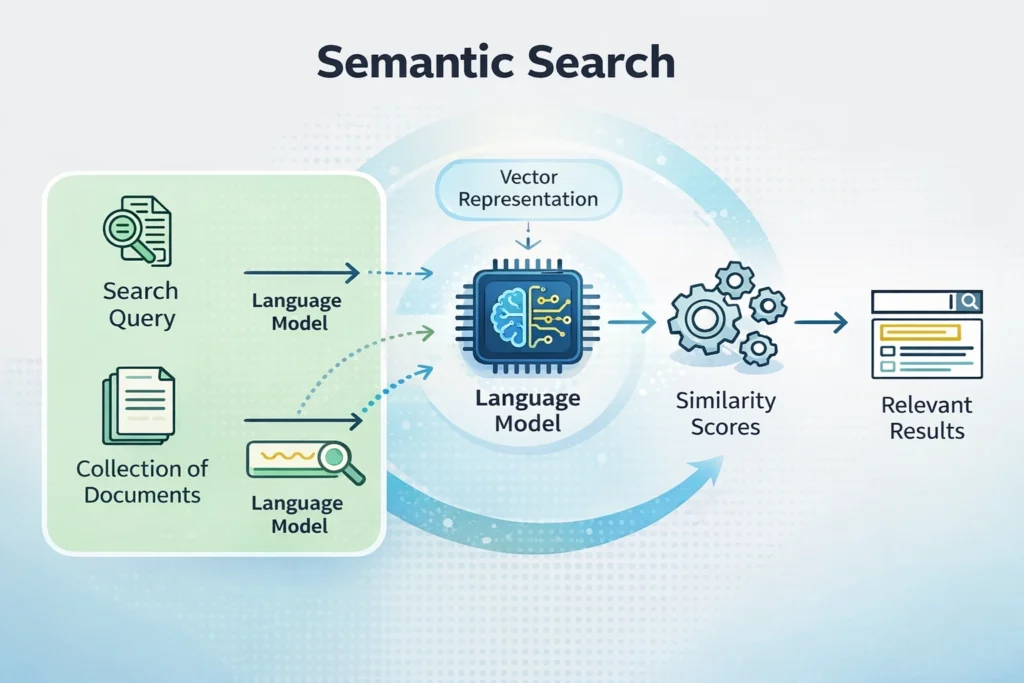
Semantic search is a way of searching that focuses on understanding the meaning behind a query, not just matching exact keywords. It looks at context, intent, and relationships between words to deliver more relevant results.
Instead of asking, “Does this page contain the same words?”, semantic search asks,
“Does this page answer what the user actually wants?”
How Semantic Search Works

Semantic search combines multiple techniques to understand queries more deeply:
Natural Language Processing (NLP)
It uses NLP to process human language the way people naturally speak or type. This helps systems understand full sentences instead of just keywords.
Context Understanding
The system looks at the context of the query. For example, the word “apple” could mean a fruit or a company, depending on the query.
Entity Recognition
It identifies important entities like:
- People
- Places
- Brands
- Concepts
This helps connect queries to real-world meanings instead of isolated words.
Query Expansion
Semantic search expands queries by including:
- Synonyms
- Related terms
- Variations
This ensures users get relevant results even if they don’t use exact keywords.
Key Features of Semantic Search
Intent Matching
Focuses on what the user wants to achieve, not just what they typed.
Context Awareness
Understands how words relate to each other within a query.
Synonym Handling
Recognizes similar words and phrases (e.g., “buy” vs “purchase”).
Personalized Results
May adjust results based on:
- Search history
- Location
- Behavior patterns
Real-World Examples
Google Search Improvements
Modern platforms, from consumer engines like Google Search to enterprise search ecosystems like Glean, use semantic search to understand complex queries and deliver accurate answers, even if keywords don’t match exactly.
Voice Search Queries
Voice assistants handle natural language queries like:
“Where can I find the best coffee near me?”
Semantic search helps interpret intent and location.
Conversational Queries
In chat-based or follow-up searches, users may ask:
“What about cheaper options?”
Semantic systems understand this refers to the previous query context.
In simple terms, semantic search makes search engines think more like humans, focusing on meaning instead of just words.
What is Vector Search?
Simple Definition
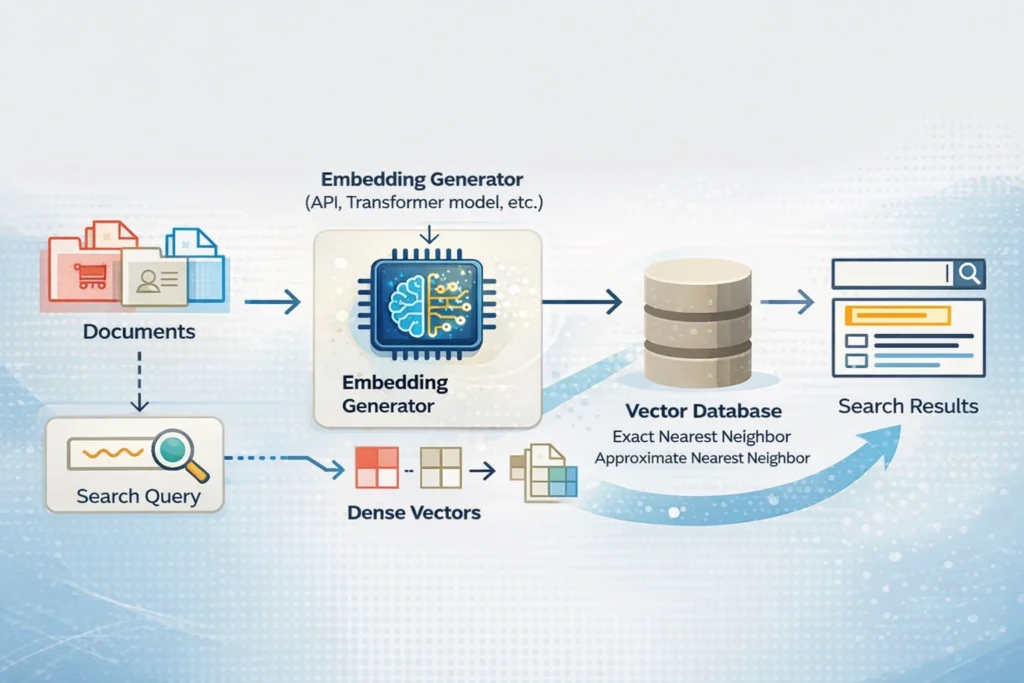
Vector search is a search method that finds results based on numerical representations (called embeddings) rather than exact words.
In simple terms, content like text, images, or audio is converted into numbers, and the system searches for items that are mathematically similar.
How Vector Search Works
Vector search relies on a few key steps:
Text/Image Converted into Vectors
Content is transformed into vectors (lists of numbers).
For example:
- A sentence
- An image
- A document
All become numerical representations in a multi-dimensional space.
Embedding Models
AI models generate these vectors. They capture:
- Meaning
- Context
- Relationships
Similar content ends up closer together in this vector space.
Similarity Matching (Cosine Similarity, etc.)
When a user searches, the query is also converted into a vector.
The system then finds the closest matches using similarity metrics like:
- Cosine similarity
- Euclidean distance
The closer the vectors, the more relevant the result.
Key Features of Vector Search
Similarity-Based Retrieval
Finds results based on meaning, even if exact words are different.
Works with Unstructured Data
Handles:
- Text
- Images
- Audio
- Documents
Scalable with Vector Databases
Uses specialized databases designed for fast similarity search across large datasets.
Real-World Examples
AI Chatbots
Modern AI systems use vector search to retrieve relevant information before generating responses.
Recommendation Systems
Platforms suggest:
- Products
- Movies
- Content
Based on similarity to user behavior and preferences.
Image and Document Search
Vector search allows you to:
- Search images using text
- Find similar documents
- Retrieve content based on meaning, not keywords
In simple terms, vector search works like a similarity engine, finding content that “feels” closest in meaning, even without matching words.
Semantic Search vs Vector Search (Core Differences)
Understanding the difference between semantic search and vector search is important because they solve similar problems in different ways. While both aim to improve search relevance, they use different approaches and are often used together in modern systems.
Side-by-Side Comparison Table
| Feature | Semantic Search | Vector Search |
|---|---|---|
| Focus | Meaning and user intent | Mathematical similarity between data points |
| Technology | NLP, language models, search algorithms | Embeddings, vector math, similarity algorithms |
| Data Type | Primarily text-based queries and content | Text, images, audio, and other unstructured data |
| Speed | Moderate (depends on processing and indexing) | High when optimized with vector databases |
| Use Case | Search engines, website search, SEO | AI systems, recommendation engines, similarity search |
Key Differences Explained
- Approach:
Semantic search focuses on understanding language and intent, while vector search focuses on measuring similarity in numerical form. - Underlying System:
Semantic search relies on linguistic processing and context analysis. Vector search depends on embeddings and mathematical distance between vectors. - Scope of Data:
Semantic search is mostly used for text-based queries, whereas vector search can handle multiple data types, including images and audio. - Performance:
Vector search is typically faster at scale, especially when powered by specialized vector databases.
Important Insight
These two are not direct competitors. In many modern systems, semantic search uses vector representations internally, and vector search acts as the engine that enables semantic understanding at scale.
In simple terms:
- Semantic search = understanding meaning
- Vector search = finding similarity based on that meaning
How They Work Together (Not Competitors)
Semantic search and vector search are often compared, but in real-world systems, they work together as complementary layers. Modern search engines and AI platforms combine both approaches to deliver fast, accurate, and context-aware results.
Semantic Search Uses Vector Representations Internally
To understand meaning, semantic systems need a way to represent language in a structured form. This is where vectors come in.
- Text is converted into embeddings (vectors)
- These embeddings capture meaning and relationships
- Similar meanings are placed closer in vector space
In practice, semantic search often relies on vector representations behind the scenes to interpret queries more effectively.
Vector Search Powers Modern Semantic Systems
Once content is converted into vectors, vector search takes over.
- It quickly compares millions of vectors
- Finds the closest matches based on similarity
- Returns results that align with the query’s meaning
This makes vector search the engine that enables semantic search at scale, especially in AI-driven systems.
Hybrid Search Architecture (Keyword + Semantic + Vector)
Most advanced systems today don’t rely on a single method. They use a hybrid approach:
1. Keyword Search
- Matches exact terms
- Fast and precise for direct queries
2. Semantic Search
- Understands intent and context
- Improves relevance
3. Vector Search
- Finds similar content using embeddings
- Handles complex and unstructured data
Why Hybrid Search Works Best
- Combines precision (keywords) with understanding (semantic)
- Adds scalability and similarity matching (vector)
- Reduces irrelevant results
- Improves user experience across different query types
Simple Way to Understand It
- Keyword search → matches words
- Semantic search → understands meaning
- Vector search → finds similar meaning at scale
Together, they form the foundation of modern intelligent search systems used in AI tools, search engines, and recommendation platforms.
When to Use Semantic Search
Semantic search is best used when your goal is to understand user intent and deliver more relevant, context-aware results. It is widely applied in systems where language and meaning matter more than exact keyword matching.
SEO and Content Optimization
Semantic search plays a major role in modern SEO. Search engines no longer rank pages based only on keywords, they evaluate how well content matches user intent.
Use semantic search when:
- You want to rank for multiple related keywords with one page
- You are optimizing content around topics, not just keywords
- You want to improve content relevance and depth
Example: A single article can rank for “data visualization tools,” “best charts for reports,” and “how to present data,” because semantic search connects these ideas.
Website Search Improvements
If your website has a search feature, semantic search can significantly improve user experience.
Use it when:
- Users search in natural language
- Queries are long or conversational
- Keyword matching fails to return useful results
It helps users find what they need even if they don’t use exact terms.
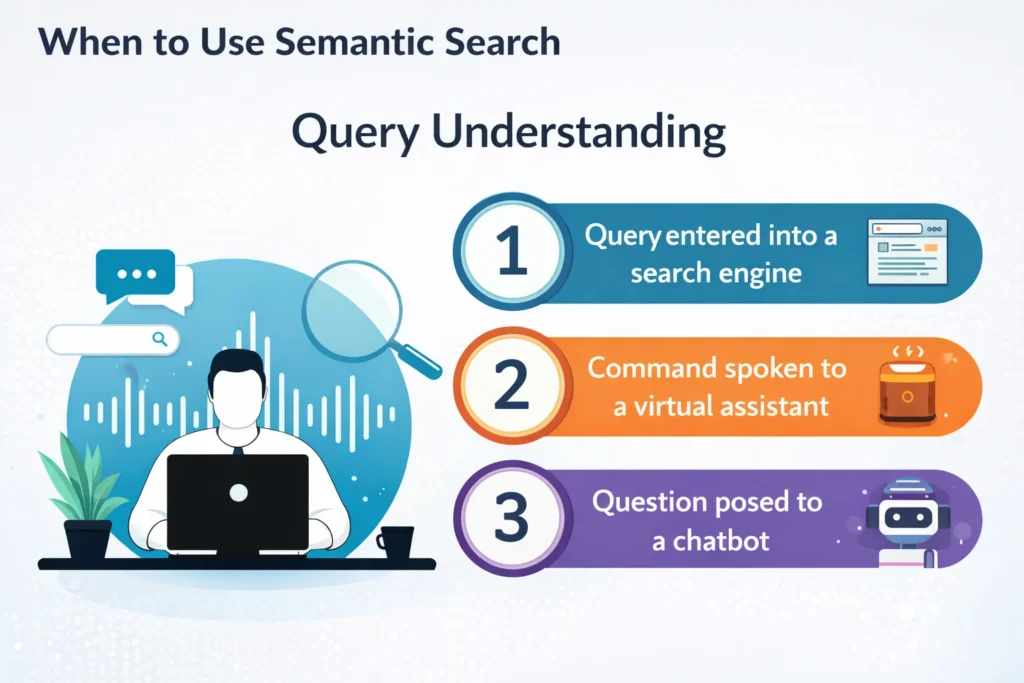
Query Understanding Systems
Semantic search is essential in systems that need to interpret user queries accurately.
Use it for:
- Chat-based interfaces
- Voice assistants
- Customer support search
These systems rely on understanding intent, not just matching words.
Knowledge Graphs
Semantic search works well with knowledge graphs, which connect entities and their relationships.
Use it when:
- You need to link concepts (people, places, topics)
- You want structured understanding of information
- Your system depends on context and relationships
Example: Searching for a person can return related data like their work, location, or associated topics.
When Semantic Search Makes the Most Sense
Use semantic search if your priority is:
- Better understanding of user intent
- More relevant and meaningful results
- Improved content discovery
In simple terms, semantic search is ideal when you want your system to understand what users mean, not just what they type.
When to Use Vector Search
Vector search is best used when you need to find similar content based on meaning, patterns, or behavior, especially across large and complex datasets. It becomes essential in systems where keyword matching is not enough.
AI Applications
Vector search is a core component in modern AI systems.
Use it when:
- You are building AI chatbots or assistants
- You need context-aware retrieval for responses
- You are working with large language models (LLMs)
It helps AI systems retrieve the most relevant information before generating answers.
Recommendation Engines
Vector search is widely used in recommendation systems to match user preferences with similar items.
Use it for:
- Product recommendations
- Content suggestions (videos, articles, music)
- Personalized user experiences
Instead of exact matches, it finds items that are behaviorally or contextually similar.
Image and Multimedia Search
Vector search is highly effective for non-text data.
Use it when:
- You want to search images using text
- You need to find visually similar images
- You are working with audio or video content
It enables search across formats where traditional keyword-based methods don’t work.
Large-Scale Unstructured Data Retrieval
Vector search is designed to handle massive amounts of unstructured data.
Use it when:
- You are dealing with documents, PDFs, logs, or mixed data types
- You need fast retrieval across millions of records
- Your system requires high scalability
Vector databases make it possible to search large datasets efficiently using similarity matching.
When Vector Search Makes the Most Sense
Use vector search if your priority is:
- Finding similarity beyond exact words
- Working with unstructured or multi-format data
- Building AI-driven systems at scale
In simple terms, vector search is ideal when you want to find what is most similar, not just what matches exactly.
Benefits and Limitations
Semantic Search Pros & Cons
Semantic search brings a major improvement in how search systems understand queries, but it also has some practical limitations depending on the use case.
Pros
Better User Intent Understanding
Semantic search focuses on what the user actually means, not just the words they type.
This helps deliver results that align more closely with real needs, especially for long or conversational queries.
Improves Search Relevance
By considering context, synonyms, and relationships between words, semantic search reduces irrelevant results.
Users are more likely to find accurate answers even if their query is not perfectly worded.
Cons
Limited for Complex Similarity Tasks
Semantic search works well for understanding language, but it is not designed for deep similarity matching across large datasets, especially when dealing with non-text data like images or audio.
Depends on Language Processing
Its effectiveness relies heavily on Natural Language Processing (NLP).
If the system fails to understand context or intent correctly, the quality of results can drop.
In simple terms, semantic search is strong at understanding meaning, but it may fall short when handling complex similarity or large-scale data matching.
Vector Search Pros & Cons
Vector search is powerful for modern AI systems, especially when dealing with similarity and large datasets. However, it also comes with technical requirements that need to be considered.
Pros
Handles Complex Similarity
Vector search excels at finding relationships between data points based on meaning and patterns.
It can identify similar content even when there are no shared keywords, making it highly effective for advanced search and AI use cases.
Works Across Multiple Data Types
Unlike traditional search methods, vector search is not limited to text. It can handle:
- Images
- Audio
- Documents
- Mixed data formats
This makes it suitable for applications where data is unstructured or multimodal.
Cons
Requires Embeddings
Before searching, all data must be converted into embeddings using machine learning models.
This adds an extra step and requires the right model selection for accurate results.
Infrastructure Complexity
Vector search systems often require specialized infrastructure, such as vector databases and optimized indexing techniques.
This can increase setup effort, cost, and maintenance compared to traditional search systems.
In simple terms, vector search is strong at finding similarity across complex data, but it requires more setup and technical resources to implement effectively.
Tools and Technologies
To build modern search systems using semantic and vector search, you need a combination of tools that handle data processing, embeddings, and retrieval. These tools form the foundation of AI-driven search applications.
Vector Databases
Vector databases are designed to store and search embeddings efficiently. They allow fast similarity matching across large datasets.
Popular options include:
- Pinecone – Fully managed, scalable, and easy to integrate
- Weaviate – Open-source with built-in AI modules
- FAISS – High-performance library for similarity search
These tools are essential for handling large-scale vector search operations.
NLP Models
NLP models are used to convert text into embeddings that capture meaning and context.
Commonly used models:
- BERT – Strong for understanding context in text
- OpenAI Embeddings – Widely used for generating high-quality vector representations
These models power the “understanding” layer of semantic and vector search systems.
Search Engines
Traditional search engines are still important, especially for keyword-based retrieval and hybrid search setups.
Popular choices:
- Elasticsearch – Supports full-text and vector search capabilities
- OpenSearch – Open-source alternative with similar features
These tools help combine keyword search with semantic and vector-based approaches.
How These Tools Work Together
A typical modern search stack looks like this:
- NLP models convert content into embeddings
- Vector databases store and retrieve similar data
- Search engines handle keyword queries and filtering
Together, they enable fast, accurate, and scalable search experiences.
Key Takeaway
To build an effective search system:
- Use NLP models for understanding
- Use vector databases for similarity search
- Use search engines for keyword matching and hybrid setups
This combination forms the backbone of modern AI-powered search systems.
Future of Search: Where Things Are Heading
Search is evolving fast. What started as simple keyword matching has now moved toward intelligent systems that understand context, generate answers, and adapt to users in real time. Here are the key directions shaping the future of search.
AI-Driven Search Systems
Search engines are becoming more AI-driven, using advanced models to understand queries and deliver precise answers.
- Queries are interpreted more like conversations
- Systems generate direct answers instead of just listing links
- Context is retained across multiple searches
This shift is making search faster, smarter, and more user-focused.
Multimodal Search (Text + Image + Voice)
Search is no longer limited to text. Users can now interact using multiple formats.
- Search with images (e.g., find similar products)
- Voice-based queries through assistants
- Combined inputs (text + image together)
This allows users to search in the most natural way possible, depending on their situation.
Personalized Search Experiences
Search results are becoming more tailored to individual users.
- Based on past behavior and preferences
- Adjusted for location and context
- More relevant and customized outputs
This improves user experience by showing results that matter most to each person.
Rise of Generative Search
One of the biggest shifts is the rise of generative search.
- AI generates answers instead of just retrieving pages
- Summarizes information from multiple sources
- Provides direct, conversational responses
This is changing how users interact with search engines, moving from “finding links” to “getting answers.”
What This Means Going Forward
- Search will become more context-aware and interactive
- Users will rely more on AI-generated responses
- Systems will combine semantic understanding + vector search + generative AI
In simple terms, the future of search is about understanding, personalization, and direct answers, not just matching keywords.
FAQs (People Also Ask Optimization)
1. Is vector search better than semantic search?
Vector search is not better than semantic search—they serve different roles. Semantic search focuses on understanding user intent and meaning, while vector search focuses on finding similarity using embeddings. In most modern systems, they are used together rather than as alternatives.
2. Can semantic search work without vector search?
Yes, semantic search can work without vector search by using Natural Language Processing (NLP) techniques and traditional search algorithms. However, many advanced systems now use vector representations internally to improve accuracy and scalability.
3. What is an example of vector search?
A common example is image search. You can upload a photo, and the system finds visually similar images without relying on keywords. Another example is recommendation systems that suggest products or content based on similarity to user behavior.
4. How does Google Search use semantic search?
Google uses semantic search to understand the intent behind queries. It analyzes context, relationships between words, and user behavior to deliver more relevant results. This is why you often get accurate answers even when your query is not perfectly worded.
5. What are embeddings in vector search?
Embeddings are numerical representations of data (such as text or images). They convert content into vectors so that systems can compare and measure similarity. In vector search, embeddings are used to find results that are closest in meaning, not just exact matches.
Conclusion
Semantic search and vector search are both important parts of modern search systems, but they solve different problems.
Semantic search focuses on understanding meaning and user intent. It improves how systems interpret queries and deliver relevant results, especially in text-based searches. Vector search, on the other hand, focuses on similarity matching using embeddings. It is designed to handle large-scale data and works well across multiple formats like text, images, and audio.
The key takeaway is that these two approaches are not competing, they work best when used together. Semantic search provides the understanding layer, while vector search provides the mechanism to find similar results efficiently at scale. Most advanced systems today combine both, often along with traditional keyword search, to deliver the best outcomes.
When choosing the right approach, it depends on your use case:
- Use semantic search when your priority is understanding queries and improving relevance
- Use vector search when you need similarity matching across complex or unstructured data
- Use a hybrid approach when building modern, scalable search systems