I looked at my Monday calendar last week and counted 17 context switches before lunch. I bounced from email triage to a vendor reschedule, three overdue invoices, duplicate CRM contacts, and a pipeline report that should have been automated months ago. By 1 p.m., I had done a lot of work and created zero new momentum.
That pattern shows up in companies of every size. Busy does not equal productive when leaders spend their best hours clearing admin debt.
A Slack survey found that small business owners lose about 96 minutes of productivity each day to wasted time while juggling four digital tools on average.
Microsoft research across 31,000 workers reached a similar point. Inefficient meetings were the top distraction dragging output down.
The fix usually is not another productivity app. It is a better system for recurring work, and a virtual assistant program can provide it when routine tasks move into a managed queue with clear service-level agreements.
Treat operations support like infrastructure, not overhead, and the difference shows up fast.
What Business Operations Support Means, and Where Virtual Assistants Fit
Business operations support is the repeatable work that keeps revenue, service, and reporting moving every day.
It includes calendar management, inbox triage, CRM hygiene, billing follow-ups, ticket routing, data cleanup, and vendor coordination. These tasks are not flashy, but they keep the business from stalling.
A few role differences matter. A virtual assistant usually owns defined task queues. An executive assistant handles strategic scheduling and stakeholder communication with more judgment. A BPO agent works inside a larger outsourcing team with tighter scripts and less flexibility.
Two terms show up a lot here. An SLA, or service-level agreement, is the target for speed and quality, such as triaging an inbox within two hours. An SOP, or standard operating procedure, is the written playbook for how the work gets done.
Where do VAs fit best? Think triage layers, documentation, scheduling logistics, templated outreach, report assembly, expense reconciliation, and list maintenance. McKinsey found that at least 30 percent of activities in about 60 percent of occupations can be automated or offloaded, which shows how much room there is for smart delegation.
That does not mean you hand over high-stakes judgment on day one. Start with repeatable queues, protect system access, and keep pricing, legal review, and personnel decisions with your core team.
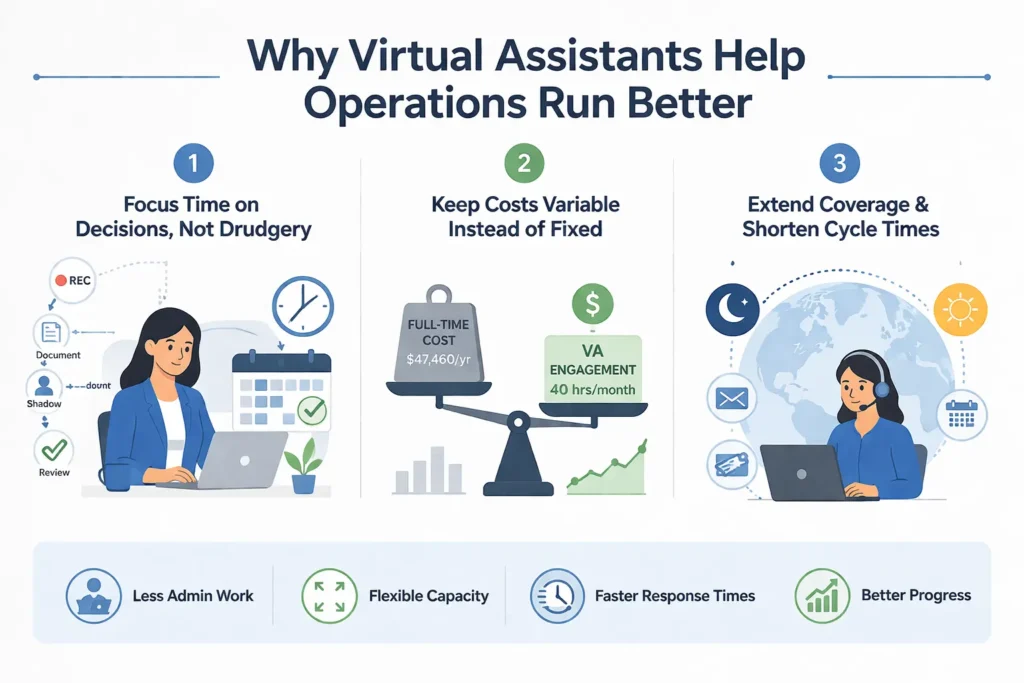
Why Virtual Assistants Help Operations Run Better
The biggest gains come from fewer context switches, flexible capacity, and faster response times.
Remote work is no longer a temporary setup. About 28 percent of paid U.S. workdays were remote in March 2024, up from roughly 5 percent before 2020. That shift makes distributed support practical for everyday operations, not just special projects.
Focus Time on Decisions, Not Drudgery
Context switching burns attention. When a VA owns inbox triage, meeting prep, follow-ups, and data entry, you protect blocks of time for sales calls, hiring decisions, or product work.
A simple Delegation Ladder helps. Record the task, document the steps, let the VA shadow you, then review mirrored work before full ownership. Trust grows faster when the process is staged.
Keep Costs Variable Instead of Fixed
The U.S. median annual wage for secretaries and administrative assistants was $47,460 in May 2024, according to the Bureau of Labor Statistics. A VA engagement scoped at 40 hours per month with clear targets usually costs far less and avoids benefits overhead.
That variable model matters when workload rises and falls. You can add coverage during launches, reduce it in slower months, and still keep continuity through shared SOPs and basic quality checks.
Extend Coverage and Shorten Cycle Times
Zendesk reports that 72 percent of customers want immediate service. A VA in an offset time zone can keep inboxes, tickets, and scheduling moving after your local team signs off.
Handoffs only work with guardrails. Use templates, a shared knowledge base, a password manager, and audit logs so faster response times do not create security gaps or inconsistent answers.
What to Delegate First to Create Real Leverage
Start with frequent, rules-based tasks, because they create fast wins and are easiest to train.
Begin with work that shows up every day, follows a clear pattern, and slows down senior people when it piles up. Once those queues run smoothly, move to semi-structured work with checklists and approval rules.
Admin Core
Inbox triage with labels and canned replies, calendar blocking, meeting prep packs, travel booking, and file organization are quick wins. They recur daily, they are visible, and they usually follow simple decision rules.
Revenue Operations
Lead intake, ideal customer profile, or ICP, checks, CRM deduplication, stage updates, quote prep, invoice follow-ups, and renewal reminders all belong here. Clean data speeds up every downstream decision, from forecasting to customer handoff.
Customer Operations
First-response triage, FAQ upkeep, macro checks, customer satisfaction, or CSAT, request flows, and post-call summaries are strong candidates. These tasks protect service levels without pulling senior staff into queue management.
Data and Project Operations
Weekly KPI roll-ups, dashboard refreshes, list cleansing, Kanban board upkeep, sprint logistics, blocker follow-ups, and status reporting work well when they run from a template. If the task has a cadence and a checklist, it is usually ready for delegation.
Not ideal for delegation: pricing strategy, compensation decisions, legal sign-offs, and sensitive negotiations without a strong SOP. Keep those close until you can break the work into smaller, safer parts.
How to Hire, Onboard, and Manage a VA
A VA program works best when you scope outcomes first, then build hiring, access, and review around them.
Treat onboarding like setting up a small operating unit. Clear inputs, outputs, permissions, and review points matter more than a perfect job title.
Step 1: Scope the Outcome. Write a one-page brief for each process with the purpose, trigger, inputs, steps, and definition of done. Add SLA targets and quality thresholds so the VA knows what good work looks like.
Step 2: Choose the Right Sourcing Channel. Compare marketplaces, direct contractors, and managed providers. With 38 percent of the U.S. workforce freelancing in 2023 and contributing $1.27 trillion to the economy, the talent pool is deep. Your choice depends on ramp speed, oversight needs, and the hours you need covered.
Step 3: Run a Paid Trial. Use one scorecard for accuracy, speed, communication, and tool fluency. A three-to-five-hour paid test on real, low-risk tasks tells you more than a polished interview ever will.
Step 4: Set Access and Security. Apply least-privilege access, store credentials in a password vault, use role-based permissions, and keep an offboarding checklist ready. Security should be built into the workflow, not added after a mistake.
Step 5: Standardize the Tool Stack. Pick one project hub, one communication channel, one documentation home, and a ticketing or form system for intake. Clean requests reduce rework and speed up training.
Step 6: Follow a 30-60-90 Day Rollout. Days 1 through 14 are the Delegation Sprint, which means record, document, and shadow. Days 15 through 45 increase volume with daily QA. Days 46 through 90 stabilize service levels, expand scope, and tighten the SOPs based on real work.
Management cadence matters just as much as hiring. Use daily check-ins for the first two weeks, then a weekly 30-minute standup that reviews SLA hit rate, time saved, error rate, blockers, and the next process to templatize.
If that sounds process-heavy, remember the trade-off. A little structure up front is cheaper than months of rework, missed messages, and founder bottlenecks.
When Managed Support Beats DIY Hiring
A managed provider makes sense when you need speed, backup coverage, and quality control without building the whole system yourself.
For founders who want a vetted, managed option, the real appeal is faster ramp-up, backup coverage, and someone helping turn scattered tasks into documented workflows with clear accountability.
When you need onboarding help, stronger SOPs, time-zone coverage, quality checks, and measurable service targets across inbox triage, CRM hygiene, scheduling, and reporting, Wing Assistant is one managed option worth evaluating as a virtual assistant for business that can make delegation easier to launch.
A DIY setup can work, but it asks you to write every SOP, screen candidates across time zones, manage reviews, and solve access issues on your own. That is a fair trade when task volume is low and your workflows are simple.
Managed providers are built for teams that want a dedicated VA with faster ramp-up and extra oversight. They can help shape onboarding, set service targets for inbox triage, CRM hygiene, scheduling, and reporting, and give founders a cleaner handoff than a pure freelance search.
This model is useful when you need backup coverage, documented processes, or a quicker start than direct hiring can offer. It also helps when you know what should be delegated but do not want to spend nights building the support stack from scratch.
Managed support is not the only answer. If your needs are narrow and stable, a direct contractor may cost less, but once the work touches several functions, the management lift usually becomes the deciding factor.
How to Track ROI and Quality
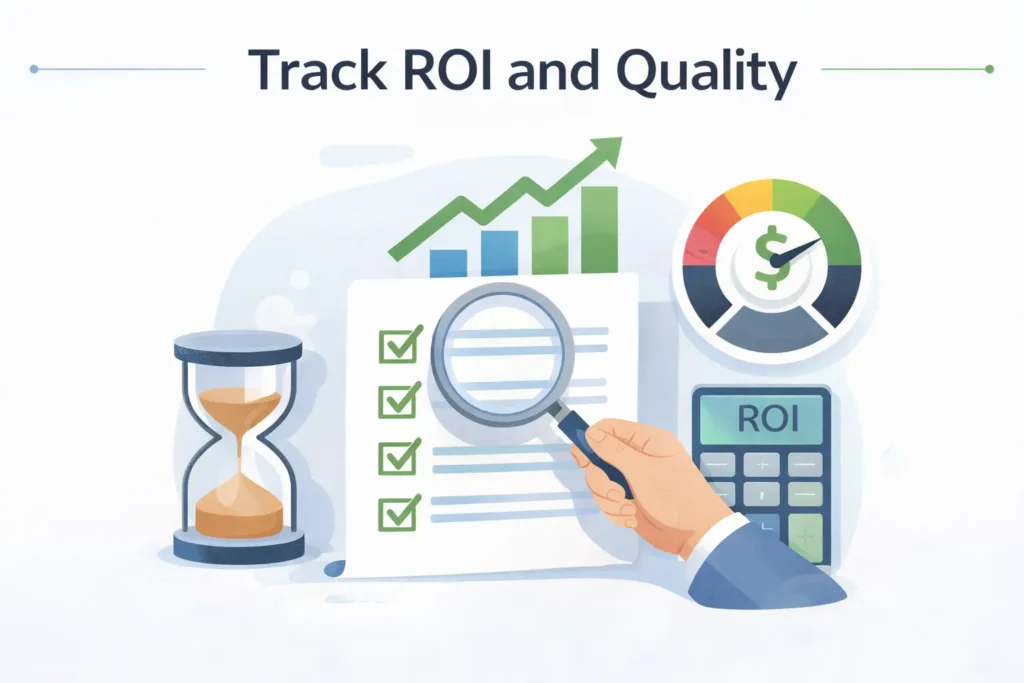
If you cannot measure time saved, service levels, and errors, you cannot prove that a VA program works.
Measure time, quality, and throughput, not just hourly cost.
Time and Cost Model
Start with a calendar audit, inbox volume count, and a list of recurring tasks. Track net hours reclaimed, which is task count times average minutes offloaded, minus review and rewrite time.
Then multiply those hours by your blended internal rate, meaning the average hourly cost of the people no longer doing the work. If a sales manager gets six hours a week back, the value is real even before revenue rises.
Service Levels and Throughput
Set SLAs for first response, resolution, and scheduling turnaround. Weekly trend lines should show backlog falling and cycle times tightening as the VA takes on more volume.
Quality, Risk, and Satisfaction
Label errors as minor or major, review a sample of at least 10 percent of outputs, and require approval for sensitive messages. A light internal satisfaction check after key tasks helps catch friction before trust erodes.
Leading and Lagging Indicators
Leading indicators include SOPs published, requests submitted through structured forms, and training hours completed. Lagging indicators include time saved, SLA hit rate, error rate, and stakeholder satisfaction, and you need both to spot problems before they spread.
How to Make Virtual Assistants Work Over Time
Process discipline matters more than personality when you want delegation to last.
Systems win.
Write SOPs before you hire, start with triage and hygiene work, and use checklists plus canned responses to reduce variance. Keep a living runbook so every process change has one source of truth.
Expand scope only after three straight green weeks on your scorecard. Once the human process is stable, then add automation or AI to speed up handoffs, summaries, and data cleanup.
McKinsey estimates that generative AI could add $2.6 trillion to $4.4 trillion in annual economic value, but that upside shows up only when the underlying workflow is already clear. Human-run SOPs come first, automation second.
Deloitte’s Global Shared Services Survey notes that cost reduction, standardization, and digital enablement sit high on the outsourcing agenda. A good VA program supports all three without forcing headcount growth before the business is ready.
Common Questions About Virtual Assistants
Most VA problems come from unclear scope, weak guardrails, or poor handoffs, not from the model itself.
VA Vs. Executive Assistant Vs. BPO Agent
A VA handles defined, repeatable task queues with clear SOPs. An executive assistant works with more autonomy on strategic scheduling and stakeholder communication. A BPO agent usually operates inside a larger outsourced team with stricter scripts and less room to adjust the process.
Tasks You Should Not Delegate
Avoid handing off pricing calls, compensation decisions, legal approvals, and sensitive negotiations without a strong playbook. If a task depends on judgment that has not been documented, keep it in-house for now.
Offshore Vs. Local Support
Choose based on time-zone coverage, compliance needs, and language sensitivity. Offshore support can lower cost and extend hours, while local support may be easier for customer-facing work that depends on nuance.
How Soon ROI Should Show Up
With a scoped Delegation Sprint, you should see time savings within 30 days and a steadier run rate by day 90. The key is to track reclaimed hours and review time every single week.
How to Prevent Quality Drift
Review a sample of work every week, update SOPs when edge cases appear, and run short post-mortems on major misses. Consistency comes from cadence and documentation, not constant supervision.