What Is AI Governance Contextual Truth? Framework, Principles & Examples
What Is AI Governance Contextual Truth?
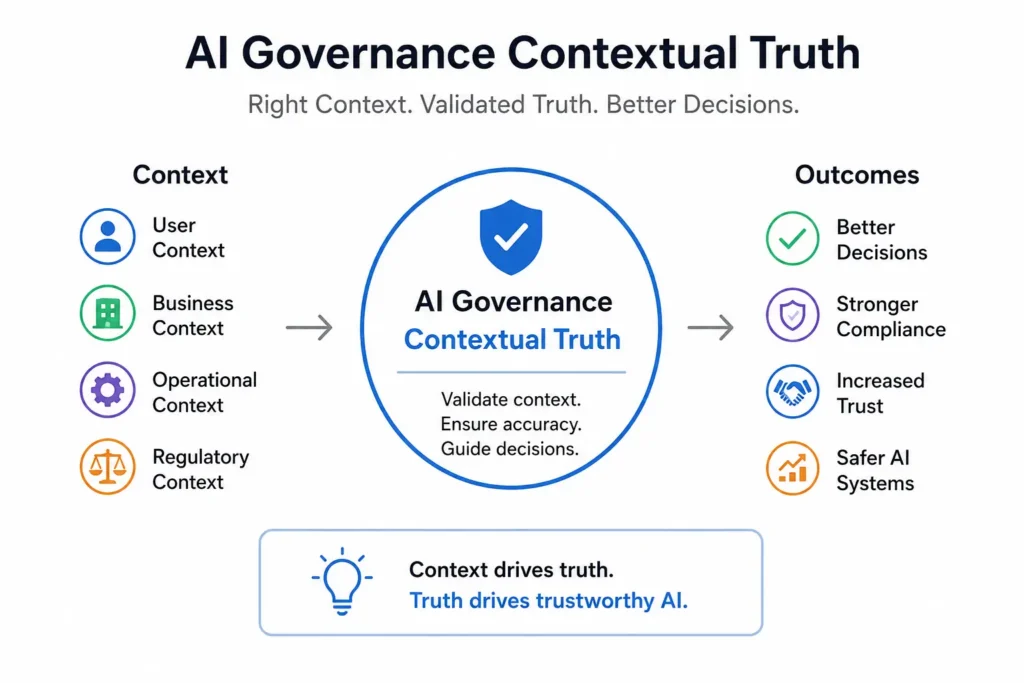
AI Governance Contextual Truth is a framework that helps organizations ensure AI systems make decisions based on the right context, verified information, and governance rules. Instead of relying only on fixed policies, it evaluates business goals, user intent, data quality, regulations, and real-world conditions before an AI system takes action.
AI Governance Contextual Truth is the practice of governing AI systems using validated contextual information to improve decision accuracy, accountability, transparency, and compliance.
Why Context Matters in AI Decision-Making
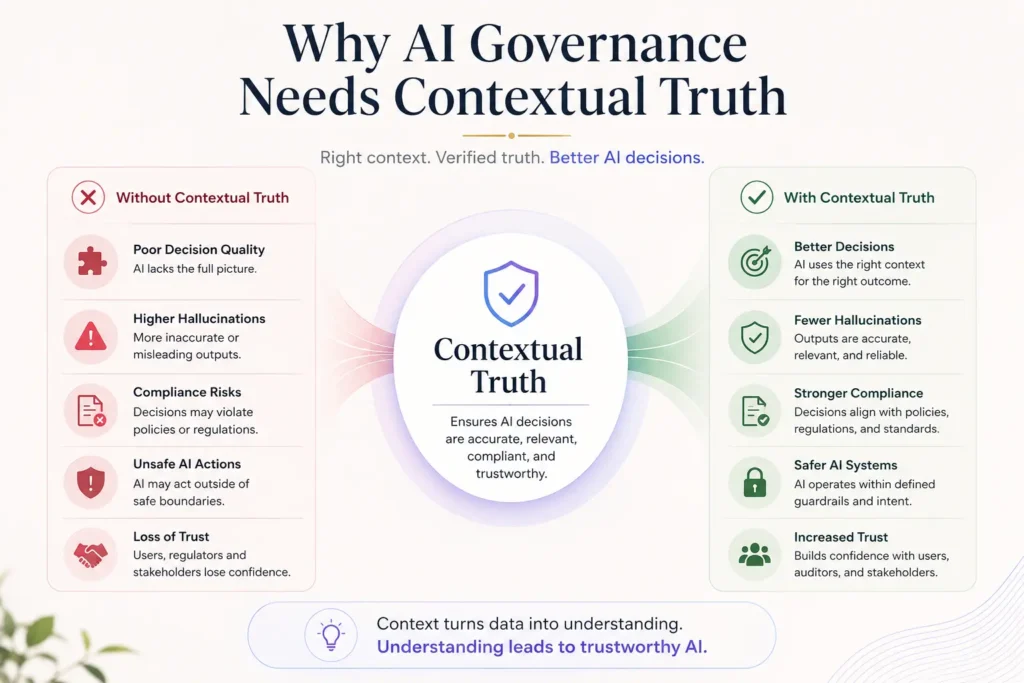
AI systems do not operate in isolation. The same input can require different responses depending on the user, business objective, location, regulatory requirements, or current conditions. Without context, AI may generate inaccurate recommendations, unsafe actions, or non-compliant outcomes.
Context helps AI systems:
Make more accurate decisions
Reduce hallucinations and errors
Improve regulatory compliance
Deliver relevant and trustworthy outputs
Adapt to changing environments
Contextual Truth vs Absolute Truth in AI Systems
Absolute truth refers to facts that remain constant regardless of circumstances. Contextual truth considers how those facts apply within a specific situation.
For example, sharing customer information may be permitted for fraud prevention but prohibited for marketing purposes. The underlying data remains the same, but the appropriate action changes based on context.
Factor
Absolute Truth
Contextual Truth
Focus
Universal facts
Situation-specific decisions
Decision Basis
Static information
Context and circumstances
Adaptability
Limited
High
AI Governance Value
Reference point
Operational guidance
The Role of Contextual Truth in AI Governance
Contextual truth serves as the bridge between governance policies and AI actions. It helps organizations validate whether an AI decision is appropriate for a specific situation before that decision is executed.
By incorporating contextual truth into AI governance, organizations can improve trust, strengthen compliance, support human oversight, and manage risks associated with autonomous AI systems and agents.
Why AI Governance Needs Contextual Truth
Traditional AI governance frameworks were designed for predictable systems operating under predefined rules. However, modern AI models and autonomous agents interact with dynamic environments where context can change rapidly. To ensure safe, accurate, and compliant AI decisions, organizations need governance approaches that go beyond static policies.
The Limitations of Rule-Based Governance
Rule-based governance relies on predefined policies and controls. While effective for stable environments, it often struggles when AI systems encounter new situations, changing regulations, or unexpected user requests. Static rules cannot account for every possible scenario, increasing the risk of inaccurate or inappropriate decisions.
The Rise of Agentic AI Systems
Agentic AI systems can plan tasks, use external tools, make decisions, and take actions with limited human involvement. As these systems become more autonomous, governance must evaluate not only what an AI does but also whether its actions are appropriate within a specific context.
Dynamic Business Environments and Changing Contexts
Business goals, customer expectations, regulations, and market conditions constantly evolve. Decisions that are correct today may not be suitable tomorrow. Contextual truth helps AI systems adapt to these changes by validating decisions against current business and operational conditions.
Trust, Transparency, and Accountability Challenges
Organizations must be able to explain how AI systems reach decisions and demonstrate compliance with governance requirements. Contextual truth improves transparency by connecting AI actions to the specific data, policies, and circumstances that influenced the outcome. This strengthens accountability and helps build trust among users, regulators, and stakeholders.
Key Takeaway: AI governance cannot rely on static rules alone. Contextual truth enables AI systems to make decisions based on real-world conditions, helping organizations improve trust, compliance, accountability, and decision quality.
The AI Governance Contextual Truth Framework
The AI Governance Contextual Truth Framework provides a structured approach for ensuring AI systems make accurate, trustworthy, and compliant decisions. The framework consists of five interconnected layers that help organizations validate context, govern decisions, monitor outcomes, and continuously improve AI performance.
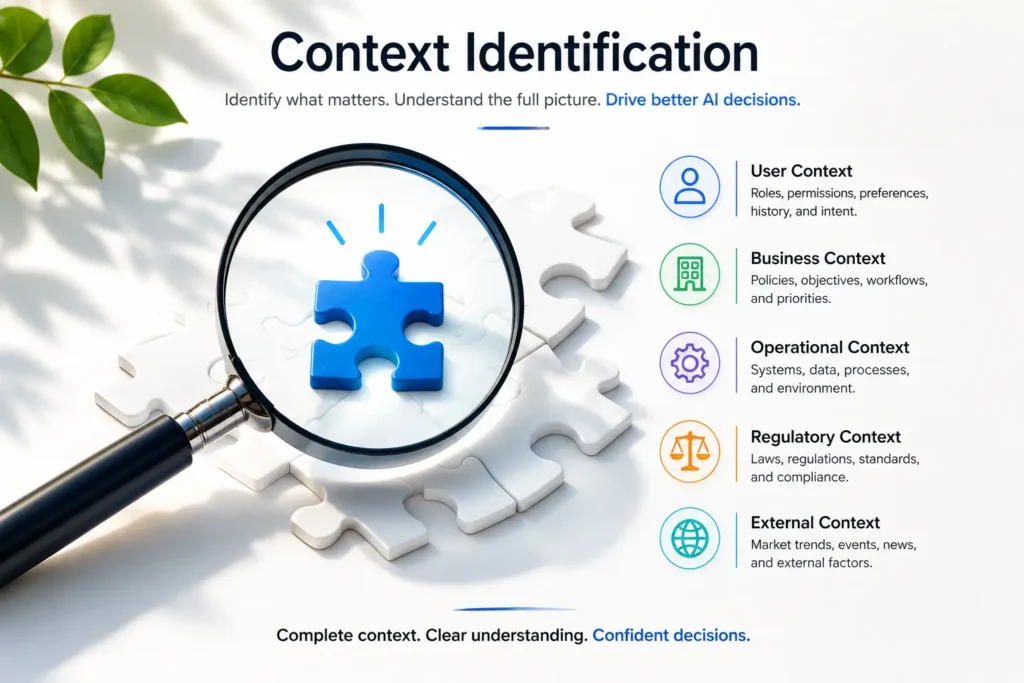
Layer 1: Context Identification
The first step is identifying the context surrounding an AI decision. Without proper context, even accurate data can lead to poor outcomes.
Business Context
Organizational goals and priorities
Business rules and policies
Industry-specific requirements
User Context
User intent and expectations
Access permissions
Role-specific requirements
Operational Context
Current system conditions
Available resources
Workflow requirements
Regulatory Context
Legal obligations
Compliance requirements
Industry regulations
Layer 2: Truth Validation
Once context is identified, organizations must verify that the information being used is accurate, reliable, and relevant.
Data Verification
Validate data accuracy and completeness
Identify outdated or inconsistent information
Source Reliability Assessment
Verify trusted data sources
Evaluate source credibility
Real-Time Context Validation
Confirm that context remains current
Detect changes that may affect decisions
Layer 3: Decision Governance
This layer ensures AI decisions remain aligned with governance objectives and organizational policies.
Decision Boundaries
Define acceptable actions
Establish operational limits
Escalation Mechanisms
Route high-risk decisions for review
Trigger approval workflows when needed
Human Oversight Triggers
Require human intervention for sensitive decisions
Maintain accountability for critical actions
Layer 4: Outcome Evaluation
After a decision is made, organizations must evaluate its impact and identify potential risks.
Performance Monitoring
Measure decision effectiveness
Track key performance indicators
Risk Monitoring
Identify governance failures
Monitor compliance risks
Context Drift Detection
Detect changes in data, users, or environments
Identify situations where governance controls need adjustment
Layer 5: Continuous Improvement
Effective AI governance requires ongoing refinement as systems and environments evolve.
This five-layer framework helps organizations govern AI systems using validated context rather than static rules alone, improving trust, compliance, transparency, and decision quality.
Core Principles of AI Governance Contextual Truth
The effectiveness of AI Governance Contextual Truth depends on a set of core principles that guide how AI systems evaluate information, make decisions, and operate within governance requirements. These principles help organizations build trustworthy, transparent, and accountable AI systems.
Context Awareness
Context awareness is the foundation of contextual truth. AI systems must understand the business environment, user intent, operational conditions, and regulatory requirements surrounding a decision. This enables AI to deliver responses and actions that are relevant to the specific situation.
Traceability
Every AI decision should be traceable to the data, context, rules, and processes that influenced the outcome. Traceability allows organizations to audit decisions, investigate issues, and demonstrate compliance when needed.
Transparency
Organizations should maintain visibility into how AI systems use data and context during decision-making. Transparent governance processes help stakeholders understand how decisions are made and reduce uncertainty around AI behavior.
Accountability
Clear accountability ensures that responsibility for AI decisions remains defined. Organizations should establish ownership for governance policies, oversight processes, and decision outcomes, particularly for high-risk AI applications.
Explainability
AI systems should provide understandable explanations for their decisions and recommendations. Explainability helps users, auditors, and regulators understand why a specific outcome was produced and whether it aligns with governance requirements.
Human Oversight
Human oversight remains essential, especially for sensitive, high-impact, or high-risk decisions. Governance frameworks should define when human review, approval, or intervention is required before an AI system takes action.
Continuous Validation
Context can change rapidly. Continuous validation ensures that data sources, contextual information, and governance controls remain accurate, relevant, and up to date throughout the AI lifecycle.
Risk-Based Governance
Not all AI decisions carry the same level of risk. Risk-based governance applies stronger controls, monitoring, and oversight to high-risk use cases while allowing greater flexibility for lower-risk activities. This approach improves governance efficiency without compromising safety or compliance.
Key Takeaway
The core principles of AI Governance Contextual Truth, context awareness, traceability, transparency, accountability, explainability, human oversight, continuous validation, and risk-based governance, work together to help organizations build trustworthy, compliant, and context-aware AI systems.
How Contextual Truth Differs From Traditional AI Governance
Traditional AI governance frameworks were developed for systems operating within predictable environments and predefined rules. While these approaches provide important controls, they often struggle to govern modern AI agents that operate in dynamic, real-world situations.
AI Governance Contextual Truth addresses this challenge by evaluating decisions based on current context, verified information, and changing conditions rather than relying solely on static policies.
Area
Traditional Governance
Contextual Truth Governance
Decision Making
Rule-based decisions guided by predefined policies
Context-aware decisions based on real-time conditions and validated information
Risk Assessment
Static risk evaluations performed at set intervals
Dynamic risk assessment that adapts to changing circumstances
AI Agents
Limited support for autonomous and multi-step actions
Designed to govern AI agents and autonomous systems
Compliance
Periodic reviews and audits
Continuous compliance monitoring and validation
Human Oversight
Reactive intervention after issues occur
Proactive oversight based on risk levels and context
Adaptability
Low adaptability to changing environments
High adaptability through continuous context evaluation
Why the Difference Matters
As AI systems become more autonomous, governance must move beyond fixed rules and periodic reviews. AI agents can make decisions, interact with external tools, and respond to changing environments in real time. Contextual Truth Governance provides the flexibility needed to manage these systems while maintaining trust, accountability, transparency, and compliance.
Example
Consider an AI-powered customer service agent handling a refund request:
Under traditional governance, the system follows predefined refund rules regardless of customer history or current circumstances.
Under contextual truth governance, the system evaluates additional factors such as customer loyalty, transaction history, fraud indicators, business policies, and regulatory requirements before making a decision.
This context-aware approach leads to more accurate, compliant, and trustworthy outcomes.
Key Takeaway
Traditional AI governance focuses on controlling AI through static rules, while Contextual Truth Governance focuses on guiding AI decisions using validated context. This makes it better suited for modern AI systems, autonomous agents, and rapidly changing business environments.
The Building Blocks of Contextual Truth in AI
Contextual truth relies on multiple layers of information that help AI systems understand situations accurately before making decisions. These building blocks provide the context needed to improve decision quality, reduce risks, and support effective AI governance.
Data Context
Data context refers to the quality, accuracy, source, and relevance of the information used by an AI system. Even advanced AI models can produce incorrect outcomes if they rely on incomplete, outdated, or unreliable data.
Business Context
Business context includes organizational goals, policies, priorities, and operational requirements. Understanding business context helps AI align its decisions with company objectives and governance standards.
User Intent Context
User intent context focuses on understanding what the user is trying to achieve. The same request can have different meanings depending on the user’s role, purpose, permissions, and expected outcome.
Regulatory Context
AI systems must operate within applicable laws, regulations, and industry standards. Regulatory context ensures decisions remain compliant with legal and governance requirements across different regions and sectors.
Environmental Context
Environmental context includes real-time conditions that may influence AI decisions. These conditions can include system status, market changes, operational constraints, security risks, or external events.
Historical Context
Historical context provides information about past interactions, previous decisions, and known outcomes. This helps AI systems make more informed decisions and avoid repeating past mistakes.
Example Scenario: How Context Changes AI Recommendations
Consider an AI system evaluating a customer refund request.
Scenario 1: New Customer
First purchase
Refund requested after product use
No special circumstances
AI Recommendation: Standard refund review process.
Scenario 2: Long-Term Customer
Five years of purchase history
Strong customer loyalty
No history of abuse
AI Recommendation: Approve expedited refund.
Scenario 3: High Fraud Risk
Multiple recent refund requests
Suspicious account activity
Fraud indicators detected
AI Recommendation: Escalate for manual review.
In all three cases, the request is the same, a refund request. However, the AI recommendation changes because the surrounding context changes. This ability to adapt decisions based on data, business, user, regulatory, environmental, and historical factors is what makes contextual truth a critical component of modern AI governance.
AI Governance Contextual Truth for Agentic AI
Agentic AI systems can plan tasks, make decisions, use external tools, and take actions with minimal human involvement. While these capabilities increase efficiency, they also create new governance challenges that traditional AI oversight frameworks were not designed to address. Contextual truth helps organizations govern autonomous AI agents by ensuring decisions remain aligned with business objectives, regulations, and real-world conditions.
Why Agentic AI Creates New Governance Challenges
Unlike traditional AI systems that generate outputs based on user prompts, agentic AI can independently pursue goals and execute actions. This increased autonomy introduces risks related to decision quality, compliance, accountability, and oversight.
Multi-Step Decision Making
Agentic AI often performs a sequence of interconnected actions to achieve a goal. A single error early in the process can affect later decisions. Contextual truth helps validate information and decisions at each stage rather than only evaluating the final outcome.
Autonomous Goal Execution
AI agents can interpret objectives and determine how to accomplish them. Without proper governance, an agent may select actions that technically achieve a goal but conflict with business policies, ethical standards, or compliance requirements. Contextual truth ensures goals are evaluated within the appropriate context before execution.
Tool Usage and External Actions
Modern AI agents frequently interact with databases, APIs, software applications, and external systems. These actions may involve sensitive data, financial transactions, or customer interactions. Governance controls must validate whether an action is appropriate before it is performed.
Managing Agent Accountability
As AI agents become more autonomous, organizations must maintain clear accountability for decisions and outcomes. Contextual truth improves accountability by creating traceable links between the agent’s actions, the context used, and the governance controls applied during decision-making.
Example: Customer Support AI Agent
Imagine a customer support AI agent receives a request for a refund.
A traditional AI system may simply apply predefined refund rules.
An agentic AI system, however, may:
Review the customer’s account history.
Check previous purchases and support interactions.
Assess fraud indicators.
Verify company refund policies.
Approve the refund, deny the request, or escalate it to a human representative.
Using contextual truth, the agent evaluates customer history, business policies, fraud risk, and regulatory requirements before making a decision. This results in a more accurate, compliant, and trustworthy outcome while maintaining appropriate human oversight for high-risk cases.
Key Takeaway
Agentic AI requires governance approaches that go beyond static rules. AI Governance Contextual Truth provides the context-aware validation, oversight, and accountability needed to manage autonomous AI agents safely and effectively.
Real-World Examples of AI Governance Contextual Truth
AI Governance Contextual Truth is not just a theoretical concept. Organizations across industries are increasingly relying on context-aware governance to improve decision quality, reduce risks, and ensure compliance. The following examples demonstrate how contextual truth helps AI systems make better decisions in real-world environments.
Healthcare AI Systems
Healthcare AI applications often operate in high-risk environments where decisions can directly affect patient outcomes.
Patient-Specific Context
Medical history
Current health conditions
Age and risk factors
Medication records
Risk-Sensitive Decisions
Treatment recommendations
Diagnostic support
Patient triage prioritization
By evaluating patient-specific context, healthcare AI can provide more accurate and safer recommendations while supporting regulatory compliance and clinical oversight.
Financial Services
Financial institutions use AI to process large volumes of transactions and assess financial risks.
Fraud Detection
Transaction patterns
Customer behavior history
Geographic location
Device and account activity
Credit Assessment
Financial history
Income and repayment records
Regulatory lending requirements
Contextual truth helps financial AI systems reduce false positives, improve risk assessments, and support fair decision-making.
Enterprise Knowledge Assistants
Organizations increasingly deploy AI assistants to help employees access information and complete tasks.
Internal Policy Compliance
Role-based access controls
Data security requirements
Company policies and procedures
Context-Aware Responses
Department-specific information
User permissions
Current business processes
By considering organizational context, AI assistants can provide accurate answers while preventing unauthorized access to sensitive information.
Autonomous Customer Service Agents
Customer service AI agents often handle requests without direct human involvement.
Escalation Decisions
Complaint severity
Customer sentiment
Regulatory requirements
Business policies
Customer-Specific Handling
Purchase history
Account status
Previous interactions
Loyalty level
Contextual truth enables AI agents to determine when issues can be resolved automatically and when human intervention is required.
Context-aware governance helps logistics AI adapt to changing conditions while minimizing disruptions and operational risks.
Key Takeaway
Across healthcare, financial services, enterprise operations, customer support, and supply chain management, contextual truth enables AI systems to make decisions based on relevant real-world conditions rather than static rules alone. This leads to greater accuracy, stronger compliance, improved trust, and better business outcomes.
Benefits of Implementing Contextual Truth in AI Governance
Organizations that adopt AI Governance Contextual Truth can improve decision-making, reduce risks, and strengthen trust in AI systems. By evaluating decisions within the proper context, AI becomes more reliable, transparent, and aligned with business and regulatory requirements.
Better Decision Quality
Context-aware AI systems make decisions based on relevant business, user, operational, and regulatory information. This leads to more accurate recommendations, fewer errors, and better outcomes than decisions based solely on static rules.
Reduced Hallucinations
AI hallucinations often occur when systems lack sufficient context or rely on incomplete information. Contextual truth helps validate data sources and decision inputs, reducing the likelihood of inaccurate or misleading outputs.
Stronger Regulatory Compliance
Regulations and compliance requirements vary across industries and regions. Contextual truth ensures AI decisions are evaluated against applicable policies and legal obligations, helping organizations reduce compliance risks.
Increased User Trust
Users are more likely to trust AI systems that provide relevant, accurate, and consistent outcomes. Context-aware governance improves confidence by ensuring AI actions align with user expectations and organizational standards.
Improved Explainability
Contextual truth creates clear links between decisions, data sources, policies, and business objectives. This makes it easier for users, auditors, and regulators to understand how and why an AI system reached a particular outcome.
Safer Autonomous Systems
As AI agents become more autonomous, the risk of unintended actions increases. Contextual truth adds governance controls that help ensure AI systems operate within approved boundaries and escalate high-risk decisions when necessary.
Faster Governance Adaptation
Business conditions, regulations, and operational requirements change continuously. Contextual truth enables governance frameworks to adapt more quickly by validating decisions against current conditions rather than relying solely on predefined rules.
Key Takeaway
Implementing Contextual Truth in AI Governance helps organizations improve decision quality, reduce hallucinations, strengthen compliance, increase user trust, enhance explainability, support safer autonomous AI systems, and adapt governance controls to changing environments.
Risks of Ignoring Contextual Truth
Organizations that rely solely on static governance rules may struggle to manage modern AI systems effectively. Without contextual truth, AI decisions can become inaccurate, non-compliant, and difficult to govern, increasing operational and business risks.
Governance Blind Spots
Traditional governance frameworks often fail to account for changing business conditions, user needs, and operational environments. These blind spots can lead to decisions that technically follow rules but are inappropriate for the situation.
AI Hallucinations and Misinformation
When AI systems lack sufficient context, they are more likely to generate inaccurate information, incorrect recommendations, or misleading responses. This can reduce decision quality and create significant business risks.
Compliance Violations
AI systems operating without proper contextual awareness may unintentionally violate regulations, industry standards, or internal policies. As regulatory requirements continue to evolve, context-aware governance becomes increasingly important for maintaining compliance.
Reputational Damage
Incorrect AI decisions, biased outputs, or public compliance failures can damage an organization’s reputation. Customers, partners, and regulators expect AI systems to operate responsibly and make decisions that reflect real-world circumstances.
Unsafe Autonomous Actions
Autonomous AI agents can perform actions without direct human involvement. Without contextual truth and governance controls, these systems may take actions that create financial, operational, legal, or security risks.
Loss of Stakeholder Trust
Trust is one of the most valuable assets in AI adoption. When AI systems produce inconsistent, inaccurate, or unexplained outcomes, confidence among customers, employees, regulators, and business leaders can quickly decline.
Key Takeaway
Ignoring contextual truth increases the risk of governance blind spots, AI hallucinations, compliance violations, reputational harm, unsafe autonomous actions, and loss of stakeholder trust. Context-aware governance helps organizations reduce these risks while improving the reliability and accountability of AI systems.
How to Implement an AI Governance Contextual Truth Framework
Implementing an AI Governance Contextual Truth Framework requires more than creating policies. Organizations must establish processes that ensure AI systems continuously evaluate context, validate information, and operate within governance requirements. The following steps provide a practical implementation roadmap.
Step 1: Map Governance Objectives
Start by defining what your governance program is intended to achieve.
Common objectives include:
Improving AI decision quality
Reducing compliance risks
Increasing transparency and accountability
Supporting safe AI adoption
Governing autonomous AI agents
Clear objectives help align governance controls with business priorities.
Step 2: Identify Critical Context Sources
Determine which contextual factors influence AI decisions.
Examples include:
Business policies
User roles and permissions
Operational data
Regulatory requirements
Historical records
External data sources
Identifying critical context sources ensures AI systems use relevant information when making decisions.
Step 3: Define Truth Validation Mechanisms
Establish processes for verifying the accuracy and reliability of information.
This may include:
Data quality checks
Source verification
Real-time validation
Access controls
Audit logging
Truth validation reduces the risk of inaccurate outputs and governance failures.
Step 4: Establish Decision Guardrails
Create boundaries that define acceptable AI behavior.
Examples include:
Restricted actions
Risk thresholds
Approval requirements
Escalation rules
Compliance controls
Guardrails help prevent unsafe or unauthorized decisions.
Step 5: Create Human Review Processes
Not all decisions should be fully automated. Define when human involvement is required.
Human review may be necessary for:
High-risk decisions
Regulatory-sensitive actions
Financial approvals
Security-related activities
Customer disputes
Human oversight strengthens accountability and governance effectiveness.
Step 6: Monitor Context Drift
Context can change over time as business conditions, regulations, and user behavior evolve.
Organizations should monitor:
Data changes
Policy updates
Regulatory changes
User behavior patterns
AI performance trends
Early detection of context drift helps maintain decision accuracy and compliance.
Step 7: Continuously Improve Governance Controls
AI governance should be treated as an ongoing process rather than a one-time initiative.
Continuous improvement should include:
Performance reviews
Governance audits
Feedback collection
Risk assessments
Policy updates
Regular refinement helps governance frameworks remain effective as AI systems evolve.
Implementation Checklist
Use the following checklist when implementing AI Governance Contextual Truth:
Define governance goals and success metrics
Identify business, user, operational, and regulatory contexts
Establish data validation and source verification processes
Create AI decision guardrails and escalation rules
Define human oversight requirements
Implement monitoring for context drift and governance risks
Maintain audit trails and decision traceability
Regularly review governance performance and update controls
Key Takeaway
Successful implementation of AI Governance Contextual Truth requires clear objectives, validated context sources, strong decision controls, human oversight, continuous monitoring, and ongoing improvement. Together, these practices help organizations build trustworthy, compliant, and context-aware AI systems.
Contextual Truth vs Related AI Governance Concepts
AI Governance Contextual Truth shares similarities with several established AI concepts, but it serves a distinct purpose. Understanding these differences helps organizations determine how contextual truth fits into their broader AI governance strategy.
Contextual Truth vs AI Governance Frameworks
AI governance frameworks provide the overall structure for managing AI risks, compliance, accountability, and oversight. Contextual truth is a component within that structure that helps ensure AI decisions are evaluated using relevant real-world context.
AI Governance Frameworks
Contextual Truth
Broad governance structure
Context-aware decision layer
Focus on policies and oversight
Focus on decision relevance and accuracy
Covers the entire AI lifecycle
Focuses on decision-making processes
Defines governance requirements
Applies context during execution
Contextual Truth vs Responsible AI
Responsible AI focuses on principles such as fairness, transparency, privacy, and ethical AI use. Contextual truth supports these goals by helping AI systems make decisions that align with the circumstances in which they operate.
Responsible AI
Contextual Truth
Ethics-focused approach
Context-focused approach
Emphasizes fairness and accountability
Emphasizes situational accuracy
Defines responsible AI principles
Applies those principles in practice
Organization-wide initiative
Decision-level governance mechanism
Contextual Truth vs AI Guardrails
AI guardrails establish boundaries that restrict what an AI system can do. Contextual truth helps determine whether a decision is appropriate within a specific situation before those guardrails are applied.
AI Guardrails
Contextual Truth
Define restrictions and limits
Evaluates decision context
Prevent unwanted actions
Improves decision quality
Static governance controls
Dynamic governance mechanism
Focus on enforcement
Focus on understanding context
Contextual Truth vs AI Safety
AI safety focuses on preventing harmful behavior, system failures, and unintended outcomes. Contextual truth contributes to AI safety by ensuring decisions are informed by accurate and relevant context.
AI Safety
Contextual Truth
Focus on preventing harm
Focus on contextual accuracy
Addresses technical and operational risks
Addresses context-related risks
Broad safety discipline
Governance and decision-making approach
Protects systems and users
Improves decision reliability
Contextual Truth vs Context Engineering
Context engineering is the practice of designing and managing the information provided to AI models. Contextual truth goes a step further by governing how that context is validated and used in decision-making.
Context Engineering
Contextual Truth
Builds and structures context
Validates and governs context
Focuses on AI inputs
Focuses on AI decisions
Improves model performance
Improves governance outcomes
Technical implementation practice
Governance methodology
Contextual Truth vs Retrieval-Augmented Generation (RAG)
RAG improves AI responses by retrieving information from external knowledge sources. Contextual truth evaluates whether the retrieved information is relevant, reliable, and appropriate for the specific situation.
Retrieval-Augmented Generation (RAG)
Contextual Truth
Retrieves external knowledge
Governs how knowledge is used
Improves factual accuracy
Improves decision accuracy
Data retrieval technique
Governance framework
Focuses on information access
Focuses on contextual decision-making
Key Takeaway
AI Governance Contextual Truth does not replace AI governance frameworks, Responsible AI, guardrails, AI safety, context engineering, or RAG. Instead, it complements these approaches by ensuring AI decisions are guided by validated, situation-specific context. This makes contextual truth a critical governance layer for modern AI systems and autonomous AI agents.
Measuring the Effectiveness of Contextual Truth Governance
Implementing AI Governance Contextual Truth is only the first step. Organizations must also measure how effectively the framework improves decision quality, governance outcomes, and operational performance. Tracking the right metrics helps identify weaknesses, validate governance controls, and support continuous improvement.
Context Accuracy Rate
Context Accuracy Rate measures how often AI systems use correct and relevant contextual information when making decisions.
This metric helps organizations determine whether AI systems are operating with accurate business, user, operational, and regulatory context.
Organizations should measure Context Accuracy Rate, Decision Consistency, Governance Compliance Rate, Hallucination Reduction Metrics, Human Intervention Frequency, and Context Drift Detection Performance to evaluate the success of Contextual Truth Governance. These metrics provide visibility into AI reliability, compliance, accountability, and overall governance effectiveness.
Future of AI Governance Contextual Truth
As AI systems become more autonomous and integrated into business operations, governance models must evolve beyond static rules and periodic audits. Contextual truth is expected to play a central role in the next generation of AI governance frameworks, helping organizations manage increasingly complex AI environments.
Governance for Autonomous Agents
Autonomous AI agents are expected to handle more business processes, make independent decisions, and interact with external systems. Future governance frameworks will rely on contextual truth to ensure these agents operate within approved objectives, compliance requirements, and risk boundaries.
Organizations will increasingly need governance models that can evaluate not only what an AI agent does but also whether its actions are appropriate within a specific context.
Real-Time Context Validation Systems
Future AI governance solutions will move from periodic validation to continuous context monitoring.
These systems will:
Validate context in real time
Detect changes in business conditions
Monitor regulatory updates
Identify emerging risks before decisions are executed
Real-time validation will help organizations maintain accurate and reliable AI decision-making in rapidly changing environments.
Context-Aware Compliance Engines
Compliance requirements are becoming more complex across industries and regions. Future governance platforms are likely to include context-aware compliance engines that automatically evaluate AI actions against applicable laws, regulations, and internal policies.
This approach can help reduce compliance risks while supporting faster decision-making.
AI Governance Platforms
Organizations are increasingly adopting dedicated AI governance platforms to manage AI risks, monitoring, compliance, and oversight.
Future platforms will likely integrate:
Context validation
Decision monitoring
Risk assessment
Audit trails
Human oversight workflows
These capabilities will enable organizations to govern AI systems at scale while maintaining transparency and accountability.
Contextual Intelligence as a Governance Standard
As AI adoption grows, contextual intelligence may become a standard requirement for effective governance. Organizations will need AI systems that understand business objectives, user intent, regulatory obligations, and operational conditions before making decisions.
Rather than relying solely on fixed rules, future governance frameworks will increasingly focus on ensuring AI systems can interpret and apply context accurately.
Key Takeaway
The future of AI Governance Contextual Truth lies in autonomous agent governance, real-time context validation, context-aware compliance, advanced AI governance platforms, and contextual intelligence. Together, these developments will help organizations build more trustworthy, compliant, and adaptive AI systems.
Frequently Asked Questions
What is AI Governance Contextual Truth?
AI Governance Contextual Truth is a governance approach that ensures AI systems make decisions using validated business, user, operational, and regulatory context. It helps organizations improve decision quality, accountability, compliance, and trust in AI systems.
Why is contextual truth important for AI governance?
Contextual truth helps AI systems evaluate decisions based on real-world conditions rather than static rules alone. This reduces errors, improves compliance, strengthens governance controls, and enables safer deployment of autonomous AI systems.
How does contextual truth reduce AI hallucinations?
Contextual truth reduces hallucinations by validating data sources, assessing information reliability, and ensuring AI systems use relevant context before generating outputs or making decisions. This helps improve factual accuracy and response quality.
Can contextual truth improve AI compliance?
Yes. Contextual truth enables AI systems to consider applicable regulations, industry standards, and organizational policies during decision-making. This helps reduce compliance risks and supports continuous governance monitoring.
What industries benefit most from contextual truth governance?
Industries that handle sensitive data, regulatory requirements, or high-risk decisions often benefit the most, including:
Healthcare
Financial services
Insurance
Government
Manufacturing
Supply chain and logistics
Enterprise software
Customer service operations
How is contextual truth different from AI guardrails?
AI guardrails define the limits and restrictions of AI behavior. Contextual truth focuses on evaluating whether a decision is appropriate within a specific situation. While guardrails control actions, contextual truth helps determine the right action to take.
Is contextual truth necessary for agentic AI?
Yes. Agentic AI systems can make decisions, use tools, and perform tasks with limited human involvement. Contextual truth provides the validation, oversight, and governance mechanisms needed to ensure these systems operate safely, responsibly, and within approved boundaries.
How do organizations implement contextual truth frameworks?
Organizations typically implement contextual truth frameworks by:
Defining governance objectives.
Identifying critical context sources.
Establishing truth validation processes.
Creating decision guardrails.
Implementing human oversight controls.
Monitoring context drift.
Continuously improving governance policies and controls.
This structured approach helps organizations build trustworthy, compliant, and context-aware AI systems.