
Urban commuting is changing faster than most transportation planners expected. Rising fuel costs, traffic congestion, and a growing focus on sustainability have pushed commuters to look for smarter, shared ways to get around.
This shift is opening up a real business opportunity and it’s why more entrepreneurs are exploring a carpooling clone as their entry point into the shared mobility market.
As urban populations continue to grow, the demand for affordable and efficient transportation is increasing. Commuters are embracing app-based shared mobility for its convenience, cost savings, and environmental benefits, while businesses see an opportunity to meet this demand with scalable solutions.
By launching a carpooling clone, entrepreneurs can enter the market faster, reduce development costs, and build a reliable platform that supports the future of urban transportation.
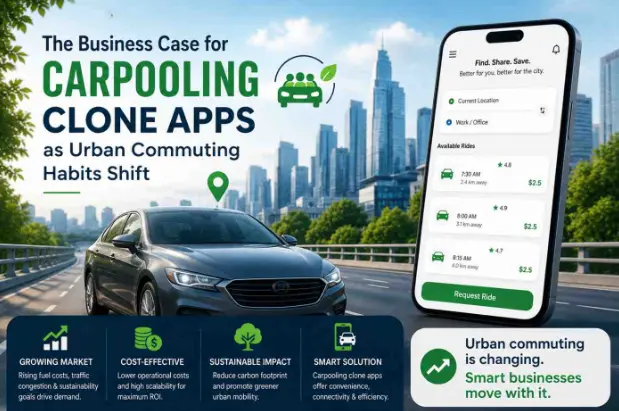
Key Takeaways
- Urban commuters are increasingly choosing shared rides to reduce travel costs and avoid traffic congestion.
- A carpooling clone app helps entrepreneurs enter the growing shared mobility market faster and more cost-effectively.
- Essential features like route matching, fare splitting, live tracking, and verified profiles improve user trust and convenience.
- Using a ready-made platform can significantly reduce development time and launch costs compared to building from scratch.
- Multiple revenue streams, including ride commissions, subscriptions, and corporate partnerships, can create a sustainable business model.
- Businesses that launch early and adapt to changing urban commuting trends have a strong opportunity to build a scalable mobility platform.
Why Urban Commuting Is Shifting Toward Shared Rides
City populations keep growing, but Carpooling Clone Approach infrastructure isn’t expanding at the same pace. That mismatch has made daily commutes slower, more expensive, and more stressful, and it’s changing what commuters expect from mobility solutions.
What’s Driving the Shift
- Rising fuel and vehicle maintenance costs
- Increasing traffic congestion in metro areas
- Growing environmental awareness among younger commuters
- Employers encouraging shared commuting to cut carbon footprints
- Limited and unreliable public transport in many growing cities
As a result, ride-sharing between commuters heading the same direction is no longer just an eco-friendly choice, it’s becoming a practical necessity. This is where a well-built platform makes all the difference.
The Business Opportunity Behind Shared Commuting
Businesses that recognize this shift early have a real advantage. A carpooling platform doesn’t need to reinvent the wheel, using an existing, proven framework lets founders launch quickly and start capturing demand while the market is still developing in most cities.
Why the Timing Matters
- Public transport systems remain overcrowded or unreliable in many regions, encouraging commuters to seek alternative travel options.
- Corporate sustainability initiatives are motivating companies to promote employee carpooling as a way to reduce carbon emissions and parking challenges.
- Commuters are increasingly comfortable with app-based shared transportation, making it easier to adopt digital carpooling solutions.
- Governments in many cities are supporting carpooling through incentives and policies aimed at reducing traffic congestion and environmental impact.
- Growing smartphone usage and digital payment adoption have made booking and paying for shared rides simpler than ever.
- Rising fuel prices and vehicle maintenance costs are encouraging more people to share commuting expenses.
- Limited competition in many local markets gives new businesses the opportunity to establish a strong presence before the market becomes saturated.
- Hybrid and flexible work schedules have created demand for more adaptable commuting solutions that traditional transport services may not provide.
For entrepreneurs, the combination of increasing commuter demand, supportive market conditions, and relatively low competition in many regions makes this an excellent time to invest in a carpooling platform.
Businesses that launch early can build a loyal user base, refine their services through real-world feedback, and position themselves for long-term growth as shared mobility continues to gain momentum.
Key Features That Make a Carpooling Platform Work
A successful platform isn’t just about matching riders and drivers, it needs to build trust, convenience, and reliability into every interaction. Here are the features that matter most:
- Route matching: based on real-time location and destination
- Fare-splitting: calculated automatically between co-riders
- Verified profiles: for both drivers and passengers
- In-app chat and live tracking: for safety and coordination
- Flexible scheduling: for recurring daily commutes
- Rating and review system: to build trust over time
- Secure payment integration: for fast and hassle-free transactions
- Ride request and instant booking: for quick commuter matching
- Push notifications: for ride updates, reminders, and trip status
- GPS navigation: to optimize routes and improve travel efficiency
- Multi-stop ride support: for commuters with flexible routes
- Trip history: to view previous rides and travel expenses
These features aren’t optional extras, they’re what separates a functional app from one people actually trust with their daily commute.
Build vs Buy: Evaluating Your Development Options
When entering this market, businesses generally choose between building from scratch or using an existing framework to move faster. Here’s a quick comparison:
| Approach | Time to Launch | Cost | Best For |
| Custom-built from scratch | 6–12 months | Higher | Businesses with unique, complex requirements |
| Using an existing framework | 4–8 weeks | Lower | Startups aiming for quick market entry |
| Hybrid (existing base + custom features) | 8–12 weeks | Moderate | Businesses wanting speed plus differentiation |
Choosing a route that lets you launch faster often matters more than having every custom feature on day one, you can always expand functionality once you understand real user behavior.
Monetization Opportunities Worth Considering
Once the platform is live, there are several ways to build sustainable revenue:
- Small commission on each shared ride
- Subscription plans for frequent commuters
- Corporate partnerships for employee commuting programs
- In-app advertising from local businesses along popular routes
- Premium features like priority matching or guaranteed seats
Combining more than one of these revenue streams tends to work better than relying on commissions alone, especially in the early growth phase.
Conclusion
Urban commuting habits are shifting, and the businesses that adapt early stand to benefit the most.
Whether you’re evaluating a carpooling clone app for a single city or planning a multi-city rollout, the fundamentals stay the same: solve a real commuting problem, build trust into the experience, and choose a development approach that gets you to market before the opportunity narrows.
With the right features and monetization strategy in place, shared commuting platforms are well positioned to grow alongside the cities they serve.
FAQs
1. Is a carpooling clone app profitable?
Yes. A carpooling clone app can generate steady revenue through ride commissions, subscription plans, corporate partnerships, and in-app advertising. In cities with a large number of daily commuters, it offers strong growth potential while providing users with an affordable and convenient transportation option.
2. How is a carpooling clone different from a ride-hailing app?
A carpooling platform allows commuters traveling in the same direction to share rides and split costs. Unlike ride-hailing apps, which provide private rides, carpooling focuses on reducing travel expenses, traffic congestion, and environmental impact through shared transportation.
3. How long does it take to launch a carpooling clone script?
Using a ready-made carpooling clone script, most businesses can launch within 4–8 weeks, depending on the required customizations. A fully custom-built platform typically takes 6–12 months, making a clone solution a faster and more cost-effective option.
4. What features are essential for a carpooling platform?
Core features include route matching, fare splitting, verified profiles, live tracking, secure payments, in-app chat, and a rating system. These features improve user safety, convenience, and trust while ensuring a smooth commuting experience.
5. Can a carpooling clone app be customized for a specific city or region?
Yes. A carpooling clone app can be customized to match local commuting patterns, pricing models, payment methods, languages, and regional regulations. This flexibility allows businesses to offer a localized experience without building the platform from scratch.